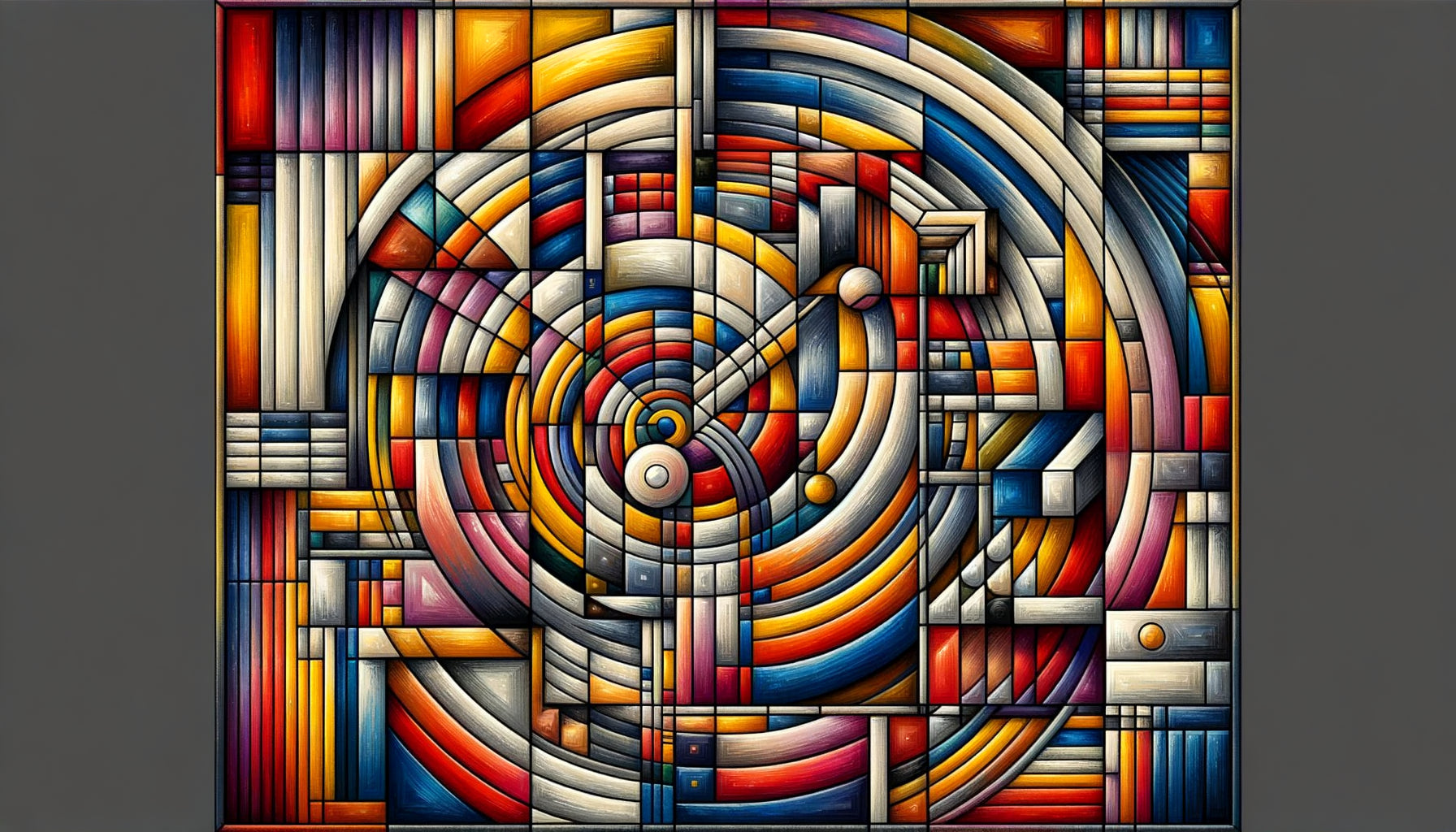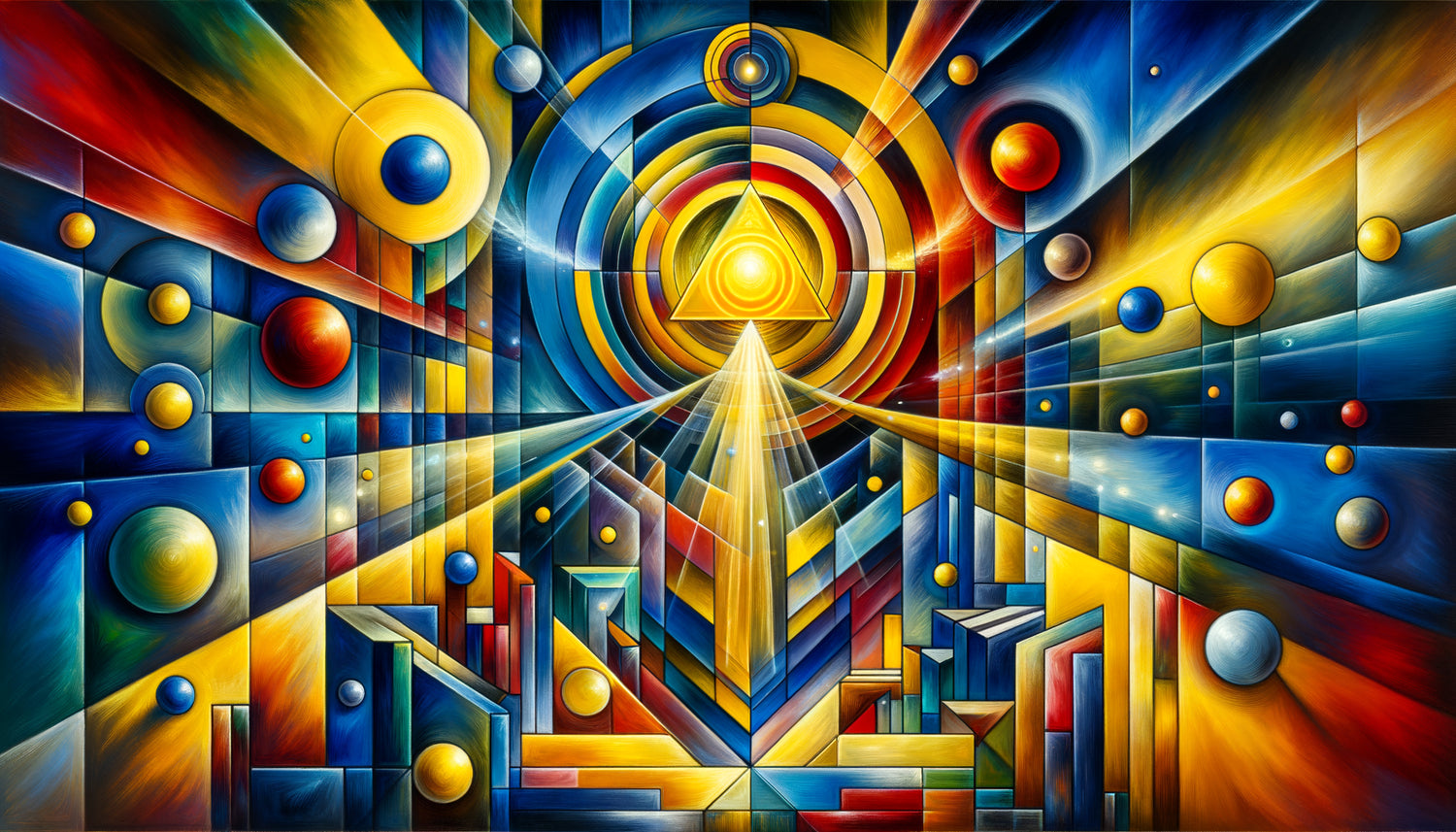
In my quiet workshop in Weimar, I cherish a well-worn book: Concerning the Spiritual in Art, original edition of 1911. Every time a client asks me why one composition works better than another, I recall Kandinsky sketching his triangles as others pray. For him, this pointed form was not merely a geometric polygon but a spiritual vibration capable of elevating the human soul to higher spheres.
Here's what Kandinsky’s spiritual vision of the triangle brings to your interior: an upward dynamic that transforms space, a creative tension that stimulates contemplation, and timeless symbolism that connects modern art to millennia of mystical quest.
Do you admire abstract paintings without really understanding why some touch you deeply? Do you feel that there is a secret language of forms, but no one has given you the keys to decipher it? This frustration is legitimate. Abstraction seems hermetic, reserved for initiates.
Yet, Kandinsky spent his life democratizing this visual language. He firmly believed that every form possesses a spiritual resonance accessible to all, regardless of our culture or artistic education. His theoretical writings constitute a veritable manual for understanding how forms influence our inner state.
This article reveals why the triangle held such a special place in his artistic cosmology, and how this knowledge transforms your way of inhabiting and decorating your spaces.
The mystical revelation of a painter seeking absoluteness
Kandinsky was not born abstract. Before his fortieth year, this former lawyer painted recognizable Russian landscapes. Then came what he described as a spiritual epiphany: seeing one of his paintings on its side, he realized that beauty existed independently of the subject represented. Forms and colors spoke their own language.
This revelation took place within a broader context. Kandinsky immersed himself in theosophy, an esoteric movement seeking to unify Eastern and Western spiritual traditions. For Theosophists, the entire universe vibrated according to harmonic laws, and art should become the instrument of these cosmic vibrations.
The triangle naturally emerged from this vision. Unlike the circle which turns on itself or the square which rests stable, the triangle points upwards. This directionality perfectly embodied human aspiration towards higher dimensions, towards what Kandinsky called the realm of the spiritual.
The influence of universal symbols
In my research to understand the compositions that I create, I discovered that Kandinsky collected triangular symbols from all traditions. The Egyptian pyramid as an axis connecting earth and sky. The Freemason’s luminous delta symbolizing the divine eye. The Christian Trinity structuring Western spirituality. The Hindu Sri Yantra composed of nine intertwined triangles.
For him, this recurrence proved that the triangle carried an archetypal truth, rooted in the collective unconscious of humanity. Using this form in his compositions was therefore not an arbitrary aesthetic choice, but the conscious activation of a millennial spiritual language.
The Spiritual Physics of Form According to Kandinsky
In Point and Line on Plane, Kandinsky develops a veritable visual grammar. Each graphic element possesses a temperature, a sound, a spiritual direction. The point represents the primordial affirmation, the line traces movement, and forms create complex organisms.
The triangle occupied the top of this formal hierarchy. Kandinsky attributed almost magical qualities to it: active dynamism, upward tension, unstable balance. Whereas the square embodied stable materiality (the four elements, the four directions), the triangle represented the spirit tearing itself away from earthly gravity.
He notably distinguished the upward-pointing triangle (spiritual aspiration, mystical impetus) from the inverted triangle (fall, materialization). This polarity created dramatic tension in his compositions, like a dialogue between ascending and descending forces, between light and darkness.
Color Amplifies the Spiritual Message
What is fascinating about Kandinsky's approach is the form-color association. The yellow triangle embodied for him maximum spiritual acuity. Yellow, the most luminous color and closest to spiritual white, combined with the sharp point of the triangle, created a kind of mystical arrow piercing the veils of matter.
I have experimented with these combinations in my own creations. A blue triangle suggests meditative depth, a calm ascent. A red triangle pulsates with volcanic energy, earthly despite its celestial orientation. These associations are not intellectual but sensual and immediate – exactly what Kandinsky sought.

How the Triangle Structures Spiritual Composition
In his large abstract compositions, Kandinsky used the triangle as an invisible architecture. Not always explicitly drawn, he often structured the whole according to implicit triangular lines, creating zones of tension and rest.
This technique recalls painters of the Renaissance organizing their sacred scenes according to hidden geometric patterns. But where ancient masters concealed these structures under realism, Kandinsky revealed them. The triangle became subject and structure simultaneously.
I observe this principle in his major works like Composition VIII (1923). Triangles proliferate there: small, large, colored, transparent, pointing in all directions. They create a non-gravitational space where the eye navigates according to spiritual laws rather than physical ones. It is destabilizing and liberating at the same time.
The triangle as a gateway between visible and invisible
Kandinsky described the triangle as a shape-bridge. Its base anchored in the material plane, its point piercing towards the immaterial. This geometric metaphor perfectly translated his conception of art: a vehicle allowing human consciousness to transcend sensory limitations.
In your interiors, this dimension makes perfect sense. A painting organized according to triangular principles does not simply decorate a wall – it activates a vertical dynamic, creating spatial breathing that transforms the atmosphere of a room.
The contemporary legacy: living with spiritual triangles
More than a century after Kandinsky's theories, his intuitions find unexpected confirmations. Neuroscience shows that our brain reacts differently to angular (stimulation, alertness) and rounded (calming) shapes. Pointed-up forms capture our attention and direct our gaze naturally.
In my daily practice of integrating abstract works into residential spaces, I observe that triangular compositions effectively create a feeling of elevation and energy. They are particularly suitable for creative workspaces, libraries, meditation corners – anywhere where one seeks spiritual or intellectual stimulation.
Conversely, I often advise against these compositions in bedrooms, where rest is preferred. Kandinsky's rounded forms (the circle as a cosmic symbol) work better there. This formal prescription exactly echoes the intentions of the Russian master.
Compose your own visual language
What Kandinsky ultimately teaches us is the possibility of a conscious dialogue with forms. You don't need to literally believe in his esoteric theories to benefit from his discoveries. Simply observe how a triangle in a painting directs your gaze, activates your attention, creates movement.
I always encourage my clients to develop their own formal sensibility. What geometry soothes you? Which stimulates you? These preferences often reveal deep aspects of our psychology. Kandinsky's genius was to systematize these intuitions into a universal language.
Ready to invite the ascending energy of the triangle into your daily life?
Discover our exclusive collection of abstract paintings that transform your walls into spaces of spiritual contemplation and daily inspiration.

Integrating Kandinsky's wisdom today
Living with a Kandinsky triangle doesn't mean turning your living room into a theosophical manifesto. Rather, it is about consciously introducing vectors of elevation into your daily visual environment.
Start simply. Observe triangles around you – architecture, design, nature. Notice how they direct your gaze and energy. Then choose an abstract work integrating this form in a balanced way. Place it strategically in a space where you want to cultivate concentration or inspiration.
The key is to move beyond superficial decoration to reach what Kandinsky called the inner necessity. Each element of your environment should resonate with your deep aspirations, creating a nourishing visual ecosystem rather than simply being pretty.
Kandinsky's spiritual triangle ultimately reminds us that our living spaces can be personal temples, where each consciously chosen form becomes a silent companion to our inner evolution. In our era saturated with empty images, this intentional approach to the visual environment offers a valuable antidote.
Imagine yourself tomorrow morning, coffee in hand, contemplating these ascending lines on your wall. They don't miraculously change your life, but they create a daily reminder: your gaze can rise, your mind can transcend the trivial. That is exactly what Kandinsky was seeking – not to impose a doctrine, but to awaken possibilities.
Frequently asked questions about Kandinsky's spiritual triangle
Do you need to know theosophy to appreciate Kandinsky's triangles?
Absolutely not. Even though Kandinsky drew deeply from theosophy and other esoteric currents, his discoveries about the psychological impact of shapes work independently of any spiritual belief. You can appreciate how a triangle structures a composition and directs your gaze without adhering to his mystical theories. The beauty of his approach lies precisely in this double reading possible: symbolic for those who are sensitive to it, purely visual for others. Both levels are legitimate and enriching. What matters is your personal experience with the work – do you feel that upward dynamic he described? If so, it doesn't matter what conceptual framework you use to explain it. Kandinsky's abstract art remains accessible to all precisely because it speaks a universal language of shapes prior to words and beliefs.
How to integrate triangular works into a modern interior without creating visual chaos?
The key lies in the balance between dynamism and rest. Kandinsky himself alternated geometric tension zones and breathing spaces in his compositions. For your interior, this means strategically dosing artworks with strong triangular presence. A large abstract painting with pronounced triangles works beautifully as a unique focal point in a room with simple and clean lines. Surround it with calm surfaces – neutral walls, furniture with soft lines. The work then creates spiritual vibration without generating cacophony. Avoid multiplying triangular patterns (rugs, cushions, other artworks) which would compete. Instead, think of creating a harmonious dialogue between your dynamic triangular piece and stable rounded or rectangular elements. This alternation also perfectly corresponds to Kandinsky's philosophy of tension and resolution, creating a visually stimulating but balanced space.
Do Kandinsky's principles on shapes also apply to other abstract artists?
Yes and no. Kandinsky established a theoretical vocabulary that others have used, adapted or challenged. Mondrian, for example, rejected oblique shapes such as the triangle, preferring the orthogonal purity of verticals and horizontals. Malevich used the triangle but in a different Suprematist perspective, less spiritualistic. On the other hand, artists like Paul Klee (Kandinsky's colleague at the Bauhaus) shared this fascination with the psychology of geometric forms. Today, many contemporary abstract art creators consciously or intuitively draw inspiration from these principles. When you choose an abstract work, observe how the shapes interact within it. Even without knowing the artist's intentions, you can apply the Kandinsky reading grid: do these triangles create movement? Does this composition suggest a spiritual direction? This analytical approach considerably enriches your experience of abstraction, whatever the artist.