I spent ten years scouring Eastern European auctions, hunting for canvases that make collectors' hearts race. A black square on a white background, a red cross floating in space, suspended colored rectangles... Each time, the same question: is this really Suprematism? Because behind this apparent simplicity lies one of the most revolutionary movements in modern art.
Here's what recognizing Russian Suprematism brings you: the ability to identify a major 20th-century artistic movement, the assurance of never confusing these works with other geometric abstractions, and access to a deep understanding of what shook up the history of art in 1915.
You are standing in front of an abstract painting in a gallery, and you feel lost. These geometric shapes could belong to a thousand different currents. De Stijl? Constructivism? Pure abstraction? You would like to be able to assert with certainty: this is an authentic Suprematist painting.
Rest assured: Suprematism has very specific codes, a unique visual grammar that I am going to reveal to you. Codes that I have learned to decipher over hundreds of works studied, authenticated, sometimes contested. After reading this, you will never look at these geometric compositions the same way again.
The manifesto of an artistic revolution
1915, Petrograd. Kazimir Malevich hangs a black square on a white background during the « 0.10 » exhibition. This act founded Russian Suprematism and marked the birth of radical geometric abstraction. But be careful: recognizing a Suprematist painting is not just about identifying simple shapes against a light background.
Russian Suprematism is distinguished by its philosophy: the supremacy of pure sensation over any representation of the visible world. Malevich seeks to free art from the obligation to represent, to reach the very essence of painting. This spiritual quest permeates each composition.
Unlike constructivism which emerged just after, Suprematism has no utilitarian vocation. It does not want to serve the industrial or social revolution. It aspires to transcendence, to the absolute, to what Malevich called non-objective sensibility.
Elementary forms: visual vocabulary of the movement
A painting from Russian Suprematism is first recognized by its ultra-restricted formal vocabulary. Forget organic curves, subtle gradients, complex textures. Suprematism works exclusively with:
The square, a fundamental and recurring form. Black, red, white - the square embodies absolute geometric perfection. It is never decorative but always charged with metaphysical meaning.
The circle, symbol of infinity and cosmic movement. In Suprematist compositions, it floats, defies gravity, dialogues with other shapes in an undefined space.
The rectangle and the cross, variations on the square that create visual tensions. These shapes intersect, overlap, create characteristic ascending dynamics of the movement.
I've noticed a constant: Suprematist artists use these shapes without ever distorting them. No irregular trapezoids, no complex polygons. This absolute geometric purity is an infallible signature.
The revealing color palette
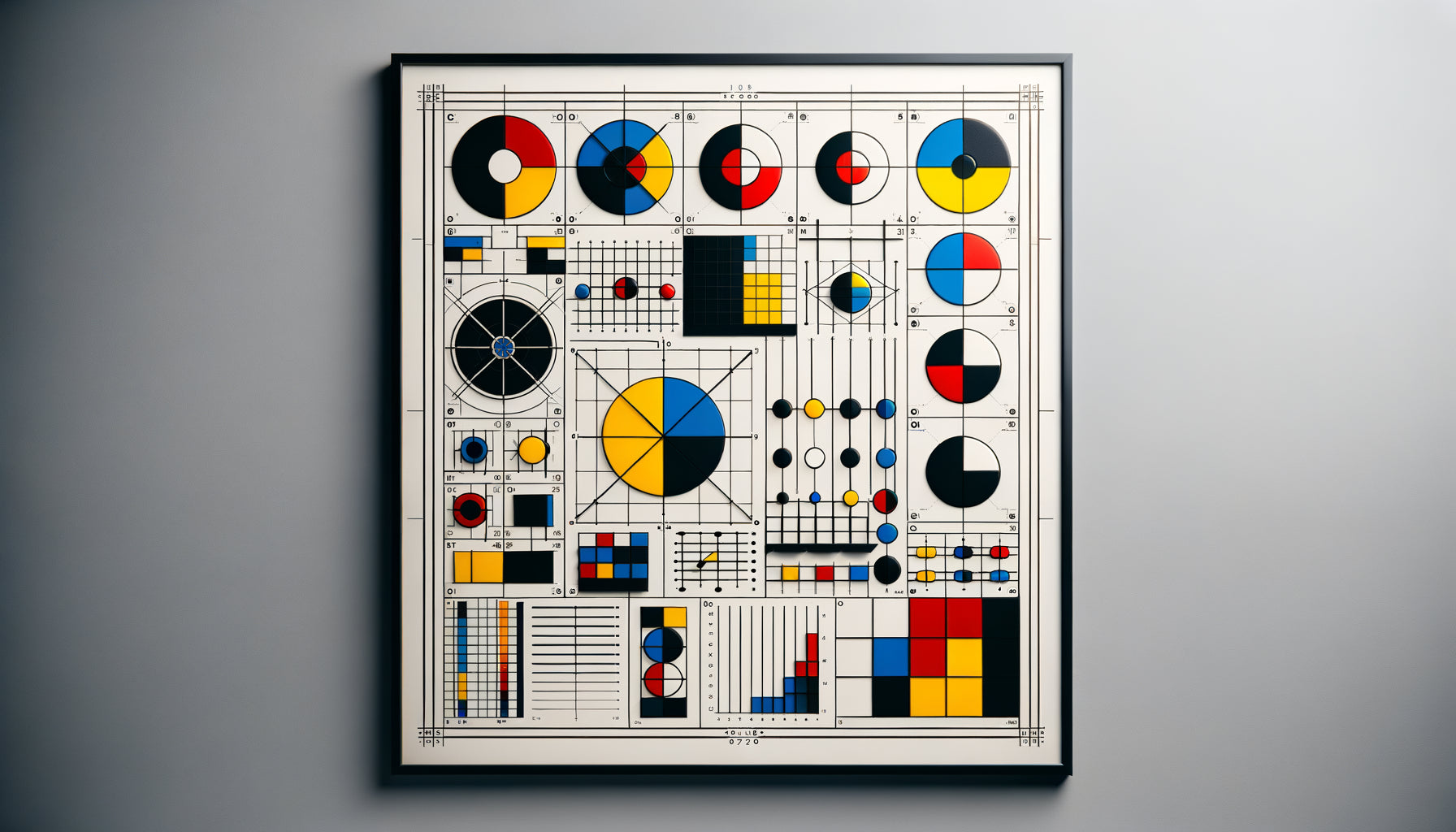
Color in Russian Suprematism obeys strict rules. Works favor pure primary colors: bright red, intense blue, vibrant yellow. Black and white play a major structural role.
Unlike Mondrian and Dutch Neoplasticism, Suprematism is not afraid to mix more shades. You can find green, orange, violet - but always bold colors, never pastel hues or muted tones in the works of the first period.

Spatial composition: the void as an active element
Here's the most decisive criterion for recognizing an authentic Russian Suprematist painting: the revolutionary treatment of space.
In a Suprematist composition, geometric shapes float in an indeterminate space. There is no up or down, no foreground or background. This sensation of cosmic levitation is absolutely characteristic. Elements seem suspended in a gravity-free universe.
The background - generally white or cream - is never just a support. It's an active space, a metaphysical dimension where shapes evolve freely. This unique relationship between form and background radically distinguishes Suprematism from other geometric abstractions.
I learned to observe the 'angle of the elements'. Suprematist shapes are often oriented diagonally, creating ascending dynamics. This obliquity generates movement, a tension that evokes elevation, spiritual ascension dear to Malevich.
The absence of calculated symmetry
Another valuable clue: Suprematist compositions avoid perfect symmetry. Balance exists, but it is dynamic, asymmetrical, unstable. This visual instability creates a vibration, a life that animates the canvas.
Shapes never align perfectly on a grid. They shift, partially overlap, create irregular spacings. This controlled freedom differentiates Suprematism from the rigorous Dutch De Stijl.
The three periods of Suprematism: chronological evolution
To refine your assessment, it is important to understand the evolution of the movement. Russian Suprematism went through three distinct phases between 1915 and 1920.
Black Suprematism (1915): the inaugural period dominated by black shapes on a white background. The Black Square, the Black Circle, the Black Cross. These radical works mark an absolute break with figurative art. Austerity is total.
Colored Suprematism (1915-1917): chromatic explosion. Primary colors invade compositions. Shapes multiply, intersect, create complex dynamics. This is the most exuberant period of the movement, when the most architectural compositions are found.
White Suprematism (1917-1918): return to absolute simplicity. White or cream shapes on a white background. Malevich here reaches zero point of painting, the dissolution of form into cosmic void. These subtle, almost invisible works represent the philosophical culmination of the movement.
Knowing this chronology allows you to locate a work and understand its stakes. A white-on-white painting cannot be earlier than 1917: it is an infallible temporal marker.

Artists Beyond Malevich
Although Malevich is the undisputed founder, Russian Suprematism includes other essential figures whose styles should be known.
El Lissitzky develops Prouns, compositions that bridge Suprematism and Constructivism. His works integrate an architectural dimension, isometric perspective effects that make them immediately identifiable.
Olga Rozanova brings a unique chromatic sensitivity to the movement. Her suprematist compositions explore more complex color harmonies, with particular attention to contrasts and resonances between tones.
Ivan Kliun and Liubov Popova have also created memorable suprematist works, often more dynamic and fragmented than those of Malevich. Their compositions sometimes integrate more elements, creating more complex structures.
How to Distinguish Suprematism and Constructivism
Confusion is common, as these two Russian movements are contemporary and share a geometric aesthetic. Here are the crucial differences:
Constructivism is utilitarian, social, functional. It wants to serve the revolution, build the new world. Suprematism is spiritual, contemplative, metaphysical. It seeks artistic absoluteness.
Visually, Constructivism often incorporates typography, photomontages, and compositions that evoke mechanical structures. Suprematism remains purely pictorial, with its floating geometric shapes in cosmic space.
Let geometric abstraction transform your interior
Discover our exclusive collection of abstract artworks that capture this dynamic tension between form and space, a direct heir to the visual revolutions of the 20th century.
Your gaze transformed
You now possess the keys to identify a Suprematist painting: elementary geometric shapes, pure primary colors, floating composition without gravity, dynamic asymmetry, spiritual dimension. These criteria, combined with knowledge of the three periods and the main artists, give you an infallible reading grid.
The next time you find yourself in front of a geometric abstraction, observe the space. If it vibrates, if it seems to extend to infinity, if the shapes seem to defy all gravity, you are probably facing the legacy of this artistic revolution born in Petrograd over a century ago.
Start by studying reproductions of Malevich's Black Square. Look at it for a long time. Let this radicality penetrate you. It is the starting point for any recognition of Russian Suprematism.
Frequently Asked Questions
What is the difference between Suprematism and geometric abstract art?
Russian Suprematism is a specific form of geometric abstraction with unique characteristics. While general geometric abstraction may use all kinds of shapes, colors, and compositions, Suprematism deliberately limits itself to elementary forms (square, circle, rectangle, cross) and pursues a precise spiritual and metaphysical goal. The feeling of cosmic levitation, the indeterminate space and the transcendental dimension are specific to Suprematism. Other geometric abstractions can be decorative, architectural or purely formal, while Suprematism always seeks pure sensitivity and the artistic absolute theorized by Malevich.
Is Russian Suprematism still practiced today?
Historical Suprematism as an organized movement waned in the early 1920s, with the rise of socialist realism in the USSR. However, its influence is immense and endures in contemporary art. Many current artists draw inspiration from Suprematist principles: geometric simplicity, search for the essential, dialogue between form and void. Its legacy can be found in American minimalism of the 1960s, in some practices of contemporary abstraction, and even in modern graphic design. While we cannot speak of new Suprematism in the strict sense, the spirit of the movement still permeates current creation, testifying to its timeless modernity.
How to integrate a Suprematist painting into a modern decoration?
A Suprematist Russian painting - or inspired by this movement - brings visual power and timeless elegance to a contemporary interior. Favor a clean space where the work can breathe: white or neutral walls, minimalist furniture. Suprematism hates decorative clutter. Give it the central place it deserves, like a visual manifesto in your living room or office. Colorful compositions work beautifully in bright spaces, while black and white works bring sophisticated rigor. Lighting is crucial: direct light reveals the texture of the canvas and the vibration of geometric shapes. Avoid multiplying Suprematist paintings on the same wall - their radicality requires singularity.