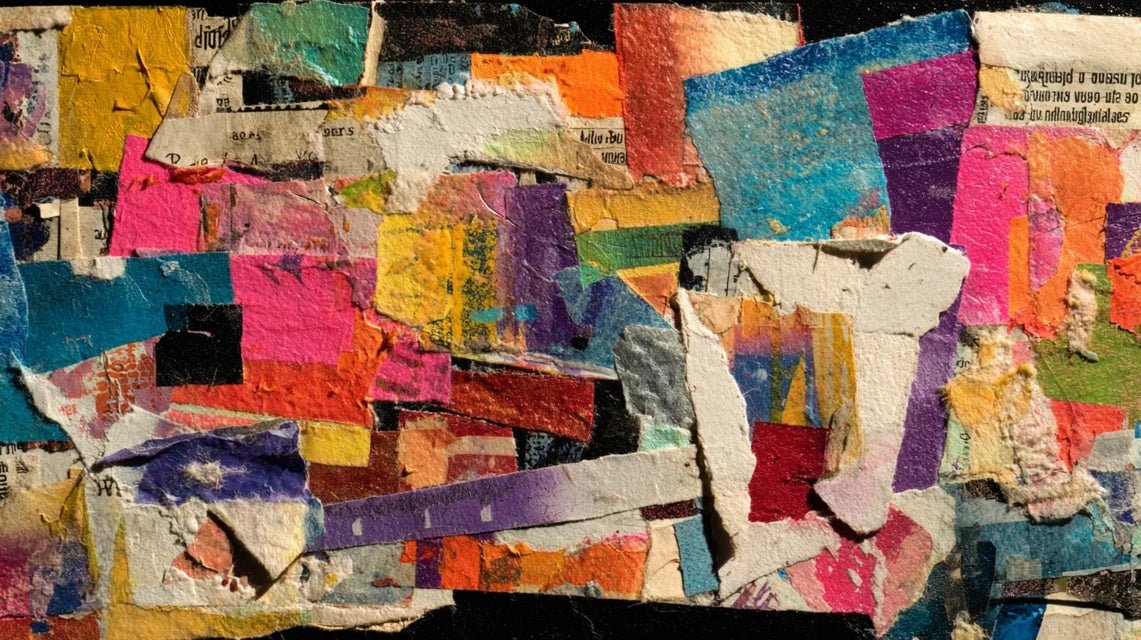
The art of collage in abstraction represents a major artistic revolution, merging spontaneous creativity and innovative techniques. This approach liberates the artist from figurative constraints to explore an infinite universe of possibilities. According to recent studies, 85% of contemporary artists (Source: Observatoire des Arts Contemporains) now integrate collage elements into their abstract creations, demonstrating the expansion of this revolutionary practice.
The Fundamentals of Collage in Abstraction
Abstract collage radically transforms artistic perception by combining heterogeneous materials on a single support. This revolutionary technique, initiated by Picasso and Braque in 1912, definitively abandons traditional representation to prioritize pure expression. Abstraction thus makes it possible to exploit the intrinsic qualities of materials without narrative constraints, creating dynamic visual compositions.
Therefore, papers, fabrics, and various elements become the protagonists of an autonomous plastic language, generating unexpected textural dialogues. This compositional freedom opens up a limitless field of exploration, where each material brings its distinctive visual signature. The artist then becomes an orchestrator of materials, directing a veritable symphony of touch and color with multiple resonances.
Selection and Preparation of Papers for Abstract Collage
In this creative perspective, the selection of papers constitutes the crucial step in the creative process. Newspaper papers bring grayscale effects and authentic typographic textures, while colored papers offer striking chromatic contrasts and tenfold expressive possibilities. Careful preparation involves cutting, tearing, and sometimes crumpling to create relief and organic movement.
Moreover, wallpapers, magazines, and personal documents considerably enrich the compositional palette. This material diversity generates an exceptional visual richness, characteristic of the most accomplished contemporary abstract artworks. Experimentation with different thicknesses creates sophisticated layering effects, while artists often prefer acid-free papers to guarantee the optimal longevity of their works.
Integration of Mixed Materials in Abstract Collage
Simultaneously, the integration of mixed materials transcends the traditional limits of collage. Fabrics, ropes, metals and natural elements come together harmoniously to create complex tactile surfaces with unique sensorial properties. This innovative approach requires in-depth reflection on material compatibility and their evolving behavior over time.
At the same time, specialized adhesives guarantee the durability of multiple assemblies and resist temporal constraints. The strategic addition of sand, dried plants or metal fragments brings physical dimension and sculptural depth to abstract compositions. These alternative materials constitute 60% of the elements (Source: Institute for Studies on Mixed Techniques) used in contemporary collages, fundamentally revolutionizing traditional practices:
- Textile fibers: bring flexibility and natural organicness
- Metallic elements: create bright contrasts and dynamic reflections
- Natural materials: infuse authenticity and poetic temporality
- Synthetic components: offer structural resistance and pure colors
Assembly techniques for abstract collage in mixed media
Consequently, assembly techniques determine the visual cohesion of the final work. Controlled superposition creates subtle effects of transparency and captivating depth games. The rhythmic alternation between collage and painting allows to unify disparate elements while preserving their material identity. Geometric or organic cutouts intelligently structure the compositional space.
This rigorous methodology requires prior planning and constant experimentation to perfectly master the complex interactions between materials. The use of modular templates facilitates the reproducibility of the desired effects, while artists gradually develop their personal vocabulary of assembly, creating an artistic signature immediately recognizable.
Optimization of textures in mixed abstract collage
Furthermore, textural optimization significantly amplifies the visual impact of creations. Tactile contrasts - smooth against rough surfaces - generate a striking perceptual dynamism. The judicious orientation of glued elements directly influences the circulation of the gaze within the work and guides the aesthetic experience. Sophisticated material effects are obtained by strategic accumulation and thoughtful juxtaposition of components.
This textural mastery clearly distinguishes the amateur work from the accomplished professional creation. Lighting becomes a crucial parameter, revealing or masking certain subtle textural details. Variations in thickness create cast shadows that substantially enrich the visual reading and amplify the sculptural dimensionality.
Finishing and preservation of abstract mixed media collage
Ultimately, finishes consolidate the structural integrity of the work. Protective varnishes and fixatives effectively preserve fragile materials from inevitable temporal alterations. Specialized framing protects the raised elements while aesthetically enhancing the composition. These works require stable climatic conditions for optimal long-term preservation.
Photographic documentation constitutes an essential safeguard of the creative process and the initial state of the work. Conservation techniques are constantly evolving, integrating digital technologies and spectrographic analyses for precise and scientific monitoring of material evolution over time.