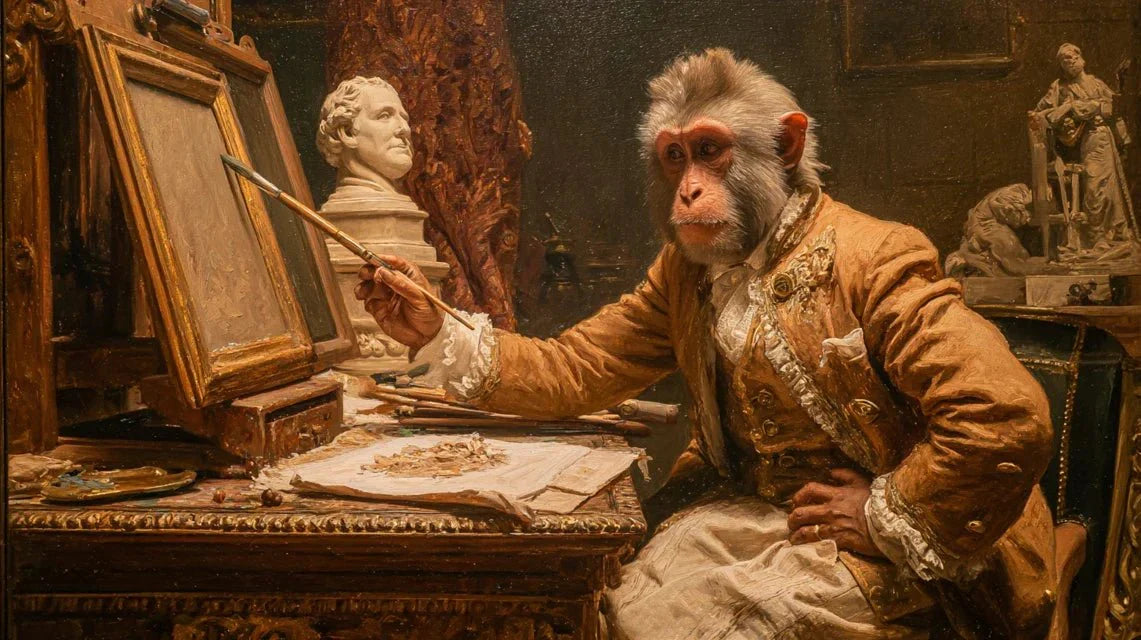
Imagine a Parisian workshop in 1740. Jean-Siméon Chardin, brush in hand, observes a curious subject: a monkey dressed as a painter, focused on his easel. This scene, far from anecdotal, revolutionizes 18th century French painting and questions our own humanity.
Chardin transforms a simple amusement into a philosophical mirror. His Monkey Painter still challenges us today: what does it mean to be human in the face of art?
When Monkeys Reveal Our Artistic Weaknesses
Chardin's monkey fails miserably. Faced with a beautiful antique statuette, he traces vague and uncertain outlines on his canvas. This failure is not accidental - it is intentional. Chardin shows us our own limitations.
The animal embodies the Latin adage "Ars simia naturae" - art imitates nature. But with Chardin, this imitation becomes pathetic and revealing. The modern art market confirms it: a Chardin was sold for 26.7 million euros in 2023 (Source: Christie's Paris), proof of our persistent fascination with this critique.
The Revolution of the Gaze on Humanity
Unlike Flemish painters who mocked society, Chardin aims deeper. He questions the very essence of human creation through this artistic metaphor. His monkey is not copying his model - he is painting a portrait, perhaps his own.
This distortion is unsettling. It reveals our fundamental inability to reproduce reality. Chardin asks us: are we truly superior to this clumsy monkey?
Contemporary animal paintings continue this questioning, showing the relevance of this reflection.
The Monkey as a Double of the Artist
Chardin hides behind his monkey. This refined self-deprecation reveals his doubts about art and humanity. The monkey wears our clothes, adopts our postures, but fails in our creative ambitions.
The Monkey Antiquarian, a counterpart to the work, enriches this questioning. The animal seriously examines works of art, parodying our cultural pretensions in an act of social critique.
Key elements of this animal iconography:
- The monkey as a distorted mirror of humanity
- A parody of our creative gestures
- The revelation of our artistic pride
- Subtle criticism of academic imitation
A Revolutionary Philosophy of Art
Chardin revolutionizes our understanding of art through this innovative philosophy of art. His monkeys do not entertain in the spirit of Rococo art - they question. What truly distinguishes us from animals in the creative act?
This question foreshadows our modern questions about artificial intelligence. Chardin's monkey, by failing to create, paradoxically reveals what constitutes our human specificity.
Louis XV himself succumbed to this fascination, acquiring several monkey paintings by Chardin. The king recognized their philosophical scope beyond simple rococo entertainment.
FAQ - Monkeys in Chardin's Art
Q : Why did Chardin choose to paint monkeys?
A : Chardin uses monkeys as a metaphor for artistic imitation, questioning the nature of human creation and criticizing the academicism of his time through the adage "Ars simia naturae".
Q : What does the failure of the monkey painter in the painting symbolize?
A : The monkey's failure reveals the limits of pure imitation and criticizes the academic method. It questions our human claim to "mimic" nature perfectly.
Q : In what way do Chardin's monkey paintings differ from those of Flemish painters?
A : While the Flemish used monkeys for general social satire, Chardin focuses on a philosophical critique of art and the condition of an artist, creating a refined self-deprecation.