Franz Kline and the gestural revolution in black and white
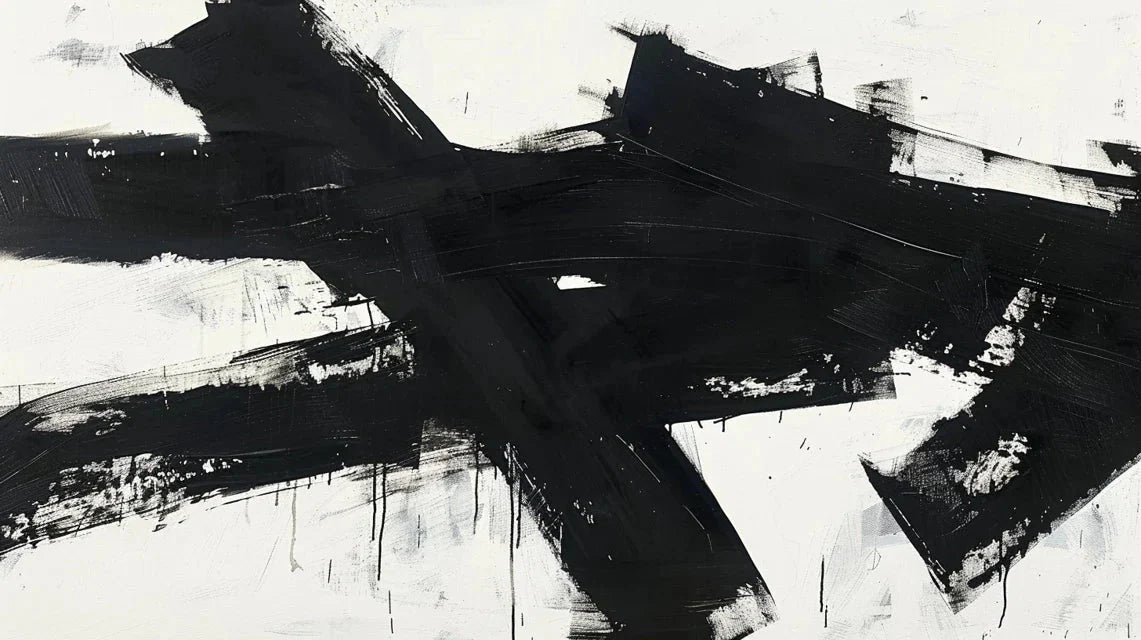
Franz Kline revolutionized the gestural approach in the 1950s by developing a radical style based exclusively on black and white contrasts. This minimalist approach allows for a pure concentration on the very essence of pictorial movement. The American artist, born in 1910, gradually abandons figuration to devote himself entirely to exploring abstract gestural dynamics.
Monochrome becomes with Franz Kline a universal language that transcends cultural references. Unlike his expressionist abstract contemporaries who exploit subjective emotion, he deliberately favors the formal and structural impact of gesture. This approach radically distinguishes Franz Kline from other artists of the New York School and establishes his unique artistic signature in action painting.
Franz Kline's gestural techniques in black and white art
Franz Kline develops specific gestural techniques to maximize the visual impact of his monochrome compositions. He uses domestic paint brushes eight inches wide, allowing for broad and energetic traces characteristic of his style. This instrumental approach revolutionizes traditional gestural painting with a remarkable precision.
His revolutionary method is based on careful preparation: contrary to popular belief, his gestures are not spontaneous but result from detailed preliminary studies, often sketched in telephone directories. The Bell-Opticon, projector introduced by Willem de Kooning, allows him to enlarge his sketches to create monumental compositions. This enlargement technique transforms the small format into a major architectural work.
Chromatic balance between black and white constitutes the technical core of his method. Franz Kline states "I paint the white as much as the black", thus creating dynamic visual tensions where each area contributes to the overall harmony. This bidirectional approach to gesture distinguishes his work from traditional pigment application.
The art of black and white gesture: Franz Kline's execution methods
Execution methods transform with Franz Kline the art of gesture into a codified system. He sometimes fixes his brushes to the end of a pole to obtain the gestural amplitude necessary for his monumental creations. This technique makes it possible to create architectural brushstrokes which structure the pictorial space with exceptional mastery.
Franz Kline develops his monochrome compositions according to a three-step process: preparatory sketch, enlargement projection, and final gestural execution. Each movement is calculated for its impact on the overall structure, demonstrating that apparent spontaneity results from thorough and methodical reflection.
In contemporary art, these methods find a particular echo in modern abstract paintings that perpetuate this radical gestural approach. Franz Kline's gesture influences creators still seeking to master the expressiveness of absolute contrast today.
Concrete applications of Franz Kline’s black and white gestural style
The concrete applications of the style are manifested in iconic works such as "Chief" (1950) and "Mahoning" (1956). These achievements demonstrate how the art of monochrome gesture can create powerful architectural compositions without figurative reference.
- Spatial structuring: Gestures organize the canvas according to geometric lines of force
- Creation of visual rhythms: The chromatic alternation generates specific perceptual dynamics
- Monumental impact: Large dimensions amplify the gestural effect to create a physical presence of the work
Franz Kline’s influence on contemporary gestural art is observed in the evolution towards sculptural minimalism. Artists such as Donald Judd and Richard Serra directly draw inspiration from his formalist approach to develop their own spatial and conceptual research.
Optimizing gestural contrasts in Franz Kline’s art
Optimization of contrasts constitutes the technical secret to maximize the impact of monochrome gesture art. He develops a scientific approach to contrast where each black area generates a resonance effect on the surrounding white spaces.
Franz Kline perfects his gestural technique by studying the optical effects of extreme contrasts. This in-depth research leads him to develop compositions where black and white create illusions of depth and movement without resorting to traditional perspective.
The durability of this gestural approach is verified in the timelessness of Franz Kline’s works. His monochrome paintings retain their original visual impact, demonstrating the effectiveness of his method for optimizing gestural contrasts and its lasting artistic relevance.