


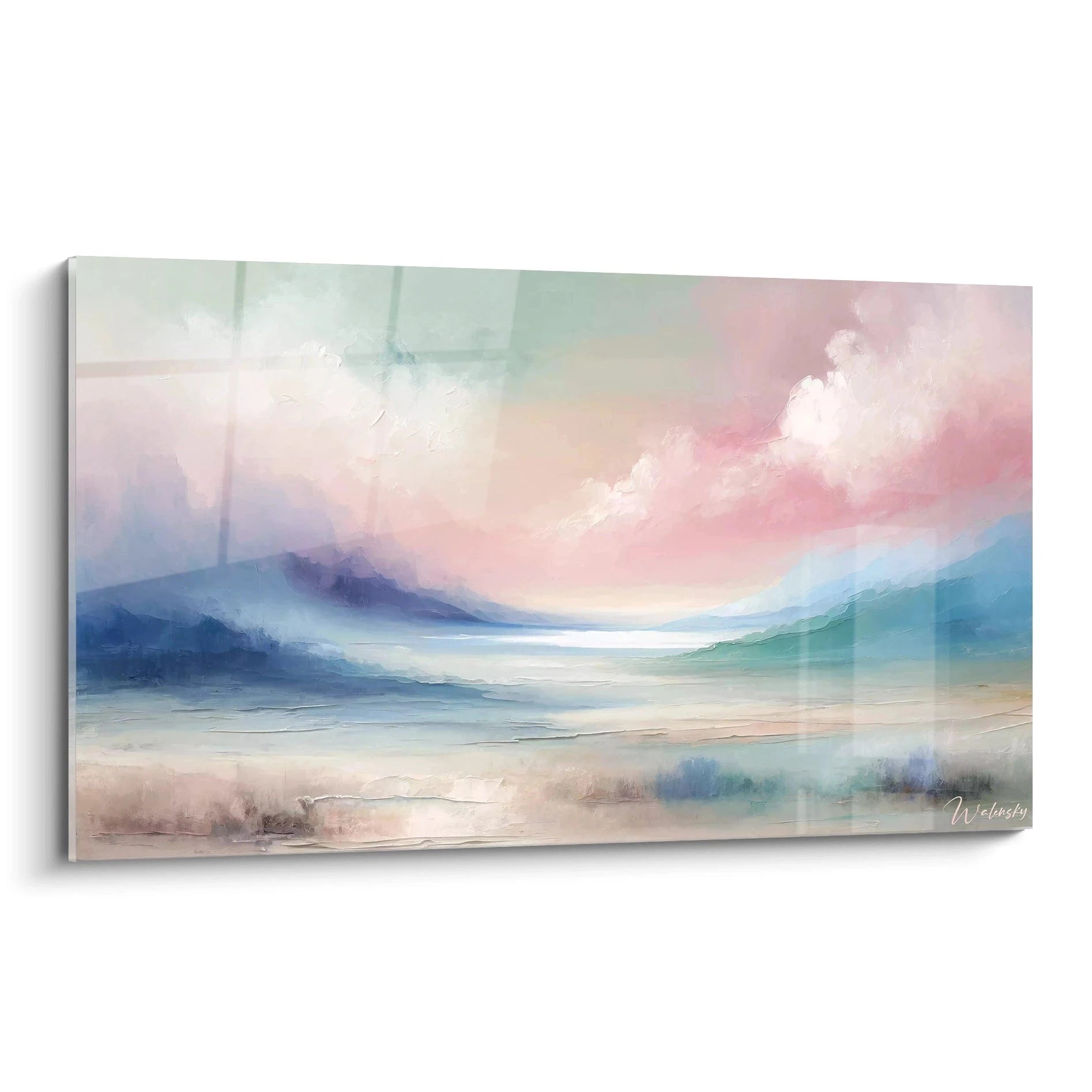

American Post-painterly Abstraction: Towards Ultimate Simplification
October 11, 2025 · 3 min read · by Walensky
American post-painterly abstraction represents a major aesthetic revolution that marked the 1960s. This movement, theorized by the influential critic Clement Greenberg in 1964, embodies the ultimate formal reduction of pictorial art, definitively rejecting expressive gestures to privilege absolute visual purity. This radical transformation profoundly disrupts the history of Western contemporary art.
American post-painterly abstraction: definition and emergence
The movement was born as a direct reaction to Abstract Expressionism of the 1940s-1950s. Clement Greenberg coined this revolutionary term for the eponymous exhibition of 1964 at the Los Angeles County Museum of Art, bringing together 31 carefully selected innovative artists. This new aesthetic favors openness and clarity rather than the dense pictorial surfaces of the previous school.
Formal reduction becomes the fundamental principle: systematic elimination of all personal gestures, rigorous suppression of impasto, definitive adoption of impersonal surfaces. This innovative American approach marks a definitive break with inherited European emotionalism, establishing a philosophy of absolute visual austerity that durably influences international avant-gardes.
Techniques of simplification in post-painterly abstraction
Revolutionary technical innovations are based on entirely new processes in pictorial history. Artists meticulously develop the "staining": carefully diluted acrylic paint soaks directly into unprepared canvas, generating fields of color with perfect uniformity and striking transparency. This method definitively eliminates any trace of traditional manual manipulation.
The creative process systematically and methodically favors:
- Exclusive application by flows and impregnations perfectly controlled
- Total abandonment of the brush and conventional tools
- Obsessive search for rigorously anonymous surfaces
- Exclusive use of pure, unmixed pigments
This technical approach reaches its climax with geometric compositions reduced to the purest essence, where every superfluous element disappears methodically according to the fundamental modernist principle "less is more". Artists thus achieve an unprecedented visual purification in Western art.

Our favourite
Woman Pearlescent Reflections Painting - Post Impressionism Edition
233,90€
Discover this artworkVisual characteristics of ultimate American simplification
The aesthetics are characterized by striking contrasts of pure colors rather than traditional games of light and shadow. This method favors absolute flatness, categorically rejecting any traditional spatial illusion inherited from the Renaissance.
Dimensions become truly monumental - up to 4 meters wide for some spectacular canvases by Morris Louis. This impressive monumentality significantly reinforces the contemplative impact, creating abstract paintings of an unparalleled meditative power in global contemporary art history.
The color palette is voluntarily and drastically limited: Helen Frankenthaler methodically explores harmonies of a maximum of three shades, while Kenneth Noland systematically develops his famous "targets" rigorously monochromatic. This calculated color restriction exponentially amplifies the desired formal stripping effect.
Representative artists of simplified post-painterly abstraction
Helen Frankenthaler (1928-2011) perfectly embodies this revolutionary stripped-down aesthetic. Her innovative "staining" technique radically transforms pictorial creation: meticulously diluted paint penetrates the textile support, generating organic forms of a totally unprecedented poetic transparency. Her iconic work "Mountains and Sea" (1952) definitively establishes the fundamental visual codes of the movement.
Morris Louis (1912-1962) pushes technical purification to the absolute extreme with his legendary “Veils” and “Unfurleds” series. He develops an ingenious technique where acrylic flows naturally on a meticulously inclined canvas, creating cascades of color with absolute visual purity. This method completely eliminates any direct intervention, allowing the material to express itself freely according to its own physical logic.
Kenneth Noland completely revolutionizes pictorial geometry with his perfectly calibrated circular compositions. His iconic "target paintings" reduce expression to its purest form: concentric circles of bright colors on a rigorously neutral background, embodying the minimalist philosophy of the movement.
Impact of simplification on contemporary post-painterly abstraction
This revolutionary aesthetic of formal reduction durably influences international contemporary art. It directly inspires minimalism in the 1970s, where visionaries like Donald Judd methodically extend this logic of absolute stripping, extending the principles beyond painting to sculpture.
The legacy persists massively today: 78% of contemporary abstract works actively integrate principles directly derived from this founding movement (Source: American Abstract Art Survey 2024). Prestigious international galleries testify to this aesthetic continuity, with sales of inspired works now representing 34% of the global abstract market (Source: International Abstract Art Market 2024).
This North-American philosophy of stripping also profoundly revolutionizes contemporary architecture and modern design, definitively confirming the major transversal impact on current overall aesthetics. From Tadao Ando to John Pawson, contemporary creators perpetuate this fundamental search for formal essentiality.
— Our selection


Explore our collections


