


Minimalist Tree Wall Art
Our Painting Minimalist Tree celebrates the pure essence of nature through refined and contemporary wall art. Each artwork captures the simple beauty of trees in understated and elegant compositions, perfect for creating a soothing atmosphere. These minimalist nature paintings blend harmoniously into all modern interiors, from the living room to the office. Clean lines, neutral palettes, and timeless designs transform your walls into spaces of serenity and artistic contemplation.
 Tree painting with golden branches on pearlescent white background - Autumn light - Tree of life edition273,90 €
 Solitary tree with golden foliage on misty background - Golden Serenity - Tree of Life Edition273,90 €
 Golden tree artwork in beige and white tones on textured canvas - Golden Serenity - Tree of Life Edition273,90 €
 Tree Wall Art with Golden and Soft Green Leaves on Light Beige Background - Golden Serenity - Tree of Life Edition273,90 €
 Solitary tree with blue-green foliage on pearlescent beige background - Contemplative Serenity - Tree of Life Edition273,90 €
 Solitary Tree Painting with Golden Foliage on Beige Background - Autumn Serenity - Tree of Life Edition228,90 €
 Winter Elegance Wall Art - Minimalist Abstract Edition273,90 €
 Silver Whisper Painting - Minimalist Abstract Edition273,90 €
 Snowy Silhouette Painting - Minimalist Abstract Edition273,90 €
 Spring Breath Wall Art - Abstract Edition273,90 €
 Breath of Greenery Canvas - Minimalist Abstract Edition273,90 €
Explore further
In Minimalist Tree Wall Art


All about Minimalist Tree Wall Art
- Presentation Painting Tree Minimalist
- Arboreal Visual Purism
- Contemporary Natural Geometry
- Zen Symbolism and Purified Decor
A minimalist tree painting transforms the vegetal representation into pure essence, stripped of all superfluous artifice. This artistic approach sublimates the arboreal structure through essential graphic lines, subdued color blocks, and an airy composition that invites visual calm. Unlike detailed botanical representations, this aesthetic reduces the tree to its symbolic quintessence: verticality, geometric branching, earthly anchorage, and spiritual elevation. Perfectly suited for contemporary spaces seeking serenity, this type of wall creation integrates into purified interiors where every decorative element counts, offering a soothing vegetal presence without visual clutter. Large-scale formats amplify this purification by creating majestic wall breaths, transforming a wall panel into a meditative window on stylized nature.
Visual Purism at the Service of Arboreal Aesthetics
The minimalist tree painting embodies a decorative philosophy where formal reduction becomes a vector of emotional intensity. This approach does not represent the tree in its botanical complexity, but extracts its fundamental structure: a monochrome flat vertical trunk, stylized branches following a purified geometry, sometimes reduced to simple graphic lines. This voluntary simplification amplifies the contemplative dimension of the work, creating a soothing focal point in modern living spaces saturated with visual stimuli.
What color palette should be favored for authentic minimalist rendering?
Restrictive color schemes define minimalist authenticity. Black monochromes on a white background create maximum graphic tension, ideal for Scandinavian or industrial interiors. Shades of gray generate subtle depth without visual disruption. Discreet earthy tones - pale ochre, beige sand, ashen taupe - bring organic warmth while preserving compositional sobriety. Some creations introduce a single accent of saturated color on a neutral background, creating a balanced visual dialogue between restraint and intensity.
The importance of compositional void in spatial perception
The management of negative spaces constitutes the foundation of minimalist effectiveness. A minimalist tree painting of large dimension strategically exploits empty zones to give the stylized tree a monumental presence without visual saturation. These compositional breaths allow the eye to circulate freely, creating an impression of spatial expansion particularly valuable in constrained urban environments. The tree then becomes an invisible architect of the wall space, visually structuring the room by its simple purified presence.
Integration into demanding professional environments
Contemporary corporate spaces are massively adopting this simplified vegetal aesthetic. Law firms, executive offices, medical waiting rooms favor these stripped-down arboreal representations that simultaneously convey professionalism and natural connection. Formal neutrality avoids any overly marked stylistic connotation, guaranteeing lasting relevance in the face of decorative evolutions. For those exploring more expressive approaches while maintaining formal purification, the abstract tree painting collection offers variations where simplification meets free artistic interpretation.
Arboreal Geometry and Contemporary Interior Architecture
The integration of a painting of a minimalist tree into modern residential architecture responds to a logic of formal continuity. The vertical lines of the stylized tree dialogue with the window mullions, the clean lines of furniture, the structures of screens. This geometric consonance creates an organic visual harmony, where the decorative element naturally extends the surrounding architectural language rather than artificially superimposing itself.
How does the arboreal silhouette restructure the perception of the wall?
The verticality inherent in the arboreal form fundamentally influences spatial perception. A large height format visually accentuates the ceiling height, particularly effective in spaces with standard height requiring visual amplification. The balanced horizontal branching counterbalances this rise, creating a stable visual anchor. Asymmetrical compositions, where branches develop preferentially to one side, generate a subtle directional dynamic guiding unconsciously the gaze and circulation in the space.
Synergy with raw materials and natural textures
The formal purification of the painting of a minimalist tree establishes a fruitful contrast with textured architectural materials. Positioned facing a raw concrete wall, the stylized tree brings organic softness without compromising the industrial aesthetic. Associated with natural stone surfaces, it reinforces the terrestrial connection through its vegetal theme while introducing contemporary graphic sophistication. This material versatility explains its massive adoption in renovated lofts, modernized neo-Haussmann apartments and architect-designed houses.
Hanging strategies to maximize minimalist impact
Spatial placement amplifies or diminishes the effectiveness of visual purification. A centered placement on a clear wall panel, without peripheral decorative competition, maximizes the contemplative force. The visual isolation of the work allows its full appreciation as meditative breathing. Monumental formats benefit from sufficient viewing distance: calculate a minimum observation distance equivalent to 1.5 times the diagonal of the painting guarantees optimal perception of the overall composition without fragmentation of the gaze on details.
Zen Symbolism and Emotional Resonance of the Purified Tree
Beyond its decorative function, the painting of a minimalist tree conveys a profound symbolic charge rooted in various contemplative traditions. The tree reduced to its graphic essence evokes the principles of Japanese zen where formal simplicity opens towards conceptual infinity. This economy of artistic means does not translate into expressive poverty but a concentration of meaning: every line counts, every void breathes, every form suggests without imposing.
Which living spaces benefit most from this purified arboreal presence?
Adult bedrooms widely adopt this theme for its calming pre-sleep power. The simple composition facilitates mental relaxation, unlike complex works stimulating visual analysis. Meditation, yoga or reading spaces naturally prefer this aesthetic aligned with their contemplative functions. Even contemporary open kitchens integrate these stylized plant representations, creating a nature-food thematic continuity while preserving the visual clarity necessary for functional spaces.
The solitary tree versus the minimalist forest composition
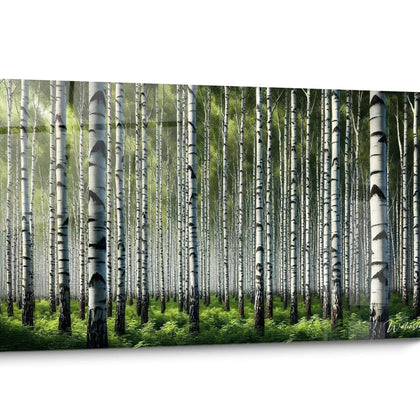
The depiction of a single tree generates a unique presence, almost personified, inviting personal projection. This arboreal solitude resonates particularly in urban interiors where it symbolizes the resilience of vegetation in a mineral environment. Conversely, minimalist forest compositions - rhythmic repetition of simplified tree silhouettes - create a soothing collective dynamic, evoking a stylized woodland walk. The choice between singularity and multiplicity depends on the intended emotional impact: personal anchoring versus collective immersion.
Perceptual evolution and lasting decorative appeal
Formal purification guarantees remarkable resistance to fleeting trends. Unlike saturated decorative styles that quickly become outdated, minimalist simplicity transcends decades without aesthetic obsolescence. This longevity justifies the investment in high-quality formats and generous dimensions: the artwork accompanies life's evolutions durably, adapting to successive redecorations through its fundamental stylistic neutrality. The eye does not tire of this sobriety, but discovers subtle nuances with repeated observations.
Would a minimalist tree painting suit low ceilings?
Absolutely, the graphic verticality of a minimalist tree painting visually amplifies ceiling height by directing the gaze upwards. Favor tall, narrow formats over horizontal compositions to maximize this optical elevation effect in vertically constrained spaces.
What real plant association effectively complements this type of wall decoration?
Architectural plants with clean, graphic foliage - sansevieria, zamioculcas, ficus elastica - create a coherent dialogue with the minimalist aesthetic of the painting. Avoid complex flowering plants or overly dense foliage that would create a visual contradiction with the sought-after wall sobriety.
How to clean a large-scale minimalist tree painting without damaging the surfaces?
Regular dusting with a dry microfiber cloth is sufficient for large formats. Avoid harsh chemicals that could alter the pigments or surface treatments. For stubborn dirt, a slightly damp cloth with clear water, followed by immediate drying, preserves aesthetic integrity without risk.
Further reading
Our articles on this topic
- Minimalist giraffe painting in a contemporary entryway: the layout rules that change everything
- Minimalist tree of life painting: the birth gift idea that stands the test of time
- Minimalist math and science paintings: where and how to hang them at home
- Square tree of life painting: the format that structures your walls
- Choosing Wall Art When You Have a Minimalist Lifestyle
L'art qui suscite l'envie
Maison belge d'art mural grand format
14 jourspour changer d'avis*
Protection Walenskyincluse
Fabriquéen Italie
FormatXXL
Kit de fixationtoujours fourni
* Hors tableaux personnalisés et tailles personnalisées


