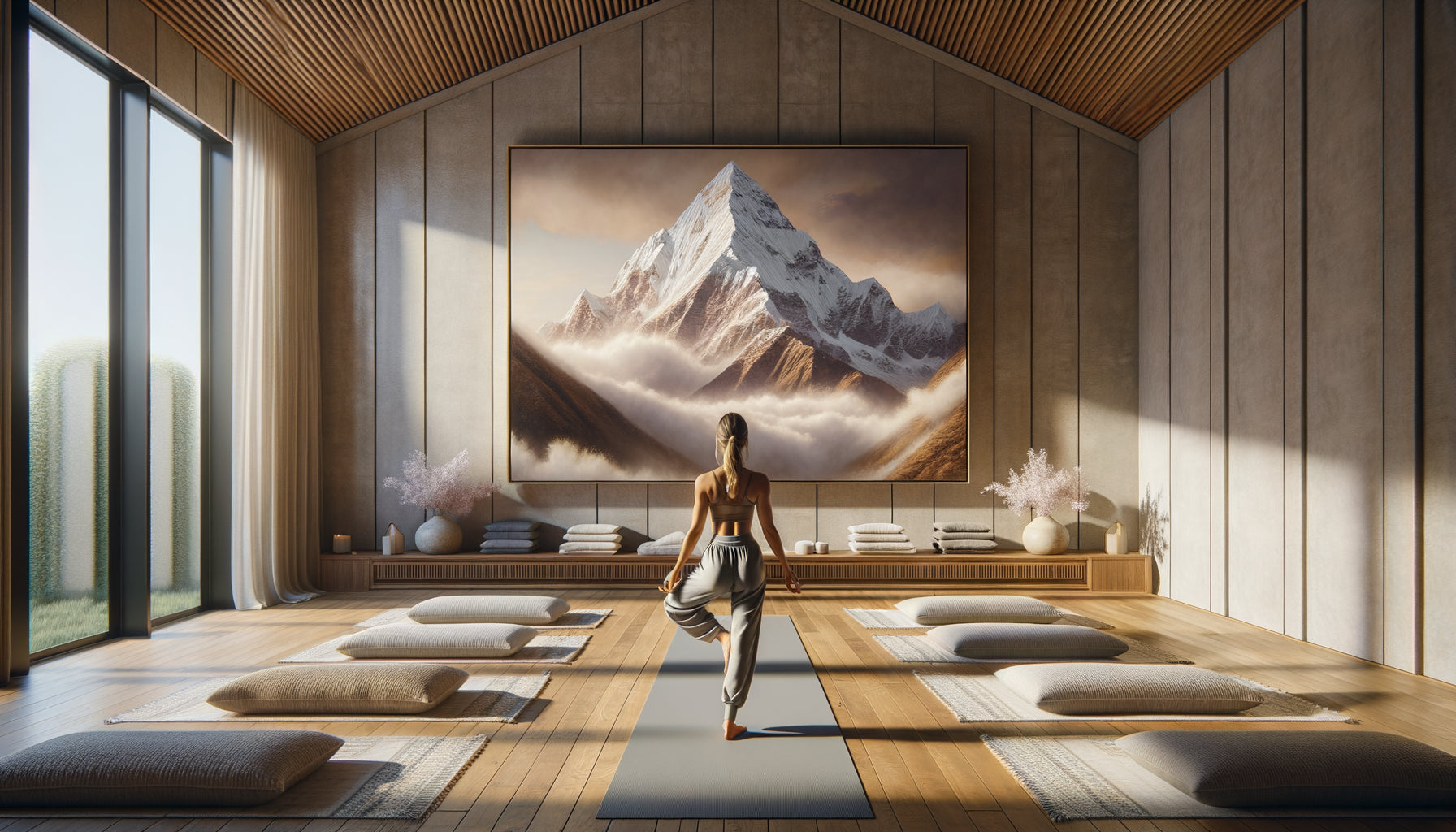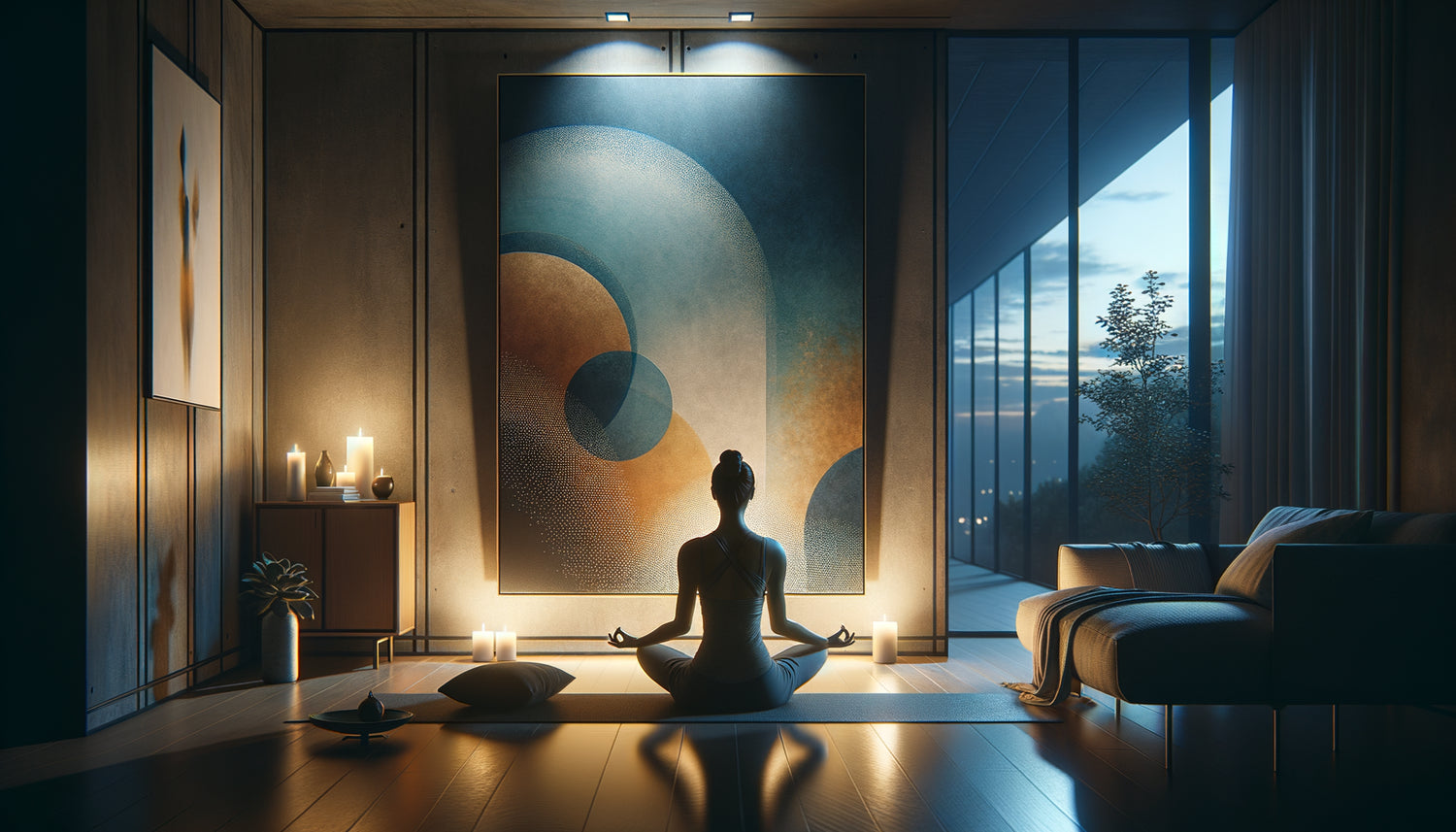
The flickering light of a candle on a painted Buddha's face. The soft halo enveloping an abstract composition in indigo tones. The shadow that transforms a mountain landscape into a nocturnal sanctuary. After accompanying more than two hundred teachers in arranging their practice spaces, I discovered this truth: the lighting of a painting radically transforms the energy of an evening yoga session. It’s not just about aesthetics; it's a subtle alchemy between light, color and sensory perception.
Here is what nighttime artwork illumination brings to your practice: it anchors the gaze and calms the mind by creating a soothing focal point, it amplifies the contemplative atmosphere through plays of shadows and depth, and it synchronizes your inner rhythm with an ambiance conducive to introspection.
You may already practice yoga in the evening, but do you feel this mental dispersion, this difficulty in truly disconnecting? Your gaze seeks a point of anchorage in the dimness, and instead of finding calm, it encounters bare walls or aggressive lighting that brings back the agitation of the day.
Rest assured: you don't need to completely rearrange your space. The solution often lies in how you light the central decorative element of your practice room. A well-lit painting becomes what I call an inner beacon – that gentle visual landmark that guides your attention without capturing it.
In this article, I will reveal to you how to orchestrate this encounter between light, wall art and nighttime practice to create truly transformative sessions.
Why night changes everything for your practice
Night yoga is not simply yoga practiced after sunset. It's a fundamentally different discipline. Your nervous system functions differently at dusk: melatonin production begins, your body temperature naturally decreases, and your mind gradually switches to an introspective mode.
In this delicate transition, the visual environment plays a decisive role. A lit painting becomes more than just a decorative element: it structures the visual space in the dimness, offering tired eyes active rest. Unlike a screen or direct lighting, softly illuminated artwork creates visual depth that invites contemplation without excessively stimulating your visual cortex.
I have observed this phenomenon in my own studio: students who arrive tense, with fleeting gazes, spontaneously find an anchor point on the Japanese forest landscape lit by two warm LED spotlights placed from a low angle. Their breathing slows down before the session even begins.
The psychology of directed light
When you illuminate a painting in a dark room, you create what space designers call a light island. This principle is based on a simple psychological mechanism: in partial darkness, our attention naturally turns to soft light sources, without the anxiety caused by bright lights.
This focused light on a work of art induces a state of relaxed concentration – exactly the mental state sought after in yoga. Your mind doesn't have to constantly scan the environment for visual cues. It has a reassuring anchor point, which frees your attention for practice.
The three lighting principles that transform the atmosphere
After years of experimentation, I identified three lighting approaches that work particularly well for creating a nighttime yoga ambiance around a painting.
Upward lighting: the sanctuary effect
Placing a light source below the painting, pointing upwards, creates a sacred, almost ceremonial atmosphere. This technique, borrowed from temple lighting, generates soft shadows that rise towards the ceiling, giving the impression that the painting emerges from the darkness.
This approach works wonderfully with paintings with spiritual themes – representations of deities, mandalas, sacred symbols. Upward lighting amplifies their presence without creating distracting reflections. I use dimmable LEDs at 2700K (very warm white) to achieve this amber glow that recalls traditional oil lamps.
Lateral lighting: contemplative depth
By positioning a light source on the side of the painting, at approximately 45 degrees, you create a gradient of light across the work. One part remains in a soft dimness while the other catches the light. This technique reveals textures and adds relief, even to a photographic print.
This approach excels with natural landscapes – forests, oceans, mountains – because it simulates the natural light of twilight. The painting seems to breathe, vibrate gently in the room. For your yin yoga or meditation sessions, this lateral lighting creates a perfect transition between day and inner night.
Diffused lighting: the serenity bubble
Instead of illuminating the painting directly, you can project light onto the adjacent wall, allowing the brightness to reflect gently on the work. This method creates a luminous aura around the painting, without marked shadows or aggressive contrasts.
This is my preferred approach for abstract compositions with soft colors – watercolors, minimalist works, pastel abstractions. The painting becomes a soothing presence rather than a demanding focal point. Perfect for yoga nidra or restorative practices where you want the atmosphere to envelop without stimulating.

How to choose light temperature according to your intention
The color of your lighting radically transforms the perception of the painting and the atmosphere of your nighttime session. This technical parameter – measured in Kelvin – is often overlooked, but it determines the emotional energy of your space.
For a soothing practice and sleep preparation, opt for sources between 1800K and 2700K. This amber light, almost orange, suppresses the blue wavelengths that disrupt melatonin production. It envelops your painting in a comforting warmth, like the last rays of the setting sun. The warm colors of the work – reds, ochres, golds – are beautifully intensified.
If your nighttime yoga session is more dynamic – an energizing flow to release daily tension – you can go up to 3000-3500K, this neutral warm white that preserves visual details without excessively stimulating. The blues, greens and purples of your painting retain their fidelity, creating a focused atmosphere rather than a sleepy one.
I absolutely avoid temperatures above 4000K in the evening. This cool light, similar to that of an office, sabotages the natural transition to rest and gives paintings a clinical appearance that destroys any contemplative atmosphere.
The art of synchronizing painting, light and type of practice
Each nighttime yoga style benefits from a specific combination between the subject of the painting and its lighting. This synchronization is nothing mystical: it relies on principles of sensory coherence.
For hatha yoga or vinyasa in the evening, where you maintain a certain dynamism, I recommend structured works – sacred geometries, natural architectures, balanced compositions – illuminated with stable and uniform light. Your gaze can rest between postures without getting lost in complex details. Lateral lighting works particularly well here.
Yin yoga and restorative yoga call for paintings with distant horizons – oceans, starry skies, morning mists – with extremely soft diffused lighting. In these deep relaxation practices, you want your gaze to be able to travel effortlessly through the work. The light must never create visual tension points.
For seated meditation and yoga nidra, monochrome paintings or those with subtle transitions – minimalist abstractions, contemplative gradients – backlit create a reassuring presence without capturing attention. You know the artwork is there, but it doesn't solicit your gaze. This is what I call breathing lighting: present but discreet, like your breath.
The importance of intensity variation
A technical detail that changes everything: using a dimmer switch on your artwork lighting. This ability to modulate the light according to the moment of the session significantly amplifies its impact.
Start your practice with a slightly higher intensity (about 60-70% of maximum power) to create a marked presence of the painting. Your attention settles, your mind finds its anchor. Then, gradually, during the heart of the session, reduce to 30-40%. The painting remains visible but gently fades away, accompanying your inner journey. For final relaxation, go down to 15-20%: a minimal, almost subliminal luminous presence.
This orchestration of light accompanies the journey of your consciousness from external agitation to inner silence. The painting becomes a guiding light that adapts to your state.

The mistakes that sabotage your nighttime ambiance
After visiting dozens of practice spaces, I have identified recurring traps in artwork lighting for nighttime yoga.
The most common mistake: placing the light source too close to the painting. Result: dazzling overexposed areas and harsh shadows that create visual tension. The rule I consistently apply: the distance between the source and the painting should be at least equal to half the width of the artwork. For an 80 cm wide painting, place your spot at a minimum of 40 cm.
Second trap: using non-dedicated bulbs. Cheap LED lights often produce imperceptible flickering consciously but fatiguing for the nervous system. Invest in quality LED sources with a Color Rendering Index (CRI) above 90. Your paintings reveal their subtle nuances, and your brain stops unconsciously compensating for this invisible flicker.
Third mistake: ignoring reflections. A canvas under glossy varnish or acrylic glass can turn your carefully crafted lighting into a disturbing mirror. If your artwork features reflective surfaces, opt for side or upward lighting rather than frontal illumination. Or even better, choose matte canvas prints that gently absorb light without reflecting it.
The General Lighting Syndrome
Many practitioners keep the main overhead lighting, even dimmed, thinking they need that general light. That's precisely what prevents the magic from happening. Effective nighttime lighting relies on contrast: areas of darkness and gently lit zones.
Turn off your ceiling light completely. Only illuminate your artwork (and possibly a small nightlight if necessary for safety). This contrast instantly transforms the atmosphere: your everyday space becomes sacred territory, your mind understands that you are entering a different time.
Transform your nighttime sessions into luminous rituals
Discover our exclusive collection of wall art for yoga studios that reveal their full depth under carefully crafted nighttime lighting.
Your new practice starts tonight
Imagine your next nighttime yoga session: you enter your practice space, turn off the general lighting, and gently illuminate the artwork. A bamboo forest emerges from the shadows, bathed in an amber glow. Or perhaps a mandala with deep blues that seems to float in the darkness.
You unroll your mat, and already, your breathing deepens. This simple luminous ritual signals to your nervous system: we are switching from action mode to contemplation mode. Your gaze finds its anchor on this gentle luminous presence, and mental chatter begins to subside.
You don't need sophisticated equipment to get started. A desk lamp with an adjustable warm LED can be enough to create this atmospheric transformation. Experiment tonight with what you already have. Observe how your practice changes when your visual environment supports your intention rather than hindering it.
Lighting a painting for nighttime yoga is not an aesthetic detail. It's a conscious transition tool between the external world and your inner landscape. A tangible way to create the temporal sanctuary that your practice needs to truly flourish.
Frequently Asked Questions about Painting Lighting for Nighttime Yoga
What lighting power should I choose to avoid disturbing the soothing atmosphere?
The ideal power is between 5 and 15 watts for a medium-sized painting (60-100 cm), but the perceived light intensity depends mainly on the distance and beam dispersion. I always recommend adjustable sources rather than fixed power. Start with an LED bulb of 7-8 watts equipped with a dimmer: you can then adjust according to your current sensitivity. The deciding criterion is not technical but sensory: your lighting is correct when you can look at the painting without squinting, and the light does not create a dazzling halo on the surrounding wall. For a restorative yoga or nidra session, you will naturally tend towards minimum intensities, while a more dynamic practice tolerates slightly brighter lighting. Remember that the color of light influences the atmosphere as much as the intensity: an 8 watt warm LED creates a much more soothing atmosphere than a 5 watt cold LED.
Should I use a specific type of painting for it to work well illuminated at night?
All paintings can function as nighttime lighting, but certain characteristics significantly amplify the effect. Works with moderately saturated colors – neither too vivid nor too dark – react beautifully to subdued lighting, revealing nuances invisible in daylight. Very dark paintings risk disappearing into the gloom despite the lighting, while works dominated by white or very light tones may become dazzling. In terms of subject matter, prioritize compositions that invite the eye to wander: landscapes with depth, fluid abstractions, serene natural scenes. Avoid artworks too rich in detail or compositions with high contrast which create visual tension. Texture also plays a crucial role: a canvas with relief reveals fascinating shadow games under sidelight, while a perfectly smooth surface is better suited to diffused lighting. Personally, I have found that paintings with natural themes – water, mountains, vegetation – create the most consistent atmospheres with the spirit of nighttime yoga, but your personal feeling remains the best guide.
Can I combine multiple light sources on the same painting?
Absolutely, and it's even a very interesting approach to create an additional dimension to your nighttime lighting. The technique that I regularly use is to combine two sources of slightly different temperatures: a very warm light (2200K) in upward lighting to create an amber base, and a slightly more neutral light (3000K) laterally to preserve details. This dual source generates remarkable depth and avoids the flatness of a single lighting. However, be careful not to create visual confusion: your sources must dialogue harmoniously, not compete with each other. The golden rule: one of the two lights should clearly dominate, the other only subtly enriching. Another approach is to place two identical light sources symmetrically on either side of the artwork for perfectly balanced lighting, particularly suitable for mandalas or geometric compositions. To begin, I advise you to first master a single source before experimenting with combinations. And if you opt for multiple sources, invest in independent dimmers: you will be able to orchestrate luminous variations during your session, creating a true choreography between shadow and light that accompanies your inner progress.