I discovered this reality during my first visit to the Madurai temple in southern India. Faced with monumental frescoes depicting Mount Kailash and sacred rivers, I realized that these landscapes were not mere decorations. They embodied portals to the divine, mystical geographies where the presence of gods materialized. This revelation transformed my understanding of Indian spiritual art.
Here's what sacred landscapes brought to Hindu art: they served as meditation supports allowing devotees to visualize divine abodes, they made visible the invisible Hindu cosmology, and they transformed places of worship into veritable spiritual maps to guide the soul towards liberation.
Many believe that Hindu art is limited to representations of deities and their attributes. This reductive vision ignores the deeply geographical and landscape dimension of this millennial spiritual tradition. Mountains, rivers, and forests are not mere decorative backgrounds but fundamental theological elements.
Rest assured: understanding the religious function of these sacred landscapes requires no expertise in Hindu theology. Through my fifteen years spent studying the iconography of Indian and Nepalese temples, I have learned to decode these visual languages that speak directly to our sense of spatial wonder.
I invite you to discover how these landscape representations served as veritable spiritual technologies, capable of transporting believers to transcendent dimensions while anchoring the sacred in the tangible reality of nature.
The cosmic mountain: when landscape becomes axis mundi
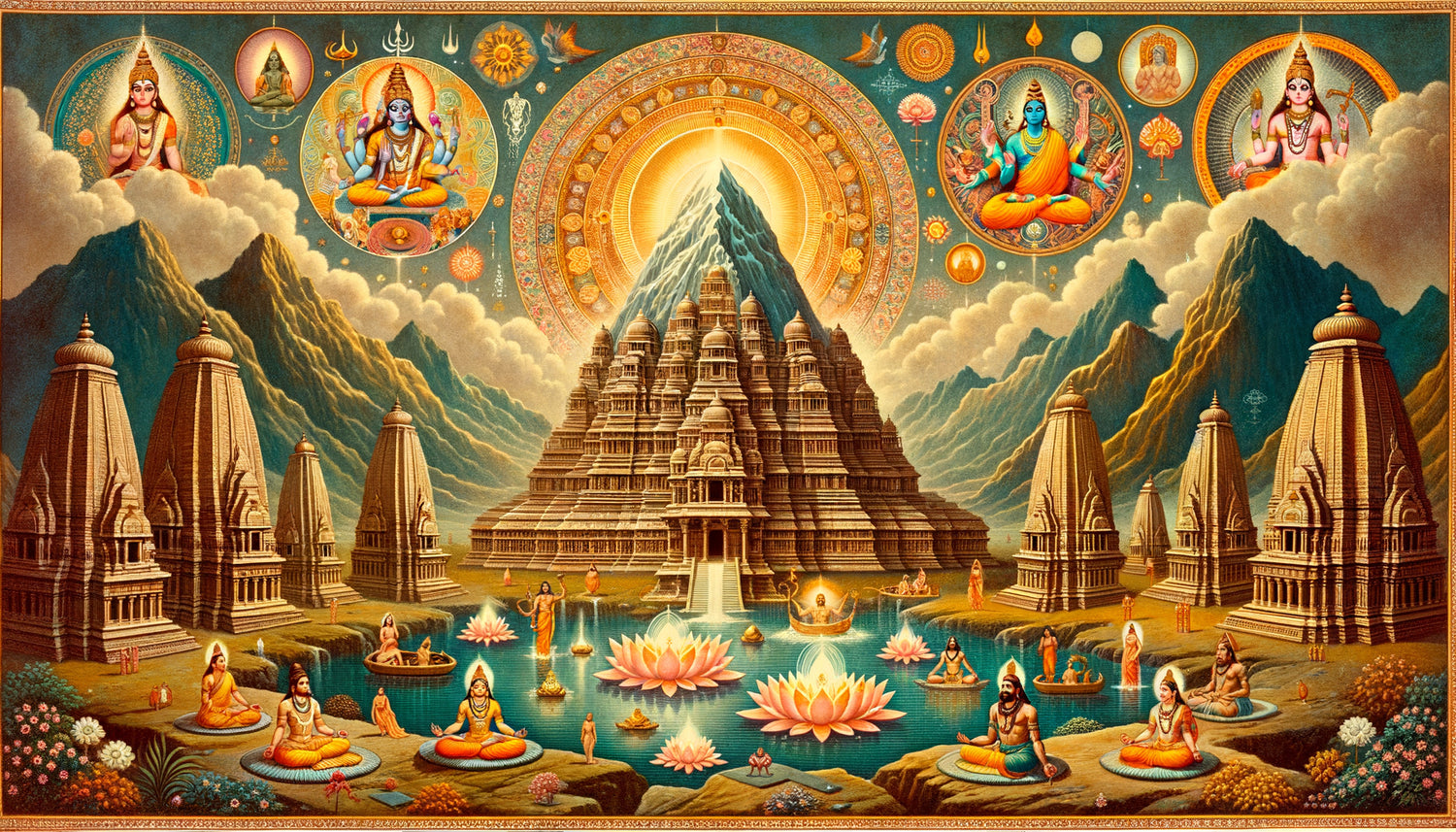
In Hindu art, Mount Meru occupies a central place as the axis of the world connecting the terrestrial and celestial spheres. This mythical mountain, depicted in countless frescoes and sculptures, fulfilled a specific religious function: it offered devotees a focal point for meditating on the very structure of the universe.
Artists reproduced this sacred geography with meticulous symbolic precision. Mount Meru often appears surrounded by seven concentric oceans and seven mountain ranges, creating a visual cosmography that devotees could memorize and internalize. This spiritual cartography transformed artistic contemplation into a true religious practice.
Mount Kailash, the earthly abode of Shiva, was another fundamental sacred landscape. Its representation in temples served as a substitute for pilgrims unable to undertake the perilous journey to this Himalayan mountain. By contemplating its painted or sculpted image, devotees performed a mental pilgrimage considered spiritually effective.
The celestial rivers that purify the soul through their mere contemplation
The religious function of fluvial landscapes in Hindu art goes far beyond aesthetics. The Ganges, descending from Shiva's hair, appears in iconography as a luminous cascade connecting heaven to earth. This representation did not simply decorate the walls of temples: it spiritually activated the sacred space.
Hindu artists developed sophisticated visual conventions for representing the seven sacred rivers. Each waterway possessed its symbolic attributes, its tutelary goddesses, and specific purifying powers. These aquatic landscapes served as instruments of ritual purification: meditating before their representation was believed to provide spiritual benefits similar to a real bath in these sacred waters.
I observed in the temples of Kerala how river frescoes were strategically placed at architectural transition points. These threshold landscapes marked the passage from the profane to the sacred, psychologically preparing the faithful to enter the presence of the divine. The religious function then became spatial and architectural.
Water as a mirror of the cosmos
Representations of sacred lakes and ponds fulfilled a particular meditative function. Their surface reflecting the sky created a visual metaphor for mirror consciousness, a central concept in several Hindu philosophical schools. These reflective landscapes invited introspection and recognition of the unity between microcosm and macrocosm.

The enchanted forests where the deities manifest
Forest landscapes in Hindu art functioned as divine theaters where the lilas (cosmic games) of the gods unfolded. The forest of Vrindavan, associated with the adventures of young Krishna, appears in countless miniatures and murals as a space of playful transcendence.
These vegetal representations did not seek botanical realism but aimed to create an atmosphere of spiritual wonder. Trees with impossible proportions, giant flowers, and intertwined vines formed a codified visual language that initiates knew how to decipher. Each plant essence carried precise theological meanings.
The religious function of these forest landscapes included the transmission of spiritual teachings. Scenes of Krishna playing the flute under the kadamba tree or Buddha meditating under the sacred fig transformed landscape elements into narrative markers allowing illiterate believers to follow sacred stories.
When Landscape Becomes Mandala: Sacred Geometry and Mystical Topography
Hindu art developed a unique approach, merging landscape and sacred geometry. Landscape mandalas simultaneously represented real geographical locations and abstract cosmological structures. The Borobudur temple in Indonesia beautifully illustrates this synthesis, where each architectural level evokes both an earthly mountain and a metaphysical plane.
This dual nature of sacred landscapes fulfilled a sophisticated religious function: it allowed practitioners to mentally navigate between the concrete and the abstract, between emotional devotion and philosophical meditation. Landscapes became contemplative diagrams structuring spiritual experience.
I was particularly fascinated by the landscape yantra of Rajasthan, where stylized natural elements are organized according to rigorous geometric principles. These compositions served as supports for advanced tantric practices, where visualization of the sacred landscape led to altered states of consciousness.
Paradise Gardens as a Foretaste of Moksha
Representations of celestial gardens offered believers a preview of spiritual liberation. These Edenic landscapes, populated with wonderful birds and eternally blooming plants, materialized the rewards awaiting virtuous souls. Their religious function was clearly motivational and eschatological.

The Landscape as Divine Body: When Nature Reveals Cosmic Anatomy
A particularly remarkable religious function of Hindu sacred landscapes resided in their identification with the bodies of the deities themselves. The representation of India as the body of the mother goddess, with the Himalayas for a crown and rivers for veins, transformed the entire geography into a living theophany.
This conception found its visual expression in the (earthly beings) representing the earth as a sacred organism. Each landscape element corresponded to a divine organ or energy center. Contemplating these images allowed believers to perceive all of nature as a bodily manifestation of the sacred.
The sites of shakti pitha, where the dismembered limbs of the goddess Sati were said to have fallen, created a pan-Indian sacred topography. Their artistic representation wove a network of correspondences linking physical landscapes and divine mythology, transforming the entire subcontinent into a living spiritual map.
Let the transcendent beauty of sacred landscapes transform your interior
Discover our exclusive collection of nature paintings that capture this spiritual dimension of the landscape and invite meditative contemplation in your living space.
Sacred landscapes as technologies for inner transformation
Beyond their formal beauty, the sacred landscapes of Hindu art functioned as true psycho-spiritual instruments. Their regular contemplation gradually modified the practitioner's consciousness, creating mental associations between visual forms and interior states.
Spiritual masters taught precise visualization techniques based on these landscape representations. A disciple could spend years meditating on a single image of Mount Meru, gradually deepening their understanding of the cosmic structure and their place in the universal order.
This transformative religious function of sacred landscapes explains the meticulous care taken in their execution. Every iconographic detail had been calibrated to produce specific contemplative effects. Colors, proportions, and compositions followed aesthetic-theological treatises passed down through generations.
Imagine yourself in a few weeks, quietly contemplating a reproduction inspired by these millennial traditions. Your gaze rests on the curves of a stylized mountain, follows the course of a symbolic river. Without even realizing it, you access that inner space of calm and depth that Hindu artists sought to awaken. Start today by observing the landscapes around you differently: they may contain more sacredness than you imagine.