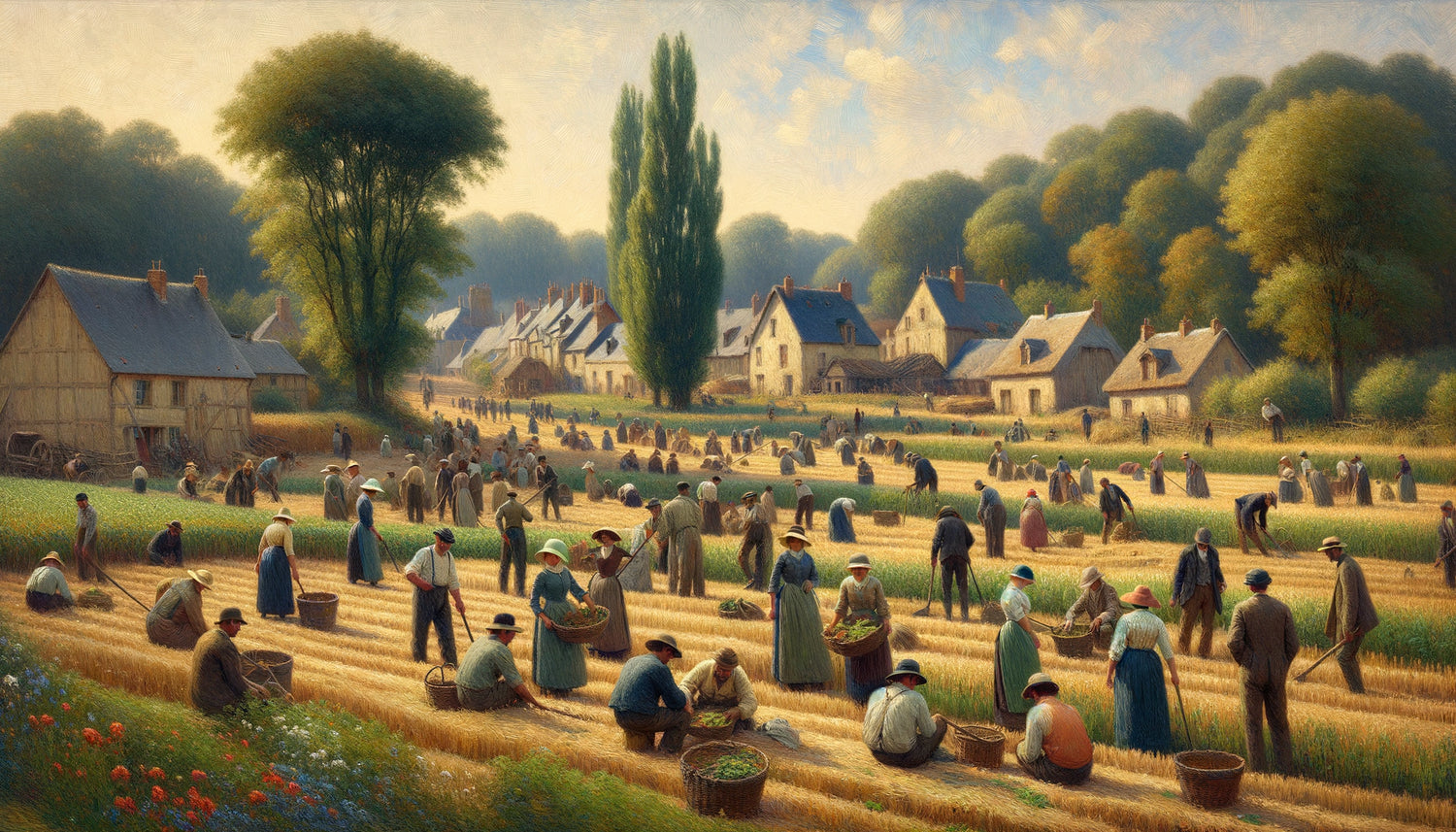
A field of wheat under a Norman sky. Peasants bent over in their age-old gestures. A dirt path bordered by poplars. Who could see a political manifesto in these bucolic scenes? Yet, Camille Pissarro, a major figure of Impressionism, painted much more than light and seasons. Each brushstroke carried within it a worldview, an aspiration for a different society.
Here's what Pissarro’s landscapes bring: a celebration of peasant labor without sentimentality, a rejection of hierarchies through the absence of centers of power, and an harmony between man and nature that embodies his anarchist ideal. His canvases do not shout their convictions; they murmur them with the quiet strength of a revolution lived on a daily basis.
Many admire Impressionist landscapes for their peaceful beauty, without suspecting that they can carry a social message. Pissarro is ranked among the painters of light, end of story. This superficial reading obscures an essential dimension of his work: his profound political commitment, which transpires in every pictorial choice.
Understanding the link between his canvases and his anarchist convictions requires neither a degree in art history nor a political encyclopedia. It suffices to observe carefully what he shows, how he shows it, and above all what he refuses to show. Pissarro’s landscapes speak to those who know how to listen to them.
Let's explore together how a painter transformed the representation of nature and rural work into an activist act, without ever sacrificing beauty to ideology.
When the brush embraces anarchist thought
Camille Pissarro did not hide his convictions. Friend of Jean Grave, assiduous reader of libertarian newspapers, participant in Parisian anarchist circles of the 1880s-1890s, he embodied the engaged artist. But unlike social realist painters like Courbet, Pissarro refused direct propaganda painting.
His anarchism was nourished by Kropotkin’s theories on mutual aid and natural harmony between beings. For these thinkers, the ideal society would resemble a living organism, without central authority, where each individual would contribute freely to the common good. This vision profoundly shaped his way of composing his canvases.
Pissarro's landscapes reflect this philosophy in their very structure. Observe his rural scenes: no dominant monument, no castle overlooking the village, no church crushing the thatched roofs with its mass. Everything breathes horizontality, peaceful coexistence. The human figures are neither idealized nor pauperized; they simply participate in the great ballet of nature.
The silent dignity of peasant labor
In Haymaking at Éragny or Peasants planting asparagus, Pissarro captures agricultural gestures with an almost ethnographic attention. But be careful: he never paints suffering, exploitation, or misery. His peasants work in a golden light, integrated into a landscape that welcomes them rather than crushes them.
This representation would almost shock with its optimism. Yet, it perfectly corresponds to his anarchist vision: working the land is not a curse but the natural expression of human activity. By removing signs of exploitation (overseers, supervising landowners, coercive tools), Pissarro pictorially imagines a society already liberated.
His peasant women are never allegories. They wear real clothes, adopt authentic postures, their faces remain individual even when seen from afar. This attention to unique individuals, rather than social types, translates the anarchist rejection of categories and uniform masses.

The revolutionary absence of visual hierarchy
Let's compare for a moment an academic landscape from the 19th century to a Pissarro canvas. The former organizes the composition according to a pyramid, with an obvious focal point guiding the gaze. With Pissarro, the gaze wanders freely. No element dominates, everything coexists in a disturbing compositional equality.
This visual democracy is not clumsy but manifest. Pissarro's landscapes apply to painting the fundamental anarchist principle: the equality of all elements without centralizing authority. A tree is no more valuable than a millstone, a peasant woman does not fade before the sky, human work dialogues on an equal footing with plant growth.
His views of villages like Pontoise or Eragny show communities where buildings blend into the landscape rather than dominate it. Houses seem to have grown naturally, like the surrounding trees. This fusion of man and nature embodies Kropotkin's utopia of a society reconciled with its environment.
The seasons as a metaphor for an organic society
Pissarro obsessively returned to the same places, painting them in all seasons. This repetition was not simply an impressionistic stylistic exercise. It translated his cyclical and organic conception of existence, opposed to the linear temporality of industrial and capitalist progress.
In his series on blossoming orchards, harvests, fields after harvest, each painting shows a stage of a natural cycle where man participates without brutalizing. Pissarro's landscapes celebrate an agricultural time when each season brings its necessary contribution, reflecting a society where everyone would give according to their abilities.
This vision sharply contrasted with France at the time of its industrial revolution. While Haussmann was reshaping Paris and factories were darkening the skies, Pissarro persistently painted vegetable gardens, orchards, and rural paths. This thematic choice in itself constituted a political stance: to recall that another social organization remained possible.

Why Pissarro carefully avoided iconography of power
Browse through Pissaro's catalogs: you will search in vain for prefectures, imposing factories, bourgeois scenes, aristocratic interiors. His work is a series of significant absences. He systematically refuses to represent structures of power and authority.
Even his rare urban scenes (the Parisian boulevards of the 1890s) show the anonymous crowd rather than the monuments. When he paints the Théâtre-Français, it's immersed in the bustle of the street, stripped of its institutional majesty. Pissarro’s landscapes practice a form of resistance by omission: not giving pictorial existence to the symbols of the established order.
This strategy finds meaning in anarchist thought: not to confront authority directly, but to build parallel ways of living and seeing. Pissaro built on canvas the landscapes of the society he desired, deliberately ignoring the one he rejected.
The Impressionist technique at the service of a libertarian vision
Beyond the subject matter, Pissarro's very manner carried his philosophy. The divided touch, pure colors juxtaposed, the rejection of rigid preparatory drawing: all corresponded to an aesthetic of freedom. Each brushstroke remained visible, autonomous, contributing to the overall harmony without dissolving into a polished finish.
This egalitarian technique, where each stroke counts as much as its neighbor, pictorially translated the anarchist ideal. Pissarro’s landscapes are built like a libertarian society: through the cooperation of free elements, without a predetermined hierarchy, where harmony emerges spontaneously from the interaction of parts.
Compare this with academic painting, where each brushstroke must disappear in favor of perfect illusion, where technique disappears under the varnish: it is the image of a society where individuals must merge into the established order. Pissarro, on the other hand, showed the work, the hesitations, the regrets. His painting breathed freedom even in its execution.
Let nature soothe your everyday life
Discover our exclusive collection of nature paintings that transform your interior into a haven of serenity inspired by the great landscape masters.
When commitment finds its most beautiful expression
Imagine your gaze fixed on a canvas by Pissarro. You don't need to know his biography to feel that particular peace emanating from his landscapes. You contemplate a world where man and nature coexist harmoniously, where work integrates with the seasons, where nothing violently dominates.
Did Pissarro’s landscapes reflect his anarchist commitment? Absolutely, but with a subtlety that is their greatest strength. Rather than painting revolt, he painted realized utopia. Rather than denouncing injustice, he showed an alternative. His anarchism did not shout; it quietly proposed another look at the world.
This lesson still resonates today: the deepest commitment may not be one that exhibits its slogans, but one that embodies its values in every creative gesture. Seek in your daily life how to translate your convictions not through speeches, but through actions and aesthetic choices. Like Pissarro transforming each landscape into a discreet manifesto for a more just society.
Frequently Asked Questions
Was Pissarro really an anarchist or just a sympathizer?
Camille Pissarro was deeply and actively anarchist, not simply a sympathizer. He maintained regular correspondence with major anarchist theorists such as Jean Grave and Peter Kropotkin, financially subscribed to libertarian newspapers like Les Temps nouveaux, and participated in Parisian anarchist discussion groups. His letters testify to an informed adherence to libertarian principles: rejection of state authority, faith in mutual aid, opposition to capitalism. Unlike some artists who flirted with anarchism as a fashion, Pissarro made it the center of his worldview, even if it earned him the distrust of conservative collectors. His commitment lasted from the 1880s until his death in 1903, crossing notably the explosive period of anarchist attacks of the 1890s, which he disapproved of while understanding the anger that motivated them.
Why didn’t Pissarro paint scenes of worker revolt like other committed artists?
Pissarro consciously rejected direct propaganda painting, which he considered counterproductive and artistically impoverishing. His anarchism was inspired by Kropotkin, who advocated for the construction of positive alternatives rather than simply destroying the existing order. For Pissarro, painting revolt meant remaining a prisoner of the system being fought. He preferred to show what an anarchist society could be like: harmonious, egalitarian, reconciled with nature. His rural landscapes functioned as concrete utopias, visual proposals for another possible world. This approach also corresponded to his temperament: a patient observer rather than a fiery tribune, he believed in the gradual transformation of consciences through beauty and example rather than revolutionary force. His canvases invited one to imagine and desire a different society, which he considered the first necessary step of any authentic social change.
Did the other Impressionists share Pissarro's political ideas?
No, Pissarro remained a political exception among the Impressionists, which sometimes created tensions within the group. Monet, Renoir and Caillebotte were politically conservative, even reactionary for Renoir who openly criticized socialist movements. Degas belonged to the monarchist bourgeoisie, a notorious antisemite during the Dreyfus affair, which caused a definitive break with Pissarro (himself Jewish). Only a few artists like Signac shared similar anarchist convictions. This ideological solitude did not prevent Pissarro from maintaining cordial relations with his fellow Impressionists, separating artistic friendship and political disagreements. However, these divergences explain why Pissarro's landscapes possess this particular tone, this absence of bourgeois decor and aristocratic leisure scenes that are abundantly found in Renoir or Monet. His anarchist commitment led him to subjects that his colleagues neglected: peasant labor, modest villages, productive rather than decorative nature.