1822. An English painter sets up his easel in the Suffolk countryside and does something extraordinary: he notes on each canvas the exact time, wind direction, and temperature. John Constable doesn't just paint clouds; he studies, classifies, and understands them. At a time when meteorology is in its infancy and scientists are desperately trying to unravel the mysteries of the atmosphere, this landscape painter becomes, unwittingly, a pioneer of scientific cloud observation.
Here's what John Constable’s revolution brings: a rigorous methodology for capturing the changing truth of the sky, a visual classification of cloud formations before science fully codifies them, and an unprecedented fusion between artistic observation and naturalist inquiry. For decades, painters had treated clouds as mere backdrops, generic backgrounds repeated from painting to painting. The frustration was palpable: how to render the fleeting light, the perpetual movement, the atmospheric drama that makes up the majesty of a stormy sky or the softness of a misty dawn? Constable realized it was necessary to stop painting imaginary clouds and start observing them scientifically. His promise: to reveal that art and science do not oppose each other, but nourish each other to reach a higher truth.
The sky notebook: when painting becomes a laboratory
Between 1820 and 1822, John Constable undertook what he called his cloud studies – more than one hundred and fifty small-format canvases, painted outdoors. But unlike his contemporaries, he inscribed meteorological notes on the back of each work: September 21, 1821, 10 am, west wind, stormy clouds after rain. This systematic approach transforms each painting into a scientific document.
The English painter was familiar with the works of Luke Howard, the London pharmacist who had just published his revolutionary classification of clouds in 1802, distinguishing cumulus, stratus, cirrus, and nimbus. Constable deeply admired this taxonomic approach and decided to create a pictorial equivalent. His cloud studies become visual catalogs of the different atmospheric formations, captured in their instantaneous truth.
This rigorous methodology marked a radical break. Where academics painted idealized skies in the studio, Constable confronted the whims of the weather outdoors, tracking the transformation of cloud masses with the tenacity of a naturalist. He noted: Landscape painting is for me a science, and should be pursued as an inquiry into the laws of nature.
The revolution of gaze: observe before inventing
Before Constable, clouds were largely conventional in landscape painting. Dutch masters of the 17th century certainly paid attention to the sky, but even they often composed their cloud formations from memory or according to proven formulas. John Constable imposed a radically different philosophy: direct observation as the only acceptable truth.
He spent hours contemplating the sky of Hampstead Heath, the moor north of London where he set up with his painting equipment. He understood that each type of cloud corresponded to specific atmospheric conditions – that the burgeoning cumulus clouds of a summer afternoon told a different story than the flattened stratocumulus of an autumn morning. This intimate knowledge of meteorological phenomena is evident in every brushstroke.
His contemporaries noticed this unsettling precision. The French painter Eugène Delacroix, after seeing Constable's paintings at the Paris Salon in 1824, exclaimed that his skies had an atmospheric veracity never achieved before. This revolution in vision influenced a whole generation of painters who understood that one had to leave the studios and confront the changing reality of nature.

Between art and meteorology: a fertile alliance
John Constable was not only seeking beauty – he was seeking scientific truth. His cloud studies constitute a fascinating bridge between two worlds usually separated: art and science. At a time when meteorology was just beginning to emerge as a discipline, his visual observations made a valuable contribution to the understanding of atmospheric phenomena.
Scientists of his time did not have photography to document cloud formations. Textual descriptions remained approximate and subjective. Constable's paintings offered a visual archive of remarkable precision, capturing the subtleties of light, texture and structure that words struggled to convey. His canvases documented the chromatic variations of clouds according to the time of day, their density, their apparent altitude.
This double nature – artistic and documentary – of his work placed him in a lineage that went back to Leonardo da Vinci, another Renaissance genius who had also studied clouds with scientific rigor. But Constable went further by systematizing his approach, creating a coherent corpus of atmospheric observations made over a short period, with a constant methodology.
The Atmospheric Touch: Translating Movement and Light
How to pictorially render the transient nature of a cloud? This may be the most formidable technical challenge Constable faced. Unlike relatively stable terrestrial landscapes, cloud formations are constantly transforming, forming and dissipating within minutes. The English painter developed a particular technique to capture this ephemerality.
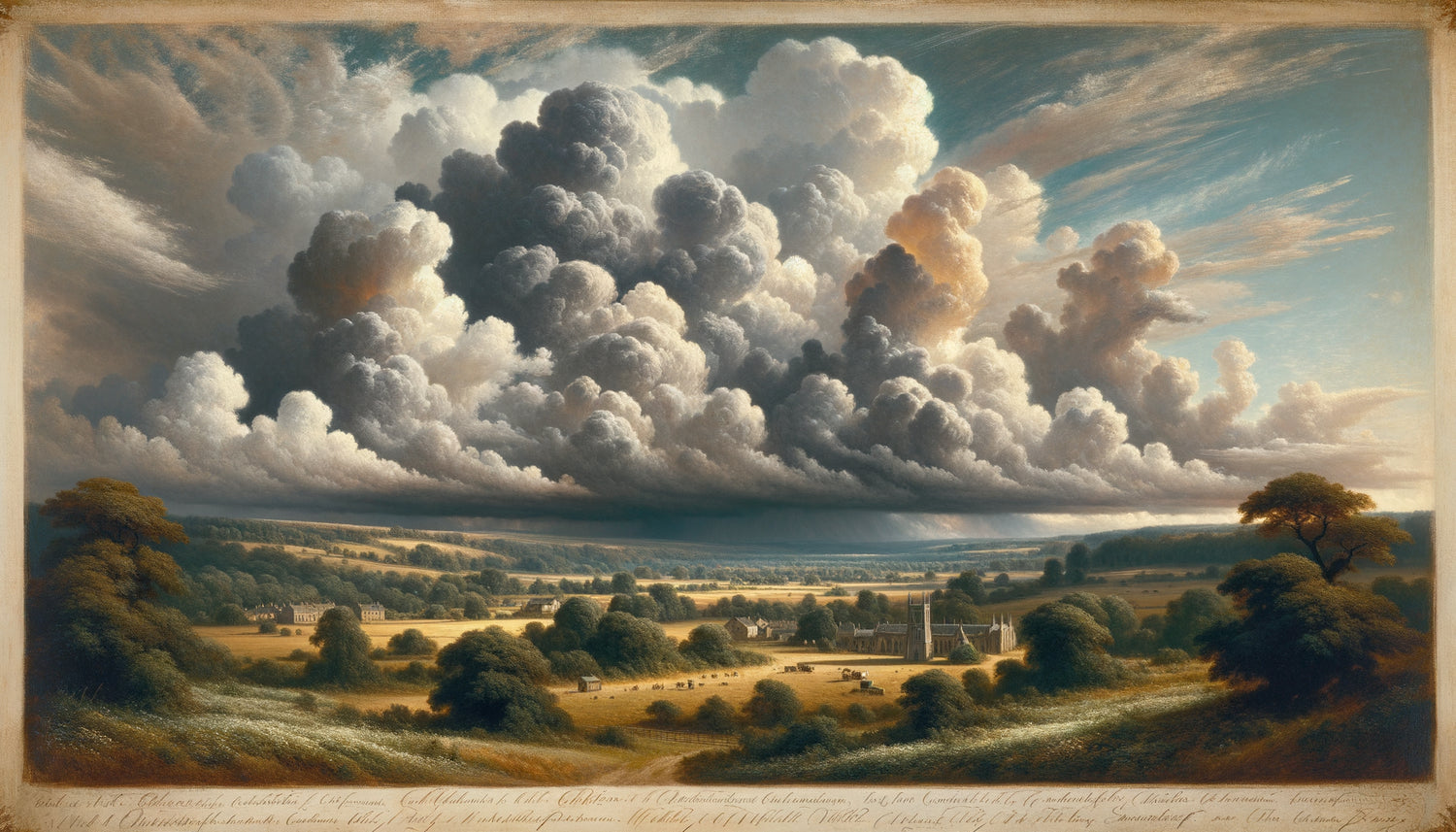
His touch became freer, more spontaneous in his sky studies. He applied paint with quick, small strokes, sometimes with a palette knife, creating impasto that suggested the volume and density of cloud masses. He juxtaposed bright whites and deep grays without completely mixing them, leaving the viewer's eye to perform optical blending – a technique that foreshadows Impressionism by several decades.
Transparent glazes alternated with opaque touches to render the variations in light passing through different atmospheric layers. Constable intuitively understood that light behaves differently as it passes through a dense cumulus or a wispy cirrus. This physical understanding of luminous phenomena gave his skies an atmospheric presence that fascinated both artists and scientists.

The Meteorological Legacy of a Landscape Painter
The influence of John Constable extended far beyond the artistic circle. His cloud studies were consulted by meteorologists seeking to refine their understanding of atmospheric phenomena. The documentary accuracy of his observations made them valuable visual references at a time when scientific imagery did not yet exist.
French Impressionists – Claude Monet in particular – recognized their debt to Constable. His ability to capture changing light effects and his rejection of academic idealization paved the way for their own exploration of visual perception and atmospheric conditions. Monet's series on haystacks or Rouen Cathedral, painted under different lights, directly extends Constable's scientific inquiry.
Today, art historians and climatologists are jointly studying these paintings. The visual archives that constitute his cloud studies provide information on the weather conditions of early 19th century England, usefully complementing the still rudimentary instrumental data of the time. This double reading – aesthetic and scientific – confirms Constable’s vision: art can be a form of rigorous knowledge of the natural world.
Painting the sky: a lesson in humility and observation
John Constable wrote to a friend: There are no two days alike, nor even two hours. Since the creation of the world, there has never been two identical leaves on a tree. This philosophy of the uniqueness of the moment underlies his entire approach. Each cloud study captures a meteorological instant that will never be exactly reproduced.
This awareness of the singularity of each observation gave a particular intensity to his work. He was not seeking to create a universal and timeless sky, but to bear witness to the infinite diversity of atmospheric phenomena. This humility before the complexity of nature distinguishes him from academic painters who claimed to capture an ideal and immutable beauty.
His notebooks are full of notes on the correlations he observed: such a type of cloud announcing rain, such a formation preceding the clearing. He did not simply represent; he sought to understand the mechanisms, to detect the laws governing atmospheric transformations. This analytical approach, coupled with exceptional artistic sensitivity, made him an observer unique in his kind.
Be inspired by the beauty of nature observed with passion
Discover our exclusive collection of nature paintings that celebrate the majesty of the skies and the splendor of landscapes, in the spirit of great observers of natural beauty.
Conclusion: when the painter becomes a scientist
John Constable demonstrated that the artist’s eye can rival scientific instruments. His revolution was not only aesthetic – it was epistemological. He proved that painting could be a legitimate method of investigating the natural world, that sensitive observation and rigorous analysis do not mutually exclude each other. His cloud studies remain today models of this fertile alliance between art and science, between contemplation and understanding. If you look up at the sky during your next walk, think of Constable: observe the precise shape of the cumulus, the texture of the cirrus, the light passing through the stratocumulus. You will perpetuate this tradition of wondered observation that transforms ordinary gaze into an exciting investigation into the mysteries of the atmosphere.
FAQ : John Constable and the scientific study of clouds
Why did Constable record meteorological information on his paintings?
John Constable considered landscape painting a natural science as much as an art. By inscribing the time, date, wind direction and atmospheric conditions on the backs of his cloud studies, he transformed each canvas into a scientific document. This systematic approach allowed him to create a true visual archive of meteorological phenomena. He sought to establish correlations between cloud formations and climatic conditions, just as a naturalist catalogs plant species. This rigorous methodology radically distinguishes Constable from academic painters who composed their skies from memory or according to aesthetic conventions. For him, each cloud told a specific atmospheric story that needed to be documented accurately. This approach makes him a pioneer of scientific observation through imagery, long before the invention of meteorological photography.
What was the relationship between Constable and Luke Howard’s cloud classification?
Luke Howard, a London pharmacist and amateur meteorologist, published in 1802 the first scientific classification of clouds, distinguishing cumulus, stratus, cirrus and nimbus – a nomenclature still used today. John Constable discovered these works with enthusiasm and considered them a revelation. He saw in Howard's taxonomic approach a model for his own pictorial inquiry. Constable decided to create the visual equivalent of this classification: his cloud studies thus become illustrations of the different types identified by Howard. But the painter went further by also capturing the subtle variations of light, color and texture that Howard's verbal descriptions could not convey. This indirect collaboration between a scientist and an artist perfectly illustrates how visual observation can enrich scientific understanding. Constable offered Howard’s theoretical work a sensitive and concrete dimension.
How did Constable’s cloud studies influence Impressionism?
The influence of John Constable on the French Impressionists was decisive and recognized. When his paintings were exhibited at the Paris Salon in 1824, they provoked a true revelation among young French painters. Eugène Delacroix himself repainted parts of his canvases after discovering Constable's free touch and atmospheric luminosity. The Impressionists, three decades later, inherited several innovations directly: painting outdoors to capture changing light effects, scientific observation of natural phenomena, and above all the idea that each moment possesses a unique atmospheric quality that must be captured quickly. Claude Monet, in particular, extended Constable's investigation into variations in light with his famous series. The technique of juxtaposed touches without complete mixing, which Constable used for his clouds, became a fundamental principle of Impressionism. By demonstrating that one could paint rapidly on the spot while maintaining rigor of observation, Constable paved the way for all pictorial modernity.