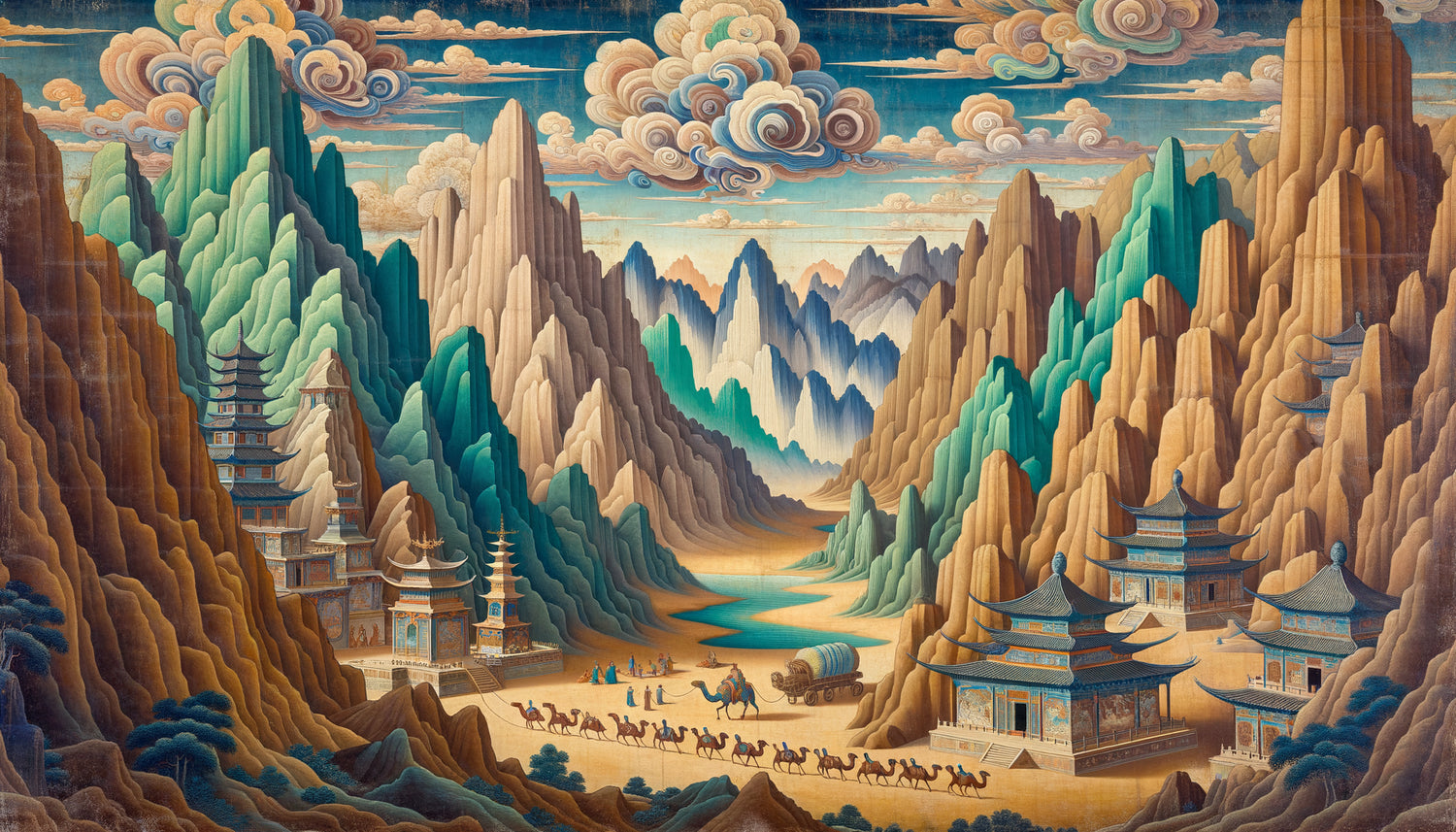
Imagine standing before an ancient fresco, contemplating azure mountains, lush oases, and caravans winding through ochre deserts. Do these landscapes painted in the Dunhuang caves depict real journeys or pure spiritual imagination? This question has fascinated researchers for decades as they scrutinize these extraordinary works. I have spent years comparing these frescoes with accounts of ancient travelers, archaeological traces, and the geography of the Silk Road. The answer is far more nuanced - and captivating - than a simple yes or no.
Here's what the landscapes of the Dunhuang caves reveal: they blend precise observations of real places, Buddhist artistic conventions, and spiritual idealization to create a unique testament to the visual universe of Silk Road travelers. These frescoes are at once mental maps, historical documents, and portals to the afterlife.
You may have wondered how these artists isolated in the Gobi Desert could paint such detailed landscapes. Did they lack references? Were they simply copying standardized models from India or Central Asia? This uncertainty can frustrate those seeking to understand the authenticity of these representations.
Rest assured: recent research, combining iconography, geology, and accounts of pilgrims, now allows us to identify real and symbolic elements. I will guide you through this fascinating visual investigation that will transform your perspective on the art of the Silk Road.
When the mountains in the frescoes echo actual geography
The landscapes of the Dunhuang caves feature striking mountain formations. In several frescoes from the Wei and Tang dynasties, the mountains display horizontal colored strata - ochre, red, white - that exactly correspond to the geological formations of the Qilian Mountains visible from Dunhuang itself.
The artists were not inventing these details. They observed daily these spectacular reliefs that dominate the oasis. Silk Road travelers passing through the Hexi Corridor invariably crossed these impressive mountain ranges. The frescoes capture this geological reality with astonishing accuracy: the rock folds, the layered colors, the mineral aridity.
Some caves, notably cave 172 (Tang dynasty), show mountain landscapes with narrow passes and steep gorges that correspond to descriptions left by the monk Xuanzang in his travel accounts to India. These representations reflect the concrete experience of pilgrims crossing the formidable Pamir or Karakoram passes.
Painted oases: memory of caravan stops
The Dunhuang frescoes abound with scenes of lush oases that violently contrast with the surrounding deserts. These representations are not fantasies. They visually document vital stages of the Silk Road: Turfan, Kucha, Khotan, Samarkand.
Carefully observe the botanical details. The painters of Dunhuang depict date palms, poplars of the Euphrates, pomegranates and vines - species actually cultivated in the oases of Central Asia. This botanical accuracy suggests that the artists drew inspiration either from their own observations or from direct accounts of travelers.
The irrigation systems painted in some scenes - canals, basins, water wheels - correspond to the actual technologies used in the oases of the Silk Road. Cave 217 shows a karez system (underground channels) identical to those still visible in Turpan. This level of technical detail betrays an intimate knowledge of the agricultural realities of these regions.
The revealing architecture in the painted landscapes
The buildings depicted in the Dunhuang landscapes blend architectural styles from across Asia. Indian stupas, Chinese pagodas, Persian fortresses and Gandharan temples can be identified. This diversity is not an inconsistency: it reflects the actual cultural hybridization of the cities of the Silk Road.
Khotan, for example, actually presented this architectural superposition. Archaeological remains confirm the coexistence of Indian Buddhist styles, Sassanian Persian influences and Chinese construction techniques. The artists of Dunhuang visually synthesized this richness that they knew through the accounts of merchants and pilgrims passing through their oasis.

Between observation and convention: the symbolic language of landscape
Not all elements of the landscapes of Dunhuang caves are documentary. Buddhist iconography imposes strict visual conventions. Mountains often represent Mount Meru, the cosmic axis of Buddhism. Jewel trees with golden leaves symbolize pure paradises, not actual botanical species.
This symbolic dimension does not contradict the presence of real elements. The artists superimposed both registers. A mountainous landscape could simultaneously evoke the Qilian mountains observable and the mythical Mount Meru. This double reading enriched the spiritual scope while anchoring sacred narratives in familiar geography.
The colors themselves oscillate between observation and codification. The intense blue of the distant mountains corresponds to a real optical effect (atmospheric diffusion), but also symbolizes spiritual purity. The artists of Dunhuang mastered this subtle language where realism and transcendence nourished each other.
The painted caravans: testimonies of an intense economic activity
Several frescoes in Dunhuang depict caravans crossing mountains and deserts. These scenes offer valuable details about the actual organization of caravan trade. We can distinguish Bactrian two-humped camels (adapted to the cold of the high plateaus), one-humped dromedaries (for hot deserts), horses, and even yaks for Himalayan passages.
The merchants depicted wear clothing with varied styles: Persian robes, Chinese tunics, Central Asian headdresses. This diversity of dress is not artistic; it documents the actual cosmopolitan composition of the caravans. Archaeological excavations along the Silk Road have revealed textiles from all these regions.
The goods visible in some scenes - bales of silk, amphorae, crates - correspond to the products actually exchanged. Cave 323 shows camels loaded with rolls of fabric, a configuration identical to descriptions in Tang chronicles concerning the trade of silk westward.
The dangers of travel: dramatic realism
The perilous landscapes painted in Dunhuang do not romanticize the journey. Vertiginous cliffs, sandstorms, torrential rivers: these obstacles represented the real dangers documented in travelers' accounts. Xuanzang precisely describes these trials in his 7th-century memoirs.
Some frescoes show skeletons and bones scattered along the roads - a direct reference to the many travelers who perished crossing the Taklamakan Desert. This macabre touch was not symbolic; it reflected the high mortality rate of caravan expeditions.

The light of the desert captured on the walls
An often overlooked aspect of Dunhuang landscapes concerns the treatment of light. The artists captured the particular quality of desert luminosity: blinding clarity, sharp shadows, horizons vibrant with heat. This precise atmospheric observation suggests an intimate familiarity with the local environment.
Chromatic variations according to the hours - pale gold of morning, crushing white of midday, purple of twilight - appear in different frescoes. This concern for luminous rendering goes beyond Buddhist iconographic conventions. It bears witness to a landscape sensitivity developed through daily observation of the surrounding desert.
Mirages and reverberation effects, typical phenomena of arid zones, may have inspired representations of celestial palaces floating above the horizons. Artists thus transposed their sensory experience of the desert into spiritual visions, creating a continuum between natural perception and religious imagination.
Be inspired by these millennial landscapes
Discover our exclusive collection of nature paintings that capture the same fusion between realistic observation and visual poetry, to transform your interior into a contemplative journey.
Dunhuang, mirror of an interconnected world
The landscapes of Dunhuang caves are neither purely documentary nor totally imaginary. They constitute complex visual syntheses where geographical observations, Buddhist artistic conventions, accounts of travelers and spiritual idealization intertwine.
This superposition of registers made sense to contemporaries. A pilgrim or merchant from the 7th century recognized in these frescoes familiar places - mountains crossed, oases traversed, dangers faced - while perceiving them as metaphors for the spiritual journey. The painted landscapes served simultaneously as mental maps of the known world and guides to enlightenment.
Today, these works offer us an irreplaceable visual testimony on how societies of the Silk Road perceived and represented their environment. They confirm that art does not oppose realism and symbolism: it fuses them to create images of inexhaustible semantic richness.
When contemplating these millennial frescoes, we touch with our gaze the lived experience of travelers who have traveled thousands of kilometers on camelback. We recognize landscapes that still exist - caves, mountains, deserts - while perceiving the spiritual dimension that transformed these places. This double vision may be the most beautiful lesson of Dunhuang: the real world, observed with enough attention and reverence, naturally becomes transcendent.
FAQ
Did the artists of Dunhuang travel on the Silk Road?
Most of the Dunhuang artists were likely local, but Dunhuang itself was a major crossroads city on the Silk Road. They encountered daily merchants, pilgrims and travelers from all over Asia. These direct contacts provided them with detailed descriptions, sketches and sometimes objects brought back from distant lands. Some workshops may have employed itinerant artists who had actually traveled. This constant flow of visual information explains the accuracy of many geographical and cultural details in the frescoes, even without personal travel by the painters.
Can specific locations be identified in the landscapes of Dunhuang?
Some landscapes appear to represent identifiable sites, particularly the immediate vicinity of Dunhuang with the Qilian Mountains and the Mingsha dunes. For more distant places, identification remains debated. Buddhist artistic conventions standardized representations, making it difficult to distinguish between a specific place and a generic type of landscape. Nevertheless, some frescoes show topographic configurations consistent with specific regions: Pamir mountain passes, Tarim oases, Tibetan plateaus. Research continues to cross-reference these images with archaeology and historical geography to refine identifications.
How have the landscapes of Dunhuang evolved over the centuries?
The landscapes of the Dunhuang caves reflect the evolution of artistic styles and cultural influences over nearly a millennium. The earliest caves (Northern Wei dynasty, 5th-6th centuries) show stylized landscapes with strong Indian influence. During the Tang period (7th-10th centuries), the golden age of Dunhuang, the landscapes gain naturalism and complexity, integrating Chinese techniques of spatial representation. Later periods see increased standardization and sometimes a creative impoverishment. This evolution testifies to the political, economic and cultural changes affecting the Silk Road itself, the frescoes becoming visual archives of this eventful history.