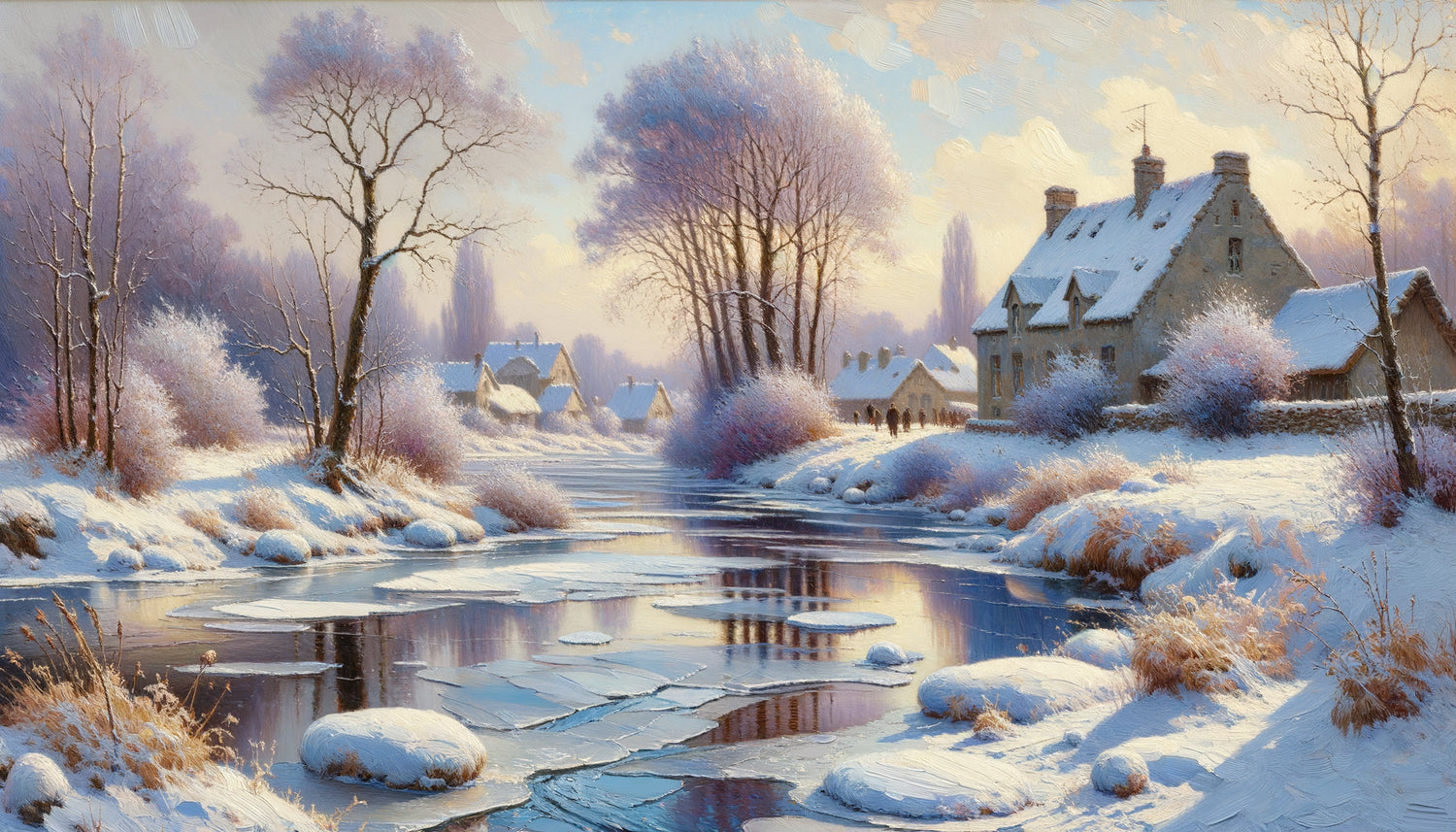
Imagine a winter morning where frost transforms every branch into crystal, where the Seine reflects a changing sky like a living mirror. It was in these fleeting moments that Alfred Sisley found his true artistic signature. Unlike his Impressionist contemporaries who explored Parisian crowds or ballerinas, this Franco-British painter obsessively devoted himself to the reflective surfaces of water and snowy expanses.
Here's what this fascination reveals: a quest for pure light in all its metamorphoses, the ability to capture the elusive, and a technical mastery that transforms natural elements into veritable color laboratories. You might wonder why this artist consistently chose these seemingly simple subjects, when so many other motifs were available to him? The answer overturns our understanding of Impressionism and offers a timeless lesson on perception. Let's discover together how Sisley made water and snow his accomplices to reveal the very essence of light, and why this approach still resonates today in our contemporary interiors seeking authenticity.
Water: The ever-changing mirror of all atmospheres
For Sisley, water was not just a landscape element, but a character in its own right. Observe his paintings depicting the Seine at Marly-le-Roi or the canals of Moret-sur-Loing: the liquid surface becomes the scene of a permanent dialogue between sky and earth. This obsession stems from a fascinating physical particularity: water has the unique ability to reflect, refract, and absorb light simultaneously.
Unlike Monet who multiplied series on the same subject, Sisley constantly changed locations but retained this aquatic constant. Why? Because water offered him an infinite chromatic palette. The same river could display silvery hues at dawn, turquoise in the middle of the day, then turn to deep purples at dusk. This variability perfectly corresponded to the Impressionist ambition: to seize the moment, to capture the passage of time in a single fixed image.
The frequently painted flooded banks added an extra dimension. These winter floods created vast reflective surfaces, multiplying light effects. Water then invaded the pictorial space, transforming the landscape into a symphony of reflections where trees, houses and clouds doubled in an aquatic dance. This visual repetition created a hypnotic depth, an invitation to contemplation that few other subjects allowed with such intensity.
Snow as a chromatic revealer
If water fascinated Sisley through its reflections, snow obsessed him for the opposite reason: its ability to reveal the hidden colors of light. Contrary to popular belief that snow is white, Sisley demonstrated painting after painting that it contains all the shades of the solar spectrum.
In his winter scenes of Louveciennes or Port-Marly, the snowy expanses are adorned with deep blues in the shadows, delicate pinks at dusk, and subtle ochres where vegetation breaks through. This revolutionary approach broke away from academic codes that prescribed using pure white to represent snow. Sisley intuitively understood what physics would later confirm: snow acts as a natural prism, decomposing light into its colored components.
Winter also offered the artist a simplified landscape structure. The bare trees created graphic architectures, and the snowy fields formed purified surfaces where every variation in light became perceptible. This compositional austerity allowed Sisley to focus all his attention on his true subject: not the landscape itself, but how light transforms it.
The technical dimensions of this obsession
Sisley's focus on water and snow reveals a remarkable technical sophistication. These surfaces required a particular touch, an application of paint that differed radically from that used for foliage or architecture. To render the fluidity of water, he developed horizontal and elongated brushstrokes, creating a sensation of continuous movement.
For snow, his technique evolved according to the thickness of the layer: generous impastos suggested fresh, thick snow, while translucent glazes evoked melting or frost. This diversity of approaches in a single painting created a tactile richness that invites the eye to travel across the canvas, constantly discovering new subtleties.

A philosophy of the ephemeral and transformation
Beyond technical considerations, Sisley's concentration on these elements reveals a profound philosophical vision. Water and snow share a fundamental characteristic: their transient nature. Water flows, changes state, reflects ever-changing skies. Snow melts, transforms, disappears with the seasons.
This impermanence corresponded to the very essence of Impressionism: capturing the present moment in all its fleetingness. Sisley did not seek to paint eternal and majestic landscapes as the Romantics before him had done. He wanted to fix the instant when a certain quality of light meets a sensitive surface, creating a unique combination that will never be exactly reproduced again.
His flood scenes then take on a particular dimension. These temporary events created landscapes par excellence: gardens transformed into lakes, roads turned into rivers, impossible reflections in usually dry places. Sisley thus immortalized visions destined to disappear within days, fascinating topographical aberrations.
The influence of his temperament and situation
Sisley's biography also sheds light on his thematic choices. Unlike Renoir who loved human warmth and bodies, or Degas fascinated by urban movement, Sisley was of a reserved and contemplative nature. Deserted or sparsely populated landscapes corresponded to his introspective personality.
His precarious financial situation also anchored him in specific locations around Paris: Louveciennes, Marly-le-Roi, Moret-sur-Loing. These towns crossed by the Seine and its tributaries offered him an infinity of variations on the aquatic theme without requiring expensive travel. Geographical constraint thus became a creative wealth, forcing him to deepen his understanding of a few places rather than fluttering superficially.
The harsh winters in this Île-de-France region, particularly during the 1870s and 1880s, also provided him with numerous opportunities to explore snowy landscapes. Where other artists awaited the return of fine weather, Sisley seized his brushes at the first snowfall, fascinated by this radical transformation of the familiar landscape.
The lesson for our contemporary interiors
This focus by Sisley on the effects of light finds a powerful echo in our living spaces today. At a time when decoration favors authenticity and connection with nature, his works offer much more than just an aesthetic dimension. They remind us of the importance of attentive observation of variations in light in our own habitats.
Integrating a reproduction by Sisley into an interior is inviting this particular sensitivity: the awareness that natural light constantly transforms our spaces, that reflective surfaces create depth and dynamism, that cool and soft tones can soothe and balance a room. His color palettes, oscillating between silvery blues and subtle pinks, harmonize perfectly with contemporary decorative codes favoring natural and soothing colors.
Let impressionistic light illuminate your daily life
Discover our exclusive collection of nature paintings that captures the same sensitivity to light play and fleeting beauties that Sisley celebrated in each of his canvases.

When specialization becomes an artistic signature
In the flourishing impressionistic world, where each artist sought their way, Sisley made a bold choice: to restrict himself in order to delve deeper. This exclusive focus on landscapes with water and snow was not a limitation, but a liberation. By reducing his thematic variables, he could infinitely explore the nuances of his subject.
This approach evokes the great specialized masters of art history: Turner's seascapes, Constable's skies, Monet's haystacks. But where these artists sometimes alternated with other themes, Sisley maintained an almost absolute fidelity to his aquatic and winter vision. His catalog of works resembles a prolonged meditation on the same questions: how to translate transparency? How to make cold visible? How to convey the humidity of the air?
This consistency also created an immediately recognizable visual identity. Faced with a Sisley, the viewer knows what awaits them: a serene communion with nature, a soft and changing light, a contemplative atmosphere. This apparent predictability hides an infinite variety in the details, like a series of musical variations on the same theme.
The legacy of a luminous obsession
Today, when we contemplate a Sisley landscape, we do not just see a scene from the 19th century. We experience an innovative way of perceiving our environment. He teaches us to look beyond forms to see lights, to appreciate reflective surfaces as paintings within a painting, to recognize in snow not an absence of color but an explosion of subtle nuances.
His influence extends far beyond the circle of art historians. Contemporary photographers, interior designers, and colorists unconsciously draw inspiration from his lessons when playing with reflections in shiny materials or exploring cool, bright tones in their creations. This fascination with water and snow has opened up an aesthetic path that we continue to follow.
Ultimately, Sisley reminds us of a fundamental truth: beauty does not necessarily lie in the diversity of subjects, but in the depth of the gaze upon them. By choosing to dedicate his artistic life to these particular effects of light, he created a body of work of rare coherence and poetry. His shimmering rivers and snowy landscapes continue to invite us to slow down, observe, and appreciate the subtle transformations that light works on the world around us. A lesson in contemplation that our accelerated lives need more than ever.
Frequently Asked Questions
Did Sisley only paint landscapes with water and snow?
Sisley did indeed focus massively on these themes, but he also painted spring and summer scenes. However, even in those paintings, water was often present in the form of rivers, canals, or reflections after rain. His reputation as an artist of water and snow comes from the overwhelming proportion of these subjects in his work and the exceptional quality he achieved in treating them. It's a bit like a chef known for their specialty: they know how to cook other things, but it is in their preferred field that they truly excel. This focus created a unique visual signature that makes his works immediately recognizable and particularly sought after by Impressionism enthusiasts.
How can the spirit of Sisley be integrated into a modern decor?
The spirit of Sisley integrates wonderfully into contemporary interiors through several approaches. First, prioritize fresh and soothing color palettes: muted blues, watery greens, pale pinks, nuanced whites. These tones create a serene atmosphere inspired by his winter landscapes. Next, play with reflective surfaces: mirrors, brushed metals, satin textiles that capture and diffuse light like water in his paintings. Finally, pay particular attention to natural lighting in your rooms, choosing sheer curtains that gently filter the light rather than block it out. A well-chosen reproduction of a Sisley landscape, positioned where natural light can illuminate it, becomes a focal point that animates the space throughout the day.
Why are Sisley's works soothing in an interior?
Sisley's paintings possess a scientifically explainable calming effect. His palettes dominated by cool tones (blues, greens, purples) are recognized in color psychology to reduce anxiety and promote relaxation. The horizontal compositions he favored, with their lines of rivers and horizons, create a feeling of stability and balance. Furthermore, the absence of prominent human figures in his landscapes avoids the social stimulation that portraits or crowd scenes provoke. Finally, the water and snow surfaces he depicted unconsciously evoke purity, renewal, and fluidity, mentally soothing concepts. Hanging a Sisley in a rest or work space is inviting this visual tranquility which helps concentration and relaxation, just like an open window on a soothing natural landscape.