I spent fifteen years restoring oriental miniatures in the vaults of the Metropolitan Museum, and I still remember the day I held a 16th-century Hamzanama in my hands. Under magnification, I discovered what would change my perception of Mughal art: an impossible palm tree, a fantastical banana tree, painted with the meticulous precision of Persian gardens, but bearing within them the palpitating soul of India. This fusion represents one of the most sophisticated artistic syntheses in history.
Here's what this adaptation of Persian conventions to the Indian context reveals: a methodology of cultural transformation, extraordinary visual hybridization techniques, and timeless lessons on how to reinvent a heritage without betraying it. These principles inspire today interior designers, decorators and creators who seek to fuse traditions and modernity in their spaces.
Many admire Mughal miniatures in museums without understanding the creative process that underlies them. How did artists trained in Persian canons manage to capture the essence of the Indian subcontinent? What alchemy made this stylistic metamorphosis possible without a brutal break? This transformation did not happen overnight, but through a patient dialogue between two visual worlds.
The good news? By studying this masterful adaptation, we discover universal strategies for cultural fusion. The Mughal court artists did not simply copy or reject: they created an entirely new visual language, a third aesthetic space that transcends its origins.
The Persian heritage: the foundation of a revolution
When Babur founded the Mughal empire in 1526, he brought with him the Safavid pictorial tradition which then dominated the Persian world. This school was characterized by strictly codified visual conventions: stylized landscapes with their cloud-shaped rocks, trees with idealized proportions, golden skies, and compositions in superimposed planes without atmospheric perspective.
Humayun, Babur's son, reinforced this influence by bringing back from his Persian exile the masters Mir Sayyid Ali and Abd al-Samad. These artists brought with them the visual vocabulary of the Tabriz royal workshop: the delicate palette dominated by lapis lazuli and golds, paradisiacal gardens with geometric architectures, slender figures with codified gestures.
In my years of restoration, I have been able to directly compare Persian and early Mughal manuscripts. The lineage is evident in the earliest works of the Hamzanama: same graphic treatment of space, same stylization of plants, same narrative organization. Yet, from these very first pages, subtle clues announce the transformation to come.
Meeting reality: India as a catalyst
The Indian landscape confronted Mughal court artists with a radically different reality. How to represent the lush jungles of Bengal with the refined vocabulary of Persian gardens? How to capture the palpable humidity of the monsoon in a tradition that privileged abstract and golden skies?
Akbar, a visionary emperor who reigned from 1556 to 1605, encouraged a revolutionary approach: direct observation of nature. Royal workshops began incorporating Hindu artists, trained in other visual traditions. This hybridization of creative teams becomes the engine for stylistic adaptation.
The Mughal court artists then develop a fascinating methodology: maintaining the Persian compositional structure while gradually modifying naturalistic details. Stylized rocks remain, but take on the eroded forms of the Deccan. Trees retain their decorative function, but become identifiable: banyans with aerial roots, mango trees with characteristic foliage, imposing tamarind trees.
The emergence of an Indian palette
I analyzed dozens of pigments from Mughal miniatures using a spectrometer. The chromatic transformation is striking: Persian blues are gradually joined by the deep greens of the tropical jungle, the red ochres of the lateritic soil, the warm browns of the bark of ancient trees. Even the sky loses its golden abstraction to adopt the complex nuances of the Indian climate: monsoon grays, intense blue of the dry season, crepuscular pinks.

Visual hybridization strategies
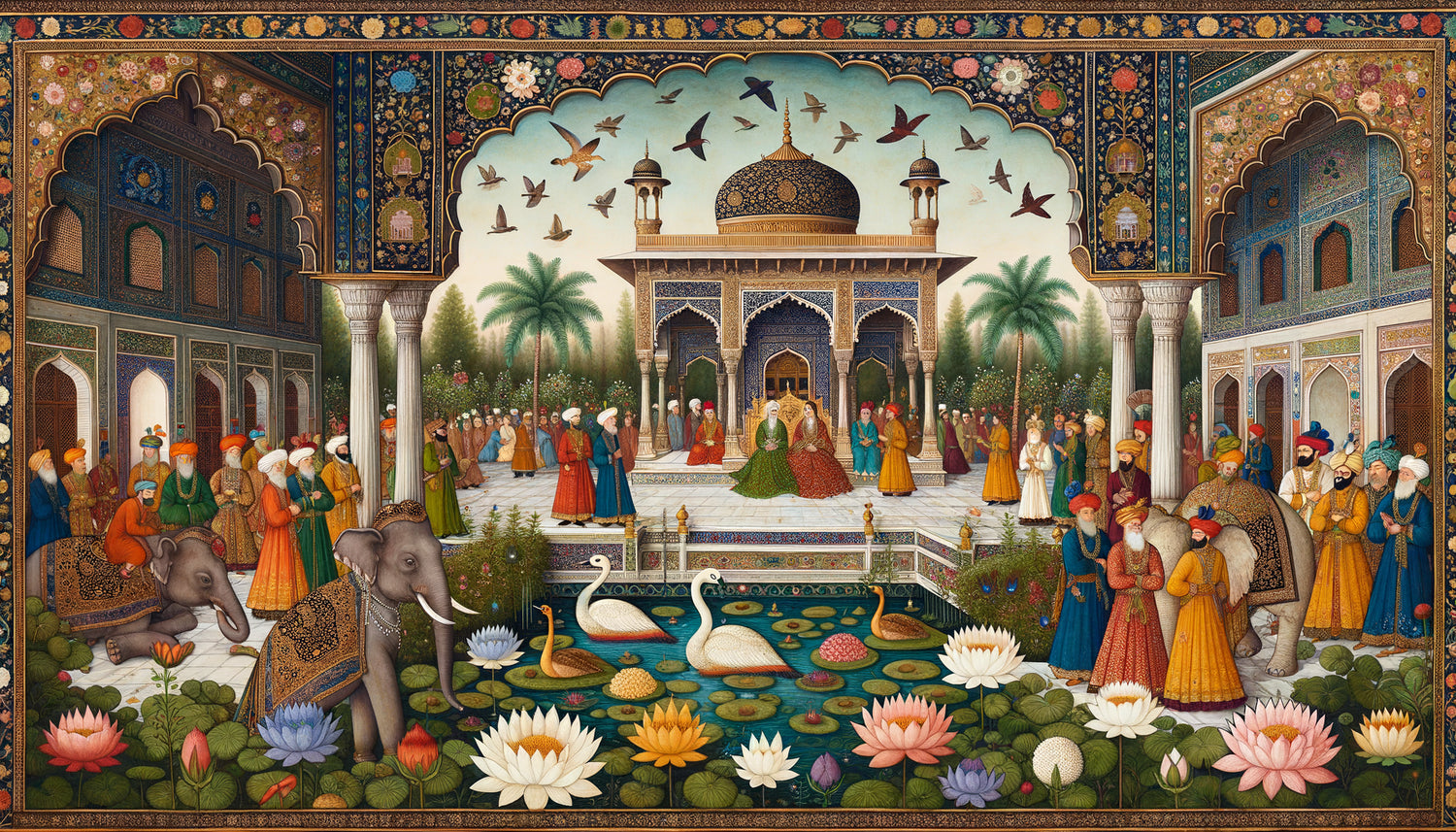
The Mughal court artists developed several sophisticated techniques to adapt Persian conventions to the Indian context. The first consists of a progressive indianization of architectural elements. Persian octagonal pavilions integrate Rajput chhatris, geometric gardens incorporate lotus-shaped ponds, decorative motifs fuse Arabic calligraphy and Indian floral patterns.
The second strategy concerns the representation of fauna. Fantastic Persian animals now coexist with species observed with remarkable scientific accuracy: Asian elephants with exact proportions, Bengal tigers, peacocks with detailed plumage, langur monkeys. This coexistence of the mythical and the naturalistic creates an extraordinarily rich visual tension.
Under Jahangir, emperor from 1605 to 1627 and a passionate naturalist, this trend intensifies. Mughal court artists are tasked with documenting imperial biodiversity. Royal workshops produce animal portraits of astonishing accuracy, while maintaining Persian aesthetic codes in the overall composition.
The revolution of atmospheric perspective
The most spectacular innovation lies in the gradual introduction of spatial depth. The Mughal court artists slowly abandon superimposed planes from Persian tradition to experiment with an atmospheric perspective inspired by both ancient Indian traditions and European influences arriving via Jesuit missions.
Distant landscapes are tinted with hazy blues. Foreground elements gain textural precision. The horizon becomes legible. This transformation represents a major departure from Persian conventions, while preserving the decorative organization of the page that characterizes the tradition of illuminated books.
The imperial workshop: laboratory of cultural fusion
Akbar's karkhana (imperial workshop) functioned as a true laboratory for artistic experimentation. More than a hundred artists worked there simultaneously, led by Persian masters but including a growing majority of Hindu painters. This diversity created an environment conducive to innovation.
The manuscripts produced reveal a fascinating system of collaboration: a Persian master established the overall composition according to traditional conventions, an Indian artist executed the landscapes with local naturalistic details, a third specialist painted the portraits, a fourth the textiles and decorative motifs. This division of labor enabled organic hybridization of styles.
Through stylistic analysis of hundreds of miniatures, I was able to identify distinct artistic personalities within this workshop. Some Mughal court artists, such as Basawan or Daswanth, develop extraordinarily bold personal styles, pushing the adaptation of Persian conventions towards a visual modernity that anticipates certain European developments.

When the Persian garden becomes an Indian jungle
The transformation of the garden is perhaps the most eloquent symbol of this adaptation. The Persian chahar bagh, with its paradisiacal geometry and orthogonal canals, transforms under the brush of Mughal court artists into spaces that retain this structure while overflowing with a typically Indian vegetal exuberance.
Tall Persian cypresses now share space with massive banyans. Geometric flowerbeds explode in profuse, identifiable botanicals. Ordered fountains coexist with lotus ponds. This fusion creates a new concept of garden, neither purely Persian nor entirely Indian, but authentically Mughal.
Paintings of gardens under Shah Jahan illustrate the culmination of this process: white marble architectures inlaid with precious stones (Persian convention of material luxury) set within lush landscapes where each plant is botanically identifiable (Indian naturalistic observation), all organized according to a new spatial perspective (Mughal innovation).
The revolutionary treatment of light
Mughal court artists develop a novel sensitivity to the effects of light. The grazing twilight on red sandstone walls, the backlight filtered by marble jaalis, the dense shadows under tropical trees: all these effects are observed in the real Indian landscape and transposed with virtuosity within the framework of Persian conventions.
This attention to light transforms the color palette and introduces atmospheric subtleties totally absent from the Persian tradition. Late Mughal miniatures possess a luminous quality almost impressionistic, while maintaining the linear precision and decorative frontality inherited from Persia.
Be inspired by this millennial fusion of cultures
Discover our exclusive collection of nature paintings that captures the spirit of harmony between tradition and innovation, to transform your interior into a space of refined contemplation.
The contemporary legacy of a successful adaptation
This artistic metamorphosis of Mughal court artists offers valuable lessons for our time. It demonstrates that a successful cultural adaptation does not mean rejecting heritage nor simply copying the new, but creating an original synthesis that honors both sources.
In my restoration work, I regularly observe how contemporary designers are inspired by this Mughal methodology: preserving the fundamental structures of a style while enriching it with new contextual details, maintaining overall visual consistency while accepting the hybridization of elements, balancing standardization and personalization.
The artists of the Mughal court also teach us the value of long time. This transformation did not occur in a few years but over several generations, allowing for organic maturation rather than a brutal rupture. The earliest miniatures of Akbar show gropings, awkwardness in the fusion; those of Shah Jahan reach perfect harmony where one no longer distinguishes the seams between Persian and Indian.
Imagine your interior transformed by this philosophy of subtle hybridization. Traditional elements that dialogue with contemporary touches. Noble materials that meet natural textures. A classic spatial organization that welcomes a personal decorative exuberance. Start with a single space, a single room, and let this alchemy operate gradually, like these Mughal artists who changed the history of art one brushstroke at a time.