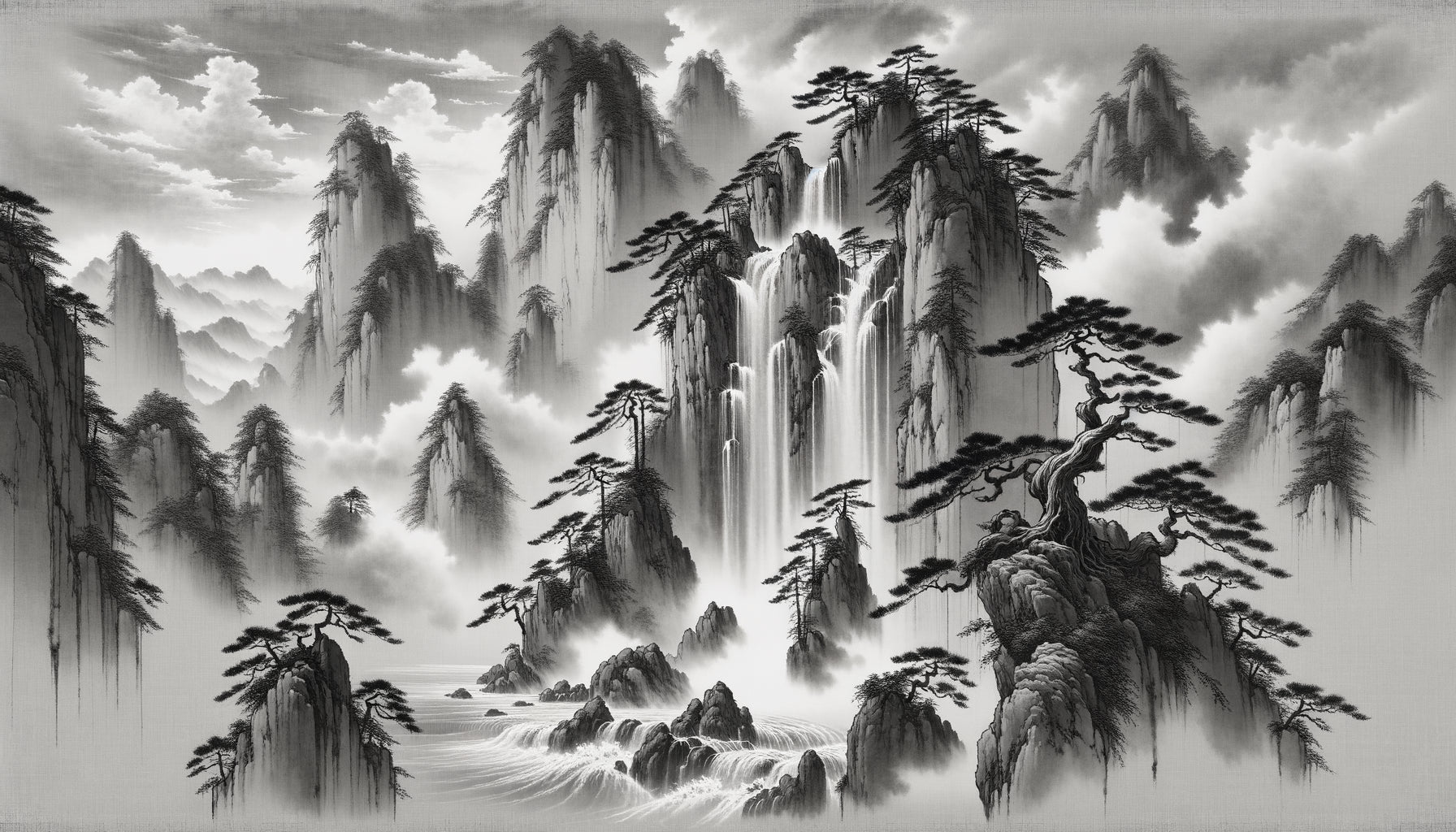
Imagine a misty mountain landscape where each brushstroke tells a story of freedom. In my Parisian workshop, between restoring antique scrolls, I often contemplate this magic: these calligraphic lines that traverse silk like poetic lightning bolts, transforming a simple natural scene into a spiritual manifesto. The Yuan painters invented something extraordinary in the 13th century: a fusion where writing dances with landscape.
Here's what this millennial technique brings: a visual dynamism that guides the eye through the composition, a spiritual dimension where each stroke carries the vital energy of the painter, and an astonishing modernity that still influences our contemporary spaces today.
You may admire these Asian prints without understanding why they capture your gaze with such intensity. This invisible force that attracts you? It is precisely this alchemy between calligraphy and landscape that the Yuan masters perfected seven centuries ago.
Good news: understanding these principles will completely transform your perception of wall art and interior decoration. These artists created a visual language that speaks directly to our contemporary need for movement and authenticity.
I'm taking you into the workshops of the four great Yuan masters, where brush and spirit were one, to discover how their innovations still resonate in our modern interiors.
The Mongolian heritage that changed everything
When the Yuan dynasty settles in 1271, Chinese scholars lose their official positions. Imagine these scholars, trained from childhood in calligraphy, suddenly deprived of their social function. Zhao Mengfu, the first to understand the opportunity, retires to his property on the shores of Tai Lake. In this refuge, he develops a revolutionary theory: calligraphy and painting share the same root.
I was able to examine several of his scrolls closely at the Guimet Museum. What immediately strikes you is this fluidity. Zhao Mengfu paints his bamboo with exactly the same gestures as when he traces characters in cursive style. The line starts from the wrist, rises in energy, explodes in an upward movement then falls like a wave. This technique creates a visual rhythm that propels the gaze throughout the composition.
Yuan painters specifically used cursive writing – caoshu – because it embodies pure movement. Unlike regular and fixed styles, cursive allows for overflows, variations in pressure, sudden accelerations. This is exactly what the landscape needed to escape the academicism of the Song.
The liberating gesture of the brush
In my own restoration work, I discovered that Yuan painters loaded their brushes differently depending on whether they were painting rocks or trees. For rocky formations, they used the technique of piqian – those dry, broken strokes that resemble cursive characters traced at maximum speed. The barely damp brush almost scratches the silk, creating these vibrant textures that suggest millennia of erosion.
Huang Gongwang, the absolute master of the Yuan period, spent months in the Fuchun Mountains with his brush and ink. His masterpiece, the Scroll of the Fuchun Mountains, shows how cursive calligraphy can literally energize a landscape. The mountain ridges follow the same flow as rapid writing strokes – abrupt ascents, dizzying descents, meditative pauses.
When ink becomes movement
The technical revolution of Yuan painters lies in their management of ink. They abandon the dense washes of the Song for working in superimposed transparent layers. Wu Zhen, a hermit who refused any compromise with Mongol power, develops a fascinating technique: he first traces his composition with extremely rapid calligraphic strokes, then returns to add touches of denser ink.
This approach creates a temporal depth. One literally sees the gesture of the painter, his hesitation, his acceleration. It's as if the time of creation remained inscribed in the work. In a contemporary interior, this quality is valuable – it brings a living dimension that no mechanical print can reproduce.
Ni Zan, the most minimalist of the four Yuan masters, pushes this logic to the extreme. His landscapes are almost empty – a few strokes to suggest distant trees, a horizontal band for the shoreline. But each stroke carries the intensity of a calligraphic character. He said: 'I only paint to express the inexpressible of my heart.' This emotional authenticity transcends centuries.
The diagonal composition inherited from writing
One discovery particularly marked me at an exhibition in Shanghai: Yuan painters organize their landscapes according to the same dynamic diagonals as cursive calligraphy. In rapid Chinese writing, characters naturally incline to the right, creating a visual tension that pushes the eye forward.
Wang Meng, grandson of Zhao Mengfu, applies this principle with genius. His dense forests and twisted mountains follow multiple diagonal axes that create a swirling effect. The gaze can never settle – it is constantly relaunched from one focal point to another, exactly as when reading cursive calligraphy where the characters seem to dance.

Active void, the secret of energy
Westerners often interpret emptiness in Asian painting as decorative minimalism. A fundamental mistake! For Yuan painters trained in calligraphy, emptiness is charged with potential energy. It's the space where the brush could go, where the gesture prepares or falls.
In cursive calligraphy, the whites between the characters are as important as the ink itself. They create the rhythm, the breathing of the text. Yuan masters transpose this understanding into their landscapes. Areas of mist, empty spaces between mountains are not absences – they are moments of suspension that accentuate the strength of inked strokes.
I tested this principle in my own decorative practice. A painting with a lot of emptiness and a few expressive strokes creates a much stronger presence in a modern space than a saturated image. Emptiness attracts the eye, invites contemplation, allows the surrounding architecture to breathe.
Tonal variations like musical notes
Yuan painters spoke of five ink tones – from deep black to almost imperceptible gray. This scale corresponds exactly to the variations in pressure in cursive calligraphy. A stroke begins light, swells in its center, then thins until it disappears.
Huang Gongwang mastered this technique perfectly. In his mountains, you can follow every movement of the brush: the frank attack on the rocky edge, the increasing pressure in the descent, the progressive lightening towards the misty valley. This tonal variation creates a dynamism that uniform washes can never achieve.
From ancient silk to contemporary walls
You are probably wondering how these techniques, centuries old, can influence your modern interior. Let me show you the fascinating bridges I have discovered while working with contemporary decorators.
First, this quality of captured movement. In a clean space with straight lines, a work inspired by Yuan principles brings exactly what is needed of organic energy. Calligraphic strokes naturally guide the eye, creating visual flows that animate the space without cluttering it.
Next, the authenticity of the gesture. In the age of digital reproduction, we intuitively feel the difference with a stroke made by a human hand. The Yuan painters taught us that each brushstroke carries a spiritual intention. This quality translates today into a presence difficult to define but immediately perceptible.
Finally, the relationship to emptiness. Contemporary Scandinavian and minimalist interiors share with the Yuan aesthetic this understanding that empty space is not lost void. It's a spatial luxury that allows the present elements to radiate fully.
Choosing a work according to the Yuan principles
When I accompany clients in choosing wall art, I systematically apply three criteria inherited from the Yuan masters. First: is there directional movement? The gaze must be guided, not dispersed. Secondly: do tonal variations create depth or simply contrast? Thirdly: is the void active or simply absent?
These questions completely transform the selection. We move from a purely decorative choice to a real conversation between the work and the space. A landscape treated with sensitive calligraphy naturally dialogues with architecture, creates visual echoes, amplifies the feeling of space.
Transform your interior with the energy of the Yuan masters
Discover our exclusive collection of nature paintings that capture this organic movement and spiritual presence inherited from the Chinese landscape tradition.

The living legacy of an artistic revolution
Every time I contemplate a true Yuan masterpiece, I feel this obviousness: these artists did not simply develop a style, they revolutionized our relationship to the visible. By merging cursive calligraphy and landscape, they proved that a painting could be simultaneously image and writing, representation and abstraction, silence and movement.
This lesson resonates powerfully in our image-saturated era. The Yuan painters remind us that a wall mural is not a decorative poster but a spiritual companion that evolves with our gaze, breathes with our space, and carries within it the living gesture of its creation.
Start simply: observe how your eye moves through the images around you. Look for these flows, diagonals, moments of suspension. You will see that the most powerful compositions – whether ancient or contemporary – always follow these principles of calligraphic dynamism discovered by the Yuan masters seven centuries ago.
Frequently Asked Questions about Calligraphy in Landscape Painting
Why was the Yuan dynasty so important for the evolution of landscape painting?
The Yuan period (1271-1368) created a unique context where Chinese scholars, excluded from official functions by the Mongol rulers, took refuge in artistic practice as an expression of cultural resistance. This marginalization paradoxically freed their creativity. The four great masters of the Yuan dynasty – Huang Gongwang, Wu Zhen, Ni Zan and Wang Meng – developed a personal and expressive style in conscious opposition to the Song academicism. They asserted that painting should express the spirit of the painter rather than simply represent nature. This subjective approach, nourished by their mastery of cursive calligraphy, transformed the landscape into a true spiritual manifesto and laid the foundations for all subsequent Chinese literati painting.
How can one recognize the influence of cursive calligraphy in a Yuan landscape?
Several visual clues betray this calligraphic influence. First, observe the quality of the stroke: it must present visible variations in pressure, going from thin to thick in a single fluid gesture, exactly as in rapid cursive writing. Then, look at the overall composition: it often follows dynamic diagonals rather than stable horizontals, creating a visual tension that guides the eye through the work. The textures of rocks and trees frequently use short, nervous strokes called 'cun' which resemble abbreviated characters. Finally, the relationship to emptiness is essential: in an authentic Yuan landscape, the unpainted areas are not simply background but active spaces that rhythm the composition, like the whites between calligraphic characters. This combination creates a work where the movement of the brush remains palpable.
Can these principles be integrated into a contemporary interior decoration?
Absolutely, and it’s particularly relevant for modern interiors! The Yuan principles naturally harmonize with contemporary minimalist aesthetics: strategic use of void, clean yet expressive lines, suggested movement rather than explicit. To integrate this approach, prioritize artworks that show traces of authentic gestures rather than perfect photographic reproductions. Choose asymmetrical compositions with plenty of negative space – this active void creates a valuable visual breathing room in our often overloaded spaces. Monochrome or near-monochrome hues typical of Yuan ink painting easily blend into modern neutral palettes while bringing depth and texture. The key is to seek pieces that carry intention, a captured movement, that quality of gestural authenticity perfected by the Yuan masters in fusing calligraphy and landscape.