I felt that shiver for the first time standing before a canvas by Peder Balke at the Nasjonalmuseet in Oslo. A Norwegian bog, drowned in mist, where the sky and water blend into a palette of tormented grays. These Nordic wetlands, long considered desolate lands, have inspired the greatest Scandinavian artists to create works of striking emotional power. Why do these enigmatic landscapes fascinate contemporary creators seeking authenticity for their interiors? Here's what bogs and mires in Nordic art bring: a deep connection with the wilderness, a minimalist aesthetic imbued with mystery, and an invitation to meditative contemplation. You may be looking to incorporate this Nordic atmosphere into your space, but you don’t know how these representations of wetlands can harmonize with a modern interior. Rest assured: these works possess an astonishing versatility that transcends decorative styles. In this article, you will discover how Nordic artists have transformed these melancholic landscapes into timeless masterpieces, and how this aesthetic can metamorphose your everyday life.
The misty soul of Nordic landscapes
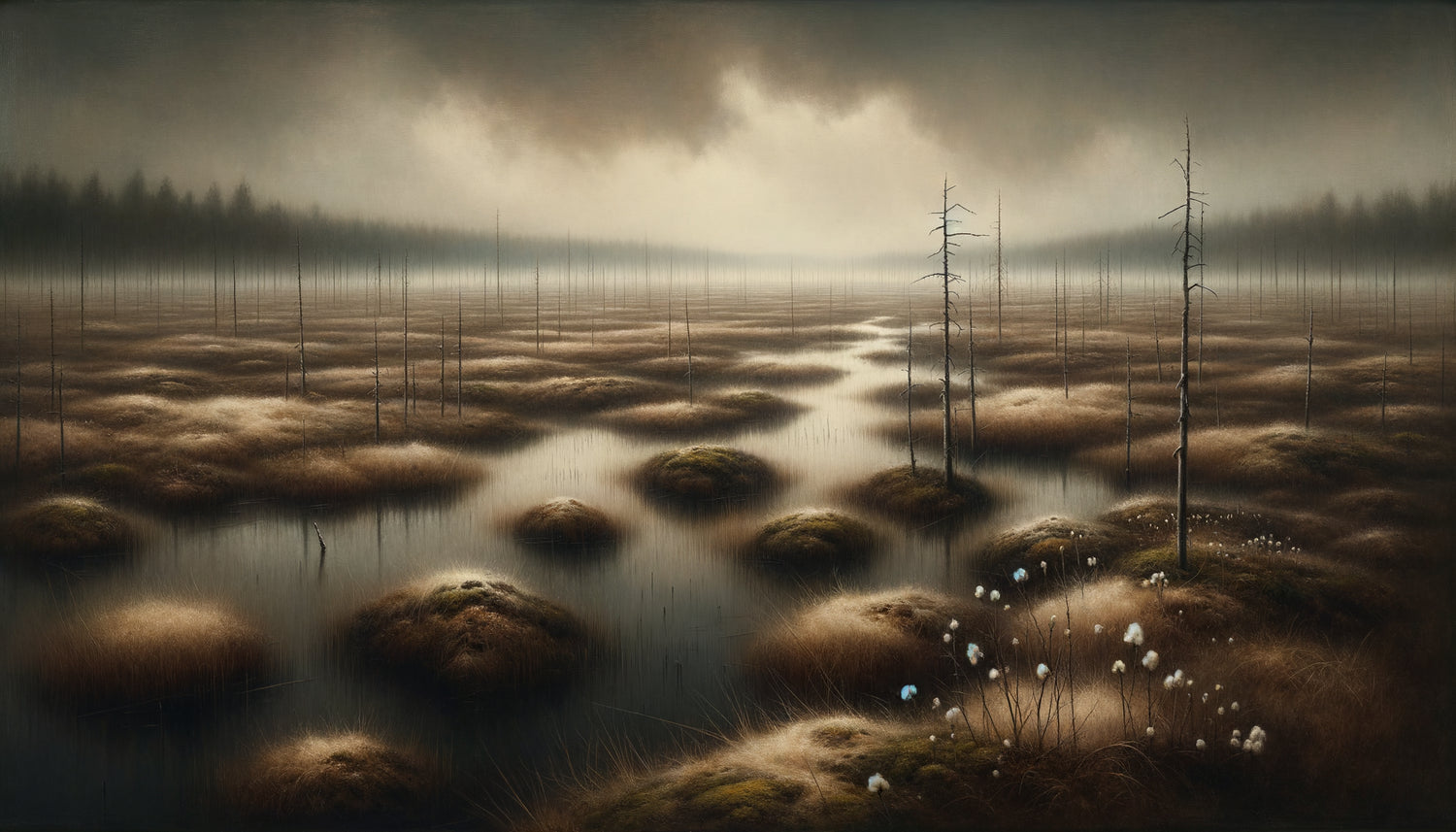
Nordic bogs carry within them an ancestral mythological dimension. In the Scandinavian countries, these mires were considered places of passage between the world of the living and that of spirits. Artists of the 19th century, particularly those of Norwegian and Finnish national romanticism, captured this atmosphere charged with mystery. Peder Balke, a little-known precursor to expressionism, painted these wetlands with astonishing economy: a few brushstrokes were enough to evoke the tormented immensity of a bog battered by winds.
I have studied for years how these mire landscapes differ from their European counterparts. Where the Dutch depicted domesticated marshes, Nordic artists favored raw wilderness. Akseli Gallen-Kallela, Finnish master, immortalized the mires of Karelia with a dramatic intensity that foreshadows modern art. His works exude this particular quality: inhabited silence, solitude populated by invisible presences.
The color palette of wetlands
The color of Nordic bogs in art has a unique signature. Observe the tones: slate gray, burnt ochre, deep moss green, peat brown. These organic hues are now found in the most sought-after Scandinavian interiors. The mires under the leaden sky offer infinite nuances that painters have managed to capture with remarkable sensitivity. Lars Hertervig, Norwegian artist whose work on coastal bogs remains fascinating, used dark underlayers to create this characteristic cold luminosity.
When minimalism meets the mire
Contemporary Nordic art has reinterpreted these wetland landscapes with a stunning minimalist approach. Finnish photographers like Pentti Sammallahti captured the essence of marshes in black and white, revealing geometric compositions of unexpected purity. These images of peat bogs transform into meditative abstractions where horizons, reflections, and plant textures converse in perfect balance.
In galleries from Helsinki to Stockholm, I noticed how current creators use marshes as a preferred motif. This trend corresponds to a search for authenticity, a need to reconnect with preserved territories. Immersive installations reproducing the atmosphere of Nordic peat bogs are experiencing resounding success among collectors. Icelandic artist Brynhildur Þorgeirsdóttir creates textile pieces inspired by peat bog mosses, translating the spongy texture of these wetlands into unsettling tactile works.
Organic materials in bog art
Some Scandinavian artists directly integrate the material of peat bogs into their creations. Peat, a millennial material, becomes pigment or support. This radical approach transforms the marsh itself into an artistic medium. The works then emit a subtle scent, a physical presence that directly evokes these mysterious wetlands. A total sensory dimension that I have rarely encountered elsewhere.

The architecture of reflections and horizons
The composition of Nordic peat bogs in painting follows fascinating architectural principles. Horizontality dominates: lines that stretch to infinity, creating a sense of space and breath. In my curatorial work, I have noticed that these marsh landscapes work particularly well in contemporary spaces with generous volumes. They bring this contemplative depth without visually saturating.
The artists of the Swedish Nationale Romantik movement developed a unique approach to wetlands. Prince Eugen, himself an accomplished painter, depicted the marshes of Lake Mälaren with exceptional chromatic sensitivity. His twilight blues and emerald greens capture that magical hour when peat bogs seem to glow from within. These works create in an interior a window onto a soothing elsewhere.
Bringing the Spirit of Peat Bogs into Your Home
How can you transpose this aesthetic of Nordic marshes into your decor? The key lies in understanding their essence: simplicity, authenticity, telluric connection. A large-format photographic reproduction of a peat bog in Finland transforms a minimalist living room into a sanctuary of serenity. The neutral tones of these wetlands naturally harmonize with raw materials such as linen, driftwood, or stone.
I have accompanied several collectors in acquiring works representing Scandinavian marshes. The effect is always striking: these pieces become meditative anchors. In a bedroom, a triptych of peat bogs under different lights invites deep rest. In an office, a watercolor of misty marshes promotes creative concentration. The art of Nordic wetlands possesses this rare ability to slow down time.
Creating a Themed Gallery of Wet Landscapes
For enthusiasts wishing to develop a coherent collection, marshes and peat bogs offer a powerful guiding thread. Mix the eras: a Norwegian romantic engraving of a peat bog dialogues beautifully with a contemporary photograph of an Icelandic wetland. This approach creates a visual narrative that transcends time while maintaining aesthetic unity. Marsh landscapes also lend themselves to series hangings, evoking the passage of seasons or hours of the day.

The Contemporary Renaissance of Wetlands
We are currently witnessing a renewed interest in these long-neglected territories. Bogs are recognized for their crucial ecological role, and this awareness is reflected in current Nordic art. Activist artists use marshes as a symbol of environmental resilience. Their works, halfway between documentation and poetry, question our relationship with wetlands while celebrating their enigmatic beauty.
The Danish painter Per Kirkeby devoted a major series to the bogs of Jutland, combining geological abstraction and landscape memory. His powerful compositions evoke the temporal strata accumulated in these millennial marshes. Each layer of color corresponds to an era, transforming the canvas into an emotional stratigraphic section. This conceptual depth makes Nordic bog art much more than a simple landscape representation.
Let the magic of Nordic landscapes into your home
Discover our exclusive collection of nature paintings that captures the contemplative essence of wetlands and transforms your space into a Nordic haven of serenity.
Your sanctuary inspired by the mists of the North
Imagine yourself every morning facing a visual window onto a Norwegian marsh steeped in the golden mist of dawn. Your space breathes differently, the rhythm slows down, and a connection is established with these wild territories that Nordic artists have known how to magnify. Bogs in art are not just landscapes: they are portals to deep contemplation, invitations to embrace the melancholic beauty of raw nature.
Start simply: choose a work that resonates with your sensitivity. Perhaps a photograph of a Finnish bog with silvery reflections, or a watercolor of a Danish marsh under a stormy sky. Let this presence of Nordic wetlands permeate your daily life, create this silent dialogue between your interior and these ancestral landscapes. Scandinavian marsh art offers you much more than decoration: it is a philosophy of life, a breath, an anchor.
Frequently Asked Questions
Why do Nordic marshes inspire so many Scandinavian artists?
Marshes and peatlands occupy a central place in the Nordic imagination for centuries. These wetlands represent liminal spaces, at the border between land and water, life and mystery. For Scandinavian artists, they embody the very essence of their territory: wild, preserved, melancholic. The particular light of the North, grazing and changing, transforms these peat bogs into natural theaters where atmospheric dramas are played out. Moreover, these marshes are conservatories of memory: they preserve pollen, bodies, objects intact for millennia. This temporal dimension fascinates creators who see in it a metaphor for persistence and transformation. Nordic art finds in these humid landscapes a unique visual vocabulary: horizontality, restricted palette, inhabited silence. It is also an act of recognition towards ecosystems long scorned, now recognized as essential to climate balance.
How to integrate a work representing peatlands into a modern interior?
Works representing Nordic marshes and peatlands blend remarkably well into contemporary interiors, contrary to what one might think. Their natural minimalist aesthetic dialogues perfectly with clean modern architecture. For a living room in neutral tones, a large photograph of a marsh from Finland creates a soothing focal point without overwhelming the space. In a bedroom, favor peat bogs under soft light, in faded shades of gray and green, which promote relaxation. The trick is to respect the spirit of these wetlands: space, breathing, simplicity. Avoid overly ornate frames; opt for raw wood, matte metal or even an unframed presentation. Combine these marsh landscapes with natural materials: crumpled linen, artisanal ceramics, driftwood. The color palette of Nordic peatlands (gray, peat brown, moss green, ocher) naturally harmonizes with current Scandinavian and wabi-sabi design trends. A well-chosen marsh artwork becomes an element of slow design, inviting contemplation.
Which Nordic artists specialized in wetland landscapes?
Several Scandinavian masters have made marshes and peat bogs their subject of choice. Peder Balke (1804-1887), a pioneering Norwegian painter, created minimalist and expressive representations of coastal wetlands with astonishing modernity. Lars Hertervig (1830-1902), also Norwegian, painted marshes with overwhelming emotional intensity, reflecting his own psychological fragility. In Finland, Akseli Gallen-Kallela (1865-1931) immortalized the peat bogs of Karelia with poetic realism. The Swedish prince Eugen (1865-1947) developed a unique chromatic approach to the marshes of Lake Mälaren. More recently, the Dane Per Kirkeby (1938-2018) devoted major series to the peat bogs of Jutland, between abstraction and geology. In photography, the Finnish photographer Pentti Sammallahti captures the meditative essence of Nordic wetlands in black and white. These artists have transformed landscapes considered inhospitable into icons of Nordic art, permanently influencing contemporary Scandinavian aesthetics and our perception of these mysterious territories.