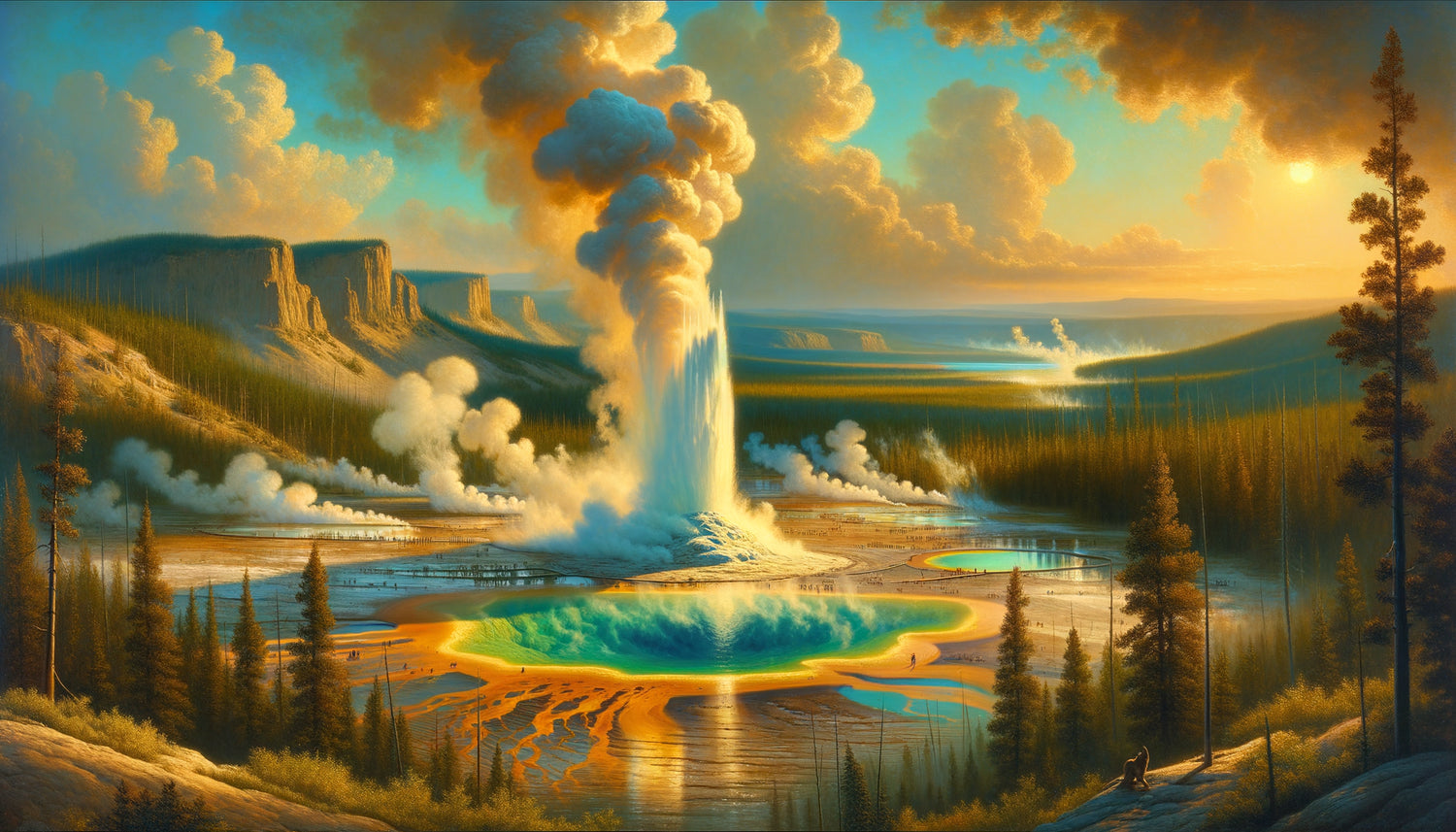
The first time I contemplated Old Faithful projecting its column of water 50 meters high, I understood why this geyser had shaped the American soul. This eruption, as regular as a natural clock, embodied everything the young nation sought to symbolize: raw power, reliability, and that wild grandeur that defines the American West. Since 1872, the year the first national park was created, Yellowstone and its geysers have become much more than a geological phenomenon. They represent a founding myth, an inexhaustible source of artistic inspiration, and an identity symbol etched in the collective imagination.
Here's what the representation of Yellowstone's geysers reveals: a transformation of nature into a national emblem, a major influence on American art from the 19th century to the present day, and a decorative source of inspiration that continues to inhabit our contemporary interiors.
You admire these spectacular landscapes in magazines, you dream of this monumental natural beauty, but you don't know how this historical fascination can enrich your daily aesthetic universe. How has a geological wonder become a universal visual language? What is the true story behind these iconic representations?
Rest assured: understanding the cultural impact of Yellowstone's geysers does not require a degree in art history or a 10,000-kilometer trip. It simply takes decoding the symbolic layers that have made these natural phenomena an essential reference for American identity.
I invite you to explore how geysers have gone from being a geological curiosity to a cultural icon, and how this transformation continues to influence our relationship with nature in our decorative choices.
When geology becomes a national myth
The first European explorers who reached the Yellowstone region in the 1800s told such extraordinary stories that they were accused of lying. Boiling water fountains gushing from the ground? Pools of unreal colors? The American government sent official expeditions to verify these fantastic accounts.
The Washburn-Langford-Doane expedition of 1870 marked a decisive turning point. For the first time, scientists, artists and photographers systematically documented Yellowstone's geysers. Painter Thomas Moran and photographer William Henry Jackson accompanied the Hayden expedition in 1871, producing works that would literally change the destiny of this territory.
Moran's monumental watercolors transformed the geysers into natural cathedrals. His representations of Castle Geyser and Old Faithful used techniques borrowed from European romantic landscapes, but applied to a typically American nature. The columns of steam became celestial architectures, the geothermal pools divine palettes.
These representations played a crucial political role. In March 1872, the US Congress voted to create Yellowstone National Park, in part thanks to Moran's works hanging in the halls of the Capitol. Geysers thus became the first natural landscape officially protected by a nation, establishing a global precedent.
The chromatic palette of the American wilderness
What is striking about historical depictions of geysers is the evolution of their color treatment. The early black and white engravings of the 1870s emphasized the dramatic contrast between white steam and dark rocks. They created an aesthetic of the sublime, where nature inspires both wonder and terror.
With the advent of chromolithography in the 1880s, Yellowstone's geysers exploded with color. Advertising posters for railway companies transformed these geological phenomena into desirable tourist destinations. The turquoise hues of pools like Morning Glory Pool, the ochres and oranges of mineral deposits, the immaculate whites of the steam composed an identity palette.
This chromatic coding profoundly influenced American art. Painters of the Hudson River School adapted their lighting techniques to geysers. Later, color photographers like Ansel Adams captured these landscapes with almost scientific precision, creating images that became absolute references for American natural beauty.
Influence on contemporary design
Today, palettes inspired by Yellowstone structure countless decorative projects. Deep blues evoking geothermal pools, mineral beiges recalling travertine terraces, touches of rust symbolizing volcanic activity: these combinations create atmospheres that are both soothing and dynamic.

From romanticism to modernism: stylistic evolutions
The depiction of geysers has evolved with successive artistic movements. Romanticism in the 19th century favored dramatic compositions where man appeared tiny against telluric power. Geysers were manifestations of the natural sublime, reminders of forces beyond human comprehension.
The Arts and Crafts movement of the early 20th century adopted a different approach. Artists like Gustave Baumann created stylized engravings of geysers, reducing shapes to their geometric essence. Eruptions became decorative motifs, integrable into architecture and interior design.
With the modernism of the 1950s-1960s, photographers like Eliot Porter documented geysers with a new attention to microscopic details. Thermophilic bacteria coloring the pools, mineral crystallizations, silica textures: these elements became subjects in their own right, transforming geysers into natural abstractions.
Contemporary art continues this diversification. Some artists use satellite images to create aerial visions of geothermal fields, revealing patterns invisible to the naked eye. Others integrate eruption videos into immersive installations, recreating the complete sensory experience.
Yellowstone in the American popular imagination
Beyond academic art, Yellowstone's geysers have permeated American popular culture at all levels. As early as the 1880s, Old Faithful became a national celebrity, appearing on countless postcards, stamps, and souvenirs.
Railroad companies, particularly the Northern Pacific Railway, invested heavily in the visual promotion of Yellowstone. Their Art Deco posters from the 1920s-1930s stylized geysers into bold geometric shapes, associating the modernity of rail travel with ancestral natural spectacle.
Cinema quickly adopted Yellowstone as a symbolic setting. From the silent era, geysers appeared in Westerns as manifestations of the untamability of the West. This tradition endures: films, documentaries and television series use eruptions as visual metaphors for transformation, contained energy, or the awakening of primordial forces.
In advertising, geysers symbolize power, reliability, and American authenticity. From car brands to cleaning products, many have exploited this imagery to convey values of natural efficiency and controlled brute force.
The geyser as a creative metaphor
The regularity of Old Faithful quickly made it a metaphor for constancy. One speaks of a person or institution as being an 'Old Faithful' to signify its absolute reliability. This anthropomorphism of the geyser reveals how much this geological phenomenon has become a cultural archetype.

Translating the power of geysers into the domestic space
How to integrate this historical fascination with Yellowstone's geysers into a contemporary interior without falling into touristy kitsch? The key lies in abstraction and suggestion rather than literal representation.
Large-format photographs of erupting geysers create spectacular focal points. Choose shots that prioritize texture and color over the postcard look. Macro images of geothermal pools, with their colored strata and mineral formations, function as quasi-pictorial abstractions.
The color palette inspired by Yellowstone adapts remarkably well to modern interiors. Combine deep turquoise blues with neutral beige and burnt Sienna tones, with touches of rust orange. These combinations evoke the geothermal landscapes while remaining sophisticated and timeless.
The organic shapes of geysers and hot springs also inspire furniture and decorative objects. Look for vases with irregular contours evoking mineral concretions, luminaires whose forms recall columns of steam, textiles with patterns inspired by colorful thermophilic bacteria.
The most refined approach is to capture the emotional essence rather than the literal appearance. Geysers embody contained power, cyclical energy, beauty born of telluric forces. Translate these concepts through contrasts: raw materials and polished finishes, calm lines and dynamic accents, contemplative spaces and touches of bright color.
The visual legacy for future generations
The depiction of Yellowstone's geysers has created a visual language that now transcends its geographical origin. These images have become universal symbols of environmental preservation, American natural beauty, and geological sublimity.
New technologies offer unprecedented perspectives. Time-lapses capture eruptions over several hours, revealing rhythms invisible to the naked eye. Thermal images reveal temperature variations in psychedelic colors. Photogrammetry creates 3D models allowing you to virtually explore geothermal formations.
This technological evolution does not diminish the emotional impact of traditional representations. Thomas Moran's watercolors retain their evocative power 150 years after their creation. They remind us that artistic representation does not only document a place, but captures the emotional relationship between the observer and the landscape.
For contemporary creators, Yellowstone’s geysers offer an inexhaustible source of inspiration. Their unique combination of regularity and unpredictability, beauty and danger, science and mystery makes them perpetually renewed subjects.
Let the power of natural landscapes transform your interior
Discover our exclusive collection of nature paintings that capture the raw energy and timeless beauty of geological wonders, to create in your home a space that dialogues with the grandeur of the natural world.
Living with the spirit of Yellowstone
Integrating geyser representations into your decor is much more than adopting an aesthetic trend. It's bringing into your home a fragment of American history, a symbol of eternal natural forces, a reminder that the most spectacular beauty often arises from invisible and patient processes.
Imagine yourself facing a large photograph of Old Faithful, its column of steam rising in an impossible blue sky. This is not just an image: it's a window on 150 years of collective wonder, on generations of artists who have tried to capture the uncapturable, on the very idea that some places deserve to be preserved for their beauty alone.
Yellowstone’s geysers remind us that beneath the calm surface, considerable energies await their moment. A valuable lesson for our contemporary lives, where we too often forget the deep forces that animate us.
Start modestly: a quality reproduction, a photographic book open to an inspiring page, a color palette borrowed from the geothermal pools. Observe how these elements subtly transform the atmosphere of your space, how they invite contemplation and dreaming.
The imagery of geysers does not belong only to America. It belongs to all those who recognize in these phenomena a metaphor for creativity itself: these regular eruptions of energy, beauty, and renewal that spring from invisible depths.
Frequently Asked Questions about Geyser Representations
Why are Yellowstone’s geysers so important in American culture?
Yellowstone's geysers hold a unique place in the American imagination as they symbolize several founding myths simultaneously. First, they embody the natural grandeur of the continent, this spectacular nature that Europeans did not possess and which defined the new nation. Secondly, their discovery coincided with westward expansion and the construction of the post-Civil War American identity. The creation of the world's first national park in 1872 represented a major political innovation: protecting nature for itself, not for its exploitation. Geysers thus became symbols of environmental responsibility and national pride. Their regularity (particularly Old Faithful) also evoked American values such as reliability and consistency. Finally, their massive artistic representation by painters like Thomas Moran created an immediately recognizable visual language, engraving these landscapes in the collective consciousness long before most Americans could visit them physically.
How to integrate geyser representations into a modern decor without a kitsch effect?
The key to avoiding the tourist souvenir effect lies in an artistic approach rather than a documentary one. Favor large format, high quality photographs that treat geysers as abstract subjects: close-ups of mineral textures, games of steam and light, aerial views revealing geometric patterns. Black and white images work particularly well in minimalist interiors, eliminating the postcard aspect while retaining the drama. For color, choose works that exploit Yellowstone's natural palette (turquoise, ocher, rust, white) in a sophisticated way. Abstraction is another avenue: instead of a literal image of a geyser, opt for works inspired by their shapes, colors or energies. Also consider scale: a large piece makes an artistic statement rather than simple decoration. Finally, context matters: understated framing, thoughtful hanging, association with contemporary furniture that creates a dialogue between raw nature and refined design.
Which contemporary artists work on geysers and geothermal landscapes?
The renewed interest in Yellowstone has inspired a new generation of visual creators. Photographers like Michael Nichols (National Geographic) document the geysers with an almost journalistic but aesthetically powerful approach, often capturing the extreme conditions of winter that transform eruptions into ice sculptures. Art Wolfe adopts a more pictorial perspective, using telephoto lenses to compress planes and create almost abstract compositions. On the video side, nature filmmakers like those from the collective Nature Cinematography produce hypnotic time-lapses that reveal the hidden rhythms of eruptions. In contemporary art, some creators use satellite images and digital processing to transform geothermal pools into almost psychedelic works. Environmental artists also integrate scientific data on geothermal activity into artistic visualizations. To discover these works, explore exhibitions in the major US national parks, platforms like 500px or National Geographic Your Shot, and galleries specializing in nature photography that are increasingly giving space to geological landscapes.