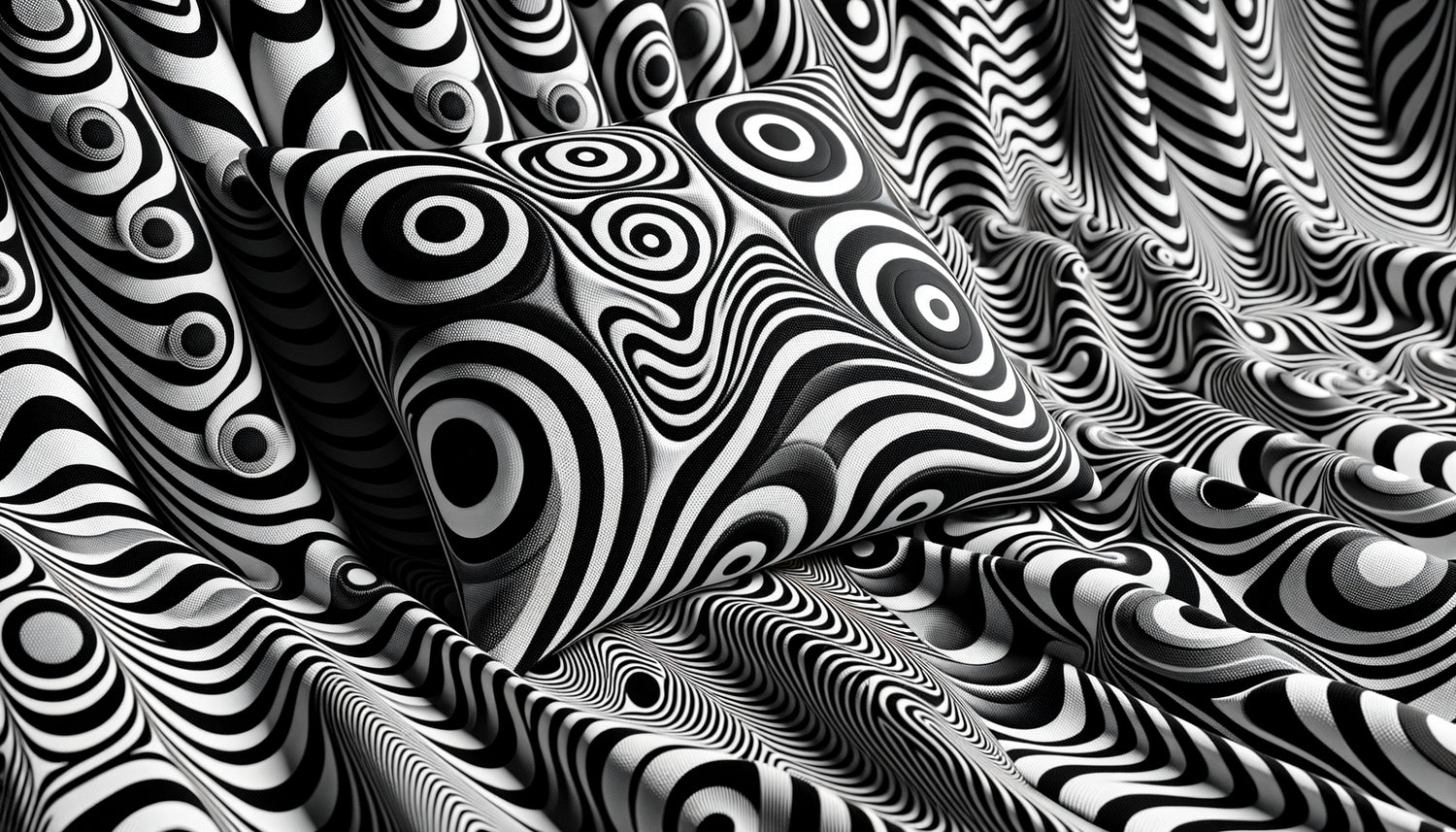
1965. A dress crosses the hall of MoMA in New York. Visitors stop dead in their tracks. On the fabric, concentric circles seem to vibrate, pulsate, defy the logic of the eye. It is neither painting nor a light projection: it is printed cotton. In a few years, optical art has shifted fashion and decoration into a new dimension, transforming our interiors and wardrobes into true visual experiences.
Here's what this textile revolution still brings today: a visual energy that instantly energizes a space, a modern sophistication that transcends eras, and that rare ability to create movement without moving an inch. Yet, faced with a cushion or curtain with optical patterns, one hesitates. Too bold? Too retro? Difficult to integrate? Rest assured: understanding the history of these patterns is discovering how to master them with elegance. I take you to the textile workshops of the sixties, where contemporary art met the loom.
When Vasarely meets the loom
The story begins in the Parisian and New York avant-garde galleries of the early 1960s. Victor Vasarely exhibits his hypnotic canvases where black and white dance in geometric illusions. Bridget Riley presents her undulating lines that seem to ripple before the astonished eyes of visitors. Op Art, as it is quickly called, fascinates by its ability to create movement from static forms.
European textile manufacturers, particularly in Scandinavia and Great Britain, immediately understand the potential. Could these patterns, designed to be contemplated on a museum wall, live on textiles? The answer comes in 1963 with the first collections of upholstery fabrics printed with distorted checkerboards and vertiginous spirals. The Finnish house Marimekko adapts optical principles to its bold prints, while in England, Hull Traders revolutionizes curtains and cushions with hypnotic geometries.
The technical challenge of illusion
Transferring optical art to textiles was not simply a matter of reproduction. Op Art artists worked with mathematical precision: a millimeter's deviation, and the illusion collapsed. Textile printers had to develop new screen printing techniques allowing for absolute sharpness, even on soft fabrics. Cotton becomes the preferred canvas for these experiments, its flat surface allowing for clear contrasts essential to optical effects.
The patterns that defined a decade
Some textile patterns from the 1960s have become true icons. Concentric circles evoking sound waves or rotating vinyl records. Distorted checkerboards where squares seem to swell and contract as if under the effect of an invisible breath. Wavy stripes directly inspired by Bridget Riley's works, creating the impression of a liquid, almost aquatic textile.
These optical patterns have invaded every domestic space. Curtains with undulating lines transformed daylight into a moving spectacle. Psychedelic checkered cushions punctuated sober sofas with touches of pure energy. Geometric tablecloths made each meal a visual experience. Even wallpapers adopted these optical illusions, creating walls that seemed to breathe and vibrate.
Black and white as a manifesto
While Op Art allowed for color, black and white textile patterns remained the most emblematic of this period. This radical chromatic choice amplified the contrasts necessary for optical illusions while embodying the refined modernity of the sixties. A cushion with black spirals on a white background became an aesthetic manifesto: rejection of bourgeois pastel shades, adherence to the avant-garde, celebration of pure geometry.
This binary palette also facilitated integration into interiors. A black and white optical textile could coexist with any ambient color, bringing its dynamism without creating a chromatic clash. Interior designers understood this: these geometric patterns functioned as accents, visual exclamation points in otherwise neutral spaces.

From the gallery to the living room: an enlightened democratization
The massive adoption of optical patterns in interior decoration was not accidental. It coincides with a period of economic prosperity and the democratization of design. Department stores suddenly offer textiles “inspired by the greatest museums” at affordable prices. Owning curtains with optical illusions is like bringing a fragment of artistic avant-garde into your home.
Fashion amplifies this phenomenon. When models parade in Op Art dresses by Pierre Cardin or André Courrèges, the public demands these patterns everywhere. Textile manufacturers respond with coordinated collections: it is now possible to match your home textiles with your wardrobe, creating total aesthetic coherence. The living room becomes an extension of the dressing room, and vice versa.
Scandinavian influence on optical patterns
While Op Art was born in Anglo-Saxon and Parisian galleries, Scandinavian designers were the ones who best integrated it into everyday textiles. Their approach to design fonctionnel combined with graphic boldness has produced more organic optical patterns, less strictly geometric. Maija Isola at Marimekko creates spirals that evoke both Vasarely and Nordic natural forms. This synthesis makes optical patterns warmer, less intimidating for the general public.
The contemporary legacy of optical textiles
Sixty years later, these motifs textiles continue to permeate contemporary decor. Fabric editors regularly reinterpret classics from the 1960s, sometimes in faithful reproduction, often in a modernized version. Current creators draw inspiration from them to develop new patterns that play with our perception, now using the possibilities of digital printing for even more sophisticated effects.
In today's interiors, a cushion with vintage optical patterns creates a bridge between past and present. It brings that retro-futuristic touch that characterized the sixties: a technological optimism, a belief in progress, a celebration of modernity. But it also works as a contrasting element in minimalist spaces, bringing the visual energy that is lacking in too neutral interiors.
How to integrate these patterns today
The mistake would be to recreate an entirely sixties interior. The strength of textiles à motifs optiques lies in their occasional use. A single cushion with a distorted checkerboard pattern on a solid sofa transforms the entire atmosphere. A plaid with concentric circles casually thrown becomes the focal point of a room. These patterns function as textile artworks: they deserve visual space around them.
Prioritize quality fabrics where the sharpness of the pattern is preserved. Blurry or misaligned prints ruin the sought-after effet optique. Thick cotton, textured linen, or cut velvet allow contrasts to remain clear. And don't be afraid of radical black and white: it is precisely this absence of chromatic compromise that makes these patterns powerful.
Your interior deserves this incomparable visual energy
Discover our exclusive collection of fashion wall art that captures the graphic spirit of the 1960s and transforms your walls into contemporary art galleries.

Your gaze will never be the same
From now on, when you come across textiles with optical patterns in a vintage boutique or a contemporary collection, you won't see just a simple retro fabric. You’ll recognize the heritage of Vasarely and Riley, the technical prowess of textile printers, the moment when contemporary art entered our homes. These geometric motifs that seem to vibrate and dance tell the story of a decade that believed in the transformative power of design.
Start modestly if boldness intimidates you: a cushion, a graphic kitchen towel, a placemat. Observe how these optical illusions change the energy of a space. You will then understand why the 1960s tipped into this textile fascination: because our interiors, like our lives, deserve to be in motion.
Your questions about 1960s optical textiles
Do optical patterns tire the eyes on a daily basis?
It's a legitimate concern, but unfounded in practice. The optical patterns used in textile decoration are designed to be viewed from a distance, unlike Op Art museum works that are contemplated up close. A cushion on your sofa or a curtain a few meters away will not create visual fatigue. The hypnotic effect works precisely because you don’t fixate on it constantly: your gaze passes, captures the movement, and continues. It is this fleeting perception that creates the charm. If you are sensitive, start with medium-sized patterns rather than very dense micro-geometries.
Can you mix multiple optical pattern textiles in the same room?
With restraint and strategy, yes. The golden rule: vary the scales of patterns. If you have a cushion with small checks, pair it with a plaid with large concentric circles. Avoid multiplying patterns of the same size and contrast, which would create a visual cacophony. Designers in the 1960s often played on a centerpiece (a large optical curtain) accompanied by more discreet accents. And maintain areas of visual rest: solid surfaces allow optical patterns to breathe and fully exert their impact.
Are vintage optical textiles difficult to maintain?
Authentic pieces from the 1960s do indeed require precautions: cold wash, no tumble dry, to preserve the intensity of the black and white contrasts. But contemporary reissues benefit from modern textile advancements and better withstand daily use. Always check care labels. A valuable tip: optical patterns remarkably mask small imperfections and stains, unlike solid fabrics. This visual resilience makes them practical choices for real living spaces, not just magazine interiors.