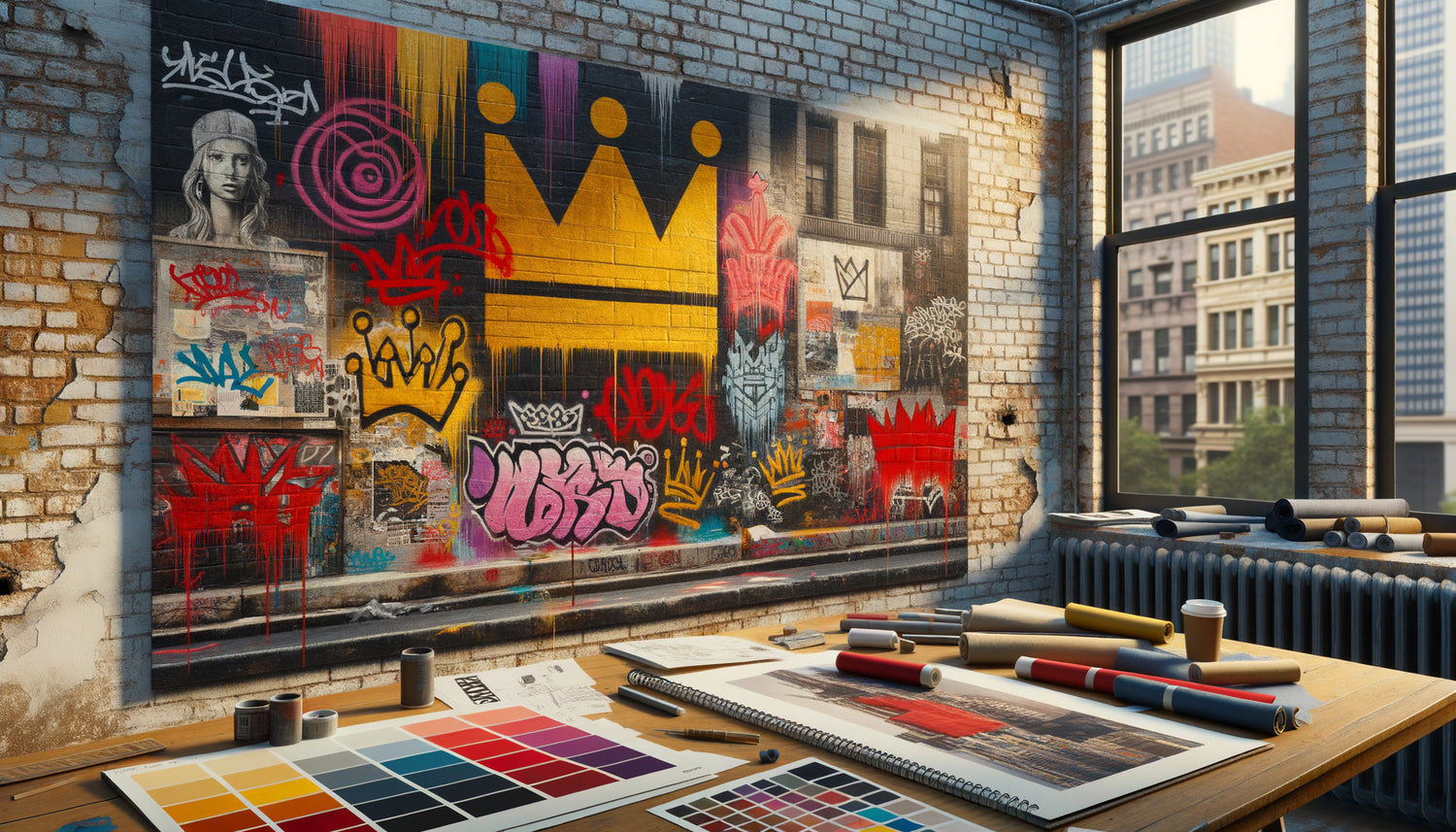
In my Parisian workshop in the Marais, between vintage sketches and magazines from the 90s, I still remember the day a Stüssy designer confided to me that their iconic 1994 collection was born from observing a Keith Haring canvas. It wasn't a coincidence. Paintings of street scenes have always been much more than simple decorative works: they are visual archives of an era, secret notebooks of streetwear creators, and invisible bridges between urban art and fashion. Here’s what these paintings of street scenes bring to streetwear collections: cultural authenticity impossible to simulate, a visual grammar directly transferable to textiles, and artistic legitimacy that transforms a simple garment into a cultural manifesto.
You are fascinated by the streetwear universe but don't always understand where these bold prints, saturated colors, and compositions that seem to come from another world originate? You’re not alone. For fifteen years observing trends and advising emerging brands, I discovered that every great streetwear collection hides an unknown pictorial reference.
Good news: understanding this dialogue between paintings of street scenes and urban fashion doesn't require any artistic training. Just a curious eye and the desire to decode the influences that have shaped a multi-billion dollar industry. Let me guide you behind the scenes of this exciting story.
When Street Artists Become Archivists of Asphalt
Paintings of street scenes began influencing streetwear as early as the 1980s, a time when no one was yet talking about urban culture as a global phenomenon. The artists who painted the streets of the Bronx, Philadelphia or Los Angeles were not looking to create works for galleries. They documented their reality: graffiti on the subways, sneakers hanging from power lines, silhouettes in motion of breakdancers.
These canvases captured a spontaneous aesthetic that fashion photographers could not capture. They immortalized textures, superimpositions, visual accidents that would become the codes of streetwear. Jean-Michel Basquiat, for example, wasn't painting clothes, but his chaotic compositions directly inspired Supreme’s all-over prints in the 2000s.
The first streetwear designers, often themselves from the graffiti scene, looked at these paintings of street scenes as style manuals. They found color palettes impossible to invent in a studio, bold juxtapositions, a raw energy that traditional luxury could not reproduce.
The Visual Grammar: From Brush to Thread
What makes street scene paintings so valuable for streetwear collections is their immediately translatable visual language. Unlike abstract or conceptual works, these canvases already speak the dialect of the streets. They naturally contain the elements that designers seek: gestural typographies, asymmetrical compositions, urban cultural references.
Take the works of Rammellzee or Futura 2000. Their paintings from the 80s already used layering techniques – this superposition of motifs and textures – which is now found on every hoodie from A Bathing Ape or Off-White. The difference? These artists did it out of expressive necessity, not marketing strategy.
The visual codes that migrated from canvas to textile
The drippings and runs seen in New York street scene paintings have become the tie-dye and acid wash effects of the 90s. The wildstyle lettering of graffiti artists inspired the impossible-to-read logos of Fuct or Obey. The anonymous silhouettes painted in flat colors in urban scenes gave birth to Carhartt WIP's famous minimalist pictograms.
This transposition is never literal. A good streetwear designer does not copy a street scene painting: he extracts its essence, its attitude, its gesture. That’s why some collections seem to vibrate with an authenticity that others, technically similar, do not possess.

Authenticity as cultural capital
In the streetwear industry, authenticity is the most valuable currency. And nothing confers more authenticity than a real connection with street art. Street scene paintings served – and still serve – as a certificate of cultural legitimacy. When Virgil Abloh incorporates a reference to a Kaws canvas into an Off-White collection, he’s not just borrowing an aesthetic: he’s claiming a heritage.
Young streetwear brands that are exploding today – Palace, Bronze 56k, Dime – all draw from the same visual repertoire. They collaborate with contemporary artists who perpetuate the tradition of street scene paintings, creating a cultural continuity between the pioneers of the 80s and the TikTok generation.
This quest for authenticity also explains why reproductions of street scene paintings now adorn streetwear boutiques themselves. These works are not mere decorations: they tell the story of the brand, they establish its cultural lineage.
Game-Changing Collaborations
The 2000s saw the explosion of artist-brand collaborations, where street scene paintings became literal streetwear collections. Kaws x Original Fake, Shepard Fairey x Obey, Futura x The North Face: these partnerships were not merchandising, but textile translations of pictorial works.
These collaborations revolutionized the perception of streetwear. They transformed a t-shirt into a portable canvas, a bomber jacket into a traveling exhibition. Suddenly, wearing streetwear no longer simply meant following a trend, but collecting accessible art.
The Basquiat Case Study
No artist better illustrates this symbiosis than Jean-Michel Basquiat. His street scene paintings – or rather, his poetic representations of urban life – have been reinterpreted by dozens of brands. Uniqlo, Coach, Comme des Garçons: all have created entire collections around his work. Why? Because Basquiat perfectly embodies this intersection between high culture and street culture that modern streetwear claims.
His three-pointed crowns now adorn as many hoodies as museum walls. His scrawled words inspire Supreme’s graphic designers as much as the curators of MoMA. This double legitimacy – artistic and urban – is exactly what contemporary streetwear collections seek.

From Local to Global: The Universalization of a Language
What’s fascinating about street scene paintings is their ability to speak universally while remaining deeply rooted in a local context. A canvas depicting a Bronx scene from the 80s resonates today with a teenager from Tokyo or São Paulo. Why? Because these works capture universal urban emotions: rebellion, belonging, creativity within constraint.
Streetwear collections have understood this power. They use paintings of street scenes as a visual lingua franca, a language that young people around the world instinctively understand. Codes born in specific neighborhoods – Harlem, Shibuya, Brick Lane – now circulate globally thanks to this pictorial mediation.
Japanese brands like Neighborhood or Wacko Maria particularly excel at this reinterpretation. They integrate references to American street scene paintings while infusing them with a Japanese aesthetic sensibility, creating fascinating cultural hybrids.
The influence today: Instagram as the new street gallery
Today, the relationship between street scene paintings and streetwear has evolved but never disappeared. Contemporary urban artists – Banksy, Invader, JR – create works that instantly become references for designers. The difference? Their distribution is immediate, global, multiplied by social networks.
Instagram has become the new street gallery, where each post can inspire a collection. Brands monitor emerging artists, viral murals, photographed urban scenes that capture the zeitgeist. This constant monitoring fuels an accelerated creative cycle where inspiration travels at the speed of a swipe.
Paradoxically, this acceleration has also created nostalgia for classic street scene paintings. Works from the 80s-90s are now considered timeless classics, and their influence on contemporary streetwear collections is assumed, almost claimed as a guarantee of seriousness.
Want to capture this urban energy at home?
Discover our exclusive collection of fashion paintings that transform your interior into a cultural manifesto and celebrate the timeless dialogue between street art and contemporary creation.
Conclusion: wearing art, living culture
Street scene paintings have never been just sources of inspiration for streetwear. They are its cultural substrate, visual memory, artistic justification. Each collection that draws on this repertoire is not only borrowing motifs: it joins a lineage, claims belonging, perpetuates a gesture.
Imagine yourself tomorrow, wearing this hoodie whose print comes from a canvas by Futura, or hanging in your living room this reproduction of a street scene that inspired an entire generation of creators. You are not simply consuming fashion or decoration: you are living culture, carrying a story. And this story begins with a curious look at these paintings that have changed the way we dress, decorate our spaces, and express our urban identity.
So next time you admire a streetwear collection, ask yourself: what canvas lies behind this pattern? Which street artist unknowingly influenced what millions of people wear today? The answer is often more fascinating than you might imagine.
FAQ: Your questions about street scene paintings and streetwear
Which street artists have most influenced streetwear?
The essential pioneers are Jean-Michel Basquiat, Keith Haring, Futura 2000 and Rammellzee for the 80s. Their direct influence can be found in the collections of founding brands like Stüssy, Supreme or A Bathing Ape. More recently, Kaws, Shepard Fairey (Obey) and Banksy have profoundly marked streetwear from the 2000s-2010s. These artists all share one characteristic: they documented or reinterpreted urban scenes with a visually recognizable and technically translatable language onto textiles. Their saturated color palette, dynamic compositions and popular cultural references provided streetwear designers with a rich and authentic visual vocabulary. Today, artists like JR, Invader or Os Gemeos continue this tradition by creating street art that directly inspires new collections. What's important is not so much the artist's name as their connection to urban reality and their ability to capture the spirit of an era.
How to recognize a true artistic reference from a simple commercial borrowing?
Excellent question that all enthusiasts ask! A true artistic reference in streetwear is recognized by several signs. First, it usually comes with an official collaboration or explicit credit to the artist, sometimes with a percentage of sales donated. Then, it reinterprets rather than copies: the designer digests the influence and transforms it into something new. You will see subtle nods, references in color names, quotes in lookbooks. A simple commercial borrowing, on the other hand, takes a popular motif without context, without history, often without permission. It lacks this narrative coherence between the brand and the artist. Ask yourself: does this collaboration make cultural sense? Does the brand have a history of respect for urban art? Does the artist share the values of the brand? If the answers are positive, you are probably facing an authentic artistic approach rather than opportunistic merchandising.
Can I integrate street scene paintings into a modern decor without creating dissonance?
Absolutely, and it's even a strong trend in contemporary interior design! Street scene artworks bring a raw energy and an authenticity that contrasts beautifully with clean interiors. The secret lies in balance: in a Scandinavian minimalist space, a large urban canvas becomes a centerpiece that brings the whole thing to life. In an industrial loft, it reinforces the urban identity. The trick is to harmonize colors: if your artwork contains touches of turquoise or green, pick up these shades in your cushions or accessories. Avoid clutter: one or two street scene artworks are enough to create impact. Also think about the framing: a simple and contemporary frame (matte black, brushed aluminum) modernizes even the most street-style works. Finally, play with scales: a very large format creates a gallery effect that elevates your entire decor. Street scene artworks are no longer reserved for streetwear spaces or artists' lofts: they find their place in any decoration that assumes some character and boldness.