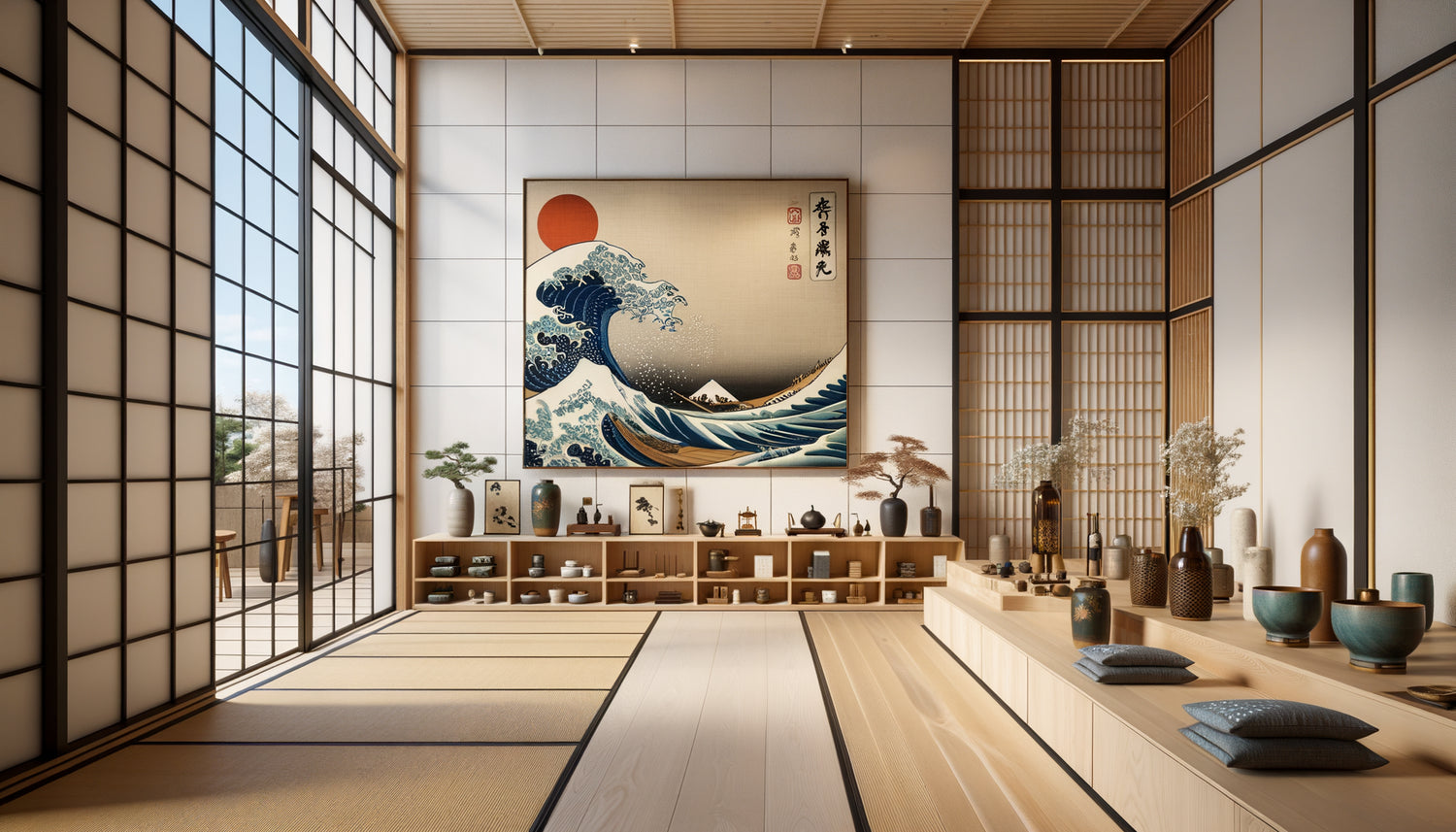
On a spring afternoon in Kyoto, while entering a contemporary ceramics shop, I froze. Not in front of the creations on display, but in front of an 18th-century ukiyo-e print hanging on the back wall. This ancient Hiroshige engraving dialogued with the minimalist forms of the stoneware bowls in a disturbing harmony. The creator smiled at me: 'Without this memory, my creations would have no soul.'
Here's what ukiyo-e prints bring to Japanese retail spaces: they create an emotional bridge between tradition and modernity, establish a cultural narrative that legitimizes the brand, and transform the act of purchasing into a contemplative experience.
You may have noticed this trend in concept stores: Japanese creators who systematically hang antique engravings in their ultramodern showrooms. This intrigues you, but you don't really understand why these centuries-old images find their place in such contemporary universes. What link between a courtesan print from the floating quarter and a collection of avant-garde clothing?
Rest assured, this strategy is nothing like an aesthetic whim. It is based on a profound philosophy of cultural identity and an intuitive understanding of what truly touches the modern customer. Japanese creators master the subtle art of visual storytelling, and ukiyo-e prints become their best ambassadors.
I invite you to discover the fascinating reasons that motivate this integration, and how it radically transforms the purchasing experience by creating a cultural depth that few other approaches can match.
Ukiyo-e as a certificate of cultural authenticity
When a Japanese creator installs an ukiyo-e print in their retail space, they are not decorating: they are authenticating. In a context where 'japonism' has become a marketing argument sometimes stripped of substance, ukiyo-e prints act as a seal of cultural legitimacy.
These ancient engravings, whether they depict Kabuki actors by Sharaku, landscapes by Hokusai or the elegant beauties of Utamaro, carry within them centuries of aesthetic codes: mastery of clean lines, bold use of negative space, sophisticated color palette. By exhibiting them, the creator establishes a direct lineage with these founding principles.
In the shop of a textile designer in Tokyo, I observed how a series of ukiyo-e prints of kimono patterns from the 19th century literally framed the contemporary creations. The message was clear without being didactic: 'My creations do not come out of nowhere, they extend a three hundred year old aesthetic conversation.'
This strategy also responds to an international expectation. Foreign customers are looking for tangible Japanese authenticity, not a watered-down or fantasized version. The ukiyo-e print, with its patina of time and historical sophistication, offers this guarantee of cultural depth that simple contemporary minimalism cannot always convey alone.
Creating a dialogue between the timeless and the modern
One of the strengths of ukiyo-e prints in a contemporary retail space lies in their ability to generate a harmonious contrast. This apparent juxtaposition of eras actually creates a fascinating visual continuity.
Consider an Osaka furniture showroom: clean lines, polished concrete, minimalist metal structures. On the wall, three Hiroshige ukiyo-e prints depicting bridges under snow. Far from creating dissonance, these engravings reveal common aesthetic principles: economy of means, asymmetrical balance, attention to empty space.
Japanese creators intuitively understand that ukiyo-e and contemporary design share a formal DNA. Hokusai's prints with their bold and off-center compositions foreshadow some graphic choices of modernism. The color blocks in Sharaku's engravings anticipate the aesthetics of contemporary flat design.
Temporality as an additional dimension
By integrating ukiyo-e prints, the retail space acquires a temporal depth. The customer is no longer simply in a 21st century store, but in a place where multiple eras coexist and dialogue. This time stratification greatly enriches the experience.
A customer potentially spends more time in the space, captivated by the details of an ukiyo-e print depicting an interior scene from the past. This extended attention span directly benefits the contemporary creations on display: they absorb some of the fascination generated by the ancient engravings.

The print as a narrative and educational tool
Ukiyo-e prints tell stories. They depict scenes from the kabuki theater, moments from daily life in Edo, illustrated legends, series on the seasons or the famous views of Mount Fuji. This narrative dimension transforms the retail space into a place of cultural transmission.
In a ceramics workshop-boutique in Kanazawa, the creator had arranged a series of ukiyo-e prints showing artisans at work: potters, dyers, carpenters. These historical images created a direct bridge with his own artisanal gesture. Without a word, they told of belonging to a lineage, perpetuating know-how, respecting ancestral gestures.
This narrative approach also allows for subtly educating the customer. Faced with a ukiyo-e print depicting traditional textile motifs, the visitor better understands the references that nourish a collection of contemporary clothing. The print becomes a non-intrusive educational tool, which enriches understanding without giving the impression of a lesson.
Japanese creators also use ukiyo-e prints to evoke specific aesthetic values: wabi-sabi through Hiroshige's rural scenes, the refined elegance of miyabi in Utamaro’s portraits of courtesans, dynamic strength in Kuniyoshi’s depictions of warriors. Each print choice communicates a philosophical positioning.
Transforming purchase into a contemplative experience
The integration of ukiyo-e prints radically changes the nature of the purchasing experience. It introduces a contemplative dimension that slows down time and changes the customer’s relationship with the commercial space.
In traditional Japanese culture, the act of appreciating a work of art is part of a meditative ritual. By hanging ukiyo-e prints, creators invite their visitors to adopt this contemplative gaze, this floating attention that characterizes the Japanese aesthetic experience.
From shopping to cultural immersion
I observed this phenomenon in a leather goods store in Daikanyama: customers photographed ukiyo-e prints from the 18th century as much as the bags on display. The sales space had become a cultural destination in its own right, a place where people also come to enrich their aesthetic sensibility.
This transformation elevates the act of purchasing beyond a simple commercial transaction. The customer does not just acquire an object, but immerses themselves in a coherent cultural universe. Ukiyo-e prints become the guarantors of this coherence, tangible proof that an authentic aesthetic research underlies the whole.
Japanese creators understand that in a world saturated with images and commercial solicitations, offering a meditative slowing down experience becomes a rare luxury. Ukiyo-e prints, by their visual complexity and symbolic richness, naturally invite this contemplative pause.

The power of shared visual references
Ukiyo-e prints form a visual repertoire deeply rooted in Japanese cultural consciousness. Every Japanese person knows Hokusai's The Great Wave off Kanagawa or Utamaro’s elegant courtesans. By integrating them into a retail space, the creator activates a reservoir of collective memory.
This immediate recognition creates a feeling of familiarity and comfort. The Japanese customer immediately feels 'at home' in this space that refers to their cultural heritage. For the international client, these iconic ukiyo-e prints offer reassuring visual landmarks in a universe that might otherwise seem too conceptual or inaccessible.
In an Omotesando concept store, I noticed how a famous ukiyo-e print functioned as a visual anchor point. Visitors naturally oriented themselves in relation to it; it structured their journey through the space. This well-known work reassured, allowing more daring contemporary creations to benefit from better receptivity.
Ukiyo-e as a marker of sophistication
Integrating authentic ukiyo-e prints into a retail space also signals a certain level of cultural and financial sophistication. Genuine antique engravings represent a considerable investment, and their presence implicitly communicates the brand's high-end positioning.
This strategy works particularly well with a cultured and affluent clientele, sensitive to subtle cultural markers. Unlike ostentatious signs of luxury, ukiyo-e prints express discreet cultural wealth, perfectly consistent with the aesthetic of refined austerity valued in Japan.
Japanese creators know that their target customers – often educated urban professionals, collectors, culture enthusiasts – will appreciate this cultivated reference. The ukiyo-e print then becomes a code of social recognition, a sign of belonging to a community of connoisseurs.
Do you want to create this dialogue between tradition and modernity in your interior?
Discover our exclusive collection of fashion wall art that captures this timeless elegance and transforms your spaces into places of refined contemplation.
When tradition illuminates innovation
Now imagine yourself walking through the door of a Japanese boutique where a magnificent ukiyo-e print stands. You no longer see it as a simple decorative element, but as a statement of aesthetic intent, a silent manifesto on how the past nourishes contemporary creation.
This understanding transforms your own perspective on the spaces you inhabit. Perhaps you are now considering introducing this same sense of timelessness into your interior, creating those fruitful dialogues between eras and styles. Japanese creators teach us that the most compelling modernity never erases its roots – it celebrates, reinterprets, and honors them.
The next time you visit a Japanese commercial space, take the time to really look at these ukiyo-e prints. Observe how they converse with contemporary creations, how they modify your perception of space and time. You may discover, as I did, that these ancient engravings have much to teach us about creating truly inspiring environments.
FAQ : Everything you need to know about ukiyo-e prints in commercial spaces
Is it necessary to have authentic ukiyo-e prints or can reproductions be used?
This question often arises, and the answer depends entirely on your intention and budget. Original ukiyo-e prints, especially those by great masters such as Hokusai, Hiroshige, or Utamaro, represent a significant investment, sometimes several thousand euros for pieces in good condition. However, their authenticity brings an irreplaceable tangible dimension: the patina of time, the texture of ancient washi paper, the subtleties of traditional printing. For a high-end commercial space, this investment is fully justified as it communicates a level of seriousness and cultural commitment difficult to match otherwise. That said, very high-quality reproductions, made with printing techniques faithful to traditional methods, can offer an acceptable compromise, especially if you are just starting out or your space is more accessible. The essential thing is consistency: if you opt for reproductions, make sure they are impeccable quality, properly framed, and chosen with the same care as you would give to originals. Japanese creators attach fundamental importance to the integrity of their aesthetic choices.
How to choose the right ukiyo-e prints for a contemporary space without creating dissonance?
The secret lies in identifying the common aesthetic principles between your contemporary creations and the ukiyo-e prints you are considering. Start by analyzing your current universe: what are your dominant colors? Does your aesthetics favor clean lines, organic shapes, asymmetrical compositions? Then, look for ukiyo-e prints that share these formal characteristics. If your space favors a palette of blues and grays, opt for Hiroshige's landscapes with their twilight skies. If your creations celebrate pure line and minimalism, Sharaku’s actor portraits with their neutral backgrounds will work wonderfully. For a more dynamic and colorful universe, Kuniyoshi’s scenes with their energetic compositions will be perfect. Don't hesitate to work with a specialist or gallery owner who can guide you towards pieces consistent with your vision. And remember that some creative tension between old and new can be extremely fertile – perfect harmony is not always the goal.
Does this approach only work for Japanese creators or can it be adapted to other cultural contexts?
Excellent question that touches on a delicate issue: cultural appropriation versus cultural appreciation. If you are not Japanese, integrating ukiyo-e prints into your commercial space requires careful consideration of coherence and respect. The approach works beautifully when motivated by a genuine knowledge and admiration of Japanese culture, and when it is part of a creative universe that authentically dialogues with Japanese aesthetic principles. If your work explores themes of negative space, refined simplicity, the relationship between nature and creation, then yes, ukiyo-e prints can legitimately enrich your narrative. On the other hand, if they are simply added for their 'exotic look' without any real connection to your approach, the result is likely to be superficial and inappropriate. The alternative is to apply the same principle to your own cultural heritage: identify historical works from your tradition that resonate with your contemporary work and create this same fruitful dialogue between past and present. The profound teaching of Japanese creators is not to specifically use ukiyo-e prints, but to know how to draw on one's cultural roots to nourish current creation.