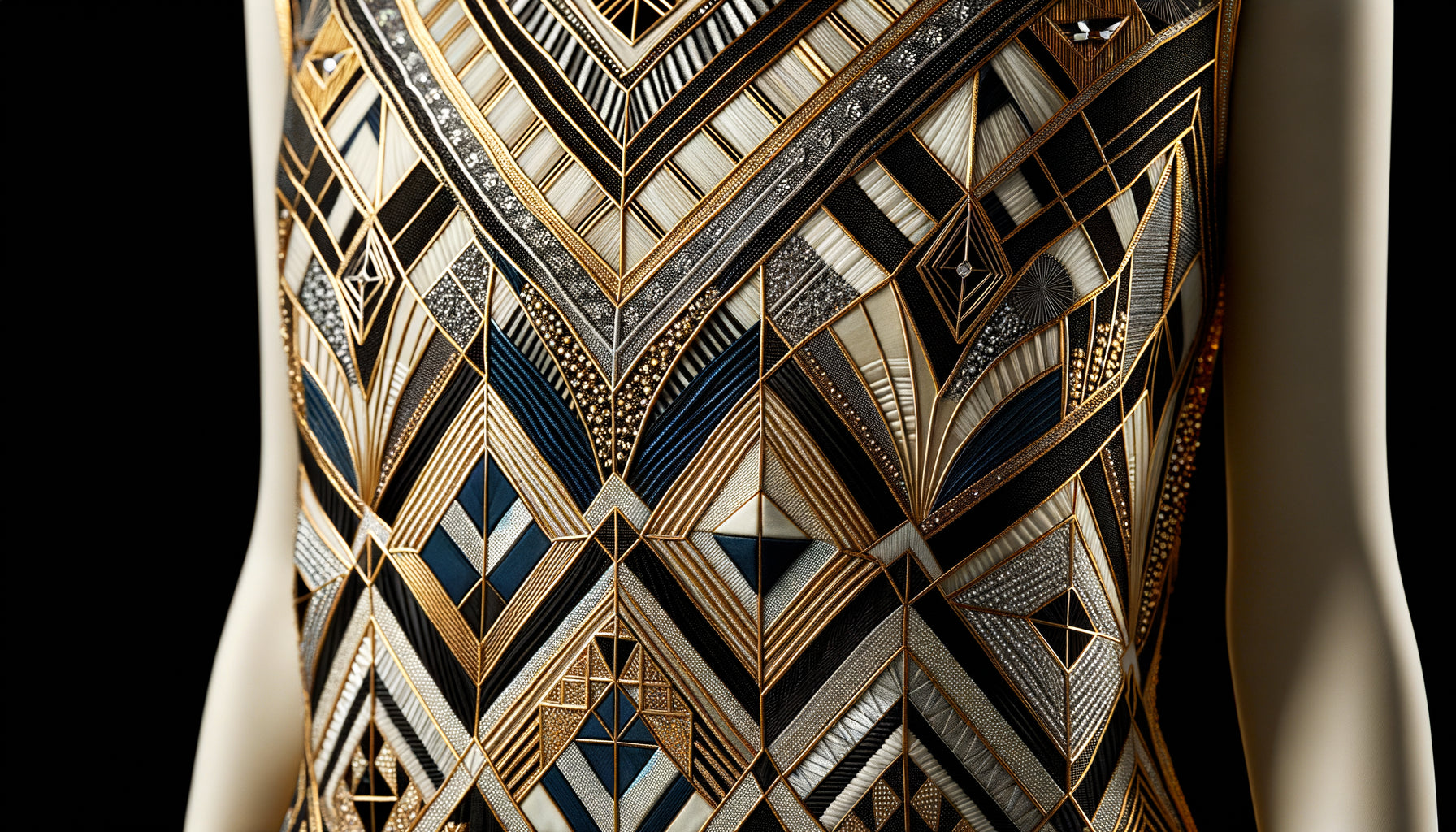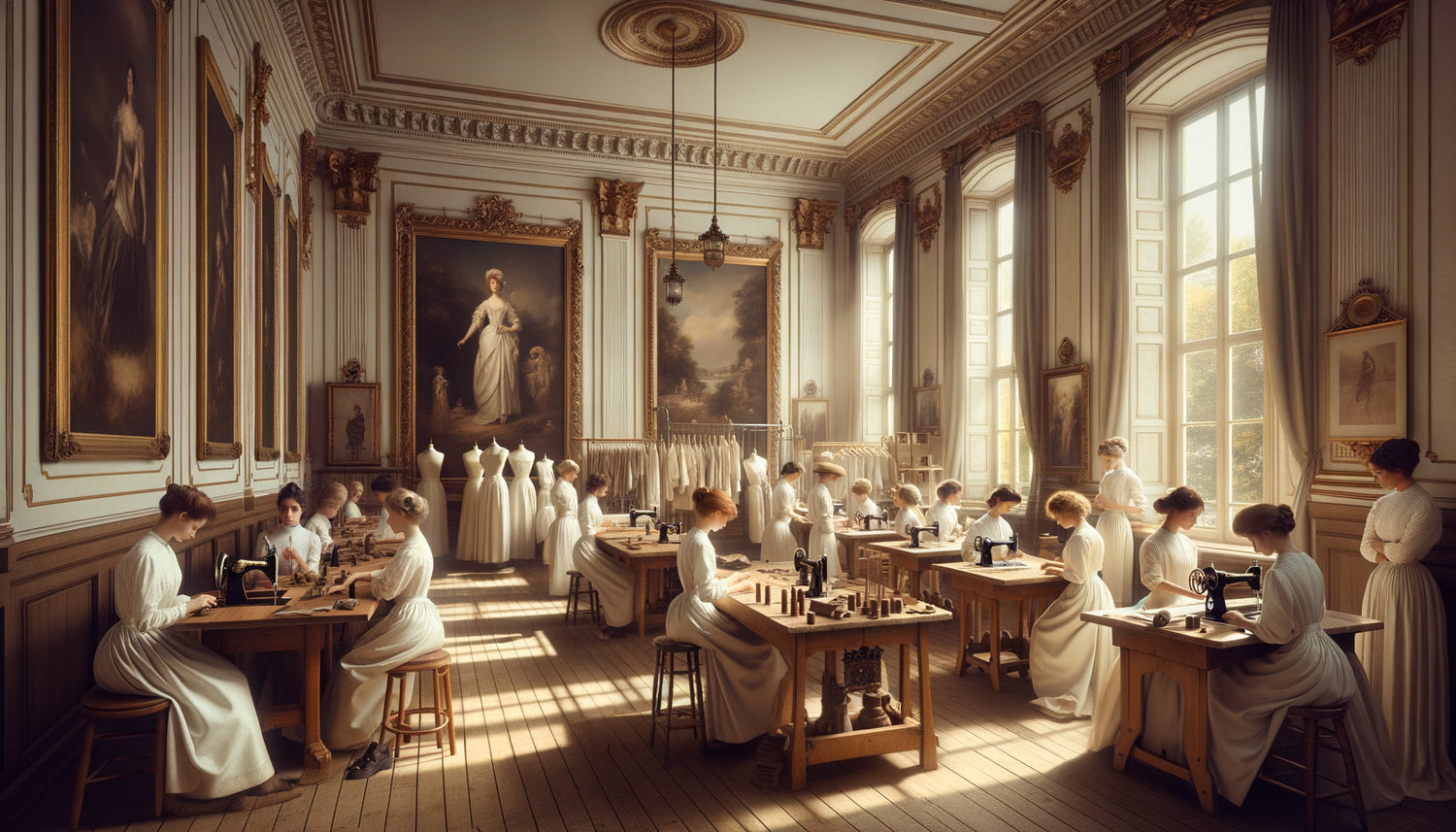
In the hushed silence of workshops on rue de la Paix, between 1920 and 1960, an ancestral practice shaped excellence: walls adorned with illustrations, engravings, and artistic reproductions were not mere decorations. They were silent educational tools that educated the eyes of young seamstresses during their twelve hours of daily work. Each stitch was part of a constant visual dialogue with Botticelli, Klimt, or Japanese prints hung above the work tables.
Here's what wall art brought to haute couture workshops: continuous visual training that refined the sense of proportion, an accessible library of chromatic references, and cultural transmission that transformed apprentices into true artisans of beauty. Without uttering a word, these images engraved criteria for harmony and balance in the subconscious.
Today, we decorate our interiors without thinking about their transformative power. We choose a painting to fill an empty wall, rarely for what it can teach us day after day. Yet, the masters of haute couture understood an essential truth: our visual environment sculpts our sensitivity. What we see daily shapes our taste, refines our judgment, and elevates our aesthetic standard.
This wisdom from the workshops is not reserved for fashion professionals. It can transform your relationship with your interior, turning your home into a space of permanent learning, a personal museum that enriches your gaze every day. Let's discover together how these sanctuaries of elegance used wall art as an educational tool, and how this approach can reinvent your decor.
Walls that taught: the silent pedagogy of workshops
In the workshops of Chanel, Dior, or Balenciaga, every wall surface had an educational function. The workshop supervisors did not choose these images randomly: they selected reproductions that illustrated fundamental principles. A Venus by Botticelli to understand the perfect drape of light fabrics. Ingres' portraits to grasp the impeccable structure of a shoulder. Utamaro’s prints to master the art of clean lines.
Apprentices spent years working under these images. While sewing miles of invisible stitches, their gaze regularly rested on these visual references. Learning took place through impregnation, like absorbing a foreign language by living in a country. No one gave lectures on the ideal proportion of a neckline: Raphael’s Madonnas taught it silently, thousands of times a day.
This method was based on a profound intuition: visual repetition creates excellence. When you see perfectly balanced compositions daily, your brain unconsciously integrates these harmonious relationships. Young seamstresses developed what is called “the eye,” this mysterious ability to instantly perceive what is wrong with a proportion, balance, or chromatic harmony.
The Masters' Palette: How Wall Art Educated in Colors
Workshops particularly used the works of colorists to train apprentices’ chromatic sensitivity. Monet’s Impressionist canvases showed how light transforms hues. Matisse’s compositions revealed the boldness of unexpected associations. Botanical watercolors from the 18th century taught the infinite nuances of white, pink, and green.
This chromatic education was crucial: matching a fabric, choosing the exact thread for an embroidery, judging whether a shade of blue harmonizes with a pearl gray—all this required an educated eye to the subtleties of color. Workshop instructors knew that this refinement could not be taught through theoretical courses. You must live surrounded by excellent visual references until your eye instinctively rejects mediocrity.
In your interior, this principle remains valid: the paintings you choose become your silent teachers of color. A watercolor with subtle tones teaches you daily the sophistication of complex shades. A black and white fashion photograph reveals the power of controlled contrast. Your visual environment educates your sensitivity, whether or not you are aware of it.

The Anatomy of Movement: When Painted Bodies Taught Clothing
Major workshops gave a particular place to representations of the body in motion. Degas’s dance drawings, Renaissance anatomical studies, and Dora Maar’s photographs showed how a fabric reacts to a gesture, how a silhouette articulates, where to place a pin to perfectly follow a curve.
This intimate knowledge of the body was not academic. It was visually engraved in the minds of seamstresses who, between adjustments, looked up at these drawn, painted, and photographed bodies. They thus integrated the structural logic of clothing: understanding that a perfect sleeve follows the movement of the shoulder as in Van Dyck’s portraits, that a bodice follows volumes as in Canova’s sculptures.
This approach transformed technique into art. Apprentices did not sew mechanically: they understood the living relationship between fabric and body. Wall art offered them an infinite library of these relationships, accessible with a simple glance during their daily work.
Cultural References: Building a Common Visual Vocabulary
Beyond pure technique, the workshop’s art created a shared culture. All the seamstresses in a single workshop shared the same visual references. When one said “a Grecian pleat,” they all instantly visualized the drapes of antique sculptures hanging on the back wall. Mentioning “a Vermeer blue” immediately evoked a precise shade.
This shared culture accelerated communication and refined understanding. The workshops thus built a codified visual language where a simple reference to a work was better than a long technical explanation. It was equivalent to those libraries that are shared within families, creating common references that become an intimate dialect.
In your home, wall art can create this same cultural richness. Paintings become the visual vocabulary of your home, aesthetic landmarks that you share with those who live with you. “The pink of the living room watercolor,” “the movement of the dancer in the bedroom”: these references build intimacy, a unique domestic culture.

The invisible composition: learning balance by osmosis
The workshops also chose their wall artworks for their exemplary composition. The rules of the golden ratio, asymmetrical balance, visual hierarchy: all these principles that great painters mastered also applied to haute couture. A garment is a carried composition, where every detail must find its rightful place in the whole.
The apprentices absorbed these compositional principles while working under perfectly balanced Poussins, geometrically rigorous Mondrians, and Dutch floral compositions where each element finds its place. An eye trained by these references instantly detected a misplaced button, an unbalanced pocket, or an embroidery that weighs down rather than embellishes.
This training through visual impregnation developed a compositional intuition that no theoretical course can convey. It is the difference between knowing intellectually that a composition must be balanced and feeling viscerally when it is not. The workshops fostered this sensitivity by saturating the visual environment with perfect examples.
Transposing the lesson: creating your personal workshop of excellence
This wisdom from haute couture workshops is applicable to any interior. You don't need to train seamstresses to benefit from the educational power of wall art. Each room in your home can become a visual learning space, which gradually elevates your aesthetic sensitivity and that of your family.
Start by identifying what you want to develop: a better understanding of colors? Choose works with sophisticated palettes. A sense of proportion? Opt for classically balanced compositions. A sensitivity to movement and grace? Representations of dance or fashion are ideal.
Place these images strategically in the spaces where you spend time. The kitchen, the office, the bedroom: each place where your gaze regularly rests becomes a silent classroom. Unlike workshops, you don't need academic reproductions. Fashion photography, contemporary illustrations, modern graphic works teach just as effectively, provided they embody excellence in their field.
The key is the consistent quality of your visual environment. It’s better to have a few exceptional images that truly educate your eye than walls covered with mediocre works. The masters of haute couture workshops did not wallpaper their walls randomly: each image was chosen for its ability to teach something specific.
Transform your interior into a workshop of visual excellence
Discover our exclusive collection of fashion paintings that capture the timeless elegance of haute couture workshops and daily educate your eye to harmony and refinement.
Transformation through sight: when your home becomes your master
Imagine coming home every evening and feeling your gaze gradually sharpen. The same paintings that you cross daily do not become familiar to the point of disappearing: they constantly reveal new subtleties. A detail of color that you hadn't noticed. A compositional tension that speaks to you differently depending on your mood. A line that suddenly resonates with something you saw in the street.
This is exactly what apprentices experienced in haute couture workshops. After months working under the same Vermeer reproduction, they continued to discover new lessons about light, texture, space. Great works never run out: they grow with us, teaching us at ever deeper levels.
Your interior can become this companion of aesthetic evolution. Not a frozen decor that you cease to see, but an active environment that continues to train you, year after year. This is the most valuable legacy of haute couture workshops: understanding that our daily living environment is our most constant teacher.
Choose your artworks as the first atelier apprentices chose theirs: not to impress guests, but to educate your own gaze and that of those you love. Create your personal museum, your gallery of excellence, your domestic workshop where each day adds an extra layer of sensitivity, finesse, visual understanding.
Frequently Asked Questions about Wall Art as a Visual Education Tool
How many artworks do you need to create this educational effect at home?
The quantity is less important than the quality and strategic placement. Haute couture workshops did not cover every square centimeter: they placed exceptional works in places where the gaze naturally rests during work. For your interior, start with one or two truly strong pieces in the spaces where you spend most of your time: above your desk, facing your dining table, in your line of sight from the sofa. A single excellent artwork that you see daily educates your eye more than ten mediocre images scattered throughout the house. The educational effect comes from repeated exposure to excellence, not accumulation. Observe where your gaze naturally rests when you are at home, and place your most inspiring artworks precisely there.
What type of works should I choose if I know nothing about art or fashion?
This is precisely the ideal time to start! Apprentices entering haute couture workshops often had no artistic culture: it was daily exposure to artworks that trained them. Start by choosing what touches you emotionally, without intellectualizing. A fashion photograph that makes you feel something, an illustration whose colors soothe you, a composition that irresistibly attracts your gaze. The only rule is quality: even without technical knowledge, you can distinguish a powerful, well-composed image from a mediocre creation. Prioritize works that embody visible craftsmanship: professional fashion photographs, illustrations by recognized creators, reproductions of great names. Your eye will naturally be educated by living with these images, just like the eye of apprentice seamstresses. In six months, you will see these same artworks differently, with more finesse, and that is proof that the process works.
How do I know if my artworks are really 'educating' my gaze or are just decorative?
Ask yourself this simple question: do you really still look at your paintings, or have they become invisible? In haute couture workshops, wall art remained alive because it always offered something to discover. A painting that educates your eye is the one towards which your gaze spontaneously returns, which reveals new details over the weeks, which makes you think "I never noticed that shade of blue" or "this composition speaks to me differently today." If your paintings have become simple decorative elements that you no longer see, they are no longer playing their educational role. The ultimate test: try removing them temporarily. If you don't notice their absence, they were no longer educating your gaze. On the other hand, if their removal creates a palpable void, if you miss something specific, it means that they were part of your daily visual learning. Educational wall art remains present in your consciousness, like a permanent dialogue with your aesthetic sensitivity.