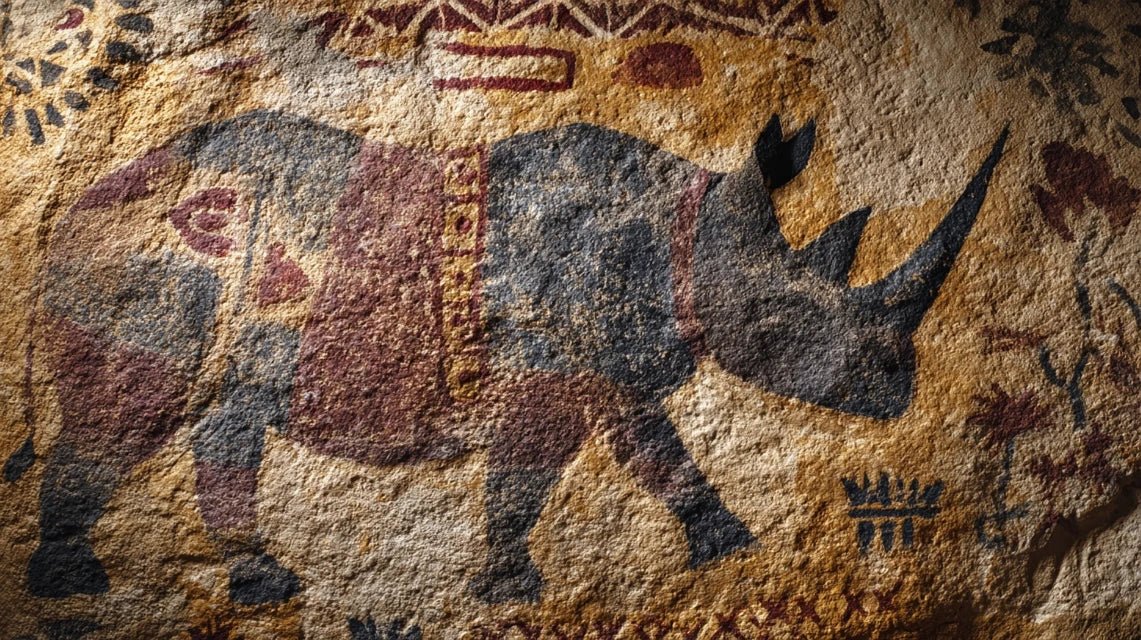
Imagine yourself facing an ochre rock face, in the silence of a southern African desert plateau. Your fingers brush against millennial engravings: a white rhinoceros, massive and powerful, seems to emerge from the stone. This creature, now threatened with extinction, was immortalized by prehistoric artists who observed it daily. The rhinoceros in African rock art tells a fascinating story: that of an intimate relationship between humans and animals over more than 27,000 years.
Here's what this evolution reveals: a transformation of artistic techniques testifying to major climatic changes, a profound modification of the symbolic relationship between communities and their environment, and a visual heritage of unsuspected richness that still influences contemporary African art today.
You may wonder why these representations seem so vivid, how peoples without writing were able to transmit such graphic mastery, or what these images tell us about lost ecosystems. The good news? Recent archaeological discoveries offer us astonishing answers that transform our understanding of prehistoric African art. Prepare for a visual journey through the millennia, where each stroke engraved in the rock becomes a window onto forgotten worlds.
The first appearances: when the black rhinoceros dominated the walls
In the caves of Namibia and South Africa, the oldest representations of rhinoceros date back to the Upper Paleolithic, between 27,000 and 19,000 years ago. At this time, African rock art favors the black rhinoceros (Diceros bicornis), recognizable by its slender silhouette and two prominent horns.
These early engravings reveal a remarkable anatomical observation. The artists capture the characteristic posture of the animal: head lowered, robust limbs, slightly arched dorsal line. Unlike European representations of the same period which often stylize animals, African creators opt for a striking realism.
The dominant technique? Percussion engraving, where the rock is hammered with hard stone tools to create deep furrows. This method produces durable images, capable of crossing the millennia without fading. Rhinoceroses often appear isolated, suggesting an animal respected for its solitary strength.
The golden age: multiplication of styles and techniques
Between 12,000 and 6,000 years ago, the rhinoceros in rock art experiences a true creative explosion. This period corresponds to the post-glacial warming that transforms African landscapes into lush savannas, rich in biodiversity.
The emergence of polychrome painting
Artists no longer simply engrave: they paint. At Tsodilo Hills in Botswana and in the Drakensberg mountains, white rhinoceroses are depicted in red ochre, brown and yellow. These natural pigments, mixed with organic binders (blood, eggs, resins), create frescoes of a remarkable visual intensity.
The white rhinoceros (Ceratotherium simum) is becoming increasingly frequent in representations, probably reflecting its expansion into grassy plains. Its more massive silhouette and square head adapted for grazing differ markedly from the black rhinoceros.
Narrative scenes appear
A major innovation: the rhinoceros is no longer alone. It integrates into complex compositions showing interactions with other animals (elephants, giraffes) or with human figures. These scenes suggest mythological narratives, hunting episodes or sophisticated naturalistic observations.
In some South African caves, we discover rhinoceroses associated with geometric patterns and handprints, creating a coded visual language whose complete reading keys we no longer possess.

Discover this inspiring artwork
The symbolic turning point: from hunted to sacred
Around 4,000 years BC, a subtle but significant transformation takes place. The rhinoceros in African rock art becomes less of a subject of naturalistic observation than a symbol of spiritual power.
Representations become stylized. Proportions are exaggerated: oversized horns, massive bodies reduced to essential geometric shapes. This evolution recalls the transition from figurative art to abstraction, but 6,000 years before modern European movements.
In the San (Bushmen) tradition, particularly documented in the Drakensberg, the rhinoceros acquires a shamanic dimension. It appears in trance scenes where semi-animal human figures seem to transform. This relationship with the rhinoceros transcends simple hunting to touch on the sacred, the connection between the visible and invisible worlds.
The colors themselves become charged with meaning: red ochre, associated with blood and life, dominates these later representations. The rhinoceros becomes guardian of vital forces, a bridge between earth and cosmos.
When the climate changes, art bears witness
The evolution of the rhinoceros in rock art reflects with astonishing accuracy the environmental upheavals that Southern and Eastern Africa has experienced.
Between 3,000 and 1,000 years BC, representations of rhinoceroses gradually become rarer in some regions. Periods of intense drought fragment animal populations. In areas where rhinoceroses disappear, rock art abandons them too, replaced by other species better adapted (antelopes, zebras).
This correlation between art and ecology makes decorated caves veritable climatic archives. By mapping the sites where rhinoceroses appear over different periods, researchers reconstruct the migrations of species, the extent of savannas, water availability.
Fascinating detail: in some Tanzanian caves, we observe superimpositions where older rhinoceroses are covered by more recent representations of other animals. These rock palimpsests tell the succession of ecosystems like chapters in a geological book.

Discover this inspiring artwork
The techniques revealed: how were these masterpieces created?
Modern analysis of African rock art reveals an extraordinary technical mastery. To represent a rhinoceros, the prehistoric artist followed a sophisticated process.
First step: the selection of the wall. Rhinoceroses are often painted or engraved on slightly concave surfaces, which accentuate their volume and create a striking three-dimensional effect at certain times of the day.
Second step: the preparation of pigments. Ochre is finely ground on grinding stones (we have found some with ochre residues dating back 100,000 years). The organic binder fixes the color and allows precise application with rudimentary brushes made of plant fibers or animal hair.
Third step: execution. Some rhinoceroses show erasures, corrections, proving that these works were not created in a mystical trance but with reflection, observation and technique. The outlines are often traced first, then filled.
Troubling detail: in several sites, the viewing angle of the rhinoceroses suggests that the artist observed them from an elevated point or that he possessed an exceptional visual memory, capable of reconstructing the animal from different angles without a direct model.
The living heritage: from rock to contemporary painting
The evolution of the rhinoceros in African rock art does not end with prehistory. It still irrigates contemporary artistic creation.
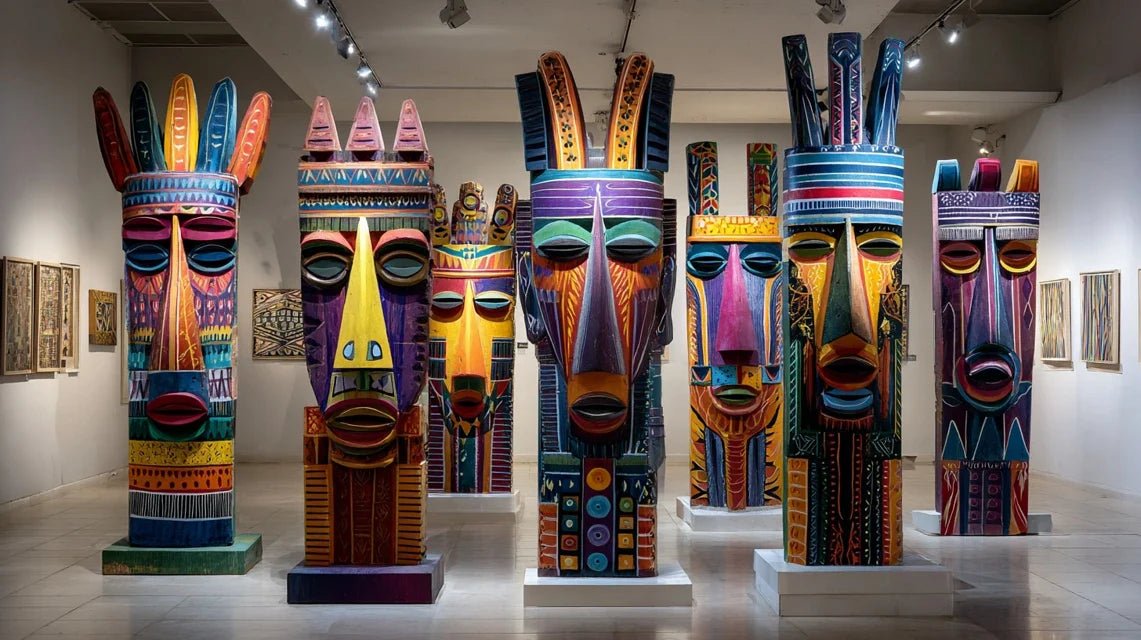
Many modern African artists draw on this millennial repertoire. The stylized forms of rock rhinoceroses reappear in painting, sculpture, textile design. This aesthetic continuity creates a fascinating dialogue between creators separated by 20,000 years but united by the same source of inspiration: African fauna and its evocative power.
The geometric patterns accompanying rhinoceroses in rock art influence contemporary African decorative art. These patterns, whose meaning is now understood to be more than just decoration, enrich modern creations with an ancestral symbolic depth.
Even more moving: in a context where rhinoceroses are threatened with extinction, their artistic representation becomes an act of cultural and ecological resistance. Painting a rhinoceros today is honoring 27,000 years of coexistence between man and animal.
Transform your interior into an ancestral art gallery
Discover our exclusive collection of African paintings that capture the timeless power of African wildlife and perpetuate this millennial artistic tradition in your living space.
Conclusion: a window on 27,000 years of coexistence
The evolution of the rhinoceros in African rock art depicts much more than an art history: it reveals an environmental, spiritual and human chronicle. From realistic engravings to polychrome paintings, from the hunted animal to the sacred symbol, each period has engraved its unique relationship with this majestic creature into the rock.
These millennial images remind us of a fundamental truth: art is born from attentive observation of living beings, from the desire to capture not only form but the essence of a presence. Prehistoric African artists did not simply reproduce; they interpreted, sacralized, transmitted.
Today, facing the potential disappearance of rhinoceroses, these decorated walls become poignant testimonies of what humanity risks losing. Perhaps it is time to look at these ancestral works not as archaeological curiosities, but as invitations to rethink our own relationship with the living world. Start by integrating this powerful aesthetic into your daily life: a reproduction, a decorative inspiration, a visual reminder that beauty and power have coexisted since the dawn of humanity.
Frequently asked questions about rhinoceros in African rock art
Why was the rhinoceros so often depicted in rock art?
The rhinoceros occupied a central place in the imagination of prehistoric African peoples for several reasons. Firstly, its imposing size and strength made it a remarkable animal, difficult to ignore in the landscape. Secondly, unlike fast felines or elusive birds, the rhinoceros moved slowly, offering artists the opportunity to observe it extensively in its natural environment. This prolonged observation explains the exceptional anatomical realism of the representations. Finally, in many ancient African cultures, the rhinoceros symbolized spiritual qualities: protective power, connection with terrestrial forces, guardian of sacred territories. Representing a rhinoceros was therefore not just an artistic exercise, but invoking these forces, creating a bridge between the material and spiritual world.
Can we precisely date the representations of rock rhinoceroses?
Dating rock art remains a scientific challenge, but researchers have several methods. For paintings, radiocarbon dating of organic binders (blood, eggs, resins) allows for direct dating, with a margin of error of a few centuries. For engravings, it is more complex: we date the mineral deposits that form on or under the engraved lines, or we analyze the patination (rock oxidation). Archaeologists also use stylistic stratigraphy: by studying the superposition of images and the evolution of techniques, they reconstruct relative chronologies. Finally, correlation with paleoenvironmental data (fossil pollen, sediments) helps to place representations in their climatic context. Result: we now know that some South African rock rhinoceroses date back more than 27,000 years, making them among the oldest known African artworks.
How did prehistoric artists achieve such accurate proportions?
This question has fascinated cave art specialists for decades. Several hypotheses coexist. The first explanation is an exceptional visual memory, developed out of necessity for survival. Prehistoric hunter-gatherers had to memorize precise anatomical details in order to effectively track game. This daily observation, repeated over years, created an intimate knowledge of animals. The second hypothesis is the use of projection techniques. Some researchers suggest that artists may have traced shadows projected by figurines or used rudimentary grid systems to transfer proportions. A third lead is the existence of a learning tradition, where techniques were passed down from generation to generation, gradually perfecting representation. Recent analyses show that some sites were used over several millennia, suggesting permanent workshops where artistic gestures were taught. This precision was therefore not miraculous, but the result of a sophisticated visual culture and transmitted know-how.