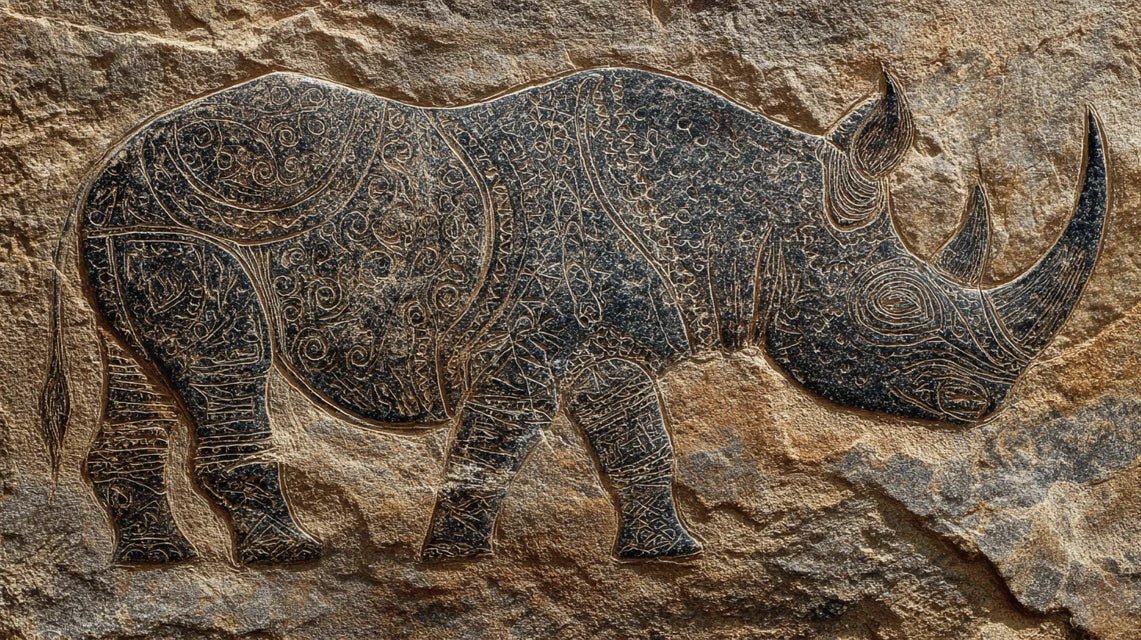
In the caves of the Sahara, on the rocky walls of Namibia and in the shelters of southern Africa, a massive silhouette emerges from ochres and blacks: the rhinoceros. Engraved millennia ago by the skilled hands of prehistoric artists, this colossal animal was not simply documented. It was venerated, feared, summoned. Each line, each curve bears witness to an intimate relationship between man and beast, where the rhinoceros embodied much more than a simple inhabitant of the savannah.
Here's what the symbolism of the rhinoceros in ancient African rock art reveals to us: a representation of vital power capable of transforming chaos into order, a spiritual mediator between the visible and invisible worlds, and a guardian of ancestral knowledge passed down from generation to generation. These millennial frescoes are not mere animal illustrations, but portals to a complex cosmology.
Yet, contemplating these works today in an archaeology book or during a museum visit often means missing their sacred dimension. We admire the technique, we marvel at their age, but we struggle to grasp why the rhinoceros, precisely, occupied such a privileged place in the imagination of these ancient peoples.
Rest assured: by exploring the meanings buried behind these rock representations, we can relearn how to read these ancestral messages. Each painting, each engraving of the rhinoceros in ancient African rock art then becomes an understanding key of civilizations that saw in this animal a universal symbol of resilience, mystical strength and cosmic connection.
Let's discover together how these Paleolithic artists immortalized the rhinoceros, and what their creations continue to whisper to us through the ages.
The rhinoceros, sacred colossus of prehistoric savannas
On the plateaus of the Drakensberg in South Africa, the San left stunning testimonies: rhinoceroses painted in red ochre, some crossed with energetic lines, others surrounded by human figures in trance. These representations are not part of the ordinary bestiary. The rhinoceros in ancient African rock art appears as a being charged with spiritual power, an animal whose very body mass evoked the stability of the world.
In the cosmology of hunter-gatherers, the rhinoceros symbolized earthly strength, this raw energy emanating from the earth itself. Its unique horn, pointed towards the sky, created a vertical axis connecting the earthly depths to the celestial spheres. Shamans sought its help in their rituals to channel this power, to access altered states of consciousness.
The symbolic anatomy of the pachyderm
Observe carefully the details: the rhinoceros' horn is often exaggeratedly long in ancient African rock art. This distortion is not clumsy, but symbolic emphasis. The horn represented the spiritual weapon, the tool for defense against evil forces, the natural scepter conferring authority and protection.
The massive legs, always solidly anchored to the ground in representations, evoked grounding and an unwavering connection to the nurturing earth. Unlike bounding antelopes or slender felines, the rhinoceros in ancient African rock art is almost always static, immutable, eternal.
When shamans summoned the spirit of the rhinoceros
In the Apollo 11 caves in Namibia, dated back more than 25,000 years ago, archaeologists discovered stone slabs adorned with rhinoceroses with strange proportions, sometimes hybridized with human forms. These works bear witness to shamanic practices where the artist-shaman identified with the animal to access its spiritual attributes.
The rhinoceros served as a psychic vehicle. By painting its silhouette, by engraving its outline in the rock, the shaman was not simply reproducing what he saw: he was invoking the very essence of the animal. This practice, documented in ancient African rock art throughout the continent, reveals an animistic conception of the world where each creature possessed a soul, a vital force that could be mobilized.
The scenes of transformation
Some frescoes show figures that are part human, part rhinoceros: bodies of men topped with horned heads, or rhinoceroses adopting bipedal postures. These therianthropic representations in ancient African rock art illustrate the critical moment of the shamanic ritual, this second where the officiant becomes the animal, absorbs its power, sees through its eyes.
In the oral tradition of the Khoi peoples, transmitted until modern times, the rhinoceros was a guardian of passages, one who allowed crossing the borders between the world of the living and that of the ancestors. Painting the rhinoceros meant opening this door.

Discover this inspiring artwork
The sacred geography: where the rock rhinoceros appears
The location of rhinoceros representations in ancient African rock art is never random. In central Sahara, in the Tassili n'Ajjer and Acacus massifs, rhinoceroses adorn the walls of caves near permanent water sources, vital points in the still-green prehistoric desert.
In southern Africa, the Tsodilo sites in Botswana, considered sacred by local populations for millennia, concentrate dozens of painted rhinoceroses. These places were ritual sanctuaries, spaces where the veil between the profane and the sacred thinned. The rhinoceros in ancient African rock art marked these territories as zones of power.
Revealing superimpositions
A fascinating fact: in several sites, rhinoceroses have been repainted at different times, sometimes over thousands of years. These rock palimpsests suggest that certain places dedicated to the rhinoceros retained their sacred character through generations, each new culture reaffirming the symbolic importance of the animal.
In the Brandberg Mountains in Namibia, the famous Lady of Brandberg fresco coexists with several finely detailed rhinoceroses. This proximity between stylized human figures and precise animal representations in ancient African rock art reveals a symbolic hierarchy: the rhinoceros as a protective entity for human rituals.
From pigment to prophecy: techniques and rituals
Creating a rhinoceros on a rocky wall was not an ordinary artistic act, but a complex ritual. The pigments used – red and yellow ochres, manganese oxides for the blacks – were collected in specific places, sometimes days away, and prepared according to precise protocols.
Chemical analysis of the rhinoceros paintings in ancient African rock art reveals the addition of organic substances: animal fats, blood, sometimes vegetable resins. These binders had more than a technical function: they incorporated the vital essence into the painting itself, creating a material link between the living animal and its representation.
The choice of the rocky support
Artists carefully selected the surfaces. Rhinos are often painted on slightly concave walls, creating a relief effect that brings the silhouette to life when the flickering light of a fire dances across it. This theatrical dimension transformed the contemplation of the rhino in ancient African rock art into an immersive experience.
Some rhino engravings in southern Africa use the technique of deep pitting, creating furrows that can be touched, traced with a finger. This tactile dimension suggests that the representations also served as educational tools, where elders taught young initiates the stories and meanings associated with the sacred animal.

Discover this inspiring artwork
The contemporary legacy of a millennial symbol
Today, as the real rhino is threatened with extinction, its representations in ancient African rock art acquire a prophetic resonance. These paintings remind us of a time when humanity lived in respectful balance with megafauna, where each animal was recognized as a bearer of wisdom.
Contemporary African communities are rediscovering these rock sites not as mere archaeological curiosities, but as living spiritual archives. The rhino painted 10,000 years ago still speaks of resilience, quiet strength, connection to the earth – values crucially necessary in our fragmented modern world.
In contemporary interior spaces, incorporating references to ancient African rock art, particularly representations of the rhino, is inviting this ancestral memory into our daily lives. It's creating a bridge between prehistoric wisdom and our current aspirations for meaning and authenticity.
Bring the power of ancestral symbols into your home
Discover our exclusive collection of African wall art that celebrates the artistic and spiritual heritage of the continent, and transforms each wall into a portal to millennial wisdom.
Read the messages of ancestors on stone
Understanding the symbolism of the rhinoceros in ancient African rock art is developing a new perspective on our relationship with the animal and spiritual world. These frescoes teach us that each creature possesses a sacred dimension, that strength is not only physical but also mystical, and that art is above all a language of connection.
Prehistoric artists were not seeking to decorate, but to communicate with the invisible. The rhinoceros was their messenger, their ally, their teacher. By contemplating these works today, we can relearn this forgotten grammar, this way of seeing the world where every form, every line, every color carries a deep intention.
In your own living space, be inspired by this symbolic approach. Choose decorative elements not only for their aesthetics, but for the stories they tell, the energies they evoke, the dialogues they establish between past and present.
The rhinoceros of African caves invites you to this transformation of gaze: see beyond appearances, recognize the sacred in everyday life, and honor the memory of those who, long before us, knew how to capture on stone the very essence of life.