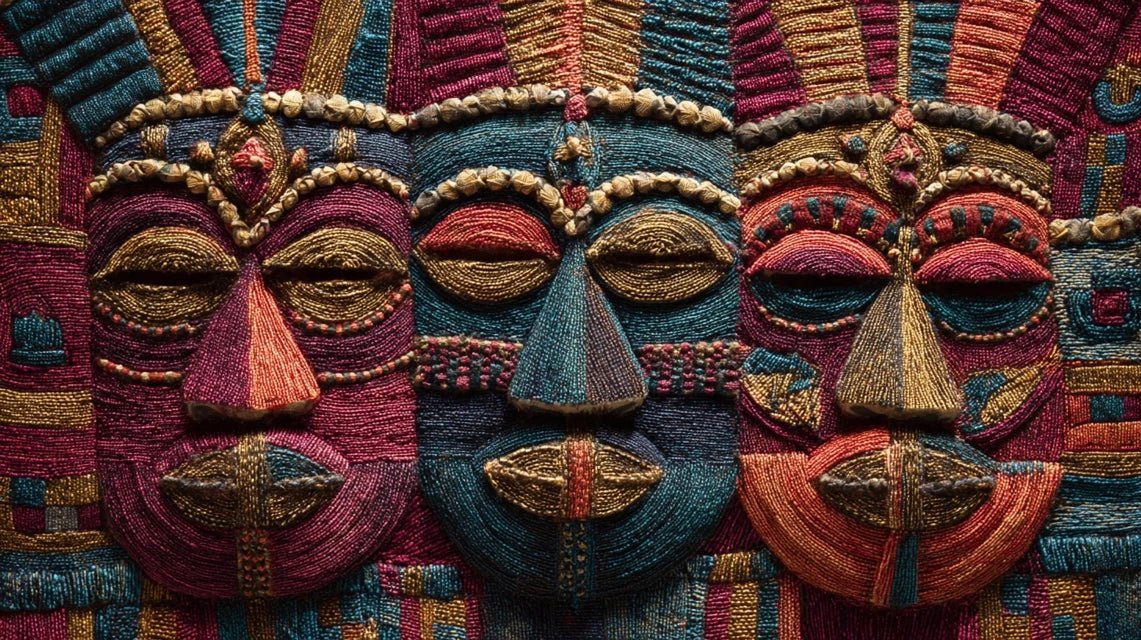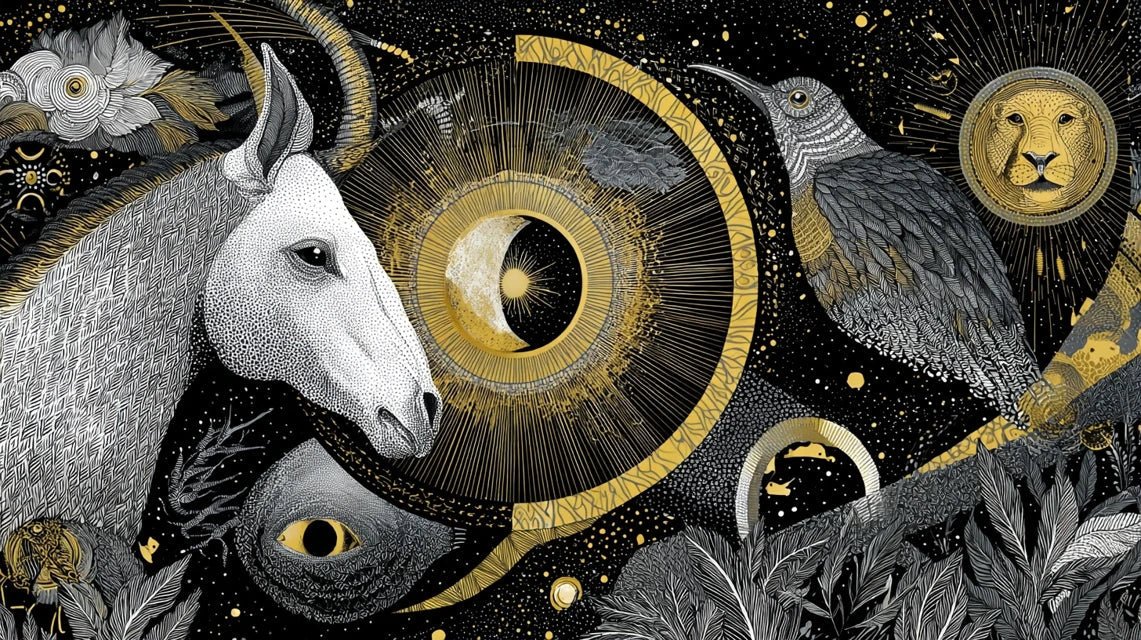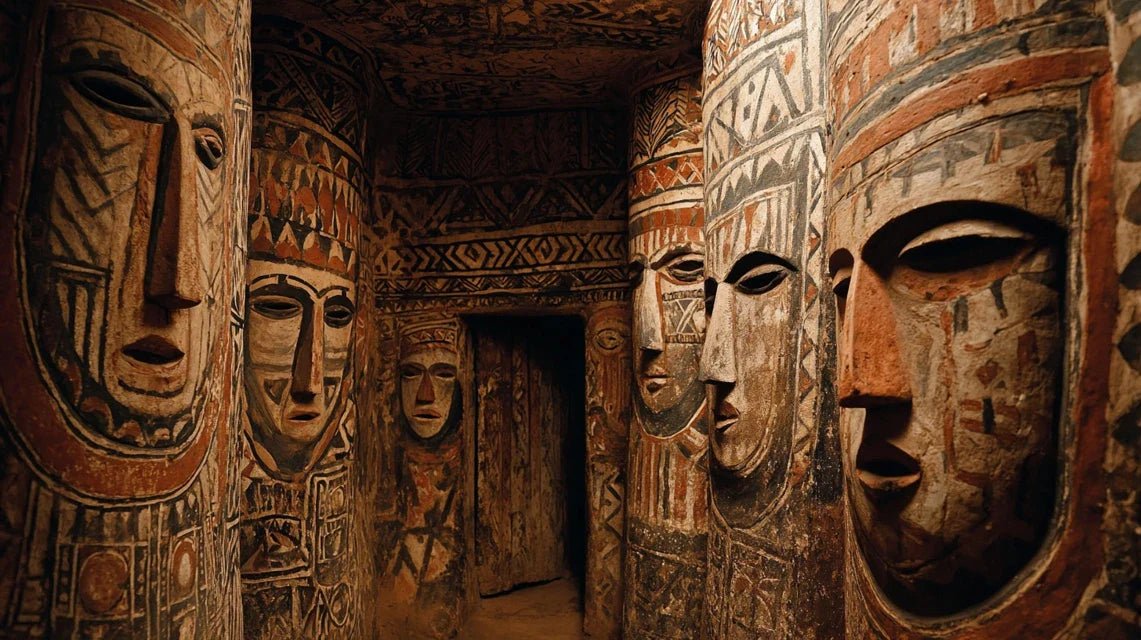
In the forgotten depths of the ancient Kongo kingdom, vaulted ceilings reveal frescoes of breathtaking beauty. Imagine these ochre, red and black pigments dancing on cold stone for centuries, telling stories of deceased kings, passages to the afterlife, and dynastic power. These Kongo royal tomb frescoes are not mere wall decorations: they embody a worldview where funerary art dialogues with eternity. Today, these ancestral compositions inspire designers and decorators seeking authenticity, visual spirituality and deep cultural connection.
Here's what the Kongo royal tomb frescoes bring to your interior world: a timeless narrative dimension that transforms your walls into storybooks, a powerful chromatic palette from natural pigments that instantly warms up the space, and a spiritual symbolism that invites contemplation and respect for ancestors.
Perhaps you are looking for that particular soul that is missing from your interior, that cultural depth that fleeting trends cannot offer. You admire African art without knowing how to integrate it properly, without falling into superficial appropriation or simple exotic decoration.
Rest assured: understanding the history and meaning of these Kongo tomb frescoes will allow you to incorporate their essence with respect and creativity. Prepare to discover a visual universe where each motif tells the grandeur of a civilization, and where each color carries a sacred intention.
Sacred Necropolises: When Art Meets Eternity
The Kongo royal tombs were mainly located in Mbanza Kongo, the spiritual capital of this empire that dominated Central Africa from the 14th to the 19th century. These tombs were not simple cavities: they constituted architectural sanctuaries where the Manikongo, these sovereigns whose power transcended death, rested.
Kongo artists mastered the art of transforming raw stone into a narrative surface. On the interior walls, they applied mineral plasters prepared according to ancestral recipes, mixing local clays, lime and plant binders. This preparation created a smooth support, ready to receive the funerary frescoes that would accompany the deceased on their cosmic journey.
Each Kongo tomb fresco followed a precise cosmology: the world of the living (nseke), the kingdom of waters (kalunga), and the universe of ancestors (mpemba). The mural compositions illustrated this passage, with geometric symbols representing the sun (cycle of life), the crescent moon (rebirth), and the cosmological crosses called yowa which structured the space between worlds.
A Palette Dictated by the Earth and the Sacred
The pigments of the Kongo royal frescoes came exclusively from natural sources imbued with symbolism. Red ochre, extracted from laterites rich in iron oxide, evoked vital blood and a telluric connection. Deep black, obtained by calcining ritual wood or grinding manganese, represented the invisible world of ancestors.
White, considered the most sacred color, came from carefully purified kaolin. In Kongo royal tombs, this white marked passages, thresholds, moments of transformation. Artists applied it with feathers or plant fibers, creating lines of extraordinary finesse that symbolically guided the deceased.
Deciphering motifs: a millennial visual language
The frescoes in royal tombs are never decorative in the modern sense: every stroke is intentional. Spirals, omnipresent, symbolize the perpetual movement between life and death, cosmic energy constantly rotating. They often appear in pairs, evoking the fundamental duality of Kongo existence.
Checkerboard patterns, characteristic of Kongo frescoes, represent the alternation of day/night, visible/invisible world. This cosmic grid structures the pictorial space as it structures the universe according to Kongo thought. Observing these compositions is understanding a philosophy where nothing is linear, where everything circulates.
Stylized anthropomorphic representations rarely show individual details: they embody royal archetypes, essences rather than portraits. The Manikongo often appears in a ceremonial position, surrounded by attributes of power: the scepter of command, copper bracelets, sometimes felines symbolizing spiritual strength.
The Christian influence: a fascinating pictorial syncretism
From the 15th century onwards, the arrival of the Portuguese and the partial conversion of the Kongo elite to Christianity transformed the frescoes in tombs. Latin crosses then appeared merged with traditional cosmogonic crosses, creating hybrid symbols of exceptional visual richness.
These syncrétique frescoes testify to a remarkable ability to adapt: Kongo artists integrated Christian saints and angels while preserving the ancestral cosmological structure. Saint Anthony, particularly venerated, mingled with traditional spiritual guardians in compositions where the two religious systems dialogued harmoniously.

Discover this inspiring artwork
From the necropolis to your interior: decorative inspiration
How to transpose the power of Kongo tomb frescoes into a contemporary space without betraying their sacred dimension? The key lies in understanding, not literal copying.
For an accent wall inspired by Kongo frescoes, prioritize an authentic earthy palette: burnt ochres, sienna earths, deep matte blacks, and that touch of mineral off-white. Avoid saturated or neon versions that would completely distort the contemplative spirit of these compositions.
The geometric motifs of royal tombs lend themselves beautifully to contemporary techniques: handcrafted stencils for cosmic checkerboards, knife applications to recreate the original mineral texture, or even shadow projection via laser cuts for a more conceptual interpretation.
Textiles and materials: extending the heritage
Kongo frescoes also inspire textile design. Contemporary African creators translate these funerary motifs into prints on linen, organic cotton or raffia, creating cushions, tapestries and rugs that carry this visual memory. The result? Interiors where every element tells a story.
Raw materials amplify the effect: combine these patterns with ebony wood, woven baskets made of natural fibers, soapstone sculptures. This material stratification recreates the atmosphere of royal tombs – that tactile connection to the earth and ancestral craftsmanship.
Preserving and transmitting: contemporary challenges
Kongo royal tomb frescoes face an existential threat. Humidity, looting, and rapid urbanization of Mbanza Kongo endanger these irreplaceable testimonies. Some necropolises have been documented in extremis before their complete disappearance.
3D digitization initiatives now allow the creation of high-resolution virtual archives. These technologies offer a second life to frescoes, making their beauty accessible to researchers, artists and enthusiasts around the world, while respecting the sacred character of the original sites.
Drawing inspiration from Kongo frescoes today also means participating in their memory. Each contemporary creation that draws on this visual heritage contributes to keeping alive a tradition that could otherwise fade into oblivion. It is a responsibility as much as it is a source of inspiration.
Respectful appropriation: a question of intention
Integrating the aesthetics of Kongo tombs into your decor requires a conscious approach. Learn about the meaning of the motifs you choose. Favor creations by contemporary African artists who reinterpret this heritage from within, with cultural legitimacy.
Avoid servile reproduction of specific funerary symbols without understanding their significance. Prefer formal inspiration – geometries, palettes, compositions – rather than the exact copy of sacred frescoes. This nuance makes all the difference between respectful appropriation and superficial exploitation.
Transform your walls into a cultural journey
Discover our exclusive collection of African paintings that capture the spirit of the continent's great pictorial traditions and bring narrative depth to your interior.

Discover this inspiring artwork
Visualize your space transformed
Imagine your living room at dusk. The grazing light caresses this accent wall with ochre and deep black tones, revealing the subtle reliefs of a composition inspired by Kongo frescoes. Your guests approach, intrigued by this geometry that is both familiar and mysterious. You then tell the story of royal tombs, of those anonymous artists who painted for eternity.
It's not just decoration: it's a cultural conversation that crosses centuries. It is proof that an interior can be beautiful and meaningful, aesthetic and educational, contemporary and deeply rooted.
The frescoes of the Kongo royal tombs remind us that true art never dies. It transforms, travels, inspires new creations. By integrating their essence into your living space, you become a guardian of a precious memory and creator of your own visual narrative. Start small: a motif, a palette, a respectful intention. The rest will follow naturally, like these cosmic spirals that have been turning for centuries on the sacred walls of Central Africa.
Frequently Asked Questions about Kongo Royal Tomb Frescoes
Can we still visit Kongo royal tombs with original frescoes?
Visiting authentic Kongo royal tombs is extremely limited and regulated. Most necropolises containing original frescoes are protected due to their extreme fragility and sacredness for local communities. Mbanza Kongo, a UNESCO World Heritage site since 2017, offers an interpretation center with high-fidelity reproductions and photographic documentation of the frescoes. These reproductions allow you to appreciate the beauty of the compositions without compromising the preservation of the originals. For enthusiasts wishing for a more direct connection, some European and American museums exhibit fragments of frescoes taken during colonial expeditions – pieces whose patrimonial status is the subject of important ethical debates about restitution. The most respectful alternative is to explore digital archives compiled by institutions such as the Royal Museum of Central Africa in Tervuren (Belgium) or to support documentation initiatives led by Congolese researchers.
How to recreate the natural pigments of Kongo frescoes at home?
Authentically reproducing the pigments of Kongo tomb frescoes requires patience and research into natural materials. For the characteristic red ochre, you can obtain natural ocher earths from specialized fine arts stores or traditional pigment shops. Mix them with a natural binder such as casein (milk protein), rabbit skin glue, or simply a matte acrylic medium for a contemporary version. The deep black is obtained with vine black or bone black (available in pure pigments), which offer that incomparable matte depth. For the mineral white, prefer Meudon white or pure kaolin rather than modern titanium white, which is too opaque. The key lies in the matte and powdery finish typical of ancient mineral paints. Test your mixtures on samples of plaster or lime mortar to get closer to the original texture. Several artisans specializing in antique decoration also offer workshops on painting with natural pigments that will allow you to master these ancestral techniques with expert guidance.
Did Kongo fresco motifs influence Western modern art?
Absolutely, although this influence is often unknown or underdocumented. From the beginning of the 20th century, Kongo frescoes and arts fascinated European avant-gardes as much as masks and sculptures. Artists like Pablo Picasso, Paul Klee or Amadeo Modigliani collected documentation and African art objects, including reproductions of Kongo mural compositions. The cosmic geometries, symbolic checkerboards and spirals characteristic of frescoes in tombs are found in cubism, constructivism and geometric abstract art. More recently, contemporary African artists and diaspora artists such as Chéri Samba, Bodys Isek Kingelez or Lubaina Himid consciously reinvest this visual heritage into their creations, creating a dialogue between Kongo funerary tradition and contemporary artistic expression. This aesthetic circulation illustrates how Kongo royal frescoes, far from being exotic curiosities frozen in time, constitute a living visual language that continues to irrigate global creation. Recognizing this influence is also doing justice to the conceptual and formal sophistication of an art too long relegated to the status of primitive craft by Western art history.