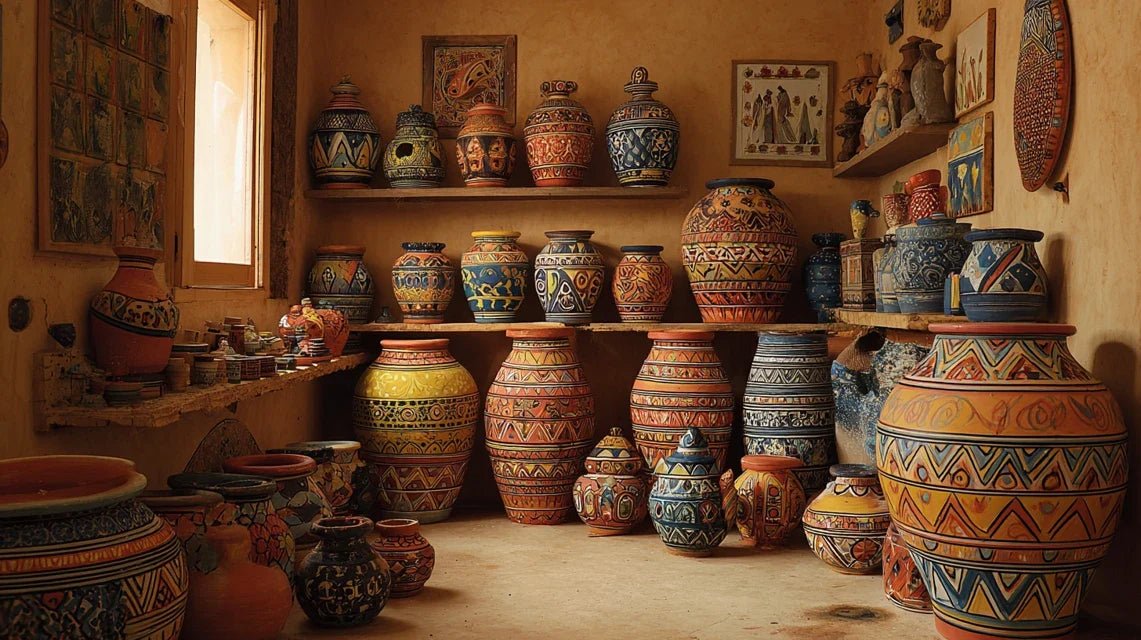
The first time I laid eyes on an authentic Kabyle jar in the workshop of a potter from Beni Yenni, I was mesmerized by these ancestral geometric patterns that seemed to tell stories spanning millennia. These symbols - triangles, diamonds, chevrons - carry within them an astonishing visual force, a collective memory passed down from hand to hand for generations. Today, these Berber pottery motifs are experiencing a spectacular renaissance in our contemporary interiors, particularly in wall art. Here's what incorporating these patterns brings: authentic cultural depth that anchors the space, a powerful graphic dimension that visually structures your walls, and an emotional connection to a living artisanal heritage. Perhaps you hesitate, fearing that these traditional motifs will clash with your current decor or appear too folkloric? This apprehension is legitimate, but unfounded. Berber patterns possess this rare ability to dialogue as well with Scandinavian minimalism as with a bohemian or industrial interior. I promise you that by the end of this article, you will know exactly how to bring this visual richness into your home, subtly and personally.
The visual grammar of Berber pottery: decoding the symbols
Before transposing these patterns into wall art, let's understand their language. Berber pottery is never decorated randomly. Each triangle evokes the mountains of the Atlas, each diamond represents the protective eye against bad luck, each broken line symbolizes water, a source of life in these arid lands. Amazigh potters - for it is traditionally women who shape these pieces - compose with a limited but infinitely combinable vocabulary: chevrons, crosses, parallel lines, dots.
This sacred geometry works on a principle of symmetry and repetition that naturally creates a soothing visual rhythm. It is precisely this that makes these patterns so relevant for contemporary wall art: they structure the space without weighing it down, bring complexity without confusion. When you choose to incorporate these Berber patterns, you are not simply adopting a decorative style - you are bringing in a cosmogony, a way of seeing the world where each sign carries meaning.
Three approaches to transpose pottery into wall composition
The fragmentary approach: isolate an emblematic motif
The most accessible method is to extract a unique motif from Berber pottery and magnify it. Imagine a large central rhombus surrounded by triangles, enlarged to the scale of a 2-meter wall: you get a wall artwork that is minimalist but full of symbolism. This approach works beautifully in clean spaces where you want to create a focal point without visually saturating the space. The secret? Respecting the original geometric proportions while playing with dimensions. An equilateral triangle must remain equilateral, even at a large scale.
The panoramic approach: creating a narrative frieze
Kabyle pottery often features horizontal decorative bands that overlap. Translate this principle by creating a wall frieze that runs the entire length of a wall, ideally at eye level. This composition of horizontal bands - alternating full motifs and breathing spaces - evokes the geological stratifications of Maghreb landscapes. It visually lengthens the room and guides the gaze in a fluid movement. I saw this technique transformed into a true installation in a Parisian loft: three bands of Berber motifs painted in ochre and Sienna tones on a cream background, creating stunning spatial depth.
The modular approach: composing with multiple formats
The third path is to create a wall gallery where different motifs from Berber pottery dialogue with each other. Think of a wall where several frames coexist - some circular like jars viewed from above, others rectangular like unrolled friezes - each presenting a different motif but in a consistent color palette. This modular approach offers remarkable flexibility: you can start with two or three pieces and gradually enrich your wall composition over time.

Discover this inspiring artwork
The color palettes that honor tradition
The colors of Berber pottery are not arbitrary. They historically come from natural pigments: red ochre from iron oxide, black from manganese, lime white, sometimes yellow from gum gutta. For an authentic wall integration, prioritize these earthy tones that immediately evoke the landscapes of the Maghreb. On a pure white wall, a pattern in these warm tones creates a striking contrast while remaining gentle on the eye.
But contemporary interpretation also allows for boldness: I have seen Berber patterns executed in deep blue and gold on charcoal gray background, creating a mysterious nocturnal atmosphere. Or even in sage green and terracotta tones for an unexpected botanical rendering. The essential? Maintain a clear tonal hierarchy: a neutral background, one or two main colors for the motifs, possibly a metallic accent. This chromatic discipline avoids the pitfall of folklore and preserves the graphic elegance of Berber compositions.
Execution techniques: from stencil to custom wallpaper
To create these wall patterns, several paths are open to you depending on your level of daring and your budget. The stencil remains the most accessible method: you trace a Berber pottery pattern, transfer it to a rigid support that you hollow out, then stamp with acrylic paint. This technique is particularly suitable for the fragmentary approach or repetitive friezes. It requires patience and precision, but offers immense satisfaction when the motif gradually reveals itself on your wall.
For more ambitious compositions, custom wallpaper represents a worthwhile investment. Several specialized workshops can now print your own compositions of Berber patterns on panels of non-woven paper. You design your composition - by photographing authentic pottery or drawing your own interpretations - and obtain a professional rendering, installable in one day. Between these two extremes, the direct wall painting with a fine brush seduces artistic souls: it requires mastery but allows nuances, imperfections that humanize the motif and recall the gesture of the potter.
Want to start your visual journey without brush or stencil?
Discover our exclusive collection of African art that captures the essence of Berber traditions in contemporary compositions ready to sublimate your walls.

Discover this inspiring artwork
Harmonizing with the existing decor: the art of decorative conversation
The main concern I constantly hear: Will these patterns clash with my current furniture? The answer lies in a simple principle: Berber pottery motifs function as complex neutrals. Their geometric nature and natural palette allow them to dialogue with a surprising variety of styles. In a Scandinavian interior with clean lines, they bring the warmth and texture that is often lacking. In an already rich bohemian space, they structure and visually organize creative clutter.
The secret to successful integration? Create visual echoes. If your wall composition features triangles, subtly repeat this form elsewhere: graphic cushions, conical lampshade, pyramidal sofa end table. These discreet correspondences weave a coherence that unifies the space without proclaiming Look, I have a theme! Similarly, pick up at least one of the colors from your wall motifs in three other elements of the room - a throw blanket, a rug, book bindings. This chromatic repetition anchors your Berber wall art within the overall decor.
Beyond decoration: creating a spatial experience
What distinguishes simple decoration from true wall art is the ability to transform the perception of space. Berber pottery motifs, with their intentional geometry, possess this faculty. A wall adorned with a composition of ascending chevrons appears visually higher - perfect for counteracting the crushing effect of a low ceiling. A horizontal frieze of repeating patterns optically lengthens a narrow room. A large central diamond on the main wall instantly creates a focal point that organizes all the furniture around it.
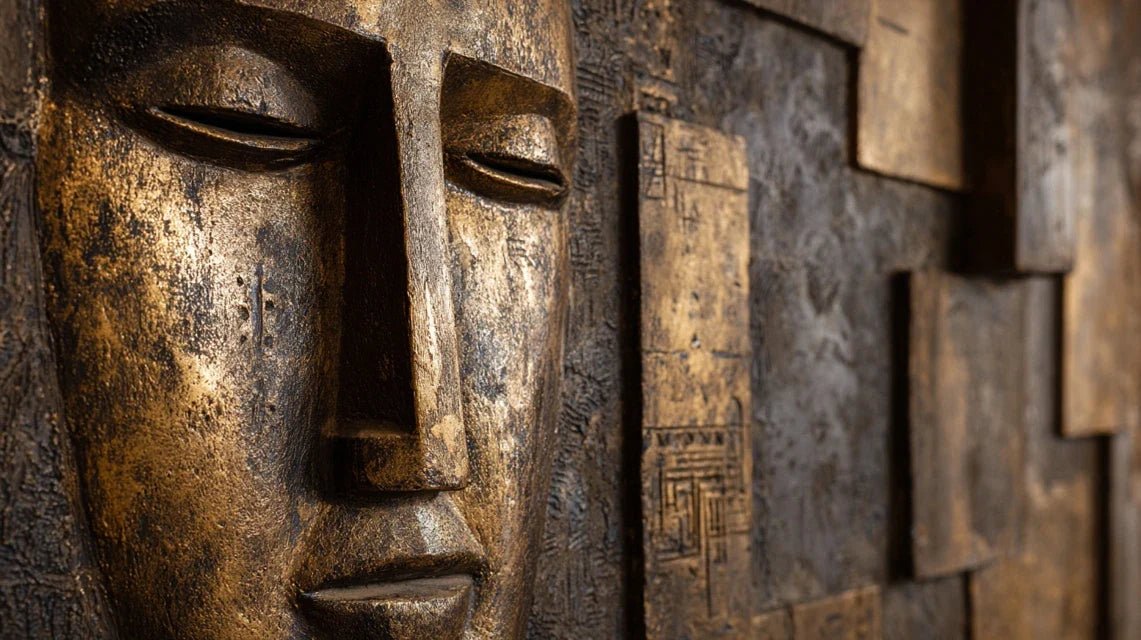
I also encourage you to think of lighting as an integral part of your wall project. A directional spotlight grazing a relief composition - if you have opted for sculpted plaster or engraved wood panels - creates shadow play that brings the Berber motifs to life throughout the day. The same composition changes radically between morning and evening light, as if the wall breathes in time with the sun - exactly like these Berber pottery pieces which, in their village of origin, change appearance over the hours.
Authenticity without appropriation: a respectful approach
Integrating Berber pottery motifs into our Western interiors legitimately raises questions of cultural appropriation. How to celebrate this artistic richness without distorting it or reducing it to a mere decorative effect? My conviction, forged by years of exchanges with Maghreb artisans: authenticity begins with knowledge. Find out about the origin of the motifs you use. Understand that one symbol traditionally served as protection, another accompanied marriage rituals.
This conscious approach transforms your wall art into a tribute rather than a superficial borrowing. Whenever possible, prioritize acquiring works created by artists of Berber or Maghrebine origin who reinterpret their visual heritage themselves. You are not just decorating your walls: you are participating in the living transmission of ancestral knowledge, creating a tangible cultural bridge between the Atlas Mountains and your living room, between the hands of a potter from Sejnane and your daily life. This awareness radically transforms your relationship with your space.
Imagine this moment: you return home after an exhausting day, and your gaze falls on that wall you have transformed. These Berber motifs are no longer just geometric shapes - they have become a visual refuge, a daily reminder that timeless forms of beauty exist, creative gestures that cross the centuries. Start modestly if the project intimidates you. A single well-chosen, well-placed motif is enough to transform a space. The essential thing is not the area covered, but the intention you put into it. Draw, photograph, compose. Let these millennial symbols dialogue with your contemporary sensibility. Your walls await their story.
FAQ: Your questions about Berber wall art
Do Berber pottery motifs suit a small space?
Absolutely, and they can even become your best allies in small volumes! The common mistake is to believe that a complex motif will visually shrink the space. In reality, it all depends on your approach. In a small room, prioritize the fragmented approach: a single large Berber motif on an accent wall, in contrasting neutral tones. This focal point creates depth and attracts the eye, paradoxically giving an impression of spaciousness. Avoid multiplying small motifs on all walls, which would actually create a feeling of clutter. A 25m² Parisian studio where I advised installing a large ochre Berber rhombus on the back wall now seems 30% more spacious - the motif creates a visual horizon that mentally pushes back the limits of the room. The key? Think big and singular rather than small and multiple.
How to choose the right Berber pottery motif for my personal style?
Choosing a Berber pattern should reflect not only your aesthetic but also your deep personality. Start by observing authentic pottery - online, in African art museums, or even better during travels. Spontaneously note the compositions that immediately attract you. Are you sensitive to structured and symmetrical patterns, with their reassuring repetitions? You will probably appreciate Kabyle friezes with regular chevrons. Do you prefer more free, almost abstract compositions? Opt for more spontaneous Rifian motifs. Is your interior minimalist? A clean pattern in a two-tone palette will suffice. Do you like visual abundance? Dare to create a dense polychrome composition. My practical advice: create a Pinterest board or print out some pottery that speaks to you, live with these images in your space for a few days, and observe which ones your gaze naturally returns to. It is your intuition that knows the answer.
Can I mix Berber patterns with other cultural influences?
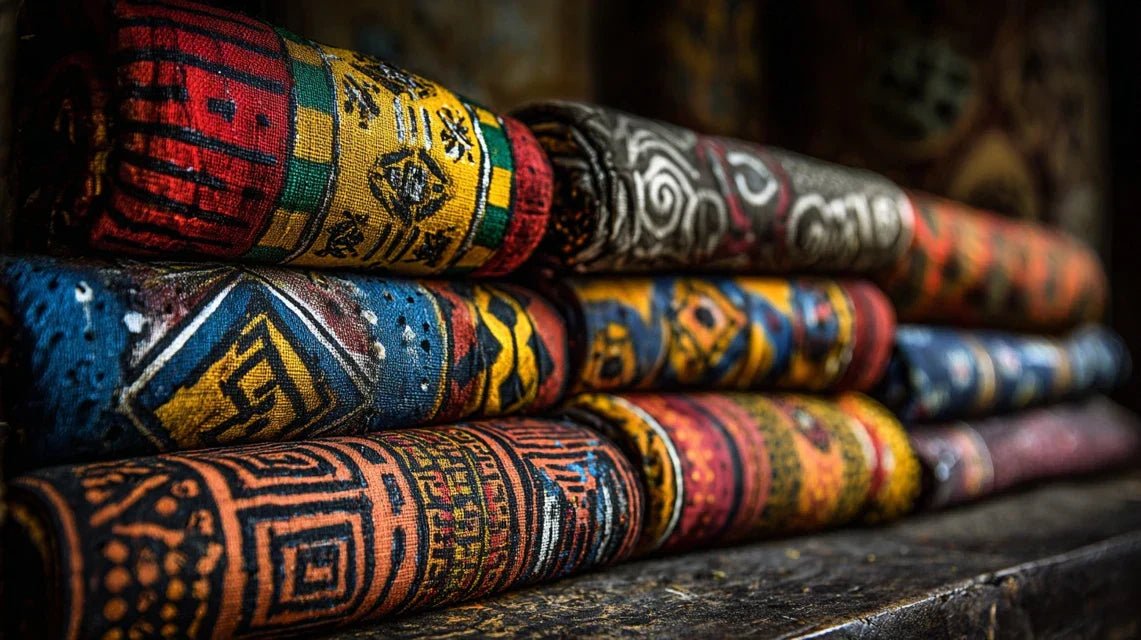
Not only can you, but that's often where the most personal and vibrant wall compositions are born! Berber patterns share surprising geometric affinities with other decorative traditions: streamlined Scandinavian motifs, Anatolian kilims, Navajo textiles, even some Art Deco patterns. The principle for successfully mixing these? Find the common thread that unifies these diverse influences. This could be a common color palette - imagine Berber ochre and indigo patterns paired with Japanese elements in the same tones. Or a shared formal principle - the angular geometry that unites Berber motifs and Scandinavian design. I saw a magnificent interior where one wall featured Kabyle pottery motifs while the adjacent wall displayed Japanese prints: both dialogued harmoniously thanks to a common use of emptiness, negative space as a compositional element. Eclecticism works when it reveals deep affinities rather than simply juxtaposing differences. Your wall art can become a magnificent narrative of your multiple cultural curiosities.