The first piece of bogolan I ever held smelled of earth. It was fifteen years ago, in a cooperative in Ségou, and the dyer who handed it to me had hands blackened by decades of work. She told me something I’ll never forget: “This fabric tells the story of our mothers, their mothers, and all those who have spoken with mud.” At that moment, I understood that bogolan was not simply a textile. It was a living library, a coded language woven into cotton and written with the earth of the Niger River.
Here's what the origin of Malian bogolan reveals: an ancestral dyeing technique based on fermented clay that transforms white cotton into a narrative canvas, a know-how exclusively passed down by women since the 12th century, and a system of geometric symbols that encodes the history, beliefs, and identity of the Bambara and Dogon peoples of Mali.
Yet, when we admire these graphic patterns in decorating magazines, we often ignore their origins. Where do these particular ochre and black hues come from? Why these geometric shapes that seem so contemporary? And above all, how does a process born in the villages of Mali in the Middle Ages still fascinate creators around the world?
Rest assured: understanding the origin of bogolan requires no technical textile knowledge. In the lines that follow, I'll take you to the banks of the Niger, into workshops where women transform mud into art, and at the heart of a tradition that defies time. You will discover how this humble fabric has become an emblem of contemporary African design.
Bogolan: when mud becomes ink
The word itself is a poetic enigma. Bogolan comes from Bambara: bogo means “earth” or “mud,” and lan means “with” or “by means of.” Literally, bogolan translates to “made with mud.” This etymology alone summarizes the entire philosophy of this technique: transforming the most common element, the earth beneath our feet, into a medium for artistic expression.
The origin of bogolan dates back to the great medieval civilizations of Mali. Historians place its birth between the 12th and 14th centuries, in the Beledougou region, north of Bamako. At that time, the Empire of Mali was flourishing, Tombouctou was an intellectual metropolis, and artisans were developing sophisticated textile techniques. Bogolan emerged in this context, probably first as a utilitarian fabric before becoming ceremonial.
What makes bogolan unique is its reversed process. Unlike classic dyes that add color, bogolan dyeing works by subtraction. We start with hand-woven cotton, which is entirely dyed yellow ochre with a decoction of ngalama tree leaves (Anogeissus leiocarpus). Then comes the magic: the application of fermented mud, rich in iron oxide, which darkens the treated areas. Finally, an alkaline solution is applied to discolor certain parts, revealing the original white cotton.
The three sacred colors of bogolan
Each color of the bogolan carries a cosmological meaning. The black, obtained from fermented mud, symbolizes fertility, knowledge and spiritual power. The white, which is actually undyed cotton revealed by discoloration, represents purity, light and truth. The yellow-ochre, the first basic dye, evokes the nourishing earth and abundance.
This limited palette has crossed centuries without major variation. Why? Because it reflects the very essence of the Malian landscape: the brown waters of the Niger, the fertile clay soils, the golden desert expanses. Bogolan is a portable landscape.
The guardians of an age-old knowledge
In Bambara tradition, bogolan is exclusively produced by women. This specialization is not insignificant: it is part of a cosmological division of labor where men weave white cotton on their horizontal looms, while women transform it into visual storytelling through dyeing.
I was fortunate enough to spend several weeks with the dyers of Ségou, and I realized that their role goes far beyond technique. They are the keepers of a complex symbolic language. Each geometric motif they trace freehand with a wooden stick or a piece of metal has a name, a story, a function.
The training of a bogolan dyer begins in childhood. Girls first observe, memorizing the precise gestures: how to collect mud in backwaters, let it ferment for months in large earthenware jars, prepare vegetable decoctions according to the seasons. Around twelve or thirteen years old, they begin to trace simple motifs. Upon reaching adulthood, they master the complete repertoire of symbols and can improvise original compositions while respecting the ancestral visual grammar.
The secrets of fermented mud
Preparing the dyeing mud is a closely guarded secret. Not just any earth is taken. The dyers select a particular clay, rich in iron oxide, which they harvest from specific sites along the Niger River. This mud is then allowed to ferment for several months, sometimes longer, in large jars buried halfway into the ground.
During fermentation, complex chemical transformations occur, releasing tannins that will react with the vegetable mordants of the fabric. Each dyer develops her own “recipe”: some add ashes, others crushed barks, a few murmur incantations. The result? A mud that is no longer simply earth, but a living ink, capable of creating deep and durable blacks without any modern chemical product.

Discover this inspiring artwork
A geometric alphabet full of meaning
The motifs of bogolan are not mere decorations. They constitute a complete semiotic system, a non-alphabetic writing that encodes concepts, proverbs, historical events and spiritual attributes.
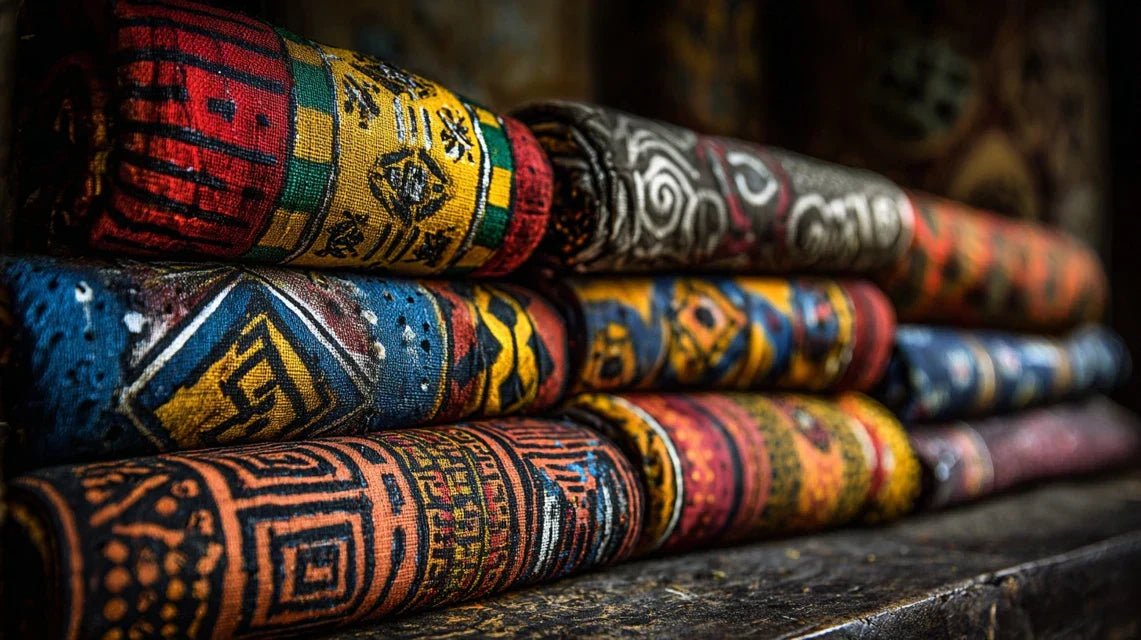
Let's take some examples that I have learned to decipher: the « nsènè » (comb) motif represents patience and meticulous care; parallel lines called « dananin » (small lizard) evoke agility and adaptation; crosses and stars symbolize cosmic crossroads where the visible and invisible meet. A partitioned rectangle can represent cultivated fields, therefore agricultural prosperity. Intersecting diagonals evoke social ties and alliances between families.
The origin of these motifs goes back to the cosmology of the Bambara and Dogon peoples. According to oral tradition, the first symbols were revealed by ancestors or spirits of nature. Some researchers establish parallels with the rock paintings of ancient Sahara, suggesting a continuity of aesthetics that dates back several millennia.
What fascinates about bogolan is this constant tension between constraint and freedom. The repertoire of motifs is limited and codified, but their arrangement allows for an infinity of compositions. Two dyers will never create exactly the same bogolan, even if they use the same symbols. It's like music: same notes, always a unique score.
From rite of passage to international podium
Originally, bogolan was not decorative fabric. It had specific ritual and protective functions in Malian society. Hunters wore bogolan tunics because it was believed that the fermented mud, impregnated with telluric forces, made them invisible to game and protected them from bush spirits.
Bogolan also played a central role in female rites of passage. After excision (a traditional practice now controversial), young girls wore bogolan pagnes during their convalescence and initiation period. The fabric symbolically absorbed impurities and marked the transition from childhood to adulthood.
Women in postpartum would also wrap themselves in bogolan for forty days, while their bodies regained balance. Again, the fabric had both a practical function (hiding stains) and a spiritual one (protection against evil spirits attracted by the vulnerability of the new mother).
This sacred dimension explains why, for a long time, bogolan remained confined to ceremonial contexts and was never worn daily. Things radically changed in the 1980s.
The creative renaissance of the 80s
It was a group of young Malian creators who transformed bogolan into an international fashion phenomenon. Under the impetus of Chris Seydou, a visionary stylist who died prematurely in 1994, and the collective of the Groupe Bogolan Kasobané founded in Bamako in 1978, bogolan left the villages to invest Parisian fashion shows.
These creators understood that the geometric patterns of bogolan resonated perfectly with the minimalist and graphic aesthetic that was emerging in Western design. They modernized cuts, created unprecedented combinations of motifs, while maintaining the authentic artisanal process. Bogolan became synonymous with Afro-modernity: rooted in tradition, resolutely contemporary.
Today, bogolan can be found everywhere: in Burberry collections that were inspired by it (which sparked a controversy over cultural appropriation), on the Dakar Fashion Week runways, in New York apartments in the form of cushions, and even in museum shops like the MoMA.
Want to capture this ancestral energy in your home?
Discover our exclusive collection of African art that celebrates the visual heritage of bogolan and the textile traditions of Mali.

Discover this inspiring work
Bogolan and ecology: a lesson for the future
In our era obsessed with fast fashion and its environmental disasters, the origin of bogolan offers a fascinating alternative model. This millennial textile is completely biodegradable, produced without any synthetic chemicals, and fits into a circular economy before the concept even existed.
Everything comes from the earth and returns to it. The cotton is grown locally using traditional methods. Dyes come from native plants and natural clay. The water used, although not potable after use, contains no toxic pollutants and naturally reintegrates into the ecosystem. Even old worn bogolan fabrics decompose without leaving a trace.
The process is also remarkably resource-efficient. Unlike industrial dyes which require high temperatures and repeated baths, bogolan dyeing is done at room temperature, with limited water consumption. Mud fermentation requires no external energy, just time and patience.
Several contemporary creators are rediscovering this ecological wisdom. In Mali, but also in Burkina Faso and Côte d'Ivoire, new cooperatives of dyers are forming alliances with ethical European and American brands. Bogolan becomes an ethical selling point: artisanal luxury, full traceability, minimal carbon footprint, support for rural communities.
How to recognize authentic bogolan
Faced with the popularity of bogolan, industrial imitations are multiplying. Here's how to distinguish a genuine artisanal bogolan from a screen-printed copy:
Irregularity is your ally. An authentic bogolan always presents subtle variations in patterns and shades. The lines are never perfectly straight, the blacks vary slightly in intensity. This is the signature of the human hand. Conversely, printed imitations show a suspicious mechanical regularity.
The smell never lies. A freshly produced bogolan retains a characteristic earthy scent, sometimes slightly acidic due to fermentation. This odor fades over time but remains perceptible for several months. Imitations smell like industrial textiles or, at best, nothing at all.
The texture tells a story. Authentic bogolan has a certain stiffness due to the tannins that impregnate the fibers. The fabric softens with successive washes but always retains body and shape. Heavily dyed black areas may even have a slight relief to the touch.
The back of the decor. On a real bogolan, the dye penetrates deeply into the fabric. The reverse shows the same patterns as the front, with only a slight attenuation of intensity. On a print, the reverse remains white or shows minimal ink penetration.
Finally, price is a relevant indicator. A meter of authentic bogolan, considering the production time (several weeks between weaving, basic dyeing, mud fermentation, pattern application and successive rinses), cannot be sold cheaply. Beware of "bogolans" for less than fifty euros per meter.
The living heritage of bogolan
What fascinates me most about the origin of bogolan is its ability to remain alive. Unlike so many artisanal techniques that have become museum heritage, bogolan continues to evolve, reinvent itself, while maintaining its intact DNA.
In Bamako, young artists like Aboubakar Fofana are pushing the technique in experimental directions, creating monumental installations where bogolan dialogues with contemporary conceptual art. In Paris, afro-diasporic stylists like Lamine Kouyaté (Xuly Bët) integrate bogolan into hybrid creations that question identity and belonging.
In the villages of Beledougou, grandmothers continue to initiate their granddaughters to the secrets of fermented mud, perpetuating an uninterrupted chain of transmission for eight centuries. These two realities coexist without contradicting each other. Bogolan is vast enough to accommodate both the strictest tradition and the boldest innovation.
This vitality may lie in the very nature of bogolan: a process based on transformation. Mud becomes pigment, cotton becomes narrative, gesture becomes symbol. With each generation, dyers reinvent this alchemy without betraying it. They prove that fidelity to origins does not require immobility, but rather constant renewal.
When you look at a bogolan, you don't just see a beautiful graphic fabric. You contemplate eight centuries of female ingenuity, an avant-garde ecological philosophy, a complex visual writing system, and living proof that a piece of cotton and mud can carry the soul of a people. It is this depth that transforms bogolan into much more than a decorative object: it becomes a bridge between worlds, a carrier of memory, a manifesto for a meaningful luxury.
So next time you come across these black and ochre patterns, stop for a moment. Imagine the hands that traced these lines, the mud that fermented for months under the Malian sun, the generations of women who passed the wooden stick as they would pass a baton. You will then touch the true origin of bogolan: not a place or a date, but a perpetuated gesture, an uninterrupted conversation between earth and humanity.
Frequently Asked Questions
How long does it take to make an authentic bogolan?
Creating an authentic bogolan is a process that requires patience and know-how. Allow between three and six weeks from start to finish. It all begins with hand-weaving the white cotton, which takes several days depending on the desired dimension. Next comes the first yellow ochre dye using ngalama leaf decoction, which requires repeated soaking and drying for about a week. The application of fermented mud, done motif by motif freehand, itself takes several days because each layer must dry before the next is applied to obtain a deep black. Finally, decolorizing treatments and successive rinses add another week. Not to mention that the mud itself must have fermented for several months, or even a year, before it can be used. It is this slowness that gives bogolan its exceptional quality and durability. A real investment in time which also explains its price on the market of authentic craftsmanship.
Can a bogolan fabric be washed without damaging the patterns?
Yes, an authentic bogolan can be washed, but with certain precautions to preserve its magnificent patterns. The golden rule: always wash in cold water, never hot. The natural dyes of the bogolan are fixed by complex chemical reactions between vegetable tannins and iron oxides from the mud, and heat could destabilize these bonds. Prefer hand washing with a mild, neutral soap, without harsh detergents or bleaching agents. Absolutely avoid bleach which would destroy the natural pigments. Gently press without wringing the fabric, and dry it flat in the shade, never in full sun which could fade the colors. With these simple precautions, your bogolan will last for years while preserving the intensity of its blacks and the clarity of its patterns. In fact, some connoisseurs even claim that bogolan becomes more beautiful with time: successive washes soften the fabric while creating a unique patina that reinforces its character. A well-maintained authentic bogolan can be passed down from generation to generation.
Why are the patterns on bogolan always geometric?
The geometric patterns of bogolan are not simply an aesthetic choice, but stem from both technical constraints and a deep cosmological philosophy. From a practical point of view, dyers apply the mud with rudimentary tools: wooden sticks, pieces of metal, sometimes just their fingers. These instruments naturally favor simple geometric shapes: lines, points, triangles, rectangles, crosses. Complex curves or figurative representations would be much more difficult to execute accurately on this medium. But beyond technique, geometric shapes carry spiritual meaning in the cosmology of the Bambara and Dogon peoples. They represent the cosmic order, the fundamental structures of the universe: the four cardinal directions, the cycles of time, the relationships between the elements. A square can symbolize the stability of the earth, a triangle the trinity of vital forces, parallel lines the flow of time or water. This sacred geometry makes bogolan more than just decoration: it is a symbolic writing that encodes the worldview of the peoples of Mali. Each pattern is an ideogram full of meaning, a visual language that initiates can read as we read a text.