In 1897, when British troops entered the royal palace of Benin, they discovered thousands of bronze plaques of astonishing sophistication. These works, five centuries old, were to revolutionize Western conceptions of African art. Today, these Benin Bronzes inspire a silent revolution in our contemporary interiors, transforming the walls of our living spaces into galleries of living history.
Here's what the legacy of the Benin Bronzes brings to contemporary wall art: a historical depth that transcends simple decoration, an emotional connection with one of Africa’s most refined artistic heritages, and a sculptural aesthetic that powerfully dialogues with modern design. These pieces are not just paintings – they carry the memory of a lost kingdom and the rebirth of cultural pride.
However, integrating this historical dimension into your interior can seem daunting. How to honor the complexity of Benin Bronzes without falling into museumization? How to choose representations that respect their heritage while fitting into a contemporary aesthetic?
Rest assured: wall art inspired by the Benin Bronzes has evolved to become accessible, while retaining its narrative power. Contemporary creators have managed to capture the essence of these masterpieces to create pieces that naturally integrate into our modern spaces.
Let's discover together how this centuries-old tradition transforms wall art today, and how you can invite it into your own sanctuary.
The fascinating legacy of the bronzes of the Kingdom of Benin
The Kingdom of Benin, established in present-day Nigeria as early as the 13th century, developed one of Africa’s most sophisticated metallurgical traditions. The Benin Bronzes – actually an alloy of copper, zinc and lead – adorned the pillars of the royal palace, telling the story of the Obas (kings) and their military prowess.
These wall plaques, cast using the ancestral technique of lost-wax casting, depicted court scenes with astonishing precision: warriors in full armor, royal ceremonies, totemic animals, Portuguese merchants in period clothing. Every detail – from the coral beads of the necklaces to the patterns of the textiles – was reproduced with photographic fidelity, five centuries before the invention of photography.
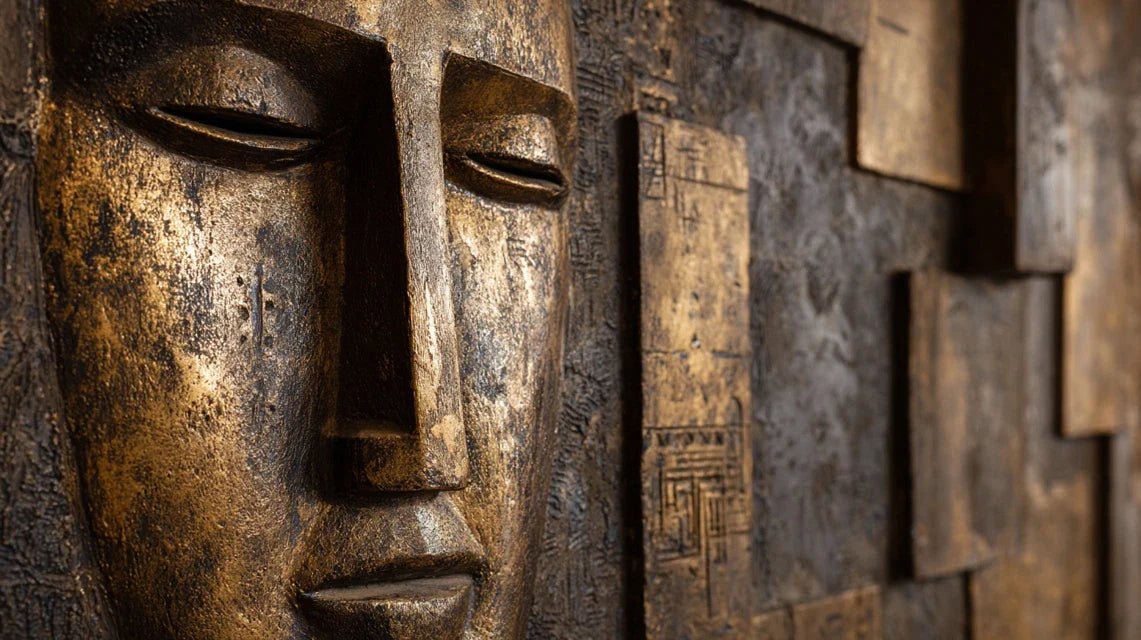
The technical mastery of the artisans of Benin defied everything Europe knew at the time. The bronze reliefs achieved a remarkable sculptural depth, creating plays of light and shadow that brought the compositions to life. This three-dimensionality remains today the distinctive signature of the Benin Bronzes.
The dispersion and debate on restitution
The punitive British expedition of 1897 marked a tragic turning point. More than 4,000 objects were looted and scattered across European museums and private collections. This cultural trauma fuels today's global debate on the restitution of Benin Bronzes, transforming these works into symbols of historical justice.
This painful history gives contemporary representations of Benin Bronzes an additional dimension: they become acts of memory, bridges between past and present, affirmations of rediscovered cultural identity.
When ancestral bronzes meet contemporary wall art
Contemporary wall art creators have developed a fascinating approach to reinterpreting the Benin Bronzes. Rather than simply reproducing the original plaques, they capture their essence: the graphic strength, the symbolic depth, the dignity of the figures depicted.
The wall art inspired by Benin Bronzes play on several aesthetic registers. Some adopt a faithful approach, reproducing iconic motifs – the warrior with his shield, the queen mother with her conical headdress, the royal leopard – in formats adapted to contemporary spaces. Others fuse these historical elements with modern techniques: metallized prints, fragmented compositions, reinvented color palettes.
This transposition of the three-dimensionality of bronze into two-dimensional wall art constitutes a stimulating creative challenge. Artists use layering techniques, texture effects, and light contrasts to suggest the characteristic relief of the original plaques.
The visual codes that cross the centuries
Some elements of the Benin Bronzes possess a visual power that transcends eras. The faces with stylized features, framed by coral beads. The warriors with hieratic proportions, frozen in a majestic eternity. The floral and geometric motifs that structure the compositions.
These visual codes integrate remarkably well into minimalist interiors, creating a fascinating contrast between contemporary simplicity and the narrative density of the Benin Bronzes. A single painting can become the focal point of an entire living room, anchoring the space in a temporality that transcends ephemeral trends.

Discover this inspiring artwork
Integrating the legacy of bronzes into your living space
Art inspired by Benin bronzes requires thoughtful staging. These works are not mere decorative accessories – they carry a historical and symbolic weight that deserves to be honored by their placement.
In a contemporary living room, a large format representing a Benin royal plaque works wonderfully above a sleek sofa, creating a dialogue between modernity and tradition. The copper and gold tones of the bronzes naturally harmonize with neutral palettes – charcoal gray, sand beige, off-white.
For a home office or workspace, depictions of warriors or dignitaries from the Kingdom of Benin inspire an energy of determination and nobility. These hieratic figures, poised in their quiet authority, create an atmosphere conducive to concentration.
In an entrance or hallway, a series of small formats featuring different motifs from the Benin bronzes creates a narrative gallery that invites cultural exploration from the moment you step inside.
Lighting: Revealing Sculptural Depth
One of the most captivating aspects of original Benin bronzes is their interaction with light. The reliefs create shadows that evolve throughout the day, animating the compositions.
For contemporary artworks inspired by this heritage, directional lighting – adjustable spotlights or lateral wall lights – helps recreate this luminous dynamic. The texture of the print, the metallic effects, and the contrasts in the composition take on an almost sculptural dimension.
Timeless Symbols of Benin Bronzes
Understanding the symbolism of Benin bronzes greatly enriches the experience of these works in your interior. Each iconographic element carries a precise meaning, inherited from centuries of royal tradition.
The leopard frequently appears in Benin bronzes, embodying royal power and the controlled ferocity of the Oba. The kings of Benin kept tamed leopards in the palace, living symbols of their authority.
Coral beads, omnipresent in depictions, signaled social status. Only members of the royal court could wear these precious ornaments, imported via trans-Saharan trade routes.
The queen mother (Iyoba), often depicted with her characteristic conical headdress, symbolizes female political influence in the Kingdom of Benin. These depictions find a particular echo in contemporary interiors conscious of equality issues.
Warriors in armor embody military discipline and the protection of the kingdom. Their frontal, hieratic posture exudes a reassuring presence in a living space.

Discover this inspiring artwork
A conversation between past and present
Integrating wall art inspired by Benin bronzes into a contemporary interior creates a fascinating conversation between eras. These works do not freeze the past in sterile nostalgia – they bring it to life, making it relevant.
Contemporary creators working with the legacy of Benin bronzes are conducting a form of cultural translation. They preserve the essence – dignity, technical sophistication, narrative richness – while adapting it to current visual codes.
This approach resonates particularly in a globalized world where cultural identities are constantly negotiated. A work inspired by Benin bronzes in a Parisian apartment, a New York loft or a Dubai villa becomes an act of affirmation: that of an African artistic heritage that rivals any European or Asian tradition in refinement.
Beyond decoration: ethical commitment
Choosing wall art inspired by Benin bronzes can also be part of a conscious approach. Several contemporary creators donate a portion of their sales to cultural projects in Nigeria, symbolically participating in a form of restitution.
Finding out about the origin of the works, the artists' approach and their commitment to communities holding this heritage adds an ethical dimension to your decorative choice.
Transform your walls into a gallery of living history
Discover our exclusive collection of African art that captures the timeless majesty of Benin bronzes and celebrates African artistic excellence in your contemporary interior.
Invite five centuries of excellence into your daily life
The Benin bronzes have survived the destruction of a kingdom, their dispersion in museums around the world, and passionate debates on restitution. They continue to fascinate because they embody a universal truth: artistic excellence transcends borders and eras.
Integrating the legacy of Benin bronzes into your wall art means choosing to live surrounded by this excellence. It's refusing decorative blandness in favor of works full of meaning. It’s transforming your walls into spaces for cultural dialogue.
Each morning, contemplating these royal figures, majestic warriors, and sophisticated motifs, you connect with a lineage of artisans who, five centuries ago, were casting bronze with a mastery that we still admire today.
Start simply: identify the wall that calls for a strong presence in your interior. Imagine a representation of Benin bronzes – perhaps a hieratic warrior, a queen mother in her dignity, a royal leopard. Visualize how this piece anchors the space, creates narrative depth, elevates the atmosphere.
The history of Benin bronzes continues to be written, now on the walls of our contemporary interiors. By inviting them into your home, you become part of this millennial story that refuses to fade away.