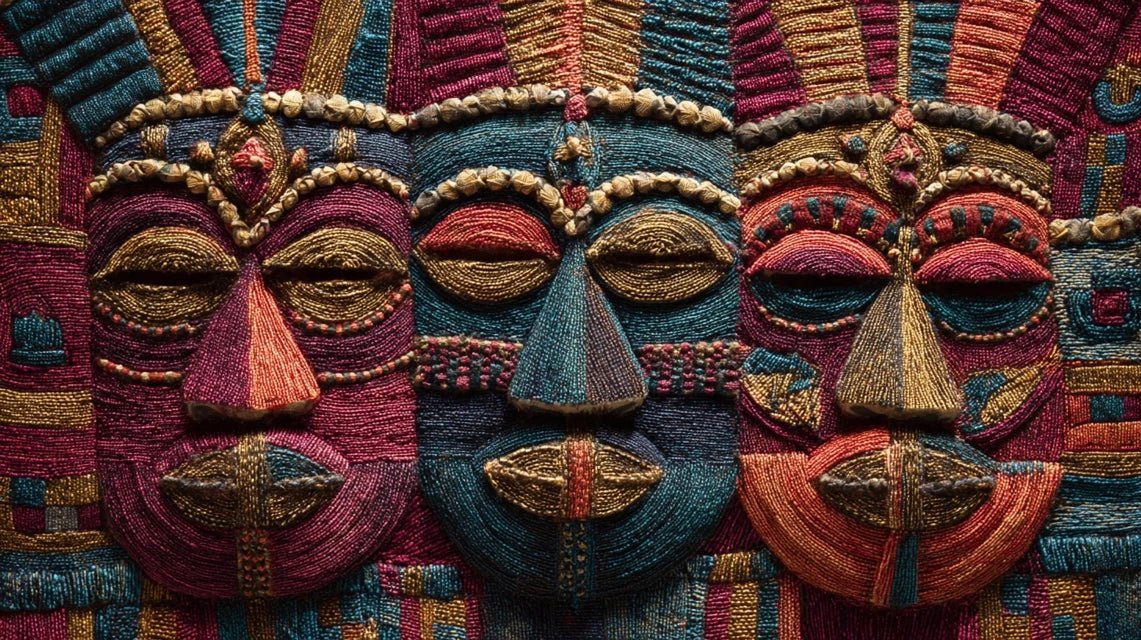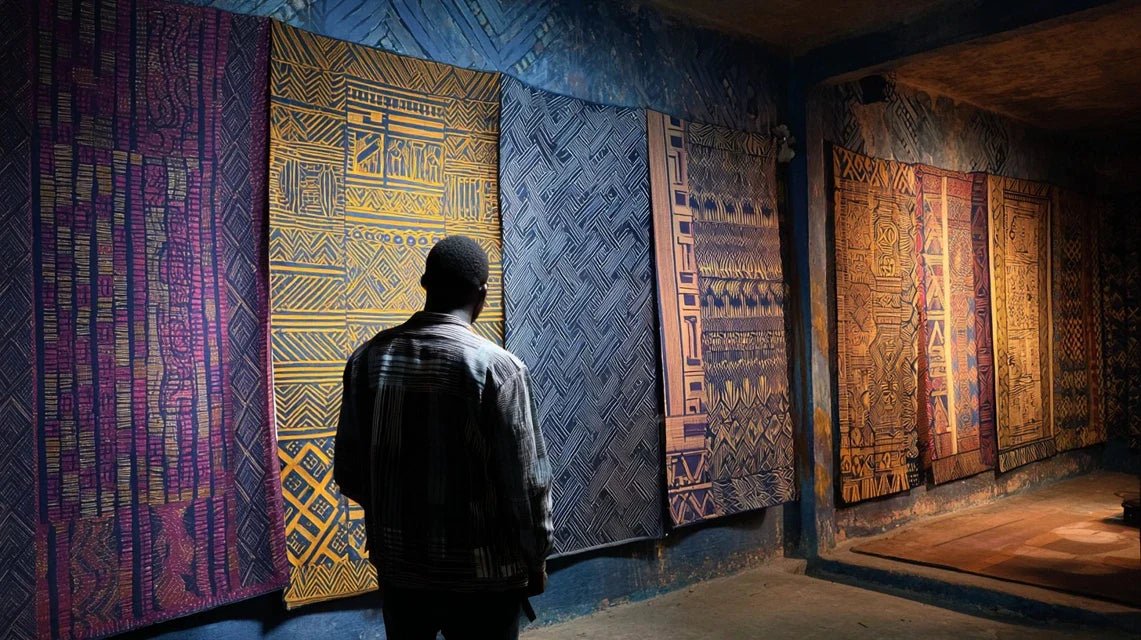
In the studio of a London collector, I first discovered a work that revolutionized my perception of African textile art. On the immaculate white wall, an Aso-Oke weaving burst with intertwined metallic threads, telling a thousand silent stories. It was no longer just a textile, but a powerful artistic statement. Here's what Nigerian Aso-Oke fabrics bring to contemporary wall art: millennia of cultural depth, unparalleled visual richness, and an authenticity that radically transforms the atmosphere of a space.
You may have already felt this frustration with standardized wall decorations, those generic prints that desperately lack soul and character. You are looking for that unique piece that will spark conversation, that will carry true meaning. Rest assured: integrating Aso-Oke textiles into modern wall art precisely responds to this quest for authenticity. I'll reveal the fascinating history of these ancestral weavings and how they have become jewels of contemporary wall decor.
Yoruba roots: when weaving becomes language
Aso-Oke, literally "cloth of the top" in the Yoruba language, originates in southwestern Nigeria, particularly in the towns of Iseyin, Oyo and Okene. For over four centuries, Yoruba weavers have perpetuated this craft on traditional narrow looms, creating strips of textile approximately 10 to 15 centimeters wide.
These strips are then sewn together to form larger pieces, a meticulous process that can take several weeks. Historically, Aso-Oke marked major life events in Yoruba culture: weddings, birth ceremonies, funerals of dignitaries. Each pattern, each color possessed a precise meaning in this sophisticated visual vocabulary.
The sacred trilogy of Aso-Oke fabrics
Nigerian artisans traditionally distinguish three types of Aso-Oke, each reserved for specific occasions. The Alaari, woven with threads dyed indigo and natural purple, symbolizes royalty and wealth. The Sanyan, recognizable by its golden beige color obtained from wild silkworm cocoons, evokes wisdom and maturity. Finally, the Etu, in its deep indigo tones, represents spirituality and ancestral connection.
This classification is not merely decorative: it constitutes a true social code that Yoruba communities instantly decipher. Wearing or displaying a specific Aso-Oke fabric communicates your status, your intentions, your respect for traditions.
From ceremonial clothing to wall art
The transformation of Aso-Oke fabrics into wall art is a fascinating evolution that accelerated in the 1990s. Nigerian artists like Nike Davies-Okundaye began showcasing these textiles as autonomous works in international galleries, taking Aso-Oke out of its purely functional context.
This transition can be explained by several converging factors. First, the Nigerian diaspora, settled in Europe and North America, sought ways to affirm their cultural identity in their new living spaces. Hanging an Aso-Oke textile on the wall became a gesture of pride and memory. Secondly, the movement to value global craftsmanship in interior decoration created demand for authentic pieces, rich in history.
Contemporary artists reinvent tradition
Today, creators like Yinka Shonibare use Aso-Oke motifs to question postcolonial identity, while textile designers integrate these ancestral techniques into monumental wall installations. The Lagos Space Programme collective even exhibited Aso-Oke weaves in contemporary light frames, creating a striking dialogue between tradition and modernity.
This artistic appropriation does not dilute the authenticity of the Aso-Oke fabric: it amplifies it. Each wall piece now tells two simultaneous stories – that of its Yoruba origins and that of its migration to contemporary spaces.

Discover this inspiring artwork
What makes Aso-Oke irresistible in wall decoration
The first time I advised a client to install an Aso-Oke panel in their minimalist Scandinavian living room, they were skeptical. Three days after the installation, they called me back: “It has become the heart of my apartment. Everything else revolves around it.”
This reaction is not isolated. Aso-Oke fabrics possess an extraordinary visual presence thanks to their metallic threads – gold or silver lurex – which capture and reflect natural light throughout the day. Unlike flat prints, these textiles create a living, changing, almost organic experience.
Texture as an architectural element
Beyond color, it is the three-dimensional texture of Aso-Oke that fascinates. The thick cotton threads, variations in thickness, and small irregularities inherent in hand weaving create a relief that photography can never fully capture. Touching an authentic Aso-Oke textile immediately reveals its artisanal quality.
This tactile dimension transforms your relationship with your decor. A wall adorned with Aso-Oke invites you to approach, to observe closely, creating a spatial intimacy that conventional decorations never offer.
How collectors select their pieces
In the markets of Iseyin or specialized galleries in Lagos, acquiring an Aso-Oke fabric intended for wall art follows specific criteria. Experts first examine the weave density: the tighter the threads, the more resistant the piece will be to time. They then check the quality of the dyes, preferring natural colorants that develop a noble patina over the years.
Authenticity is a major issue. With the growing popularity of Aso-Oke, industrially produced imitations flood some markets. True artisanal pieces exhibit slight variations in tension, subtle color transitions, and sometimes even tiny « imperfections » that mark handwork.
Preserving heritage while decorating
Installing an Aso-Oke fabric as wall art requires some precautions. These ancestral textiles deserve to be protected from direct sunlight which could alter their vegetable dyes. Framing them under UV glass or mounting them on breathable textile supports guarantees their longevity.
Some collectors choose to have old Aso-Oke pieces restored before exhibiting them, entrusting this delicate work to specialists in African textiles. This approach preserves not only the object but also the cultural memory it embodies.
Transform your walls into an authentic cultural art gallery
Discover our exclusive collection of african art that captures the essence of Yoruba textile traditions and brings unparalleled artistic depth to your interior.

Discover this inspiring artwork
Aso-Oke and the Future of Conscious Decor
We are witnessing a profound shift in interior decoration: a rejection of disposability in favor of meaning. Aso-Oke fabrics fit perfectly within this philosophy. Acquiring an authentic piece means supporting communities of Nigerian artisans who perpetuate know-how threatened by industrialization.
Several initiatives are emerging to connect the weavers of Iseyin directly with international textile art enthusiasts. These short circuits guarantee fair remuneration and sometimes allow for custom orders, where you can choose the colors and patterns of your wall Aso-Oke.
This approach transforms your decorative purchase into a cultural act. Each time your gaze rests on your Aso-Oke textile, you do not simply see a beautiful decoration: you contemplate hours of meticulous work, generations of transmission, a silent but powerful cultural resistance.
Imagine Your Space Transformed
Visualize for a moment your living room, bedroom or office with a majestic Aso-Oke panel as a focal point. The golden threads catch the morning light, the geometric patterns create a soothing visual rhythm, and each visitor stops, intrigued, to ask about the story of this extraordinary piece.
You don't need to completely redecorate: Aso-Oke has this rare ability to harmonize seemingly contradictory styles. It dialogues as well with raw concrete as with plush velvet, with minimalist Scandinavian furniture as with bohemian accumulations.
Start by exploring the different types of Aso-Oke, let yourself be drawn to a color palette, a particular weaving density. Trust your intuition: these textiles have crossed centuries creating instant emotional connections. The piece that calls to you will know exactly where to take place in your life.
Frequently Asked Questions
How to differentiate a genuine Aso-Oke from an industrial imitation?
An authentic Aso-Oke fabric always exhibits slight irregularities that bear witness to hand weaving: subtle variations in the width of the bands, progressive color transitions rather than abrupt ones, and a texture that feels distinctly richer and more complex. Hand-woven pieces also have a band structure sewn together, visible on the edges, while imitations are generally woven in one piece on industrial looms. The weight of the textile is also an indicator: traditional Aso-Oke, tightly woven with thick cotton and metallic threads, has substantial density. Finally, don't hesitate to ask about the provenance and history of the piece – serious sellers can often identify the region of production and sometimes even the original workshop.
What budget should you allocate for an Aso-Oke fabric intended for wall art?
Prices vary considerably depending on the age, size, complexity of the patterns and authenticity of the piece. For a contemporary Aso-Oke of artisanal quality measuring approximately 1.50 m by 1 m, expect to pay between 150 and 400 euros. Antique collector's pieces, particularly those with rare natural dyes or complex patterns, can reach 800 to 2000 euros. Exceptional antique textiles, acquired from specialist galleries with certificates of authenticity, sometimes exceed this amount. Consider this investment as the acquisition of a work of art rather than a simple decorative element: an authentic Aso-Oke fabric retains its value and is often a transmissible heritage. To start, prioritize fair trade circuits that connect directly with Nigerian artisan cooperatives.
How to maintain and preserve an Aso-Oke installed on the wall?
The preservation of a wall-mounted Aso-Oke fabric rests on three fundamental principles. Firstly, protect it from direct sunlight which progressively degrades natural dyes; install it on a wall perpendicular to windows or use UV filtering curtains during intense sun hours. Secondly, control ambient humidity: these textiles made of natural fibers fear excessive humidity which promotes mold, but also extreme dryness which weakens the fibers; aim for a humidity rate between 45 and 55%. Thirdly, dust delicately every two months with a vacuum cleaner set to minimum power, inserting a thin tulle between the nozzle and the textile. For accidental stains, always consult a specialist in antique textiles rather than attempting a domestic cleaning that could be irreversible. If your Aso-Oke is framed, check annually for condensation behind the glass and ensure that the mounting allows for minimal air circulation to avoid the development of microorganisms.