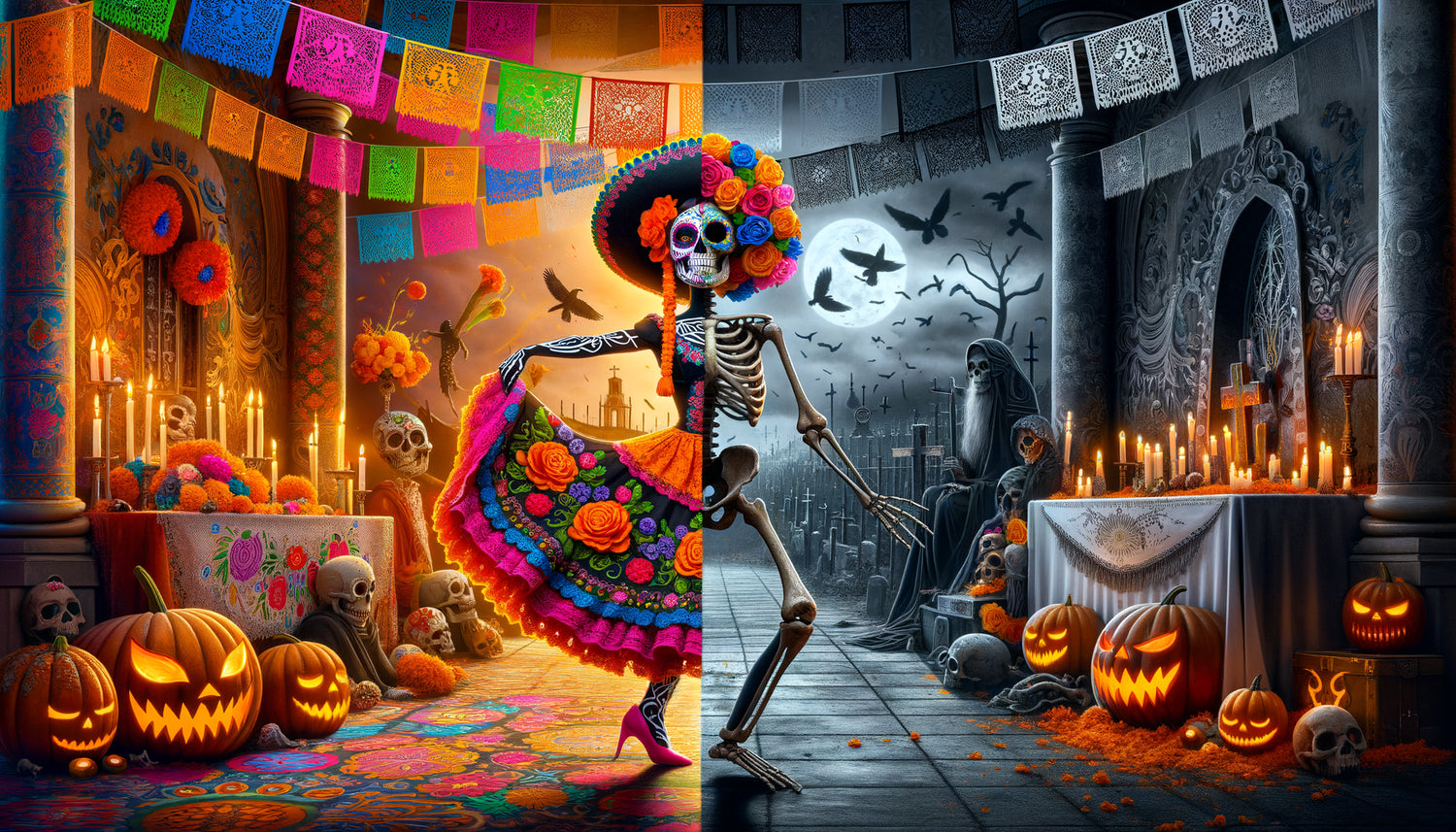
I spent two years between Mexico and Los Angeles, organizing folk art exhibitions and observing one fascinating thing: the same dancing skeleton motif that sparked joyful laughter in my Coyoacán studio would elicit uneasy chills in my Venice Beach gallery. This experience led me to a troubling question: how can a symbol simultaneously embody both the celebration of life and the fear of death, depending on which side of the border you are on?
Here's what this cultural duality reveals: a radically different understanding of mortality that transforms our interiors, our celebrations, and our relationship to decorative symbolism. Mexican dancing skeletons represent the continuity between life and death, whereas American representations create an impermeable boundary between the two worlds.
If you’ve ever hesitated to incorporate skeleton motifs into your decor, you know this confusion: how do you distinguish the macabre from the festive? Should these symbols be reserved for Halloween or can they inhabit your everyday?
Rest assured: understanding these cultural codes will transform your perception of these bony figures. You'll discover why some dancing skeletons invite joy while others send a chill down your spine, and how to use this knowledge to create spaces vibrant with meaning.
I promise you that by the end of this article, you’ll know exactly why these differences exist and how to integrate them appropriately into your decorative universe.
The Dancing Catrina: When Bones Celebrate Life
At the heart of Mexico, during Día de Muertos, I photographed hundreds of dancing skeletons adorning altars, facades, and family tables. These calaveras twirl, play guitars, prepare tamales, get married. They perform all the gestures of existence with theatrical elegance.
The iconic figure of la Catrina, created by artist José Guadalupe Posada in 1912, embodies this philosophy. A skeleton elegantly dressed in an extravagant feathered hat, she gently mocks social pretensions while reminding us of a universal truth: rich or poor, we all become dust.
Mexican dancing skeletons wear colorful clothing, bright orange cempasúchil flowers, festive accessories. They smile broadly, their empty orbits seeming to sparkle with mischief. This joyful aesthetic is rooted in a pre-Hispanic cosmology where death was merely a passage, not an end.
For Aztec and Mayan cultures, the deceased returned to visit loved ones during annual celebrations. Spanish Catholicism grafted itself onto these traditions, creating a unique syncretism where the dead remain active members of the family community. Dancing skeletons thus become affectionate representations of ancestors who continue to participate in the festivities.
The American Skeleton: Guardian of the Beyond's Borders
Cross the border to the north, and the skeleton changes in nature. In the American imagination, inherited from Anglo-Saxon and Protestant traditions, the skeleton embodies the Grim Reaper, the messenger of absolute end, the scarecrow of haunted cemeteries.
I organized a comparative exhibition in San Diego, juxtaposing Mexican calaveras with Gothic American representations. The difference was striking: where Mexican skeletons danced in circles, American skeletons emerged from graves, brandished scythes, hid in the shadows.
This iconography reflects a Protestant conception where death marks a definitive separation between the living and the dead. No welcoming purgatory, no back-and-forth between worlds. Death becomes a traumatic event to be pushed away, not celebrated.
American Halloween, despite its Celtic origins, has transformed into a festival of controlled fright. Skeletons play the role of transgressive figures, illegally emerging from their underground realm to terrorize the living. Even when they dance – think of the classic 'Spooky Scary Skeletons' – it is in a comedic horror atmosphere, never an authentic celebration.

Color, costume and choreography: decoding the language of bones
How to visually distinguish a festive skeleton from a scary one? After dozens of exhibitions, I have identified infallible markers.
Mexican festive skeletons
They invariably wear vintage clothing: Victorian dresses, charro costumes, mariachi outfits. Their bones are decorated with floral motifs, colorful spirals, vibrant dots. The artist uses saturated colors: fuchsia pinks, flamboyant oranges, deep purples, bright turquoises.
Their postures evoke joyful movement: arms raised in a sign of dance, musical instruments in hand, bodies in dynamic torsion. Several skeletons appear together, forming social scenes: orchestras, weddings, family meals. This collective dimension is crucial – death does not isolate, it brings people together.
American scary skeletons
Represented in monochromatic tones – bone white on black backgrounds, sometimes with touches of putrid green or bloody red. Rarely dressed, or if so, in torn rags suggesting decomposition.
Their postures are aggressive or supplicating: clawed hands reaching out to the viewer, mouths wide open in silent screams, bodies emerging from the earth. Isolated in their representation, they embody the existential solitude of modern Western death.
The contexts differ radically: gloomy cemeteries, haunted houses, dark dungeons for American versions; sunny village squares, family kitchens, flowering gardens for Mexican versions.
When America Adopts the Catrina: Appropriation or Appreciation?
In recent years, I have observed a growing fascination among Americans for the aesthetics of Día de Muertos. Sugar skulls now adorn t-shirts, mugs, and wall decorations far beyond Latino-American communities.
This cultural migration raises delicate questions. In my gallery, I've seen clients buy reproductions of Catrinas for their Halloween decor, inadvertently mixing two incompatible traditions. Día de Muertos takes place on November 1st and 2nd, celebrates the continuity of life, honors specific ancestors. Halloween, October 31st, cultivates playful fear of anonymous and threatening deaths.
Yet, this diffusion is not necessarily negative. It testifies to a thirst for reconciliation with mortality, a desire to move away from American denial of finitude. When accompanied by contextual understanding – explaining the origin, respecting the meaning – the adoption of Mexican motifs can enrich our symbolic vocabulary.
I encourage my clients to create distinct spaces: a vignette dedicated specifically to Día de Muertos with ofrendas, photos of deceased loved ones and authentic calaveras, separated from more playful Halloween decorations. This physical separation honors the conceptual difference between celebrating memory and playing with fear.

Integrating Dancing Skeletons into Your Decor: A Sensitive Guide
How to use these powerful symbols without a cultural faux pas? Here are my recommendations based on fifteen years of decorative support.
For a Festive Mexican Atmosphere
Prioritize reproductions by Mexican artists or artisans respectful of traditions. Look for pieces showing skeletons in joyful activities: musicians, dancers, cooks. Combine them with contextual elements: marigolds, papel picado (cut paper), bright colors.
Create a small permanent shrine if you wish to honor the tradition: a shelf with photos of deceased loved ones, candles, objects they loved, and one or two decorative calaveras. This space becomes a place of positive memory, not sadness.
For a Halloween decoration
If you prefer the gothic aesthetic, fully embrace the fantastical register. Skeletons emerging from libraries, dancing in Victorian frames, playing with dark humor. The important thing is tonal consistency: playful-scary or elegant-macabre, but not confusion of cultural codes.
Use lighting to create the atmosphere: dim lights, flickering candles, spotlights creating theatrical shadows. The visual context transforms the perception of the symbol.
For a contemporary hybrid approach
Some contemporary artists create fascinating bridges between the two traditions. I have exhibited works showing skeletons in festive poses but with a gothic palette, or conversely compositions of dark colors crossed by splashes of Mexican color.
This third way works particularly well in eclectic interiors that consciously assume cultural mixing. The essential thing remains reflection: why this symbol? What does it mean to me? How can I honor it?
Transform your space with symbols that tell your story
Discover our exclusive collection of Halloween wall art that celebrates the richness of traditions and invites the beauty of the ephemeral into your daily life.
Beyond the skeleton: rethinking our relationship with finitude
This exploration of dancing skeletons reveals something deeper than a simple aesthetic difference. It exposes two radically distinct philosophies of life.
The Mexican tradition proposes a familiarity with death that defuses its terrifying power. By representing it as dancing, festive, dressed in our finest clothes, it becomes a companion rather than an enemy. Children grow up manipulating sugar skulls, decorating skeletons, celebrating their deceased grandparents as if they were dining at the table.
The American approach, inherited from a long Puritan tradition, exiles death from everyday life. People die in hospitals, not at home. The dead disappear quickly into sealed coffins. Vocabulary avoids the very word: people 'pass', 'leave', 'depart'. This distance creates a diffuse anxiety that Halloween temporarily channels through controlled thrills.
Neither is superior – they respond to different psychological needs. But understanding both enriches our emotional palette. Perhaps we can borrow from Mexican wisdom a certain lightness in the face of the inevitable, while retaining the solemn respect that our culture accords to the deceased.
In your decor, this duality translates into conscious choices. A dancing Mexican skeleton in your living room is not just a decorative object – it's a philosophical statement about your willingness to integrate finitude into your daily existence with grace rather than dread.
Conclusion : Dancing with our contradictions
Dancing skeletons offer us a fascinating mirror of our anxieties and hopes. Festive in Mexico because they embody the joyful continuity between generations, frightening in the United States because they violate the border meant to protect the living from the dead.
Imagine your space transformed by this new understanding. You now choose your skeletal motifs not by chance aesthetic, but because they express your own philosophy of the ephemeral. Each piece tells a story – that of celebration or shiver, memory or fantasy.
Start simply: find a skeleton representation that truly speaks to you. Question your reaction. Does it make you smile or worry you? Why? This introspection will transform your relationship not only to decoration, but to what it symbolizes.
Because in the end, decorating is nothing more than a way of revealing who we are and how we choose to inhabit this temporary world with beauty, humor and awareness.
FAQ : Your questions about dancing skeletons
Can I decorate with Mexican calaveras if I am not of Latin American origin?
Absolutely, provided you approach these symbols with respect and understanding. The key lies in education: learn about the meaning of Día de Muertos, explain the context to your guests, do not reduce these images to simple 'trendy' motifs. Prioritize purchasing from Mexican artisans or artists who donate a portion of their profits to communities of origin. Create an appropriate context rather than mixing calaveras and commercial Halloween decorations. Cultural appreciation is distinguished from appropriation by intention, context and respect. If you use these symbols to honor your own deceased in the spirit of tradition – with photos, offerings and reflection – you participate in an enriching cultural conversation rather than a superficial extraction.
Are dancing skeletons appropriate in a child's room?
It depends entirely on cultural tradition and the family's approach to death. In Mexican families, children grow up surrounded by cheerful skulls, participating in decorating sugar skulls, celebrating the memory of ancestors naturally. This early familiarity creates a healthy relationship with finitude. Conversely, in a context where skeletons are associated with horror and fear, their constant presence could generate anxiety. If you want to introduce these motifs, prioritize the most colorful and festive versions, accompany them with age-appropriate conversations about remembering loved ones who have passed away, and observe reactions. Some children find these images comforting – the idea that grandma continues to dance somewhere – while others prefer more abstract symbols. The key is to adapt your decoration to your child's sensitivity.
How to create a decoration that honors both traditions without confusing them?
The solution lies in spatial and temporal separation. Create two distinct spaces or moments: a corner dedicated to Día de Muertos early November, with an altar, photos of deceased relatives, colorful skulls, marigolds, and candles, in a spirit of joyful memory. Then, if you celebrate Halloween, another space with your gothic, fantastic, or humorous-scary aesthetic. You can also opt for a chronological approach: Halloween decorations until October 31st, then transformation of the space for Día de Muertos the two days following. This physical or temporal distinction respects the integrity of each tradition while allowing you to explore both. Explain the difference to your guests or children – it's a wonderful opportunity for intercultural education. Some contemporary creators also offer intentional hybrid pieces that dialogue between traditions, but they work best when the artist consciously masters and respects both cultural codes.