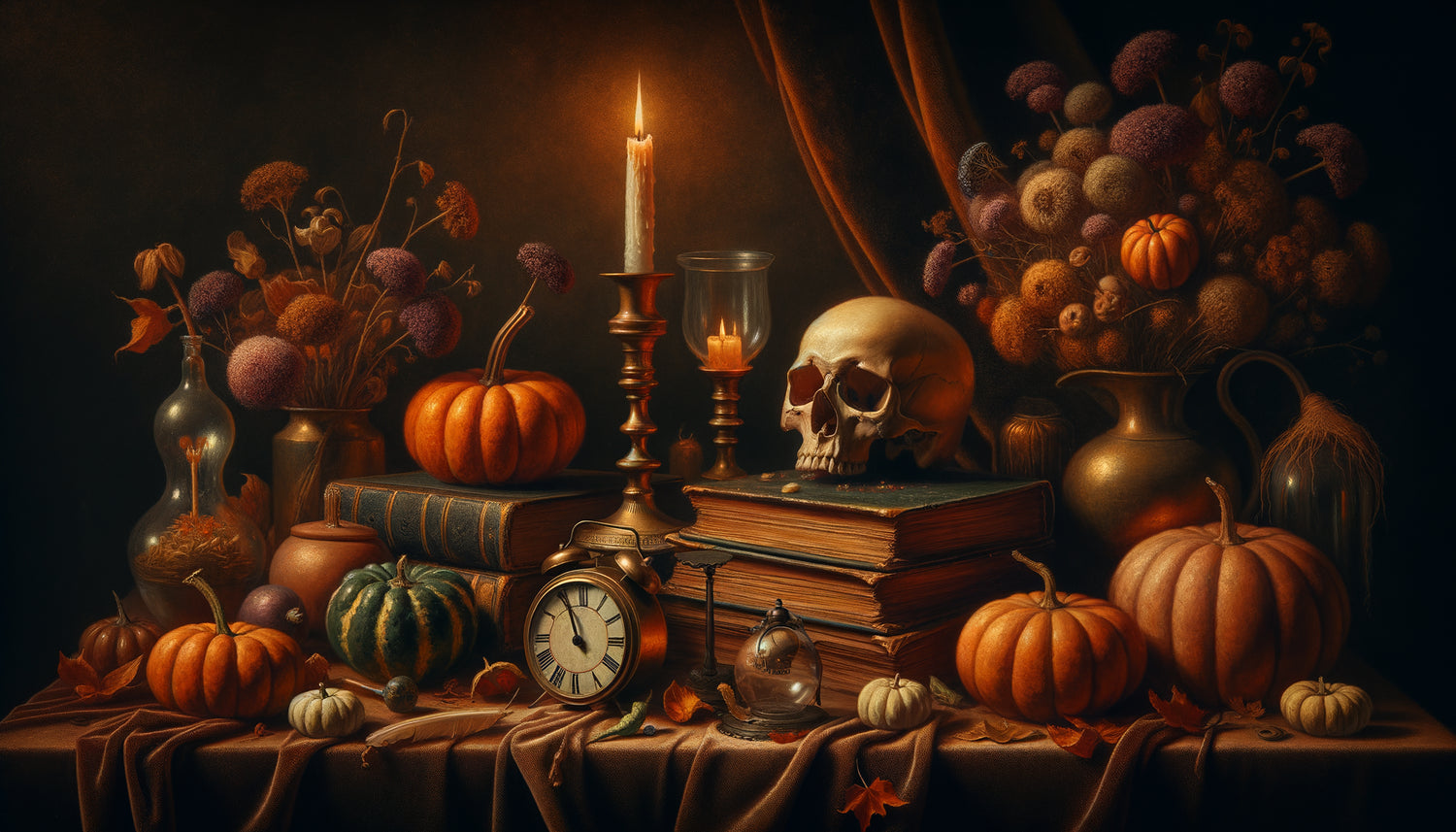
In my workshop in Brussels, between my portfolios of campaigns for fashion houses and art galleries, stands a reproduction of
You may have felt this frustration: your Halloween decorations seem flat, artificial, lacking the sophistication you seek. How to create an atmosphere that impresses without falling into commercial kitsch? How to transform your interior into a temporary gallery rather than a simple party showcase?
The answer lies in the workshops of Amsterdam and Leiden, three centuries before the appearance of carved pumpkins. Dutch still life painters codified a visual language that we reinvent every autumn, often without knowing it. Let's discover this fascinating genealogy together.
The birth of a genre: when the Dutch invented the art of memento mori
In the 1620s, as the Dutch Republic experienced its Golden Age, a new pictorial genre emerged in workshops:
I think back to my first visit to the Mauritshuis in The Hague. Faced with these monumental canvases, I understood that Dutch vanities were not mere exercises in style. They orchestrated a theatrical staging where each object carried a coded message. The skull, obviously, symbolizes inevitable death. Soap bubbles evoke the brevity of life. Musical instruments suggest fleeting pleasures.
This visual grammar of vanitas is based on a principle that we find intact in Halloween still lifes:
The aesthetics of chiaroscuro: light as a protagonist
In my shootings for decoration publishers, I systematically apply the lessons of Rembrandt and Vermeer. Dutch vanities mastered
This technique creates exactly the atmosphere sought by lovers of sophisticated Halloween decor. A skull placed near a chandelier, lit laterally, produces this dramatic contrast between areas of intense light and deep shadows. Dutch painters knew that darkness amplifies mystery and guides the eye to essential elements.
The color palette of vanitas
Observe carefully a vanitas by Harmen Steenwijck: deep browns, warm ochres, silver grays, sometimes enhanced with a blood red or midnight blue. This restricted palette creates an immediate visual consistency. When I style a Halloween still life for a magazine, I avoid garish orange and synthetic purple. I prefer these subdued and sophisticated tones directly inherited from the 17th century Dutch.

The hidden symbolism: decoding objects in vanitas
What fascinates about Dutch vanitas is their elaborate symbolic system. Each element carries multiple levels of reading. This semantic richness is sorely lacking in standardized Halloween decorations, but can be easily reintroduced.
Skulls, omnipresent in vanitas as in Halloween iconography, symbolize death, of course. But in the Dutch Calvinist context, they also invited spiritual reflection. Open books represent human knowledge, derisory in the face of eternity. Scientific instruments – compasses, globes – evoke the pride of science. Jewels and gold coins denounce the vanity of earthly riches.
This symbolism finds a contemporary echo. A well-composed Halloween still life can incorporate these same elements: an old grimoire (esoteric knowledge), vintage jewelry (material attachment), a stopped pocket watch (suspended time). You thus create a visual narrative rather than a simple accumulation of accessories.
The pyramidal composition: the invisible architecture of still lifes
After ten years directing photoshoots, I instantly recognize the compositional structure of Dutch vanitas: a pyramidal or diagonal architecture that guides the eye through the scene. Painters never arranged their objects randomly.
Take Vanity with violin and glass ball by Pieter Claesz: the gaze enters through the skull in the foreground, rises along the violin placed diagonally, culminates on the reflective sphere, then descends towards the books. This visual choreography maintains attention and creates dynamism in a static scene.
For your Halloween still lifes, adopt this principle: avoid frontal alignment. Layer the planes, create diagonals with dead branches or candles of different heights, use an architectural element – an imposing skull, a pumpkin – as a central focal point.
The role of textures in visual depth
Dutch masters were obsessed with rendering materials: polished metal reflecting light, velvet absorbing shadow, glass distorting shapes. This attention to texture contrasts considerably enriches a composition. In your Halloween scenes, combine the smooth (ceramic skull) with the rough (tree bark), the shiny (brass chandelier) with the matte (artificial spiderweb).
Transform your interior into an ephemeral art gallery
Discover our exclusive collection of Halloween wall art that reinterprets the aesthetics of Dutch vanitas with contemporary sophistication.

From vanitas to festive decor: how Halloween reinvented an artistic genre
The question arises legitimately: how did we go from meditative paintings on death to festive decorations? The transition was gradual, notably through Victorian gothic culture of the 19th century.
Victorians, fascinated by death and spiritualism, popularized a macabre elegant aesthetic: post-mortem photographs, mourning jewelry made of deceased hair, romantic cemeteries gardens. This sensibility prepared the ground for a playful appropriation of death symbols. Halloween, a Celtic Christianized then commercialized holiday, became the receptacle of this visual tradition.
In the 1980s-1990s, with the explosion of gothic and dark pop culture, Halloween still lifes began to consciously borrow from the codes of vanitas: accumulation of symbolic objects, dramatic lighting, dark palette. Decoration magazines then refined this aesthetic, moving it away from kitsch and closer to its artistic origins.
Create your own Halloween vanitas: a practical guide inspired by the masters
Drawing on this historical understanding, how do you compose a Halloween still life worthy of a Dutch master? I share my method, tested on dozens of editorial projects.
First step : choose a support – console, fireplace, tray – and a dark background. Dutch vanitas often used stone niches or wall hangings. Opt for a charcoal gray wall or hang a black velvet fabric.
Second step : select your objects according to their symbolic charge. A skull (real or reproduction), central element. Black or ivory wax candles, of varying heights. Organic elements: driftwood branches, dried autumn leaves, faded flowers (black dahlias, dead roses). Cultural objects: old books with worn bindings, antique sheet music, vintage glasses. Material vanities: vintage jewelry, ancient coins, hourglass.
Third step : compose in a pyramid or diagonal. Place the skull slightly off-center, as a focal point. Arrange candles at different heights to create vertical rhythm. Leave books open, casually place jewelry. Dutch masters sought this elegant disorder, as if the scene had just been abandoned.
Fourth step : work the lighting. A single light source, lateral, preferably warm (real candle or flame effect LED). Turn off ambient lights. Let shadows invade the background. Photograph your composition – it should instantly evoke a 17th-century painting.
Contemporary legacy: when ancient art inspires modern decoration
This lineage between Dutch vanitas and Halloween still lifes reveals a fascinating truth: great aesthetic traditions never die, they transform. What was philosophical meditation becomes festive celebration. The spiritual message fades, but the visual language persists.
In my practice as a stylist, I find that the most successful compositions are those that consciously draw on art history. A client who understands that they are not simply decorating for Halloween, but updating a four-hundred-year-old pictorial tradition, approaches their staging with more intention, rigor and ambition.
Dutch vanitas teach us that the macabre can be sophisticated, that death can be beautiful, that meditation on our mortality can produce striking visual compositions. Halloween offers us the annual opportunity to reinvent this heritage, to play with these ancestral codes, to transform our interiors into ephemeral cabinets of curiosities.
The next time you place a decorative skull near a flickering candle, remember: you're not just decorating for a party. You are perpetuating, consciously or unconsciously, an artistic tradition born in the workshops of Amsterdam, codified by the greatest painters of their time, passed down through the centuries to your coffee table. You are the last link in a chain that connects Pieter Claesz to your contemporary living room.
And this awareness transforms everything: your gaze on objects, your attention to detail, your pleasure in composing. You no longer succumb to the commercial codes of Halloween; you reclaim an aesthetic spanning millennia to create something personal, cultivated, and truly memorable.