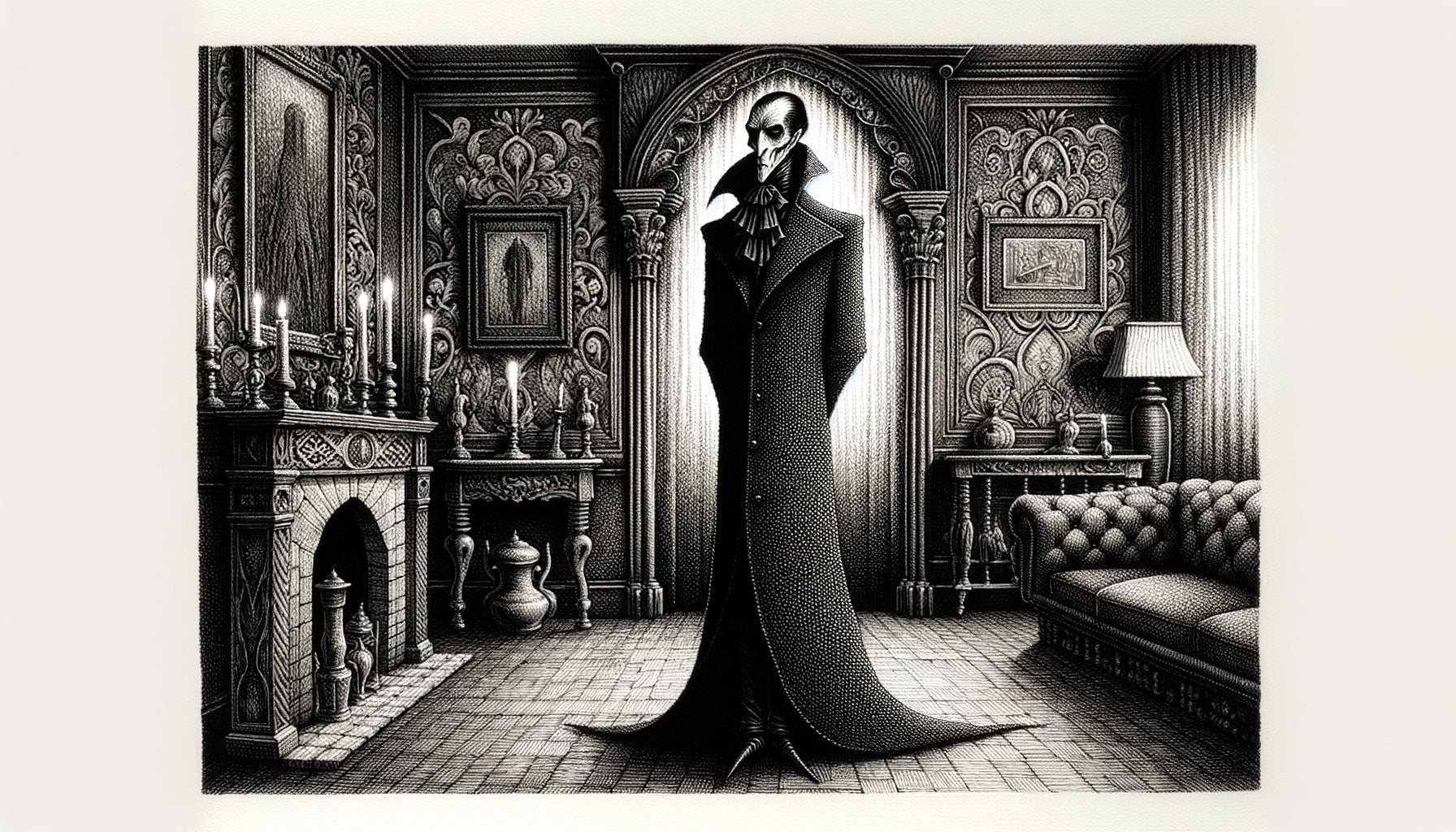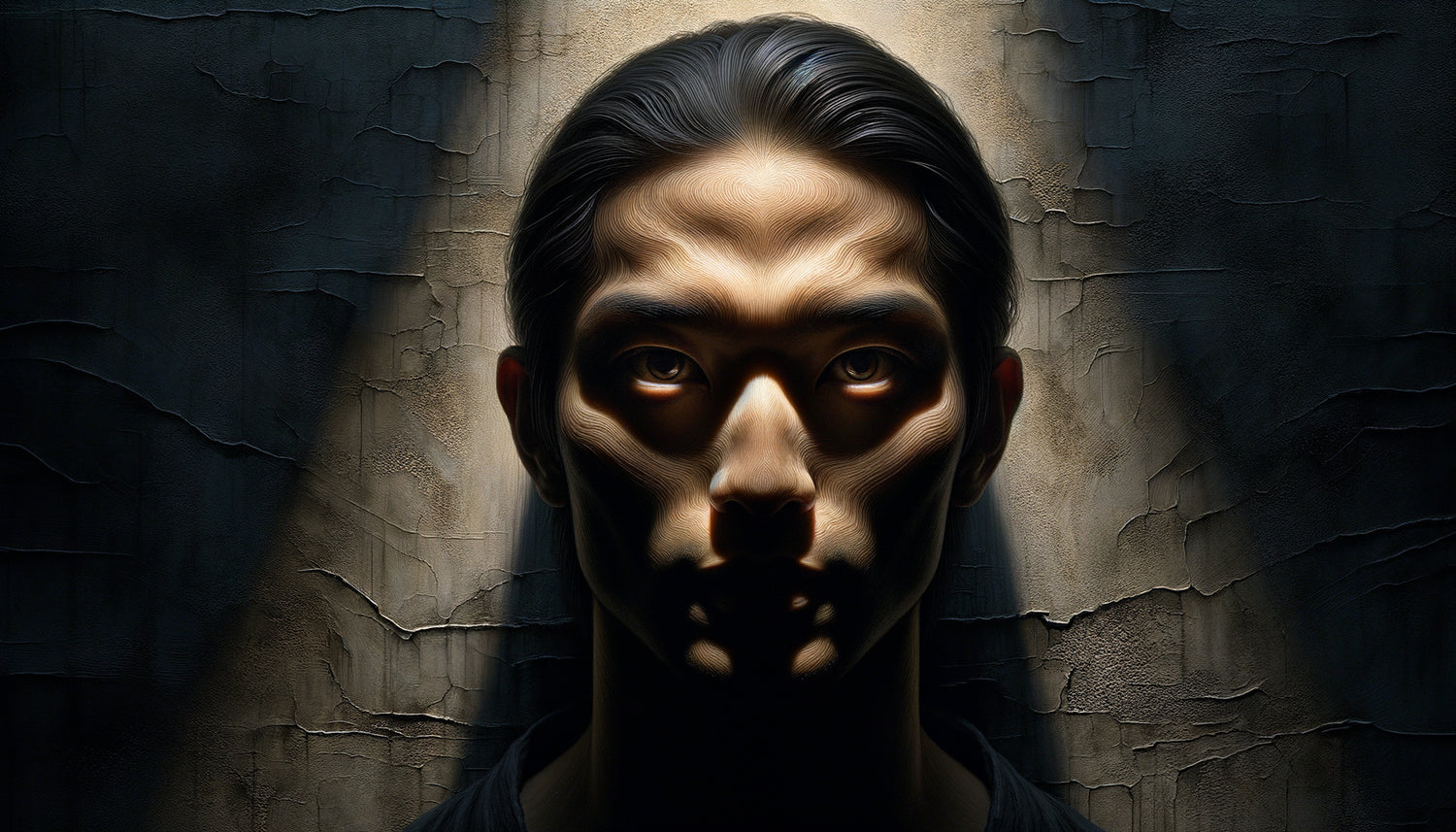
This rectangle of pale light on a dark wall. This barely visible silhouette in the twilight. This face emerging abruptly from the darkness. For twenty-three years that I have been composing visual atmospheres for cinema and conceptual photography, I have understood an essential truth: terror does not come from what is shown, but from what is hidden. Chiaroscuro is not just a lighting technique; it is a millennial psychological manipulation perfected by the masters of horror.
Here's what the technique of Caravaggesque chiaroscuro applied to scenes of terror brings: it activates our ancestral fears of the unknown, it transforms the viewer's imagination into an unwitting accomplice in their own anguish, and it creates a visual tension that paralyzes our ability to anticipate danger.
Have you ever felt this frustration watching a modern horror film, overlit, where every detail is visible? This total absence of chills, this impression of attending a catalog of latex monsters rather than a true descent into hell? The problem is not the lack of budget or special effects. It's the lack of chiaroscuro mastery.
Rest assured: understanding this technique requires no artistic training. It simply takes observing how our primitive brains react to shadow and light, and why certain visual configurations instantly trigger our alert system.
I am going to reveal the technical secret that separates an unsettling scene from a frankly terrifying one, and how you can recognize - and even apply - this visual black magic in your own decorative creations.
Radical tenebrism: when 80% of darkness dominate the image
The first time I analyzed Caravaggio's The Sacrifice of Isaac at the Louvre, I counted: only 22% of the canvas receives direct light. The rest plunges into a deep, almost aggressive black. This proportion is not accidental.
In the most effective scenes of terror - think of The Witch, Hereditary or Victorian Gothic paintings - we systematically find this ratio: 80% darkness for 20% light. Why does this specific configuration work so well psychologically?
Our reptilian brain, the one that allowed us to survive for millennia, automatically considers darkness as a potential danger. When the majority of the visual field is plunged into darkness, our limbic system enters hypervigilance mode. Our pupils dilate. Our heart rate increases slightly. We frantically scan the dark areas for threats.
This technique of radical tenebrism - literally 'dark style' in Italian - forces the viewer to become active rather than passive. Their imagination begins to populate the darkness with hypothetical dangers. It is they who create their own monsters in the shadows, creatures always more terrifying than what a director could show.
The 'single source lighting' rule
Observe the masters: Caravaggio, Rembrandt, Georges de La Tour. Their most dramatic compositions always use a single, identifiable light source. A candle. A window. A moonbeam. Never diffuse ambient light.
In a scene of terror, this unique source creates harsh, sharp shadows that cut up the space into zones of bright safety and dangerous territories. The brutal contrast between these two worlds generates a psychological boundary: here reason, there chaos. And of course, it is always from darkness that the threat emerges.
Directional upward lighting: disrupting facial recognition
Here's an experiment I consistently do during my workshops: I illuminate a face from below with a simple flashlight. Immediately, even the most familiar face becomes deeply unsettling.
Why? Because since birth, we are programmed to see faces lit from above - by the sun, ceiling lamps, the sky. Our occipito-temporal cortex, specialized in facial recognition, possesses expected shadow patterns: shadows under the nose, under the lips, under the chin.
When light comes from below, these shadows reverse. The eye sockets illuminate while the eyebrows plunge into darkness. The nose casts a shadow upwards. The brain no longer recognizes the facial structure as human. This face becomes something else, something unspeakable.
This technique of inverted chiaroscuro is omnipresent in German expressionist horror cinema of the 1920s - Nosferatu, The Cabinet of Dr. Caligari - and continues to be used today precisely because it short-circuits our most fundamental recognition system.
Application in interior decoration
Are you organizing a Halloween party? Place your light sources on the floor, directed upwards. Lanterns, LED candles in low photophores, string lights at skirting board level. Instantly, your space transforms. The faces of your guests take on that unsettling quality, and the walls themselves seem to breathe differently.

The 'light pool' technique: islands of light in an ocean of shadow
Imagine a scene: a hallway plunged into total darkness, traversed by three circles of light from spaced-apart lamps. Between each circle, three meters of impenetrable darkness. A character must cross this hallway.
Your anxiety rises with each passage from a lit zone to a dark one. Why? Because these 'light pools' - these islands of light - create a psychological rhythm of safety/danger/safety/danger that exhausts our nervous system.
In Baroque painting, we find this technique in the form of discontinuous patches of light. Some parts of the painting receive dazzling light while others remain invisible. Our eye frantically jumps from one lit zone to another, trying to piece together the complete scene, but there are always these black voids that refuse to reveal their secrets.
This fragmentation of visual information creates what neuroscientists call a 'high cognitive load'. Our brain has to work harder to understand what it sees, and meanwhile, our anxiety amplifies. We are constantly trying to mentally complete the dark areas, and this uncertainty is psychologically exhausting.
Exaggerated cast shadows: amplifying the threat
Do you know this scene? A small silhouette, and on the wall behind it, a gigantic and distorted shadow. This disproportion between reality and its projection is not just an easy visual effect: it's an ancestral manipulation of our perception of danger.
In my art direction work, I discovered that a projected shadow that is 200 to 300% the size of its source creates the optimal level of concern. Smaller, the effect is negligible. Larger, it becomes almost comical. But within this precise window, something deeply disturbing operates.
The exaggerated cast shadow acts as a visual prophecy of what the threat could become. It amplifies the physical presence of an element while keeping it partially hidden. It's the promise of impending violence, of an imminent monstrous transformation.
Contrast of sharpness: what remains blurry terrifies us more
Here's a secret that few people notice: in the most terrifying compositions using chiaroscuro, the lit areas are with surgical sharpness, while the dark areas remain blurred, indistinct.
This sharpness/blur contrast creates a cognitive hierarchy. Our brain considers the sharp as 'real and manageable' and the blur as 'uncertain and dangerous'. When an indistinct form slowly emerges from the blurry darkness towards the sharp zone, it passes from the realm of pure imagination to that of concrete threat. This transition is absolutely terrifying.
Master the art of chiaroscuro in your decor
Discover our exclusive collection of Halloween wall art that use these chiaroscuro techniques to create truly striking atmospheres in your interior.

Applying terrifying chiaroscuro: three principles to remember
After two decades dissecting what makes an image psychologically disturbing, I’ve identified three non-negotiable principles for truly effective chiaroscuro in scenes of terror.
First principle: the 80/20 ratio is sacred. If more than 30% of your composition is illuminated, you lose tension. Darkness must overwhelmingly dominate so that light becomes precious and insufficient.
Second principle: one source, multiple directions. Even with a single source, use reflective surfaces to create unpredictable light bounces. Light coming from three different directions while originating from a single source creates deep spatial disorientation.
Third principle: shadow must contain a promise. Dark areas should never be empty or flat. They should suggest depth, a potential presence, something that might be there. It is this ambiguity that transforms shadow into psychological menace.
In your own creations - whether it’s interior decoration, photography, or simply appreciating a work of art - look for these elements. Count the light/dark ratio. Identify the light sources. Observe where your eye wants to go but cannot see clearly. That's where true terror resides.
When light becomes as terrifying as shadow
Let me conclude with a fascinating paradox: in the most successful chiaroscuro compositions, light itself becomes frightening.
Think of those scenes where a beam of light reveals exactly what you didn't want to see. Where the sudden illumination of a distorted face is more terrifying than the darkness that preceded it. Light is no longer a promise of safety; it becomes the vehicle for horrible revelation.
This is the pinnacle of chiaroscuro mastery: when you have so conditioned your viewer to associate shadow with danger that light itself becomes suspect, threatening, undesirable. You no longer want to see what it might reveal.
Imagine your living room transformed for Halloween. Paintings using these ancestral chiaroscuro techniques hung on your walls. These games of light and shadow that seem to breathe, live, promise invisible presences. Your space will no longer be simply decorated, it will be psychologically charged.
Start simple: observe how natural light streams through your interior at different times. Identify areas that naturally fall into shadow. Then, instead of illuminating them evenly, accentuate these contrasts. Create islands of light. Leave corners in the dark. Use low sources.
Chiaroscuro does not wait for technical perfection. It rewards the boldness of leaving zones in mystery, the courage of not revealing everything, the wisdom of understanding that our imagination is always more terrifying than any explicit image.
FAQ: Mastering Terrifying Chiaroscuro
Can you create a terrifying chiaroscuro effect with modern LED lighting?
Absolutely, and it's even easier than with traditional sources! LEDs offer precise control over intensity and direction. The common mistake is to use too many sources. For true chiaroscuro, limit yourself to one or two directional LED sources maximum per space. Favor warm white LEDs (2700-3000K) which create denser shadows and less 'clean' than cool whites. Use dimmers to precisely adjust your 80/20 ratio between darkness and light. Floor LED strips are particularly effective for this upward lighting that distorts faces and creates a psychologically destabilizing atmosphere.
Does chiaroscuro work in small spaces or do you need large rooms?
Small spaces are actually perfect for terrifying chiaroscuro! The proximity of the walls amplifies cast shadows and creates this feeling of confinement that intensifies anxiety. In a small hallway or entrance, a single light source on the floor can completely transform the atmosphere. The trick in small spaces is to play with height: place your light source either very low (30 cm from the floor) or mid-height (1m20), never at usual height. This disruption of lighting conventions works particularly well in restricted spaces where every element is more visible and impactful. A small space skillfully worked in chiaroscuro will always be more effective than a large space evenly lit.
How to avoid terrifying chiaroscuro becoming simply 'too dark' and failed?
The border is subtle but essential. A failed chiaroscuro is simply underexposed: everything is dark and you can’t see anything. A successful chiaroscuro creates intentional areas of darkness while maintaining perfectly readable focal points. The rule I apply: your main element (face, object, point of interest) must receive enough light to be identifiable in 2-3 seconds. It's this partial readability that creates tension, not total invisibility. Test your composition by photographing it with your smartphone: if you can’t see absolutely anything on the screen, it's too dark. If you clearly see your main subject but 70-80% of the image remains in very dark tones, you have succeeded. Darkness must be present and threatening, but not total.