1882. The first national painting exhibition in Tokyo triggers a cultural earthquake. In one room, Japanese artists paint oil landscapes with Western perspective. In the other, a group of irreconcilables defend mineral pigments and rice paper. This creative tension will give birth to Nihonga, literally 'Japanese painting', a movement that refuses to choose between tradition and modernity in order to invent a third way, radically original.
Here's what Nihonga teaches us today: the art of transforming an identity crisis into creative renaissance, the ability to preserve one's heritage while engaging with the world, and the conviction that tradition is not a frozen museum but a living matter. Between 1868 and 1912, artists of the Meiji era faced a dizzying challenge: how to remain Japanese when the West fascinates? How to modernize without betraying?
You may admire Hokusai's prints or antique screens, but feel this frustration: how could these beautiful forms speak to our time without falling into nostalgia or imitation? That is exactly the question that haunted artists of Meiji Japan.
Rest assured: Nihonga is not a dusty history lesson. It's an exciting human adventure, full of controversies, bold bets and masterpieces that continue to influence contemporary Japanese art. I invite you to dive into this fascinating period when Japan reinvented its view of itself.
1868: When the West arrives and everything changes
Imagine the shock. For over two centuries, Japan has voluntarily cut itself off from the world. Then, in a few years, everything accelerates: the Meiji Restoration abruptly opens the country to foreign influences. Japanese people discover oil painting, linear perspective, Western-style shadow modeling. The effect is devastating: suddenly, ancestral techniques seem flat, outdated, insufficient.
Young painters rush to the workshops of Italian and French masters invited to Japan. The government itself encourages this artistic westernization, a symbol of modernity. Traditional Japanese painting – with its delicate washes, natural pigments, asymmetrical compositions – seems doomed. Some artists sell their goat hair brushes and grinding stones for colors. A cultural twilight seems inevitable.
Yet, in this moment of collective doubt, some voices rise up. Not through blind conservatism, but through a deep intuition: what if true modernity consisted of reinventing tradition rather than abandoning it?
The counter-offensive: Okakura Kakuzō and Fenollosa, an unlikely duo
The history of Nihonga truly begins with an improbable encounter: Ernest Fenollosa, an American professor of philosophy who fell in love with Japanese art, and Okakura Kakuzō, a brilliant and combative Japanese intellectual. Together, they will lead a crusade to save traditional painting.
Their argument? The West itself is fascinated by Japanese art – japonism is all the rage in Paris, Van Gogh collects prints. Why should Japan imitate Europe at precisely the moment when Europe is drawing inspiration from Japan? This irony galvanizes them.
In 1887, they founded the Tokyo School of Fine Arts where, a revolutionary move, only Japanese techniques are taught. No oil painting. Only mineral pigments ground by hand, rice paper or silk, traditional brushes. But with a crucial twist: students also study Western anatomy, European color theories, and above all, they travel, observe, digest foreign influences to metabolize them in the Japanese way.
The Nihonga was born from this alchemy: a fidelity to ancestral materials and techniques, but total freedom in subjects, compositions, ambitions. Neither pastiche nor servile imitation of the West. A third path, proudly hybrid.

Discover this inspiring artwork
Materials as a manifesto: pigments, paper and patience
Understanding Nihonga, is first understanding its materials, because they carry a philosophy. Where oil painting allows for corrections and impasto, Nihonga artists work with mineral pigments (ground malachite for greens, azurite for blues, gold and silver powder) bound with animal glue, applied to washi paper or silk.
Each gesture is definitive. Water and pigments diffuse into the fibers of the paper with a spontaneity that cannot be totally controlled. This technique requires intense mental preparation – we find here the influence of Zen and calligraphy. The Nihonga painter is as much an artisan as a meditator.
The Meiji artists defended these technical constraints as virtues. At a time of rampant industrialization, they offered a slow, contemplative art rooted in manual gesture. Their works do not seek realistic illusion but a more subtle truth: that of the passing seasons, changing light, the ephemeral captured with delicacy.
The masters of the renaissance: Kanō Hōgai, Hashimoto Gahō and Yokoyama Taikan
The Nihonga finds its heroes. Kanō Hōgai, from the famous Kanō school which painted for the shoguns, agrees to radically rethink his heritage. His masterpiece, 'Merciful Mother Kannon' (1888), depicts a Buddhist deity with an almost Western sensibility in the drapery, but in a purely Japanese palette and technique. A bold synthesis.
Hashimoto Gahō, his contemporary, paints tigers and dragons with new power, incorporating anatomical studies while preserving the calligraphic breath of the brush. His works circulate in world exhibitions, where they amaze Europeans: here is a Japanese art that is neither an exotic curiosity nor a pale copy of the West.
Then comes Yokoyama Taikan, Okakura’s student, who pushes the Nihonga towards lyrical abstraction. His landscapes dimly suggested, where mountains barely emerge from the clouds, anticipate some research in Western modern art. He paints Mount Fuji hundreds of times, each version exploring a different nuance of light, atmosphere, emotion.
These artists do not just paint: they theorize, teach, exhibit internationally. They transform the Nihonga into a coherent movement, into a credible alternative to the hegemony of Western painting.

Discover this inspiring work
The fertile paradox: preserving by transforming
The genius of the Nihonga lies in its assumed paradox. These artists proclaim themselves guardians of tradition, but they constantly innovate. They paint new subjects: urban landscapes, scenes from modern life, psychological portraits. They experiment with scale, creating monumental screens that rival Western canvases.
Some discreetly incorporate Western influences: a treatment of light inspired by Impressionism, a composition borrowed from the Renaissance. But always, the rice paper, the mineral pigments, the Japanese brush remain the basic tools. This material fidelity guarantees a visually recognizable identity among thousands.
The Meiji Japan then understands a valuable lesson: tradition is not a tomb where burying the past, but a laboratory where reinventing it. The artists of the Nihonga do not reject the West – they digest it, transform it, integrate it into a vision that remains fundamentally Japanese. It is this flexibility that ensures their survival and relevance.
The Living Legacy: From Meiji to Today
1912 marks the end of the Meiji era, but Nihonga largely survives. Throughout the 20th century, the movement continues to evolve. Some artists explore total abstraction while using ancestral techniques. Others engage in dialogue with pop art, minimalism, and conceptual art, always with their brushes and pigments.
Today, contemporary artists still claim Nihonga. They exhibit in international galleries, their works reach dizzying prices at auctions. Proof that this traditional Japanese painting reinvented over a century ago still speaks to our globalized era.
For us, art and decoration enthusiasts, Nihonga offers a valuable inspiration. It shows us that we can create interiors that honor the past without falling into kitsch, that open up to influences without losing their soul. A Nihonga artwork hung in a contemporary space creates this fascinating temporal dialogue: the modernity of the creative gesture meets the timelessness of ancient techniques.
Be inspired by this encounter between tradition and modernity
Discover our exclusive collection of Asian art that captures the spirit of Nihonga and brings this timeless Japanese elegance to your interior.
The Nihonga reminds us of an essential truth: true modernity is not about erasing the past, but reinventing it with courage. The artists of Meiji Japan rejected the false dilemma between tradition and progress. They created an original synthesis that continues, more than a century later, to nourish our imagination.
So, the next time you contemplate a Japanese work – whether it is ancient or contemporary – ask yourself this question: what is my own path between heritage and innovation? How can I, on my scale, create spaces, aesthetic choices that honor what precedes me while speaking to my present? The Nihonga does not have all the answers, but it beautifully poses the right questions. And sometimes, that's exactly what we need to transform our gaze.
Frequently Asked Questions about Nihonga
What is the difference between Nihonga and classic Japanese painting?
Nihonga was born in the Meiji era as a conscious reinvention of traditional Japanese painting. While classical painting followed strictly codified schools (Kanō, Tosa, Rinpa), Nihonga allows itself a new creative freedom while preserving ancestral materials: mineral pigments, washi paper, silk, animal glue. The fundamental difference lies in the intention: Nihonga artists consciously dialogue with Western art, integrating modern influences (anatomy, perspective, contemporary subjects) while asserting their Japanese identity. It is a tradition voluntarily reinvented rather than simply perpetuated. A Nihonga painting can represent a modern urban landscape or explore abstraction, an unthinkable freedom in classical schools. This creative tension between technical fidelity and thematic innovation defines the essence of the movement.
Why does Nihonga remain relevant today?
Nihonga speaks to our globalized era because it resolves a universal dilemma: how to preserve one's cultural identity while opening up to external influences? At a time when everything seems to be homogenizing, Nihonga demonstrates that one can be both rooted and cosmopolitan, traditional and contemporary. Contemporary Nihonga artists exhibit in the largest international galleries, their works dialogue with global contemporary art while remaining recognizable by their ancestral techniques. For interior decoration, a Nihonga work brings this rare quality: a presence at once timeless and current, an aesthetic that works as well in a minimalist loft as in a classic interior. It creates a fascinating temporal bridge between past and present, tradition and innovation, Orient and Occident – exactly what demanding art lovers are looking for today.
How to recognize an authentic Nihonga painting?
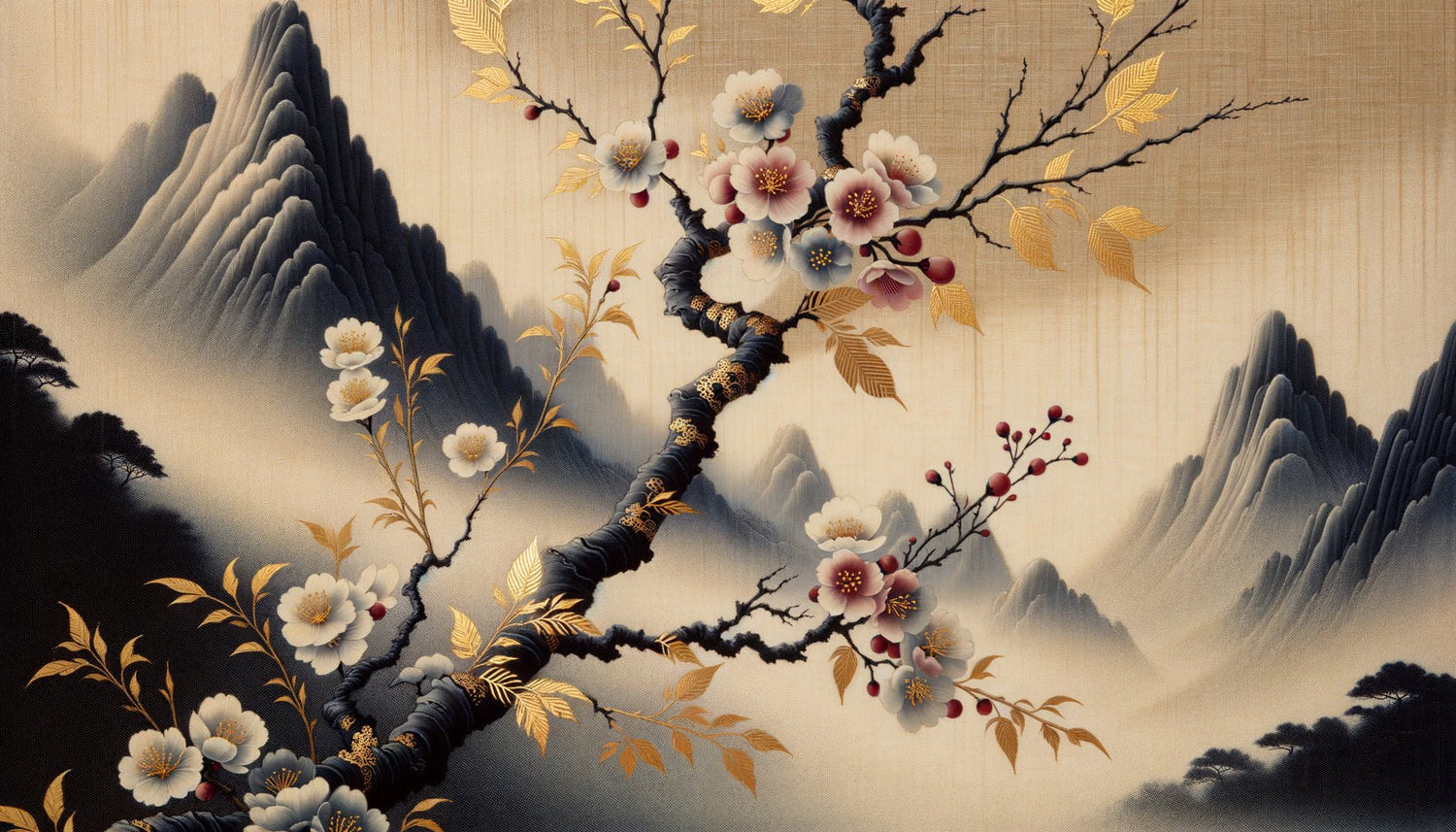
An authentic Nihonga work is first recognized by its materials: it is made on traditional washi paper or silk, with natural mineral pigments (malachite, azurite, cinnabar, crushed oyster shell) bound with animal glue. Unlike oil painting, the colors have a distinctive matte quality, almost powdery, and gold or silver can be incorporated in the form of leaf or powder. Observe the texture: mineral pigments create a slightly grainy surface, especially in greens and blues. The paper itself participates in the work – its whiteness, its fibrous texture are visible and part of the composition. Finally, look at the treatment of outlines: Nihonga often retains the calligraphic fluidity of the Japanese brush, even in modern works. True Nihonga artists usually sign their work with a traditional red seal and their signature in Japanese characters, perpetuating this ancestral practice.