I remember that precise moment in a Kyoto gallery. Between two Hokusai prints, an empty space. Not a lapse, not negligence. An intention. The curator smiled at me: 'It’s the MA that reveals the artwork'. I spent twenty minutes in front of this void which spoke as much as the artworks themselves. It was fifteen years ago, and since then, my practice as a set designer specializing in Asian art has been built around this revelation: the void is not absence, it’s the presence that breathes.
Here's what the concept of MA brings to your walls: a visual breath that amplifies each artwork, an immediate sophistication that transcends simple decoration, and that rare serenity in our overloaded interiors. MA transforms your wall into a meditative composition where each element finds its rightful place.
You’ve probably already felt this frustration: accumulating frames, paintings, decorative objects, hoping to create a harmonious wall. Result? A feeling of saturation, visual chaos. Each new piece dilutes the impact of the previous one. You step back, you observe, and something is wrong. Too much. It's always too.
Rest assured: you haven’t failed. You’ve simply applied a Western logic of accumulation where Japanese thought proposes the opposite. MA isn't a complicated technique reserved for experts. It’s a change in perspective, an accessible philosophy that will radically transform your approach to wall decoration.
I am going to reveal how this millennial concept, born from Zen temples and Noh theater, can metamorphose your walls into true breathing works of art.
MA: The void that contains everything
MA (間) literally translates as 'interval', 'space-time', 'pause'. But these words capture only a fraction of its depth. In traditional Japanese architecture, MA refers to the space between pillars, between rooms, between the garden and the interior. It is never a passive void. It’s a space charged with potentiality.
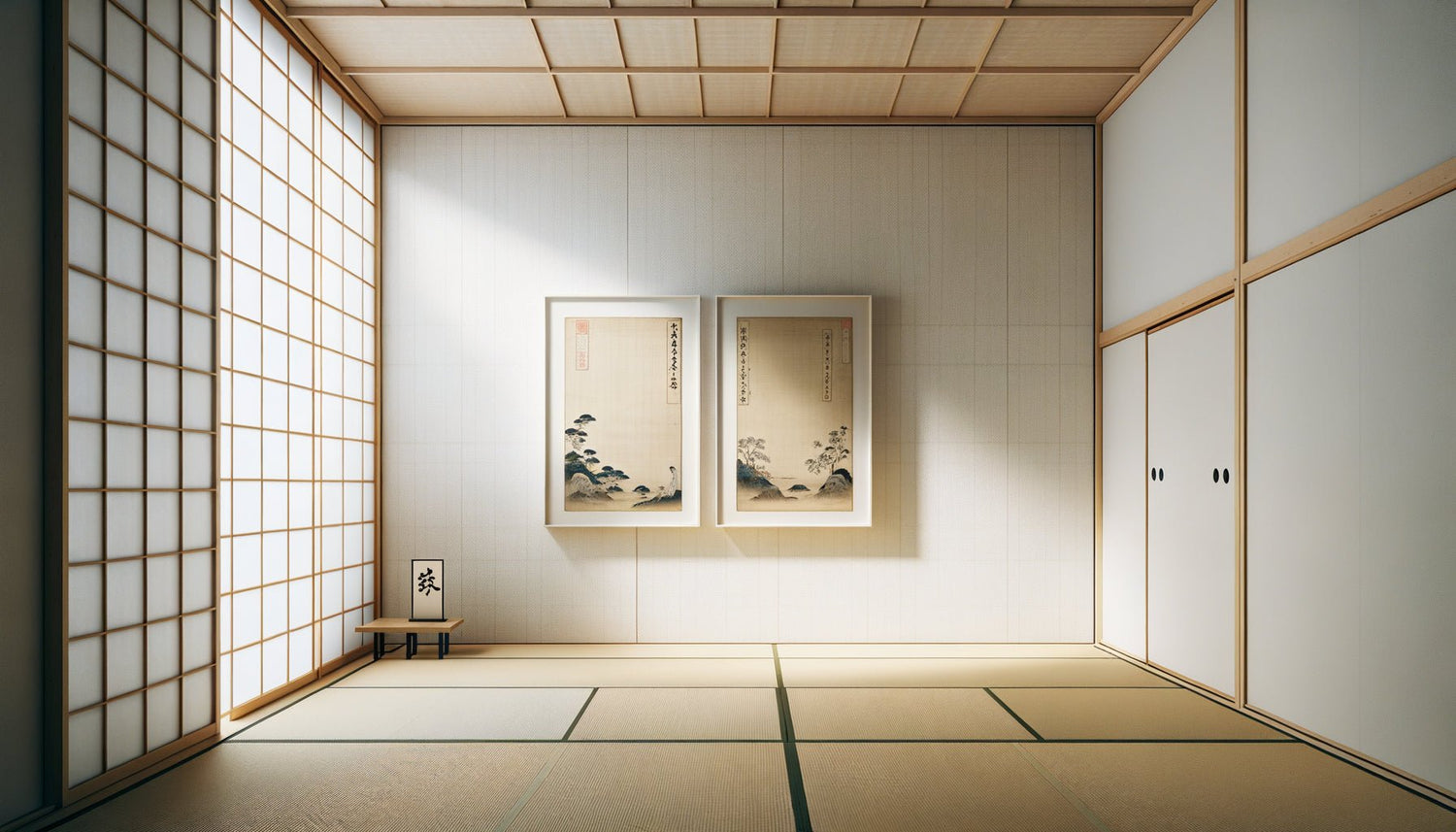
In wall composition, MA becomes that breathing space between your paintings, between a work and the edge of the wall, between full and void. It’s not simply about spacing your frames. MA possesses an energetic quality: it creates dynamic tension, a silent dialogue between the elements.
I have learned to recognize successful MA by a physical sensation: your gaze circulates naturally, without snag, without fatigue. Each artwork benefits from its own territory of silence. The entire wall becomes a visual breath where the void and the full balance like inspiration and expiration.
The fundamental difference with Western space
In the West, we seek to fill the void. We perceive it as a lack, a missed opportunity. The MA (Japanese aesthetics) inverts this logic: the void reveals the full. Without silence, there is no music. Without space, there is no form. It's the interval between notes that creates the melody, not their accumulation.
This philosophy radically transforms the wall composition. Instead of trying to cover every square centimeter, you orchestrate a balance where each empty zone amplifies the works it surrounds. The white wall is no longer a decorative failure, but an active element of the composition.
How MA concretely transforms your wall
During a recent project in a Parisian loft, my client possessed a magnificent Hiroshige print. She had framed it, surrounded by four smaller engravings, added photographs of travels to Japan. The whole thing screamed instead of whispered. We removed everything except the main print. A single painting, centered on a four-meter wall. The emptiness around was no longer a lack but a majestic presence.
MA operates several simultaneous transformations in the wall composition:
Visual amplification : The more generous the empty space around a work, the greater its impact. A small 30x40 cm painting, surrounded by two meters of emptiness on each side, acquires a monumental presence. The void acts as a natural amplifier.
Creation of rhythm : When composing with multiple works, MA creates the strong and weak beats. An alternation between dense zones and empty zones naturally guides the eye, creating a fluid visual path. You orchestrate a circulation, not a collision.
Emotional breathing room : The void gives time for emotion to settle in. Your gaze can linger, contemplate, digest. In our lives saturated with information, this visual pause becomes a rare luxury, a refuge of calm on a daily basis.

Discover this inspiring work
The three golden rules for integrating MA
1. The sacred ratio: 60/40
In Japanese tradition, the MA often works according to an approximate balance of 60% empty space for 40% filled. On a three-meter wide wall, this means that about 1.20 meters will be occupied by artworks, leaving 1.80 meters of breathing room. This ratio may seem radical to our Western eyes accustomed to density, but it instantly creates this zen sophistication.
I apply it flexibly according to the contexts. In a contemporary living room, I can go up to 70/30. In a bedroom, a sanctuary of rest, I prefer a maximum of 50/50. The essential thing is always to prioritize emptiness over accumulation.
2. Intentional asymmetry
The MA thrives on asymmetry. Forget perfectly centered and balanced compositions. Japanese thought prefers dynamic imbalance: a large void on one side, a concentration of artworks on the other. This tension creates movement, life.
On an entrance wall I recently designed, I placed three prints in the left third, leaving the two-thirds right completely empty. The eye travels from density to expansion, mimicking the movement of entering the house. The MA becomes narrative.
3. Emptiness as a natural frame
Consider the emptiness around your artworks as their true frame. A painting has its physical wooden or metal frame, but the MA creates an infinitely more powerful invisible frame. I recommend a minimum of 80 cm to 1 meter of empty space around a significant work so that it can fully breathe.
This rule changes everything: you are no longer hanging paintings on a wall, you are sculpting the emptiness around them. The approach is reversed, and with it, the result.
When I understood that less was infinitely more
Ten years ago, I began my career by multiplying artworks in my projects. The more pieces there were, the more I thought I demonstrated my value. During an exhibition in Tokyo, a master of ikebana showed me his arrangement: three branches, one vase, an ocean of space. 'Each branch breathes for all the forests', he said to me.
I understood that the MA was not a minimalist constraint, but a maximum liberation. By removing, we reveal. By spacing, we amplify. This lesson revolutionized my practice: my clients no longer seek to fill their walls, but to compose them like visual haikus.
The MA works particularly well with Asian art – Japanese prints, calligraphy, Chinese ink paintings – whose aesthetics already incorporate this philosophy of emptiness. But its principle applies to all artistic styles. I have created remarkable MA compositions with contemporary photography, geometric abstraction, even classic portraits. Emptiness is universal.

Discover this inspiring artwork
Three MA compositions to start the day
Solitary meditation: A single significant work on a large wall. Slightly off-center position (rule of thirds). The surrounding void becomes contemplative. Perfect for a bedroom or hallway. MA here reaches its purest form: an object, a universe.
The breathing triptych: Three works of identical or progressive size, aligned horizontally with generous intervals (50 to 80 cm between each). The space between the works creates a ternary rhythm, a visual breath. Ideal for a living room above a sofa.
Vertical asymmetry: Two artworks of different formats, arranged vertically with a lateral and vertical offset. The MA circulates around and between them, creating an upward movement. The composition seems to float, light, freed from gravity.
In each of these configurations, resist the urge to fill in. Every empty centimeter works for you, creating depth, elegance, and that indefinable quality that the Japanese call yohaku no bi: the beauty of emptiness.
Let the void reveal beauty
Discover our exclusive collection of Asian artworks that naturally embody the MA: works designed to breathe, conceived to transform your walls into spaces of contemplation.
MA as a philosophy of wall life
Applying MA to your walls goes beyond decoration. It's adopting a philosophy of the essential. Each morning, when passing in front of your composition, you will experience this silent lesson: value lies not in accumulation, but in the space that allows each element to reveal its full presence.
Your guests will notice something different, without always being able to name what it is. A feeling of calm, clarity, discreet luxury. It's the MA at work, invisible but omnipresent. The void you dared to preserve becomes the signature of your refinement.
Start gently. Remove a piece from your current composition. Observe how the others suddenly breathe better. Move a frame to create more space around it. Feel the transformation. MA doesn't require an immediate revolution, just this progressive awareness of emptiness as an ally.
In our lives saturated with stimuli, information, objects, MA offers a saving counterpoint. Your walls become visual refuges, decompression zones for the gaze and mind. This breathing you install on your walls eventually positively contaminates your entire interior, then your life itself.
The concept of MA reminds us of this essential truth: the space between things is never empty, it is full of potential. By applying it to your wall compositions, you are not only creating elegant decoration. You install an age-old wisdom in your daily life, a visual lesson on what really matters: not how much we possess, but how we allow each thing to exist fully.
Frequently Asked Questions about MA in Wall Decoration
Does MA work in a small space?
Absolutely, and that's even where it reveals its greatest magic. In a small apartment, the temptation is to maximize every surface, paradoxically creating a feeling of suffocation. MA reverses this logic: by generously preserving emptiness, you visually enlarge the space. A small wall with a single well-chosen work, surrounded by emptiness, will give an impression of infinite amplitude superior to three crowded paintings. I have transformed studios of 25m² into airy spaces simply by applying the 60/40 ratio. Emptiness does not consume space, it reveals it. In a small interior, each piece must count double: for itself and for the emptiness it justifies. Prioritize a strong piece, a quality Japanese print for example, and let it reign over its territory of silence.
How to convince my family that the wall is not 'empty'?
This resistance is natural, especially if your surroundings grew up with the Western aesthetic of accumulation. My strategy? Create a comparative experience. Photograph your current wall. Remove half the elements, keeping only the most significant. Photograph again. Show the two images side by side and ask: 'In which room would you like to rest?' Invariably, the MA composition wins. The brain instinctively recognizes visual breathing, even if the culturally conditioned eye resists. Also explain that contemporary luxury is defined by space, not accumulation. Five-star hotels, prestigious galleries, interiors of high-end magazines: all intuitively apply MA. Emptiness is not a lack, it is the privilege of those who can afford not to fill.
Can I mix MA with other decorative styles?
Not only can you, but you should! MA is not reserved for traditional Japanese style. It's a universal principle of composition that enriches any aesthetic. I have applied MA in Scandinavian interiors (where it reinforces minimalist hygge), industrial (where the void highlights the brutality of materials), bohemian (where it avoids visual saturation), even classic (where it brings unexpected modernity). The key is to respect the spirit of MA – prioritize breathing over accumulation – while adapting the ratio to your style. A baroque interior will tolerate 45% full rather than 40%, but will still benefit from the principle. MA is not a stylistic dictate, it's a compositional wisdom that transcends trends. Even in an eclectic interior, leaving empty spaces between your collections will create coherence and sophistication.