Paris, 1867. The Universal Exposition is in full swing. Between pavilions dedicated to industrial machines, a small Japanese stand causes a silent shockwave. Colorful paper sheets, as light as petals, circulate from hand to hand. woodblock prints. Within a few weeks, everything changes. Prestigious artists abandon their academic codes. Collectors empty their wallets. An aesthetic revolution begins, one that will transform our walls forever.
Here's what Japonism brings to your decor: a new way of composing wall space with bold asymmetrical compositions, a radically different color palette that enhances natural light, and a decorative philosophy where each element breathes without saturating the eye.
Perhaps you have felt this frustration in front of your walls. You accumulate frames, multiply decorations, but something is wrong. Too cluttered. Not consistent enough. The eye doesn't know where to rest. You are looking for that refined elegance that you admire in magazines, that ability to create a strong impact with economy of means.
Rest assured: this aesthetic quest that you are embarking on, the greatest Western artists of the 19th century have experienced it before you. And they found their answer in Japanese prints which gave birth to the Japonism movement between 1860 and 1890.
I invite you into this fascinating story that changed everything in modern wall decoration, and how you can be inspired by it today.
The visual shock of 1860: when the West discovers ukiyo-e
Imagine Paris in the 1860s. Bourgeois salons are overflowing with gilding, monumental canvases in imposing frames, dark still lifes. Symmetry reigns supreme. Then arrive these Japanese paper sheets, initially used as packaging for imported porcelain.
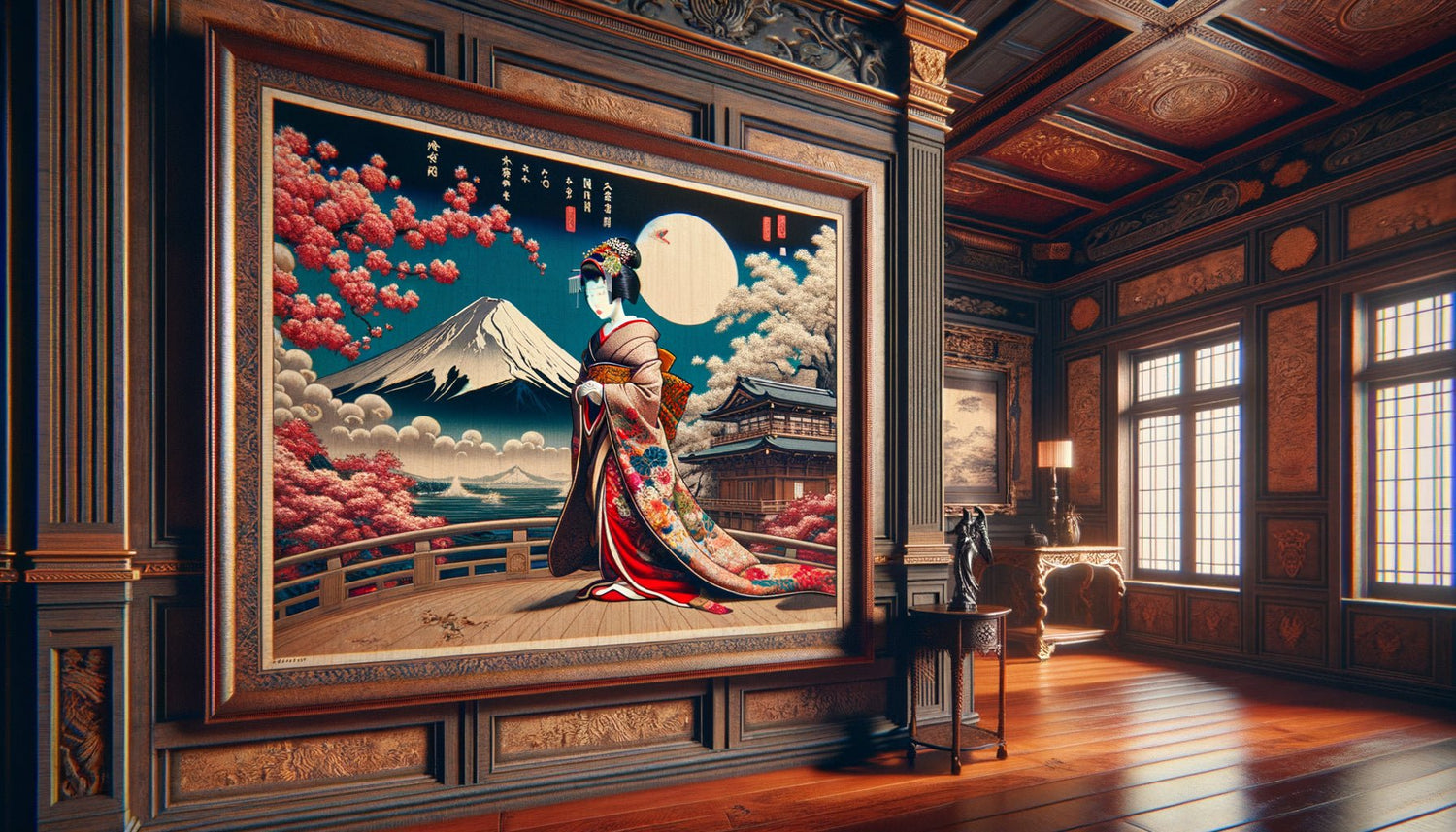
These woodblock prints represent the floating world, the ephemeral: elegant courtesans, kabuki theater actors, stylized landscapes. But it is not so much the subject that fascinates as the revolutionary composition. Bold framing, perspectives that cut figures, blocks of pure colors without shadow or modeling.
The Goncourt brothers become obsessive collectors. Claude Monet covers his Giverny salon with Japanese prints. Vincent Van Gogh copies several, fascinated by their graphic power. Japonism is not a simple fashion: it is an aesthetic paradigm shift that will permeate Impressionism, Art Nouveau, and even contemporary design.
Asymmetry as a new visual language
The great lesson of ukiyo-e prints? <strong>Asymmetry creates more interest than symmetry</strong>. In a Japanese composition, the main element may only occupy one third of the space. The rest breathes. The void becomes as important as the full.
This revelation transforms Western wall decor. No more perfectly balanced mirror compositions. Instead, dynamic arrangements where the eye travels through space according to a thought-out path. A large piece on the left, two smaller ones offset to the right, an assumed empty space between them.
Even today, this approach remains the most effective way to create captivating walls without visual clutter.
The Chromatic Revolution of Japonism
Ukiyo-e prints introduced a <strong>radically new palette</strong> to the West. The intense Prussian blue of Hokusai's waves. The delicate pinks of Hiroshige's cherry blossoms. The deep blacks used not to darken, but to structure and accentuate.
Before Japonism, Western painting favored earthy tones, academic browns, gray shadows. Japanese artists dared <strong>frank chromatic contrasts</strong>: a bright red kimono on an electric blue background, without transition. Pure, saturated colors that seemed to vibrate on the paper.
This color audacity liberated generations of artists. The Impressionists adopt deep blues for their skies and waters. The Nabis explore blocks of vibrant colors. Art Nouveau draws from this palette to create its recognizable posters.
For your walls, it means daring <strong>bold chromatic associations</strong>. A work with vibrant tones does not need to be surrounded by neutral shades to function. On the contrary, it can dialogue with other saturated colors if the overall composition breathes.
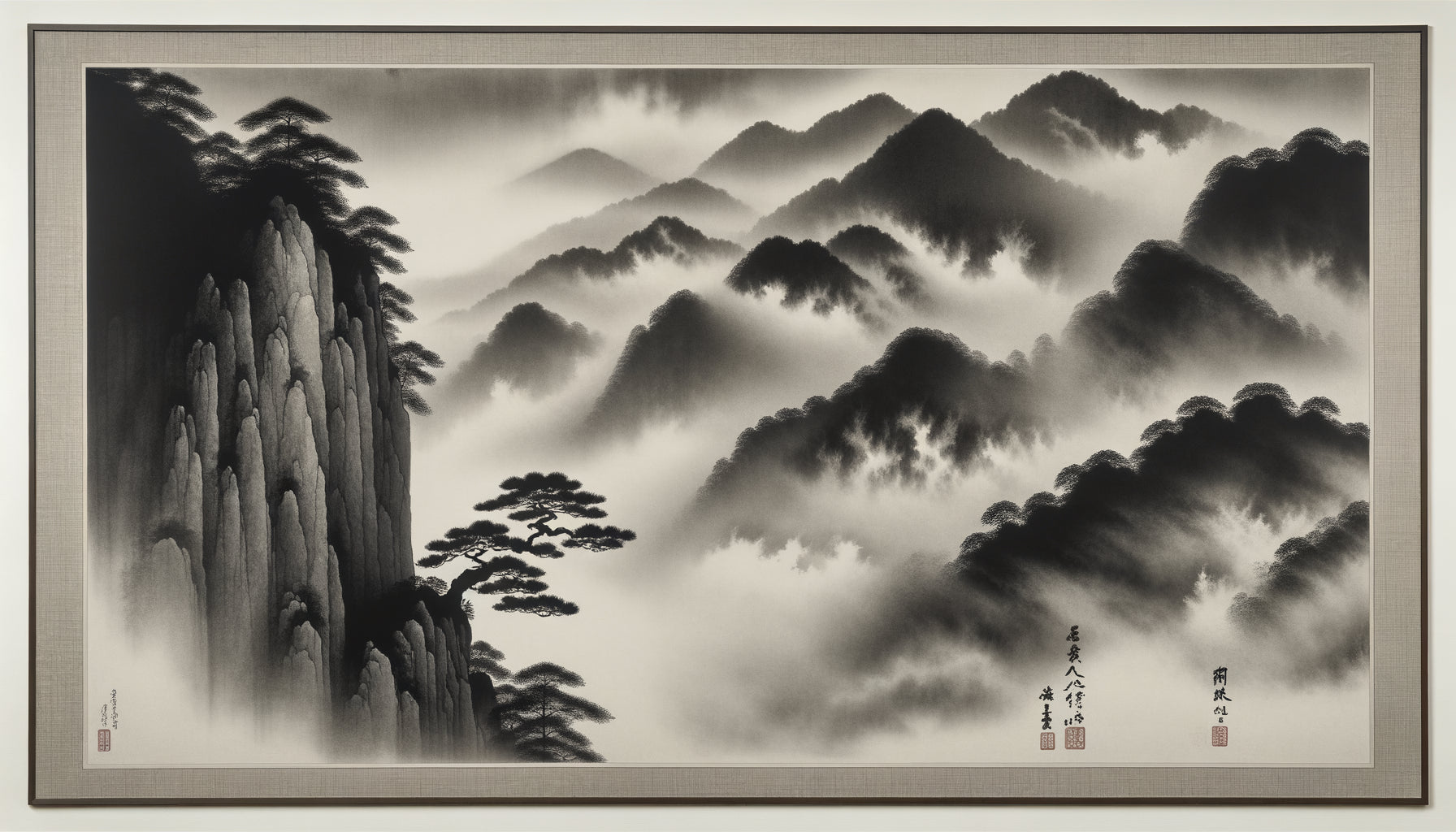
 Discover this inspiring artwork
These Japanese elements that changed everything in our interiors
Discover this inspiring artwork
These Japanese elements that changed everything in our interiorsJaponism is not limited to ukiyo-e prints hanging on walls. It's an entire <strong>philosophy of domestic space</strong> that infiltrated Western homes from the 1870s.
Japanese screens, with their large decorative surfaces, offer an alternative to fixed partitions. They allow you to redefine the space according to the time of day. This flexibility immediately appeals to progressive architects.
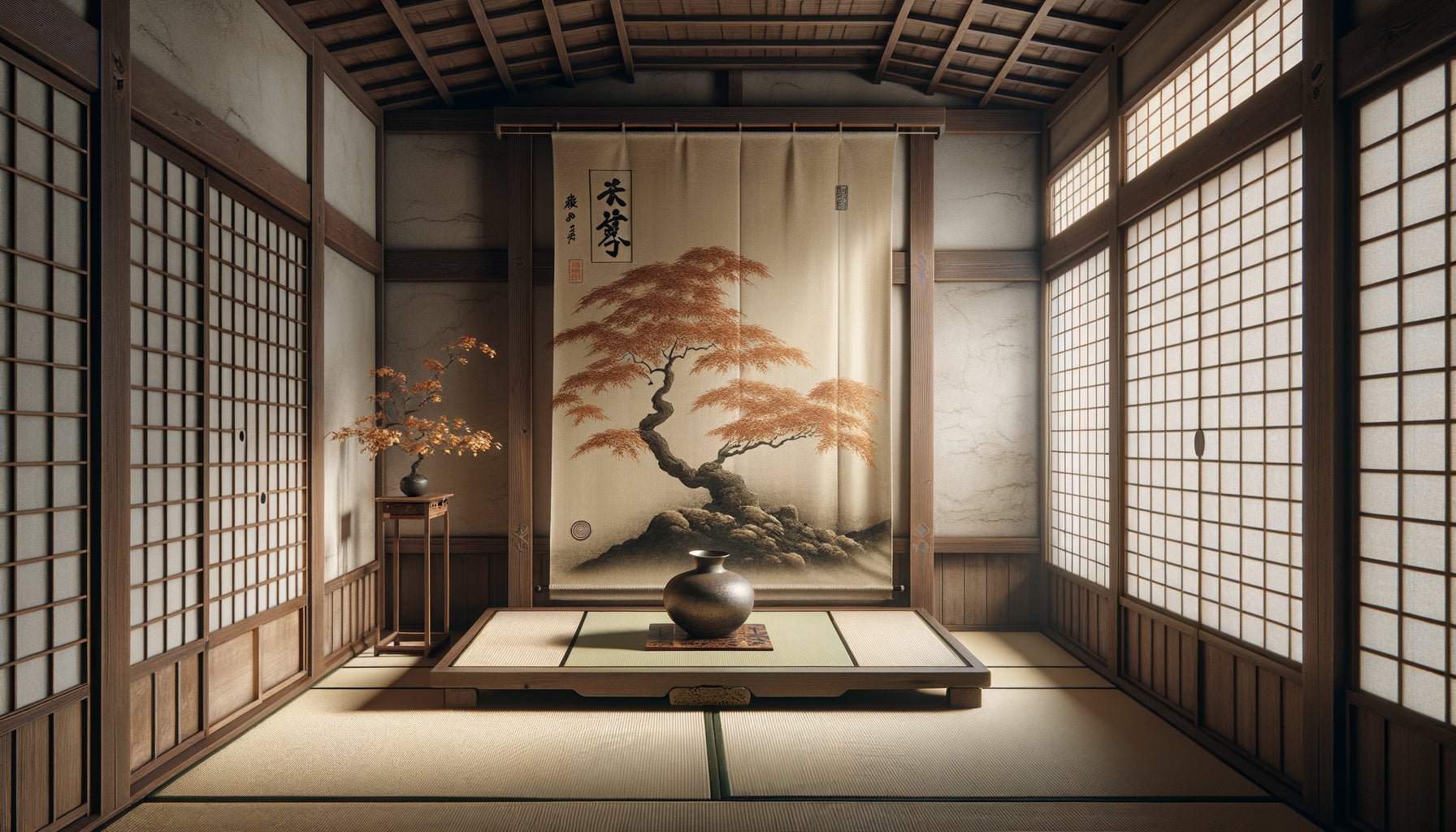
Kakemonos, these suspended scrolls that are changed with the seasons, introduce the revolutionary concept of temporary decoration. Why freeze your walls for eternity when you can make them evolve? This idea germinates in creative minds and will influence 20th-century design.
Nature stylized as a decorative motif
Japanese prints never reproduce nature realistically. They stylize it, synthesize it, refine it. A cherry branch becomes an elegant arabesque. A wave transforms into graphic claws. Mount Fuji simplifies into an almost abstract triangle.
This approach fascinates Western artists tired of academic naturalism. It opens the way to progressive abstraction, towards a more conceptual representation of the world. Art Nouveau seizes it to create its sinuous plant motifs that adorn facades, posters, wallpapers.
For your decoration, this means favoring evocative rather than descriptive representations. A work that suggests rather than shows leaves more room for imagination and is less tiring on the eyes every day.
How to integrate the spirit of Japonism today
You don't need to transform your interior into a traditional tea house to benefit from the aesthetic lessons of Japonism. A few principles are enough to create balanced and airy wall compositions.
Start by decluttering. Japonism teaches us that empty space has aesthetic value. A wall with two well-chosen and well-placed works will have more impact than a wall saturated with small frames. Embrace the bare areas. They allow the eye to rest and enhance what you have chosen to show.
Then, dare asymmetry. Abandon the idea that everything must be centered and balanced in a mirror image. Place a large piece off-center, accompanied by smaller ones offset. Create offset compositions that generate movement.
Work through contrast rather than accumulation. A work with vibrant colors gains power when it dialogues with purified spaces. Ukiyo-e prints show us that an intense red element becomes even more vibrant when it emerges from a neutral background.
The lesson of the masters: Hokusai, Hiroshige and their legacy
Two names dominate the universe of ukiyo-e prints that fascinated the West: Katsushika Hokusai and Utagawa Hiroshige. Their series of landscapes literally redefined how space is represented.
Hokusai, with his Thirty-six Views of Mount Fuji, shows how a single subject can be infinitely renewed depending on the point of view, season, atmosphere. His famous Great Wave off Kanagawa becomes the most reproduced Japanese image in the world. Its bold framing, with the wave occupying almost all the space and the distant Fuji minuscule, defies all academic conventions.
Hiroshige excels in elongated vertical compositions, perfect for narrow wall spaces. His series on the Tōkaidō stations play with horizontal bands of color, perspective plunging shots, pre-cinema framing.
These two masters teach us that composition is as important as subject matter. You can have the most beautiful object in the world; if it's poorly positioned in space, it loses its power.

Discover this inspiring work
From Japonism to your interior: the aesthetic transformation
The movement of Japonism between 1860 and 1890 bequeathed us much more than ukiyo-e prints to collect. It transformed our very understanding of what a beautiful wall composition is.
Before this aesthetic revolution, decorating meant filling, accumulating, showing one's wealth through abundance. After Japonism, a new luxury emerges: that of rigorous selection, mastered space, visual breathing.
This philosophy remains surprisingly relevant today. In our contemporary interiors often overloaded with objects and visual information, the principles of Japonism offer a path to aesthetic serenity. Fewer elements, better chosen, better placed, with room to breathe.
The great designers of the 20th century understood this. From Charles Rennie Mackintosh to Eileen Gray, from Charlotte Perriand to Isamu Noguchi, all drew on this Japanese heritage to create spaces that are pure but warm, minimalist but never cold.
Ready to transform your walls with the timeless elegance of Japonism?
Discover our exclusive collection of Asian artworks that capture the spirit of ukiyo-e prints in contemporary compositions perfectly suited to modern interiors.
Conclusion: The living legacy of an aesthetic revolution
Japonism does not belong to the past. Every time you create an asymmetrical wall composition, every time you embrace an empty space on a wall, every time you prioritize a strong work over ten small ones, you extend this aesthetic revolution that began more than 150 years ago.
Ukiyo-e prints taught the West that there were other ways to see, compose, and decorate. They freed artists from their academic conventions and paved the way for modern avant-gardes.
Today, you can make this heritage your own. Start simply: choose a work that truly touches you, place it boldly, give it space to breathe. Observe how your room transforms. How your gaze circulates differently. How emptiness becomes as important as fullness.
This is the spirit of Japonism: extreme attention to every element, and the courage to let it breathe.
Frequently Asked Questions about Japonism and Ukiyo-e Prints
Do I need to create a completely Japanese interior to integrate ukiyo-e prints?
Absolutely not, and that's precisely the whole point of Japonism! This movement isn't about copying a traditional Japanese interior, but about integrating some Japanese aesthetic principles into your existing decor. A single ukiyo print or a Japanese-inspired work can transform a classic Western wall. The Parisian artists of the 1870s didn't live in Japanese houses; they simply hung a few prints among their Western works, and that created a fascinating aesthetic dialogue. Start with a piece that speaks to you truly, integrate it into your current decor by applying principles of asymmetry and breathing space. You will be surprised at how a single well-placed element can redefine the balance of a room. Japonism is first and foremost a state of mind: prioritizing quality over quantity, valuing empty space, daring off-center compositions.
Do ukiyo-e prints work in contemporary minimalist interiors?
It's even their preferred terrain! Ukiyo-e prints and contemporary minimalism share fundamental values: simplicity, clarity of lines, mastery of empty space, maximum visual impact with a minimum of means. A minimalist interior can sometimes seem cold or impersonal; a Japanese print or ukiyo-inspired work immediately brings warmth, color, and a refined cultural touch without breaking the overall simplicity. The large blocks of color in Japanese prints dialogue perfectly with white walls and clean surfaces of contemporary design. Think of the interiors of Japanese architects like Tadao Ando or Kenya Hara: they combine radical minimalism and traditional elements with natural elegance. To succeed in this combination, choose works with strong graphic compositions and limit yourself to a few carefully selected pieces rather than multiplying decorative elements.
How to start a wall composition inspired by Japonism without making a mistake?
The beauty of Japonism is that there aren't really any mistakes possible if you respect a few simple principles. Start by choosing your masterpiece: a work that truly touches you, preferably with colors or patterns that resonate with your interior. Place it in an off-center position rather than exactly in the center of the wall; this immediately creates more dynamism. Leave it plenty of breathing room around it: at least 20 to 30 cm of empty space on the sides. Observe the composition for a few days before adding anything else. Often, a single strong piece is enough. If you want to add other elements, prioritize different sizes and offset positions rather than rigid alignment. Think in terms of a visual triangle: three elements of different sizes placed asymmetrically create a balanced and dynamic composition. And above all, trust your eye: if something seems too cluttered, it probably is. The spirit of Japonism is to dare to remove rather than add.