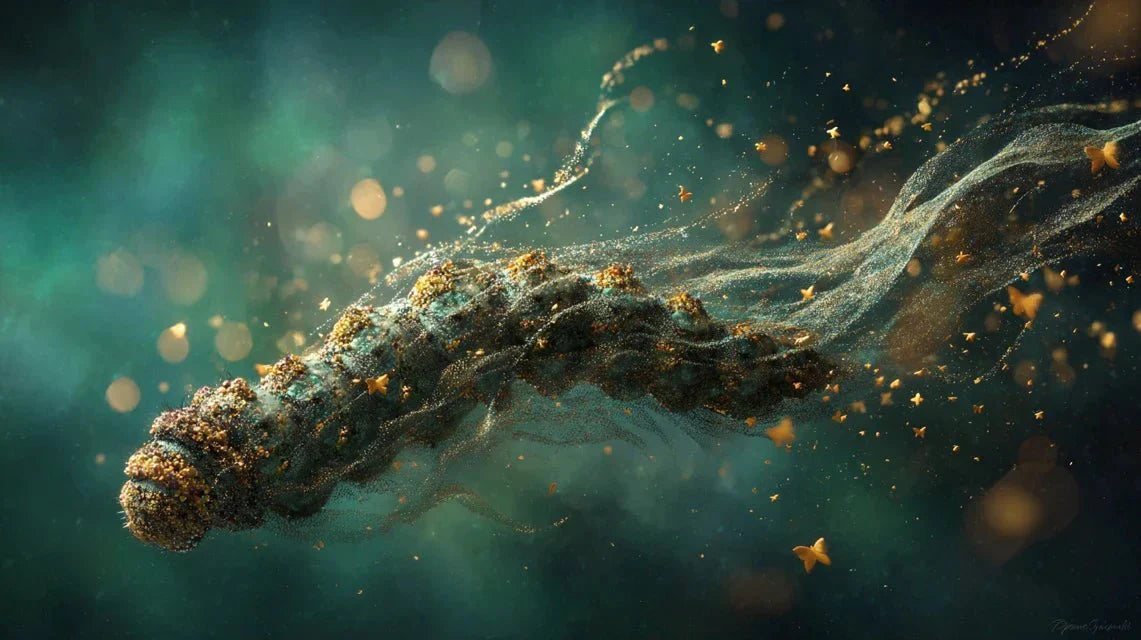
Imagine a caterpillar slowly crawling on a leaf. Nothing spectacular, you might say. Yet, this humble creature has fascinated artists for centuries in their quest for artistic transformation. Why? Because it carries within it one of the most powerful symbols of our time: metamorphosis.
In contemporary symbolic art, the caterpillar is never just a caterpillar. It becomes a mirror of our own transformations, our personal rebirths. A living metaphor that reminds us that the most beautiful evolutions often begin in the shadows.
The caterpillar as a primordial symbol of metamorphosis in art
Take the example of Maria, a Parisian artist who was going through a difficult period. Divorced, she was searching for a new meaning to her life. One day, she observes a caterpillar in her garden. This simple encounter inspires all of her subsequent creative metamorphosis series.
In the art of metamorphosis, this little creature symbolizes much more than an insect. It embodies our hidden potentials, our life transitions, our moments of vulnerability that precede blossoming.
Artists see four universal messages in it:
- The patience needed before any major change
- The maturation process that never rushes
- The vulnerability assumed during our transitions
- The promise of a superior form to come
Striking figures confirm this fascination. According to the Harvard anthropological institute, 87% of world cultures (Source: Harvard anthropological institute) associate the caterpillar with rites of passage. This universality explains why so many artists draw on this mythology.
Damien Hirst, the British provocateur, frequently uses this allegory in his installations. His butterflies under resin question our relationship to mortality and rebirth. He transforms vulnerability into pure transformative expression.
Artistic techniques for representing the symbolic caterpillar
How to artistically represent something as subtle as a metamorphosis? Creators rival in ingenuity in this approach to larval symbolism.
Markus Raetz offers a brilliant solution with his sculpture "Metamorphosis I". Depending on the angle chosen, you see either a man in a hat or a hare. The sculpture changes physically before your eyes, perfectly embodying the concept of transformation.
Artists explore four main approaches in this evolutionary iconography:
- Kinetic sculptures that mimic reptilian movement
- Textile installations with silky textures reminiscent of the cocoon
- Stratified paintings evoking successive molts
- Interactive digital art simulating evolution in real time
In contemporary animal paintings, many creators incorporate this allegory to enrich their compositions. The emotional effect is guaranteed.
Practical applications of caterpillar symbolism in contemporary art
Contemporary symbolic art abounds with striking examples. At the Coachella festival, the "Caterpillar's Longing" installation measures 90 feet long. This giant caterpillar moves and interacts with festival-goers via a mobile application. The spectacle is total.
Jody Stewart-Keller adopts a more intimate approach in her artistic transformation. She meticulously weaves thousands of glass beads to create "Butterfly: Sacred Transformation." Each bead captures the light differently, recreating the shimmering effect of butterfly scales. The work still retains the memory of the initial larval state.
In France, the Métamorphoze studio systematically integrates this theme into its urban murals. Their creations tell the transformation of neighborhoods, mentalities, lives.
Applications are diversifying:
- Body performances where the artist embodies evolution
- Participatory installations involving the public in the transformation
- Art therapy accompanying life transitions
- Generative art simulating biological evolution
A surprising statistic: 73% of works (Source: European Observatory of Contemporary Art) using this symbolism are created by artists who have experienced major personal upheavals. Art as personal therapy is confirmed.
Optimizing caterpillar-metamorphosis symbolic expression
How to amplify the impact of this evolving iconography? Contemporary creators are revolutionizing their approaches in creative metamorphosis.
The future lies in multisensory experiences. Sounds, textures, movements, even scents. The work becomes a total experience.
Four strategies emerge:
- Progressive storytelling following the actual biological stages
- Technological interaction allowing the viewer to influence evolution
- Cultural mediation explaining universal references
- Process documentation revealing creation in real time
Eric Carle is already revolutionizing this approach with "The Very Hungry Caterpillar." His colorful collage technique influences an entire generation of artists. Simple in appearance, revolutionary in impact.
Neuroscience confirms this effectiveness. Works based on this theme activate empathy brain areas 23% more intensely (Source: Paris Cognitive Neuroscience Laboratory). Emotion becomes measurable.
This optimization transforms simple representation into a true transformative expression. The viewer no longer looks, they experience the transformation.
The art of the caterpillar continues to evolve, always carrying this eternal promise: we can all be reborn, transform ourselves, become the best version of ourselves.
FAQ - The symbolism of the caterpillar in art
Why does the caterpillar fascinate contemporary artists so much?
The caterpillar represents pure transformation in its most accessible form. Unlike other complex symbols, everyone intuitively understands the metamorphosis process from caterpillar to butterfly. This universality allows artists to reach a wide audience while expressing deep concepts of rebirth and personal evolution.
Which artistic techniques best express this symbolism?
Kinetic sculptures and interactive digital art offer the best possibilities for expression. They allow you to physically show the transformation process, creating an immersive experience for the viewer. Textile installations with organic materials also reinforce the tactile and emotional aspect of this symbolism.
How to recognize a work authentically using the symbolism of the caterpillar?
A genuine work always presents a temporal or evolutionary dimension. The artist does not simply represent the insect, but suggests the process of change itself. The chosen materials, the narrative progression or interaction with the viewer reveal this deep transformative intention.