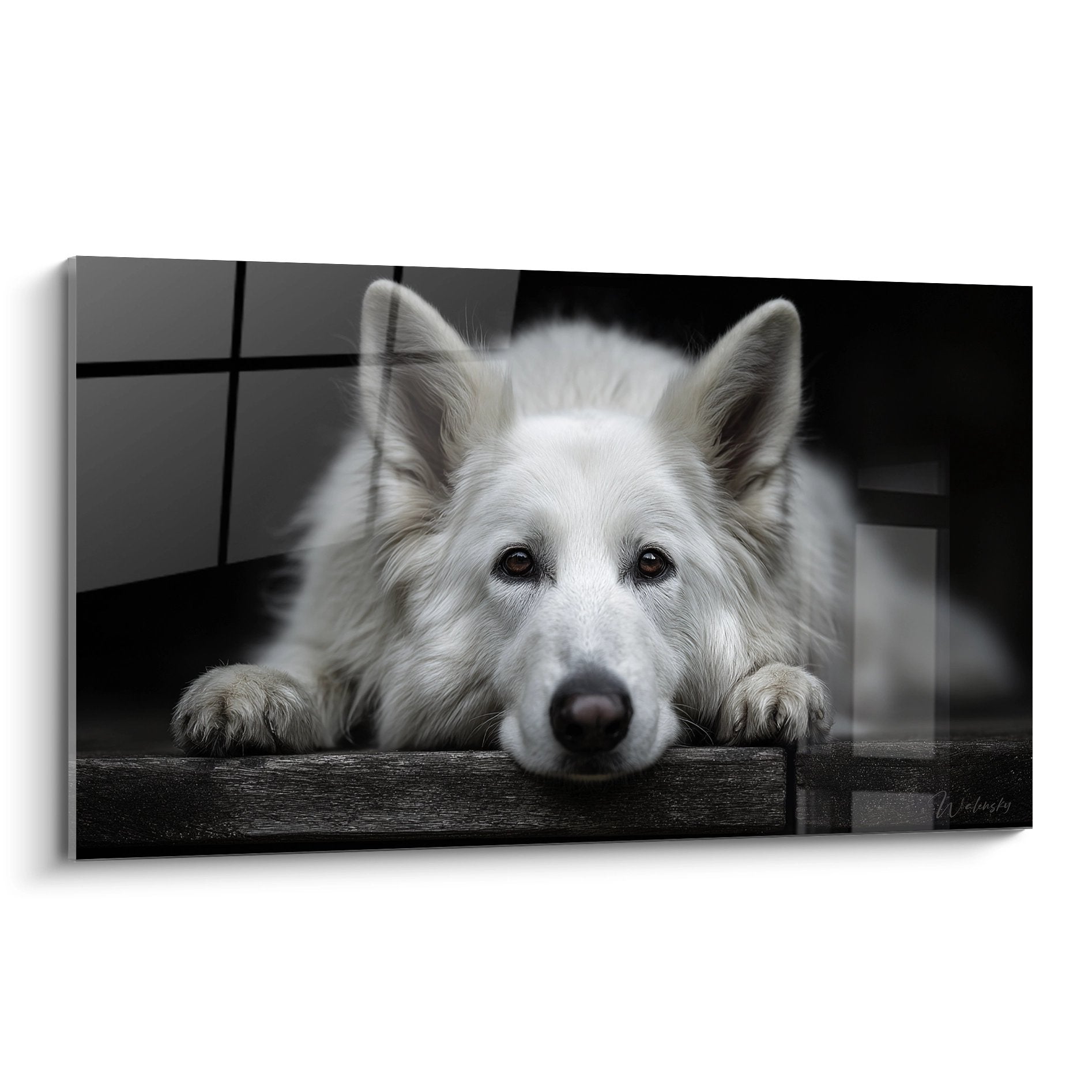
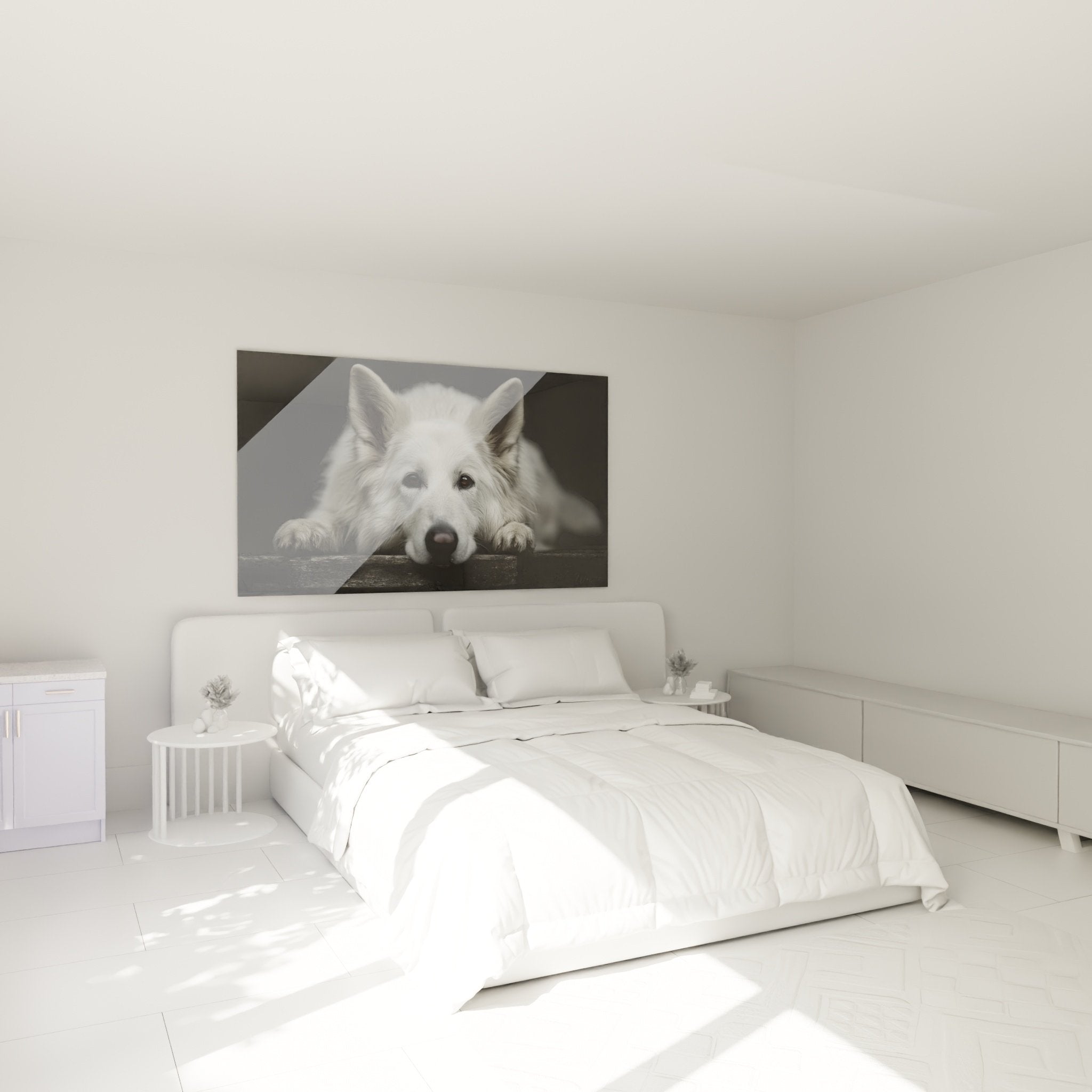
The White Swiss Shepherd dog painting black and white represents a fascinating artistic exploration of chromatic contrast applied to this majestic breed. This monochrome interpretation reveals the subtle nuances of the White Swiss Shepherd's immaculate coat through a binary palette that amplifies every anatomical detail. The absence of color radically transforms visual perception, concentrating attention on the textures, shadows and characteristic facial expressions of this exceptional breed. This graphic approach is particularly suited to refined contemporary environments where chromatic sobriety stands as the dominant decorative signature.
The Power of Monochrome Contrast to Enhance the White Swiss Shepherd
The black and white interpretation of the White Swiss Shepherd generates an exceptional visual dramatization that transcends traditional photographic representations. This chromatic reduction emphasizes the breed's specific anatomical contours, notably the triangular facial structure, characteristic erect ears and intelligent expression of the gaze. The shadow zones created by monochrome treatment visually sculpt the dense coat, revealing a three-dimensional depth impossible to achieve with standard color reproduction.
How does black and white treatment intensify canine expression?
The suppression of chromatic nuances forces the eye to concentrate on the micro-expressions of the White Swiss Shepherd's face. The tonal variations between pure white coat and shadowed areas create a play of contrasts that highlights the underlying muscle anatomy. This graphic approach is ideally suited to minimalist Scandinavian interiors, industrial lofts with exposed metal structures, or premium professional spaces seeking discreet sophistication. For a complete collection dedicated to this breed, explore our White Swiss Shepherd dog painting range which offers various artistic interpretations.
Harmony with contemporary monochrome environments
In spaces dominated by grey palettes, polished concrete or whitewashed wood, a White Swiss Shepherd dog black and white painting integrates as an architectural element rather than simple wall decoration. Its chromatic neutrality allows maximum decorative versatility, functioning equally effectively in an executive office as in a master bedroom with soothing tones. White Swiss Shepherd owners particularly appreciate this graphic version which captures the essence of their companion without chromatic distractions, creating a timeless and elegant tribute.
What materials amplify monochrome rendering?
Matte surfaces absorb light differently than glossy finishes, radically altering the perception of tonal gradations. For high-definition photographic rendering, large format prints on rigid supports preserve the sharpness of transitions between light and dark areas. The absence of parasitic light reflection guarantees that subtle coat details remain perceptible even under lateral or direct overhead lighting, unlike glossy surfaces that create highlight zones masking the intermediate nuances essential to visual depth.
Monumental Impact of XXL Formats in Monochrome Treatment
A White Swiss Shepherd dog black and white painting in large dimensions radically transforms the spatial dynamics of a room. From 120x80 cm upwards, the monochrome representation generates a wall presence comparable to an architectural work, where each hair of the coat becomes a distinct graphic element. This monumental scale reveals anatomical details invisible at reduced formats: variations in undercoat density, luminous reflections on the black nose, infinitesimal nuances between pure white and off-white that structure muzzle volume.
Why does large format specifically magnify black and white treatment?
Monumental enlargement amplifies the tonal contrast which forms the aesthetic foundation of monochrome rendering. On a 150x100 cm surface, the eye perceives simultaneously the overall vision and textural micro-details, creating a stratified visual experience impossible with reduced dimensions. This scale is particularly suited to double-height spaces, partition walls in open areas, or prestige corridors where available wall length justifies a panoramic composition. Our selection of White Swiss Shepherd dog portrait painting offers close-up framings optimized for this monumental viewing.
Management of optimal viewing distances
A large format monochrome painting requires a minimum distance of 2.5 meters for the eye to reconstruct the overall image from tonal variations. This spatial constraint directly influences location choice: facing the main sofa in a spacious living room, at the back of an executive meeting room, or as a focal point in an entrance with deep perspective. At close range (less than one meter), the observer perceives only abstract transitions between light and dark areas, temporarily transforming the figurative representation into quasi-abstract graphic composition.
How do horizontal versus vertical proportions modify perception?
Horizontal panoramic formats (such as 180x90 cm) favor dynamic profile compositions, capturing the White Swiss Shepherd in movement or characteristic alert posture. Vertical formats (100x150 cm) suit majestic front portraits, accentuating the imposing stature and natural nobility of the breed. Black and white treatment amplifies these compositional choices by eliminating chromatic distractions that would fragment visual unity, concentrating all graphic energy on directional lines and structuring tonal masses.
Decorative Sophistication and Timelessness of Monochrome Rendering
The White Swiss Shepherd dog black and white painting embodies decorative elegance that transcends ephemeral chromatic trends. This chromatic neutrality guarantees aesthetic permanence over decades, resisting the evolution of dominant color palettes in interior design sectors. Unlike color representations susceptible to appearing dated after furniture or textile renewal, the monochrome version maintains its stylistic relevance independently of environmental transformations.
Which professional environments favor monochrome treatment?
Veterinary clinics specializing in Nordic breeds, professional breeder offices of White Swiss Shepherds and dog club reception spaces massively opt for monochrome representations. This graphic sobriety communicates professionalism and expertise, avoiding the sentimental connotations associated with hyperrealistic color representations. In premium residential environments, this version integrates harmoniously with contemporary black and white photography art collections, establishing visual continuity with other monochrome works present in the space.
Compatibility with directed architectural lighting
Rail lighting systems with orientable spotlights fully reveal the potential of a large format monochrome painting. The absence of colors eliminates risks of chromatic distortion caused by variable LED light source color temperatures. Whether lit at 2700K (warm white) or 5000K (cool white), monochrome rendering preserves its visual integrity, unlike color versions whose palette may appear altered under certain light spectrums. This chromatic stability greatly simplifies museum-quality lighting technical choices.
How does black and white enhance breeds with immaculate white coats?
Paradoxically, monochrome reduction enhances white breeds far more than faithful color reproduction. The subtle tonal gradations between different coat areas become the main subject, revealing the structural complexity of a coat that appears uniformly white to the untrained eye. Shadow zones created by variable hair density, skin folds around the mouth and eyes, transitions between guard hair and undercoat generate an unsuspected graphic richness that fully justifies the monochrome artistic choice for this specific breed.
FAQ - Frequently asked questions about black and white White Swiss Shepherd paintings
Does a black and white White Swiss Shepherd dog painting suit colorful interiors?
Absolutely, chromatic neutrality functions as a visual stabilizing element in environments with saturated palettes. It creates an eye rest point counterbalancing environmental chromatic stimulation without conflicting with existing dominant tones.
How does monochrome treatment influence emotional perception of the canine subject?
Color elimination directs attention toward pure facial expression and body language, intensifying emotional connection by concentration on universally recognizable elements of canine emotion rather than superficial chromatic attributes of the coat.
What optimal tonal density should be sought for an impactful black and white White Swiss Shepherd dog painting?
Favor compositions presenting a complete tonal spectrum from absolute black to pure white, with at least seven distinct intermediate values. This tonal richness guarantees three-dimensional depth and avoids the two-dimensional effect of monochrome renderings with excessive contrast that lose the subtle nuances essential to specific breed recognition.