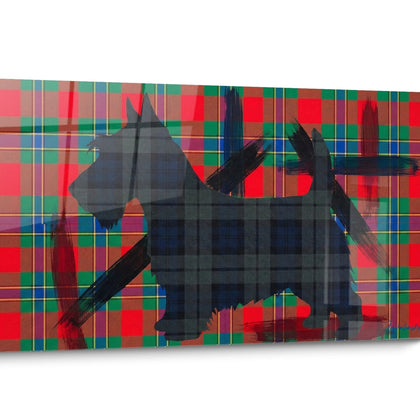
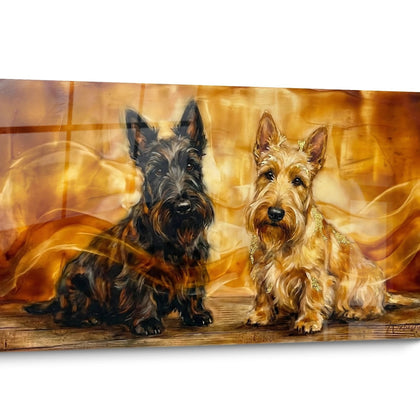
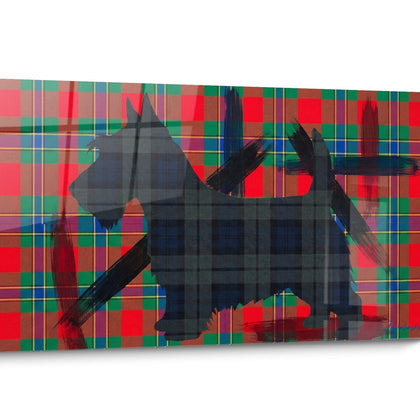
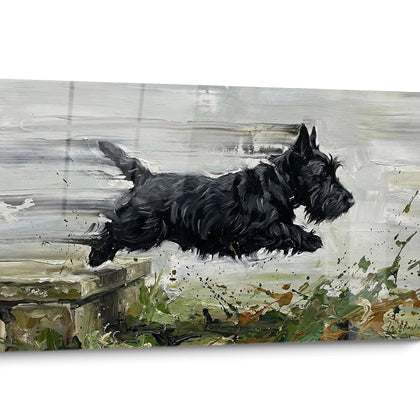
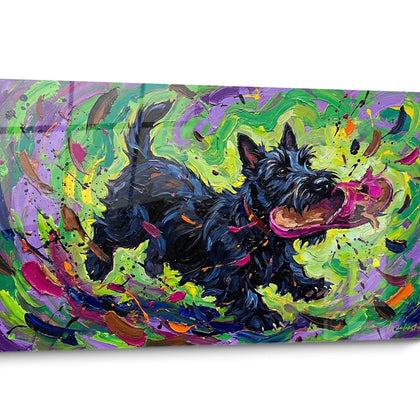
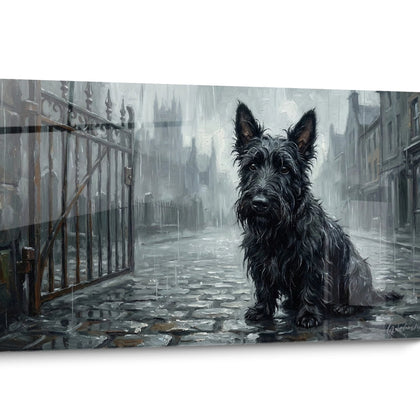
The black and white Scottish Terrier dog wall art embodies graphic elegance at the service of contemporary canine décor. This monochrome representation of the celebrated Scottish terrier captures the timeless essence of this emblematic breed, transforming your living space into a genuine gallery dedicated to animal art. The generous formats offered magnify every characteristic detail of the Scottie: its unmistakably compact silhouette, its distinctive beard and its proud head carriage. The absence of color reinforces the emotional intensity of the gaze, creating an immediate connection with the observer. These large-scale wall creations appeal to canine art enthusiasts seeking a refined alternative to traditional colorful representations, perfect for visually structuring a contemporary living room, a professional office or a distinguished reception area.
The Visual Impact of Black and White Contrast on the Scottish Terrier
The black and white Scottish Terrier dog wall art masterfully exploits shades of gray to reveal the unique texture of this mythical breed's coat. The monochrome rendering accentuates natural contrasts between dark areas of the body and the highlights captured by the Scottie's characteristic rough coat. This refined chromatic approach allows instantaneous visual reading even from several meters away, ideal for large architectural spaces.
Why choose a monochrome rendering for a Scottish Terrier?
Black and white representation transcends transient decorative trends. It bestows upon the black and white Scottish Terrier dog wall art a timelessness that traverses epochs without aesthetic aging. Monochrome eliminates chromatic distractions to concentrate attention on the subject's expressivity: the terrier's proud attitude, its penetrating gaze, the geometry of its squat silhouette. Canine art collectors particularly appreciate this sobriety which integrates harmoniously into minimalist or industrial interiors where neutral palettes dominate.
Contrast variations for different atmospheres
High-contrast interpretations create a spectacular dramatic effect, ideal for contemporary masculine spaces or architects' offices. Conversely, softened gray renderings generate a contemplative atmosphere appropriate for rest areas or private libraries. The choice of contrast level directly influences the energy emanated by the work: dynamic and assertive for marked contrasts, meditative and sophisticated for gentle transitions. This flexibility allows the black and white Scottish Terrier dog wall art to adapt to varied decorative contexts while maintaining its aesthetic coherence.
Interaction with natural and artificial lighting
Monochrome creations react differently depending on light sources. A black and white Scottish Terrier large format wall art positioned facing a bay window will capture variations in light intensity throughout the day, progressively revealing subtle details of the coat and expression. Directed artificial lighting creates shadow play that amplifies perceived three-dimensionality, giving the impression the terrier emerges literally from its support. This sensitivity to light transforms the work into an evolving decorative element that constantly renews itself according to observation conditions.
Creating Sophisticated Atmospheres with Monochrome Scottish Terrier
The black and white Scottish Terrier dog wall art functions as a true visual pivot in refined contemporary interiors. Its restricted palette allows it to dialogue effectively with raw materials like polished concrete, brushed steel or aged wood. Interior designers exploit this chromatic neutrality to visually anchor open spaces where functional areas succeed each other without marked physical separation.
Association with extended monochrome palettes
In Scandinavian interiors where broken whites and pearl grays dominate, a black and white Scottish Terrier large dimension wall art brings the visual depth necessary to avoid blandness. It creates a dark anchor point that structures the gaze and prevents the space from appearing washed out. Conversely, in an environment with anthracite or charcoal tones, this type of representation introduces clear nuances that lighten the atmosphere without compromising overall chromatic coherence. This versatility makes the monochrome Scottish Terrier a durable decorative investment.
How does black and white Scottish Terrier strengthen a space's identity?
Beyond its decorative function, this type of representation conveys strong symbolic values. The Scottish Terrier traditionally embodies determination, loyalty and strong character. Presented in black and white, it acquires an even more assertive dimension, almost heraldic. Owners of law offices, communication agencies or coworking spaces use these works to project an image of professional reliability tinged with distinctive personality. The choice of monochrome signals a preference for sober elegance rather than colorful ostentation.
Display strategies to maximize impact
The installation of black and white Scottish Terrier dog wall art requires in-depth spatial consideration. In a narrow corridor, it creates a visual perspective that optically lengthens the space. Above a charcoal gray sofa, it establishes thematic continuity while introducing a narrative element. Some decorators create monochrome wall galleries by combining multiple Scottish Terrier representations with black and white architectural photography, generating sophisticated aesthetic coherence. For those wishing to explore other visual treatments of this breed, a Scottish Terrier watercolor wall art offers a complementary colorful alternative that can dialogue with the monochrome version in adjacent spaces.
Optimize the Integration of Black and White Scottish Terrier in Your Décor
Successful installation of black and white Scottish Terrier dog wall art requires prior analysis of the existing chromatic environment. Generous formats require clear walls where the work can breathe without visual competition. A minimum space of 30 centimeters around the frame allows optimal appreciation without sense of clutter. Seasoned collectors favor matte finish walls rather than glossy to avoid parasitic reflections that would fragment image perception.
What furniture to pair with a monochrome Scottish Terrier wall art?
Contemporary furniture with clean lines constitutes the ideal setting for these creations. A bleached oak Scandinavian buffet, a metal console with graphite finishes or an industrial steel bookcase create harmonious visual dialogues. Biophilic décor enthusiasts introduce plants with graphic foliage like monsteras or ficus lyrata whose organic forms elegantly contrast with the stylized terrier representation. This nature-culture juxtaposition generates a dynamic aesthetic tension particularly appreciated in urban lofts.
Managing proportions in large spaces
In generous volumes with significant ceiling height, a black and white Scottish Terrier large format wall art avoids the "postage stamp" effect that would diminish its impact. Interior architects recommend the work occupy approximately two-thirds the width of the furniture on which it is visually anchored. For entirely clear walls, the medial third principle applies: the work's center positions at average eye level, creating natural interaction with the standing observer. Cathedral ceiling rooms benefit from slightly elevated installations that draw the gaze upward, amplifying the sensation of space.
Seasonal evolution of décor around the wall art
The chromatic neutrality of black and white Scottish Terrier dog wall art facilitates seasonal decorative rotations. In winter, association with thick textiles in charcoal tones and copper metallic accessories creates a sophisticated cocooning atmosphere. Summer invites lightening the environment with cream linen and vegetative touches that maintain visual freshness. This adaptability transforms the work into a decorative constant around which changing elements gravitate, thus renewing the aesthetic experience without requiring complete rearrangement.
Does a black and white Scottish Terrier wall art suit colorful interiors?
Paradoxically, these monochrome representations excel in colorful environments where they function as visual rest zones. In a living room with terracotta and teal tones, the wall art brings soothing neutrality that balances ambient chromatic intensity without creating aesthetic conflict.
What observation distance should be favored for black and white Scottish Terrier wall art?
Monumental formats fully deploy at a distance equivalent to 1.5 times their diagonal. This rule allows simultaneous appreciation of the entire composition and expressive details of the terrier, creating an immersive visual experience without requiring fatiguing head movements.
How to maintain a black and white Scottish Terrier dog wall art to preserve its contrast?
Monochrome creations relentlessly reveal dust that diminishes contrasts. Monthly dusting with an antistatik microfiber cloth preserves the depth of blacks and luminosity of whites, thus maintaining the work's optimal visual impact over the long term.


 Dog Silhouettes Mosaic Wall Art in Black - Canine Procession - Scottish Terrier Edition232,90 €
 Black Terrier Expressionist Splashes Wall Art - Piercing Gaze - Scottish Terrier Edition233,90 €
 Black and White Scottish Terrier Painting on Rocks - Faithful Companion - Scottish Terrier Edition233,90 €
 Gray and White Scottish Terrier Duo Canvas - Faithful Companions - Scottish Terrier Edition233,90 €
 Scottish Terrier in the Rain Watercolor Painting - Autumn Melancholy - Scottish Terrier Edition213,90 €
 Black Dog in the Rain on a Paved Street - Urban Melancholy - Scottish Terrier Edition233,90 €
 Black and Grey Dog in Library Armchair Wall Art - Aristocratic Reading - Scottish Terrier Edition213,90 €
 Black Sleeping Dog on Parquet Painting - Peaceful Rest - Scottish Terrier Edition233,90 €
 Gray Dog Urban Walk Wall Art - City Promenade - Scottish Terrier Edition233,90 €