


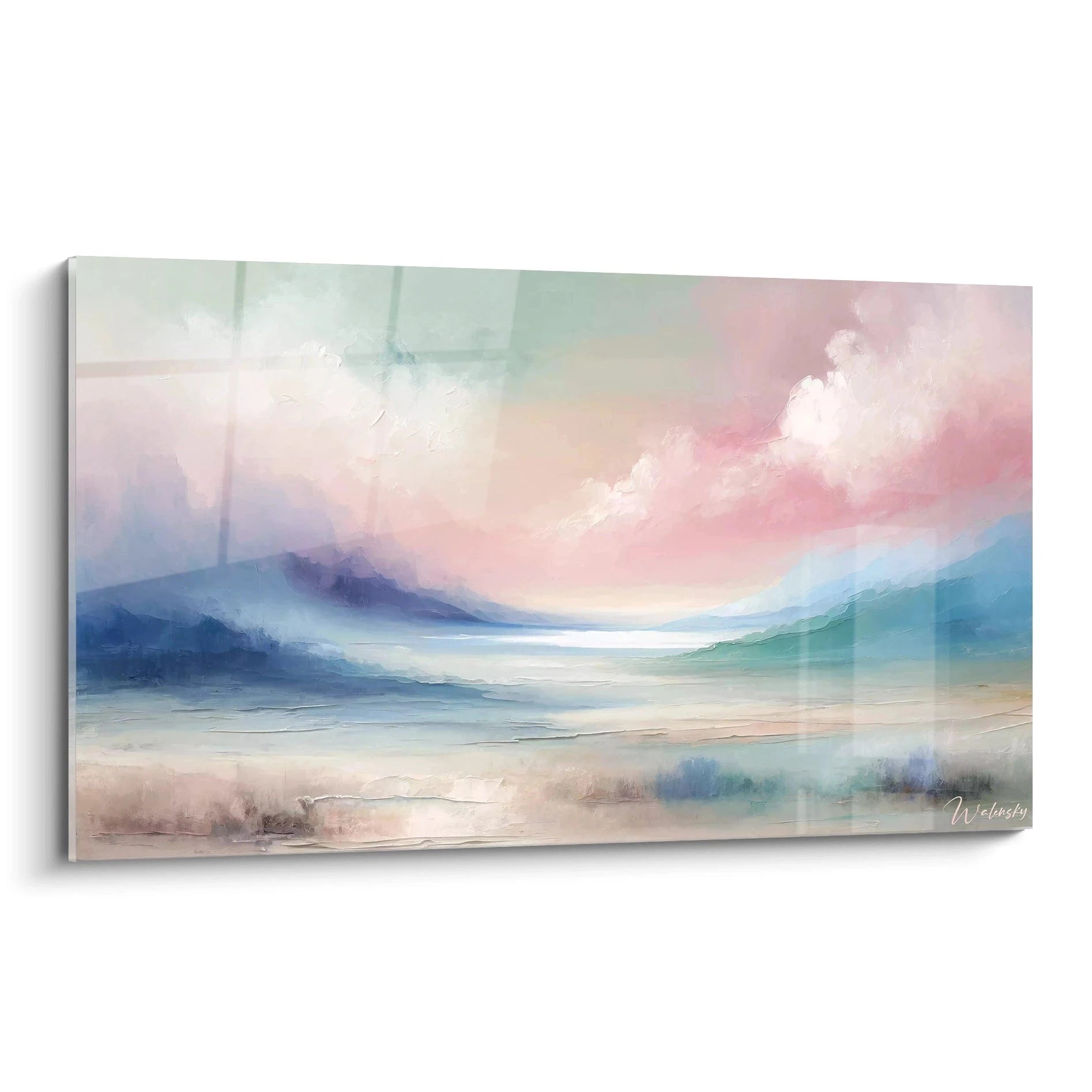

What size artwork is suitable for a 40m² yoga studio?
October 27, 2025 · 8 min read · by Walensky
I remember this Vinyasa instructor who contacted me after hanging a huge triptych of 2 meters in her small studio. "My students are distracted during Savasana," she confided to me, dismayed. The work, beautiful as it was, created too intense visual stimulation in the space. This experience perfectly illustrates the delicate balance between art and practice in a place of serenity.
Here's what an adapted painting brings to your yoga studio: a visual anchor that guides attention without capturing it, a spatial depth that visually expands your 40m² space, and an atmosphere that amplifies the intention of each session. But how do you choose the ideal size when every centimeter counts?
You may have already felt this frustration: a bare wall that lacks warmth, or conversely, a decoration that clutters the mental space of your practitioners. Between the contradictory advice of decorators and budgetary constraints, it is difficult to find the right balance. Rest assured: there are simple rules, specifically adapted for contemplative practice spaces.
In this article, I share with you the precise dimensions that will transform your 40m² studio into a harmonious sanctuary, without compromising the experience of your students.
The rule of sacred proportions for a yoga studio
In a 40m² space – typically 6 meters by 6.5 meters – the optimal size of a painting is between 80 and 120 cm wide. This dimension respects what I call the “soft contemplation zone”: present enough to structure the space, discreet enough not to actively solicit the gaze.
For the main wall, the one your practitioners naturally see when lying down, prioritize a horizontal format of 100 x 70 cm. This proportion is inspired by the golden ratio and subconsciously creates a feeling of balance. I have observed in several studios that this dimension allows the gaze to settle naturally without creating an overwhelming focal point.
The error of excessive proportions
A painting exceeding 140 cm in a 40m² studio creates what ergonomists call “visual dominance.” Your students, especially in the final relaxation position, will subconsciously feel spatial pressure. The painting then becomes a mental obstacle rather than a support for practice.
Adapting the size according to your space configuration
Not all 40m² studios are alike. Ceiling height radically transforms the perception of dimensions. With a standard height of 2.50 meters, an 80 x 60 cm painting positioned 1.60 m from the floor is within the natural line of vision of a person sitting in lotus position.
For a studio with a mezzanine or cathedral ceiling exceeding 3 meters, you can dare to use a slightly more generous format: 120 x 90 cm. The extra vertical space better absorbs this dimension without creating an overwhelming effect.
The welcome wall technique
If your studio has a separate entrance wall from the practice area, this is the ideal location for a slightly more imposing artwork: 130 x 100 cm. Your students discover it upon arrival, creating a mental transition between the outside and your sacred space, but it disappears from their field of vision during practice.

Our favourite
Tree Watcher of the Mountains Wall Art - Tree of Life Edition
233,90€
Discover this artworkWhen to opt for several small artworks rather than one large one
In some 40m² studios, the wall configuration suggests a different approach. I arranged a space where three artworks of 50 x 40 cm each, spaced 15 cm apart, created an organic composition reminiscent of a Japanese triptych. This solution works beautifully for contemplative yoga styles like Yin or Restorative.
The advantage of this configuration: you can modulate the visual intensity according to the seasons or practice cycles. Temporarily remove one panel to lighten the space during silent retreats, or add a piece for creative workshops.
The asymmetrical composition for dynamic spaces
For a Vinyasa or Ashtanga studio, where energy flows quickly, an asymmetrical composition works remarkably well: a main artwork of 90 x 70 cm accompanied by a smaller one of 40 x 30 cm in the opposite corner. This arrangement creates a subtle visual movement that supports the dynamic nature of practice.
The dimensions that visually enlarge your studio
A little-known secret: a horizontal format of 110 x 60 cm positioned on the shortest wall creates an illusion of widening. Your 40m² studio gains psychologically 4 to 5 m² perceived. This is particularly valuable if your space is rectangular and narrow.
Conversely, a vertical format of 60 x 100 cm draws the eye upwards, beautiful for low ceilings that you want to visually enhance. I used this technique in a basement transformed into a studio, instantly creating a sense of spiritual elevation.
The third wall rule
A simple formula I consistently apply: your artwork should never occupy more than one-third of the width of the wall. On a 3-meter wall in your 40m² studio, that means a maximum of 100 cm. This proportion maintains the balance between artistic presence and spatial breathing.

The psychological impact of dimensions on practice
After observing hundreds of sessions, I noticed that artwork between 80 and 100 cm creates a fascinating phenomenon: they become what I call “peripheral companions.” Your students don't actively look at them, but their presence subtly informs the energy of the room.
Artwork that is too small (less than 60 cm in a 40m² studio) goes unnoticed, providing no spatial benefit. Artwork that is too large (more than 150 cm) becomes a “competing visual teacher,” capturing attention that should remain inward. The ideal zone of 80 to 120 cm creates this precious presence-absence in meditative spaces.
Adapting the size to the type of yoga taught
For Kundalini or chakra yoga, where visual stimulation is part of the experience, dare 120 x 90 cm with saturated colors. For Yoga Nidra or restorative practices, prefer 80 x 60 cm in soothing tones. Size then becomes a pedagogical tool that supports your teaching intention.
Check proportions before purchase: the template technique
Before investing, create a template from cardboard or kraft paper to the dimensions you are considering. Temporarily attach it to your wall and observe it from each practice position: standing in Tadasana, seated in lotus, lying down in Savasana. This real-world validation will save you costly disappointments.
Invite a few loyal students to test the space with the template. Their spontaneous feedback is valuable: “I barely notice it” is an excellent sign for a yoga studio, unlike a commercial space where you would seek the opposite effect.
Transform your studio into a harmonious sanctuary
Discover our exclusive collection of wall art for yoga studios that respect sacred proportions and amplify the energy of your 40m² space.
Create your visual haven
Imagine your students entering your 40m² studio, their gaze naturally embracing the space, briefly resting on this 100 x 70 cm artwork that breathes in time with their practice. No distraction, no emptiness: just a presence that anchors intention. This is the subtle alchemy that good proportions create.
Start by accurately measuring your main wall. Note the ceiling height. Then apply the simple rule: between 80 and 120 cm wide, adjusted to your specific configuration. Your studio will thank you for the quality of presence it naturally inspires.
Art in a yoga space is never just decoration. It's a silent guide that shapes the experience of each practitioner. By choosing a size suitable for your 40m², you offer more than just decoration: you create an energetic container that supports every breath, every movement, every moment of inner peace.
Frequently asked questions about wall art for 40m² yoga studios
Can I install multiple artworks in my 40m² studio without overwhelming the space?
Absolutely, provided you respect the rule of wall breathing. In a 40m² studio, you can harmoniously install two to three artworks if you maintain at least 1.50 meters of empty space between each piece. The ideal is to place a main artwork measuring 100 x 70 cm on the focal wall, and possibly a smaller one measuring 50 x 40 cm on a side wall. This configuration creates a smooth visual flow without fragmenting attention. Avoid decorating all four walls: always keep at least one wall completely bare, which becomes an essential “visual pause” for the mind. This spatial breathing is as important as the silence between two mantras.
At what height should I hang my artwork in a yoga studio?
The standard height of art galleries (center of the artwork at 1.60 m) is not suitable for yoga studios. Your students spend 60 to 70% of their time in low positions: sitting, on all fours, or lying down. For a 40m² studio, position the center of your artwork between 1.40 and 1.50 meters from the floor. This slightly lowered height places the work within the natural line of vision of someone seated in lotus or half-lotus position. Test by installing yourself in the center of the room in different postures. The painting should naturally appear within your field of view without needing to look up, creating that soothing presence that characterizes Asian contemplative spaces. If your ceiling is over 3 meters high, you can slightly increase it to 1.55 meters.
How do I know if my artwork is too large for my 40m² studio?
Do this simple test that I call “the Savasana exercise”: lie in the center of your studio in the final relaxation position, eyes open. If your gaze is immediately and irresistibly drawn to the painting, if it dominates your field of vision to the point of eliciting a mental reaction (“oh, it’s beautiful” or “look, I hadn't noticed that detail”), then it is too large or too stimulating. A well-proportioned painting in a yoga space should be perceived as a soothing presence in the background, never as a spectacle that demands attention. Another reliable indicator: if your students spontaneously comment on the artwork at each class, it means that it captures too much mental energy. The ideal painting is one that is remembered with pleasure after the class, but not actively noticed during practice.
Explore our collections


