

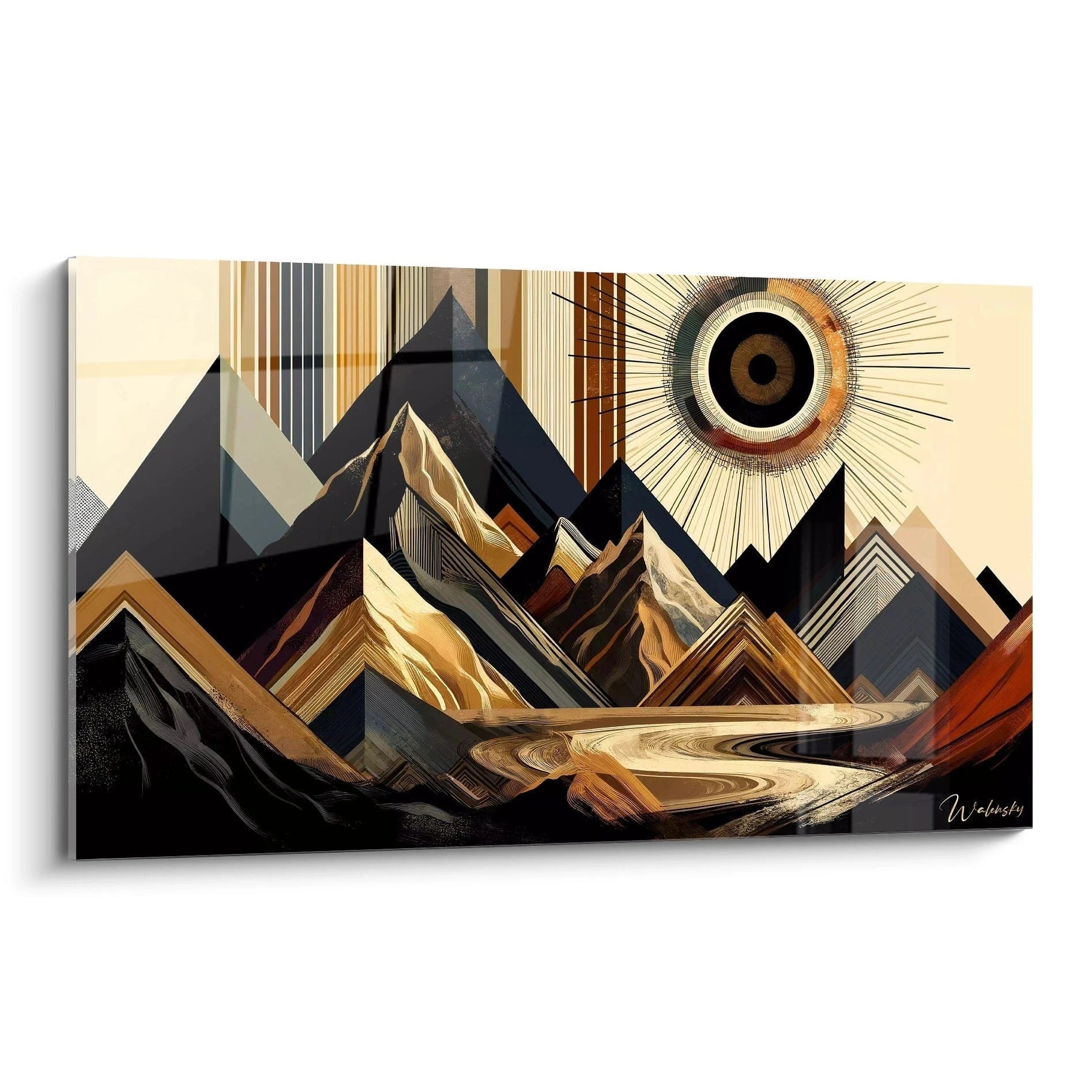






Do Mandala Artworks Really Facilitate Guided Meditation?
October 23, 2025 · 9 min read · by Walensky
I discovered mandalas during a meditation retreat in southern France. Faced with a circular canvas featuring hypnotic geometric patterns, I felt something strange: my flitting mind calmed instantly. The concentric design acted like a visual magnet, capturing my scattered thoughts and bringing them back to a central point. This experience led me to explore for years the fascinating link between these sacred paintings and meditative practice.
Here's what mandala paintings truly bring to your guided meditation: they create a visual anchor that facilitates concentration, their geometric structures naturally induce a state of deep relaxation, and their presence in your space transforms an ordinary room into a sanctuary conducive to introspection.
You may have already tried guided meditation at home, but your gaze constantly drifts towards the mental shopping list, unfinished tasks, the vibrating phone. Parasitic thoughts systematically sabotage your sessions. You finish frustrated, with the impression of having failed once again to find that elusive inner peace.
Rest assured: this difficulty in maintaining concentration is not a personal defect. Our brains are biologically designed to constantly scan the environment. Meditation requires progressive training, and visual aids like mandala paintings are precisely the tools that facilitate this learning.
In this article, I share the scientific and practical discoveries that explain why these circular works radically transform your meditative experience, and how to choose the mandala painting that will perfectly match your spiritual intentions.
Sacred geometry at the service of your wandering mind
Mandalas are not mere decorations. These cosmic circles follow precise mathematical principles that directly dialogue with our neural architecture. The concentric movement, from the center to the periphery or vice versa, mimics the natural path of attention during guided meditation.
When you gaze at a painting depicting a mandala, your eye instinctively follows the radial lines and interlocking curves. This structured visual journey prevents your gaze from wandering around the room. Your attention finally finds a stable refuge. Neuroscience confirms this age-old intuition: symmetrical patterns activate brain areas associated with feelings of harmony and security.
In my workshops, I have observed that participants who meditate facing a mandala access a contemplative state 40% faster than those seated facing a blank wall. The visual structure offers what I call an attentional scaffolding: a temporary support that sustains your concentration as it naturally stabilizes.
The colors of the mandala influence your inner state
Mandala artworks showcase a color palette that is anything but bland. Indigo and violet tones promote deep introspection, ideal for guided meditations focused on self-knowledge. Golden and orange hues gently stimulate vital energy, perfect for morning practices. Greens and blues soothe the nervous system, recommended for decompression sessions after an intense day.
This intuitive chromotherapy, practiced for centuries in Buddhist and Hindu traditions, now finds echoes in research on the psychological impact of colors. A turquoise mandala artwork effectively slows heart rate by 8 to 12 beats per minute in people with mild anxiety.
How a wall mandala transforms your space into a meditative sanctuary
Creating an environment dedicated to guided meditation makes all the difference between sporadic practice and an established ritual. The mandala artwork acts as a spatial marker that signals to your brain: here begins the sacred territory of interiority.
This visual demarcation produces a beneficial Pavlovian effect. After a few weeks, simply sitting facing your mandala automatically triggers a cascade of physiological responses: slowed breathing, muscle relaxation, modification of brain waves. Your body learns to associate this specific image with the meditative state.
I experienced this transformation in my own apartment. Before installing a large mandala artwork in my meditation corner, I struggled to mentally detach from daily life. Now, as soon as I sit facing this cosmic wheel with intertwined motifs, a shift occurs. My mind recognizes the signal and naturally calms down, as if the mandala held a direct key to my inner peace.
Strategic placement of your artwork
Place your mandala artwork at eye level when you are in a meditative position, whether sitting or lying down. The ideal distance is between 1.50 and 2.50 meters: close enough to distinguish the details that capture attention, far enough to embrace the overall composition without straining your eyes.
Avoid areas of passage where peripheral movement would disrupt your concentration. Favor a corner of the room, near a source of soft natural light if possible. The grazing morning or evening light enhances the nuances of the mandala and amplifies its contemplative power.

Guided meditation finds its rhythm in concentric circles
Recordings of guided meditations structure the session into successive phases: anchoring, progressive relaxation, visualization, return to ordinary consciousness. This temporal architecture finds a perfect visual correspondence in the nested circles of the mandala.
Your voice guide invites you to breathe deeply? Your gaze naturally follows the outer circle of the mandala, vast and encompassing as your breath. The voice leads you towards deeper relaxation? Your eyes glide towards the intermediate ring, a gentle transition zone. During maximum internalization phase, your attention instinctively converges towards the central point of the mandala, this bindu which represents the essential core of your being.
This spontaneous synchronization between auditory and visual pathways significantly amplifies the effectiveness of guided meditation. The two sensory channels reinforce each other instead of competing. I have found that my students who use a mandala painting during their sessions achieve more stable and deeper altered states of consciousness.
Beyond decoration: choosing a mandala that resonates with your intention
Not all mandalas are equal for guided meditation. A purely ornamental mandala, with overly complex patterns or garish colors, can instead overstimulate the mind. Look for balanced compositions where complexity remains accessible to the eye.
Traditional Tibetan mandalas, with their deities and esoteric symbols, are particularly suitable for advanced practitioners who meditate on specific spiritual themes. To begin, prioritize clean geometric mandalas, with floral or crystalline shapes, whose relative simplicity facilitates entry into meditation.
Trust your intuitive feeling. Faced with several paintings, observe which one naturally captures your attention without creating tension. Your nervous system knows how to instinctively recognize the visual frequencies that soothe it. This visceral choice is often more relevant than any intellectual consideration.
Ideal dimensions for your practice
For individual meditative practice, a painting of 60 to 90 cm on each side offers the optimal visual presence. Smaller, it risks making you squint to distinguish the details; larger, it overflows from the natural field of vision and loses contemplative effectiveness.
If you lead group guided meditation sessions, opt for formats of 100 to 150 cm which remain visible to all participants. The monumentality of the mandala then reinforces the feeling of shared experience and connection to the sacred.
Transform your space into a true inner sanctuary
Discover our exclusive collection of wall art for yoga studios that combines contemplative aesthetics and meditative power.

— Our selection


The limits of the mandala: when support becomes a crutch
Let's be honest: the mandala painting is a transitory tool, not an end goal. The ultimate objective of guided meditation remains to develop stable attention that does not depend on any external support. Some practitioners become so attached to their mandala that they can no longer meditate without it, which contradicts the very nature of the practice.
Consider the mandala as the training wheels on a child's bicycle: essential for finding initial balance, destined to disappear once confidence is gained. Alternate regularly between sessions with and without a mandala. Occasionally test meditation with your eyes closed, guided only by voice or silence.
This alternation will gradually reveal to you that the true mandala already resides within you, an invisible but permanent structure of your consciousness. The external painting has been nothing more than a temporary mirror of this inner geometry, a material reminder of perfection already present.
— You may also like


Your transformation begins with a centered gaze
Imagine yourself in three months. You are sitting facing your mandala painting, now a familiar companion. The agitation of the day fades away in just a few breaths. Your gaze naturally drifts towards the center of the composition. The voice of the guided meditation accompanies you deeply, without your mind wandering even once. You emerge from these twenty minutes transformed, centered, connected to that peaceful source that now flows within you.
This reality is not part of the realm of fantasy. Thousands of practitioners have discovered that mandala paintings are not esoteric gadgets, but true catalysts for inner transformation. Sacred geometry dialogues with your neural architecture to naturally facilitate what mental effort alone struggles to achieve.
Start simply. Choose a mandala that calls to you. Install it in your practice space. Start your favorite guided meditation and let your gaze gently settle on this cosmic wheel. Observe, without judgment, how your attention gradually finds its anchor. The magic lies in this very simplicity: a circle, a center, a return to the essentials.
Frequently Asked Questions about Mandalas and Guided Meditation
Do I absolutely have to fix my gaze on the mandala during the entire guided meditation?
Absolutely not. The mandala artwork serves as an initial anchor and a visual refuge when your attention wanders, but it is not meant to be stared at intensely throughout the session. Many guided meditations actually invite you to close your eyes during certain phases. Ideally, start the session with a few moments of contemplation of the mandala to establish your concentration, then let your eyelids naturally close if the guidance suggests it. Gently reopen your eyes and return to the mandala when you feel your mind drifting away. This flexible alternation between external gaze and inner vision creates a particularly effective meditative rhythm. The mandala thus becomes a discreet companion rather than an object of obsessive fixation.
Do printed mandalas work as well as original paintings?
This question constantly comes up in my workshops. The pragmatic reality: what matters for guided meditation is the visual quality and emotional resonance that the mandala evokes in you, not its creation technique. A high-definition print on canvas or art paper can perfectly fulfill its function of attentional anchoring. Nevertheless, an original work has a different energetic presence, linked to the artist's intention and presence during creation. If your budget allows and you feel a particular connection with a unique piece, this additional dimension will enrich your practice. But never let material considerations delay your meditative engagement. A printed mandala at 30 euros on which you meditate daily is worth infinitely more than an original painting at 3000 euros that remains in a box. The regularity of practice always prevails over the prestige of the object.
Can I use multiple different mandalas or should I stick to one?
Both approaches have their advantages. Meditating in front of the same mandala for several months creates that precious familiarity which allows your brain to automatically associate this image with the meditative state. Repetition deepens the contemplative relationship with the artwork, revealing subtleties you hadn't noticed initially. However, changing mandalas periodically prevents visual habituation and stimulates your attention in a renewed way. My personal recommendation: start with a single mandala for at least three months, allowing time to firmly establish your meditative routine. Then, gradually build a small collection of three to five artworks that you will alternate according to your intentions at the moment. A mandala with soothing tones for periods of stress, another with bright colors for phases of lethargy, a third with complex motifs for advanced practices. This intentional flexibility enriches your meditative palette without creating counterproductive dispersion.
Explore our collections


