

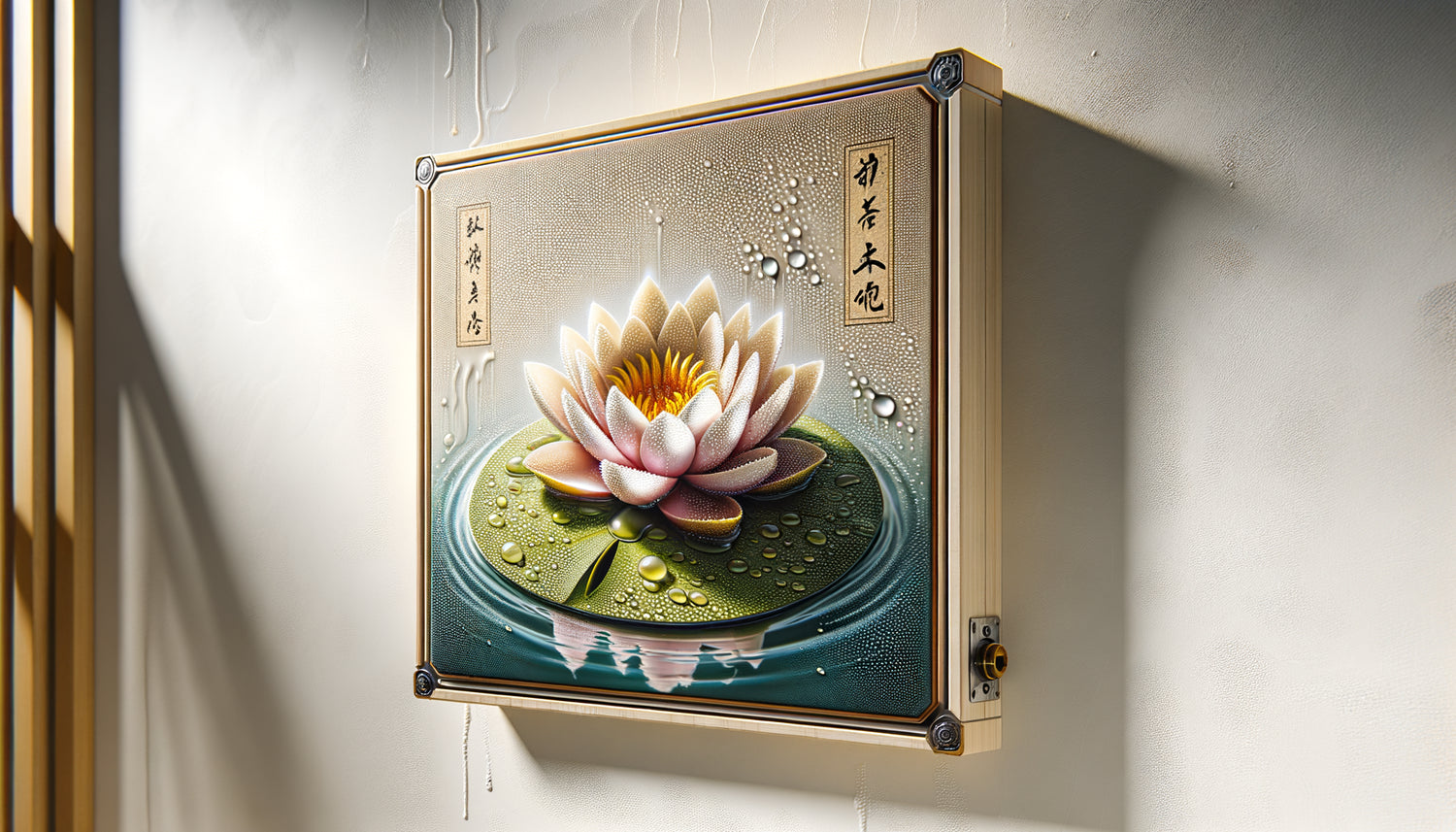
The first time I decorated a hot yoga studio, I made a mistake that still haunts me. A beautiful canvas depicting a lotus, carefully framed, hung facing the practitioners. Three weeks later, the surface was warped, the colors faded, and the frame was moldy. The owner showed me the traces of moisture that had infiltrated everywhere. It was on that day that I understood that the extreme environment of hot yoga requires a radically different approach to wall decor.
Here's what moisture-resistant artworks bring to hot yoga studios: exceptional durability in the face of extreme conditions (40°C and 80% humidity), preservation of the inspiring aesthetics essential to practice, and long-term profitability that avoids constantly replacing damaged artwork.
If you manage a hot yoga studio, you know this frustration: investing in beautiful decor only to see your artworks deteriorate within months. Frames warping, canvases molding, prints peeling off. You may have tried classic solutions, convinced that a good varnish or a sealed frame would be enough. Yet, moisture always finds its way.
The good news? Specific materials exist, designed specifically for these hostile environments. Solutions that combine beauty and resistance, without compromise. I'm revealing to you today the secrets of these moisture-resistant artworks that transform the appearance of your space without fearing heat and steam.
The relentless environment of hot yoga: understanding the enemy
A hot yoga studio is not simply a warm room. It's a true extreme ecosystem where the temperature oscillates between 35 and 42°C, with a humidity rate that can reach 80%, or even more during Bikram or hot yoga sessions. To give you an idea, it’s equivalent to a bathroom after a scalding shower... maintained like that for 90 minutes, several times a day.
This combination of heat and humidity creates what experts call a hygroscopic environment. Air saturated with water vapor constantly seeks to balance itself with all the porous materials present in the room. Wood swells and deforms. Paper absorbs moisture like a sponge. Textiles become breeding grounds for mold. Adhesives gradually dissolve.
I have visited dozens of studios where owners had tried to hang traditional artworks. The result is always the same: after a few weeks, the works show signs of degradation. Cotton canvases loosen and warp. Photographic prints develop brownish halos. Solid wood frames twist and crack. Metal fixings rust and leave marks on white walls.
Even more insidious, mold begins to proliferate in confined spaces between the glass and the artwork, creating those characteristic black spots that are impossible to remove. Air quality suffers, and with it, the very experience your practitioners seek: a pure, healthy, inspiring space.
Materials that champion moisture resistance
Faced with these challenges, some materials stand out for their exceptional resistance to extreme conditions. Aluminium dibond is my first choice for hot yoga studios. This composite of two aluminium plates sandwiching a polyethylene core is absolutely not afraid of humidity. It does not rust, warp or mildew. Its smooth, non-porous surface naturally repels water.
Plexiglas prints offer an equally effective alternative. This transparent acrylic material has total impermeability and remarkable dimensional stability. Unlike traditional glass, it does not create condensation between layers, eliminating the risk of mold development. Its lightness also facilitates installation, a significant advantage.
Expanded PVC, often overlooked in high-end decoration, nevertheless reveals unsuspected qualities for humid environments. Totally impermeable and rot-proof, it wonderfully accepts high-definition prints. Its surface can be treated to obtain different finishes, from matte to glossy, depending on the desired atmosphere.
The inks and surface treatments that make the difference
Choosing the support is only half the job. The inks used play an equally crucial role. UV latex inks, polymerized by exposure to ultraviolet light, create an exceptionally strong molecular bond. They do not fade, bleed or crack under the effects of heat and humidity. I have seen UV latex prints in studios that remained impeccable after three years of intensive use.
Eco solvent inks also offer a remarkable resistance to moisture, although slightly less environmentally friendly. Their chemical composition naturally repels water, creating a hydrophobic surface that facilitates maintenance. A simple wipe with a microfiber cloth is enough to remove condensation marks.
Some manufacturers also apply antibacterial surface treatments, particularly relevant in a health and wellness context. These coatings inhibit the growth of bacteria and fungi, extending the life of the artwork while maintaining a healthier environment for your practitioners.

Beyond resistance: the aesthetics that inspire practice
Technical durability is not enough. A painting in a hot yoga studio must also nourish the spiritual and sensory experience of practitioners. During intense postures, when the body trembles and the mind seeks an anchor point, the gaze naturally rests on the walls. The artwork then becomes a support for meditation, an invitation to persevere.
Natural motifs work particularly well: soothing landscapes, stylized plant elements, geological formations, infinite skies. These images resonate with the very intention of yoga, this reconnection to the essential. I have observed how some practitioners always return to the same places, facing the artwork that inspires them in particular.
The color palette also deserves special attention. Earthy tones - ochres, beiges, sage greens - create an enveloping atmosphere that pleasantly contrasts with the intensity of the practice. Blues evoke freshness and calm, a welcome balance in the ambient heat. Touches of gold or copper bring a spiritual dimension without falling into cliché.
Some studios opt for abstract creations that leave room for personal interpretation. Fluid shapes evoking movement, textures inviting visual touch, streamlined compositions that promote concentration. These contemporary works particularly appeal to an urban clientele seeking authenticity without folklore.
Costly mistakes to avoid at all costs
Over the course of my collaborations with hot yoga studios, I have noted the recurring errors that cost dearly, in money as well as credibility. The most common? Underestimating the destructive power of the environment and choosing artworks « almost suitable ». A wooden frame treated but not specifically designed for extreme humidity. A canvas with a standard protective varnish. These half-measures invariably end in failure.
Another classic trap: placing paintings too close to steam sources. Even the most resistant materials have their limits. A painting positioned directly above a humidifier or facing a ventilation grille will suffer disproportionate exposure. The golden rule? Maintain a distance of at least 1.5 meters from hot spots and direct steam sources.
Neglecting maintenance is also a fatal error. Humidity-resistant paintings are not magical - they require regular cleaning. The accumulation of condensation, even on impermeable surfaces, eventually leaves mineral traces if it is not wiped away. A simple protocol - daily wiping with a dry microfiber cloth after sessions - is enough to preserve the brilliance of the artworks.
Installation: details that change everything
The mounting method directly influences the longevity of your wall art. Stainless steel fixings, although more expensive, resist rust indefinitely. Suspension systems with cables allow for air circulation behind the artwork, reducing the risk of trapped condensation. Some professional installers even create a 2-3 cm space between the wall and the artwork to promote this natural ventilation.
Absolutely avoid traditional double-sided adhesives, which quickly dissolve in moisture. If you opt for an adhesive fixing, choose high-performance special tapes designed for humid environments, such as those used in commercial bathrooms or industrial kitchens.

The investment that pays off: the calculation no one makes
Let's talk about figures with transparency. A moisture-resistant artwork of quality generally costs 30 to 50% more than a standard print. This difference deters some studio managers, especially when opening when every euro counts. Yet, economic analysis reveals a very different reality.
A traditional artwork in a hot yoga studio lasts on average 3 to 6 months before showing visible signs of degradation. A specialized artwork maintains its impeccable appearance for 5 to 7 years, or even longer with proper maintenance. Over a period of 5 years, you will replace about 10 times a standard artwork against only once a moisture-resistant artwork.
Not counting the hidden costs: the time spent searching for replacements, the negative impression on your clients who see degraded works (what confidence can be given to a studio that does not take care of its environment?), repeated installation fees, potential damage to walls caused by humidity seeping through unsuitable works.
Some of my clients have even noticed an improvement in their retention rate after investing in durable and inspiring decoration. Practitioners appreciate the attention to detail, the aesthetic consistency maintained over time. They photograph the spaces, share on social networks, become natural ambassadors of your studio.
Transform your studio into a lasting visual sanctuary
Discover our exclusive collection of wall art for yoga studios that resists heat and humidity while inspiring your practitioners day after day.
Create a visual consistency that tells your story
A single humidity resistant artwork makes a difference. A thoughtful collection completely transforms the experience. I always encourage studio owners to think in terms of visual storytelling. What story do you want to tell? What emotion do you want to cultivate?
A studio focused on performance and achievement can opt for images of mountain peaks, endless horizons, sublimated natural challenges. A space that prioritizes gentleness and recovery will be drawn to more contemplative compositions: Zen gardens, calm waters, soft lights. The consistency between your teaching approach and your decor reinforces the identity of your studio.
Also consider the spatial layout. In a hot yoga room, some areas deserve more attention: the wall facing the entrance (first impression), the space visible during downward dog pose (one of the most frequent), the final relaxation area in Savasana. These strategic locations justify investing in particularly inspiring pieces.
Don't hesitate to integrate works of different sizes. A large centerpiece creates a powerful focal point, while more modest formats can punctuate the space, guide the eye, create a visual rhythm. This variation avoids monotony while maintaining overall harmony through a unifying palette or theme.
The long-term vision: when decoration becomes strategic investment
I have seen studios transform their reputation thanks to careful and lasting decor. In a saturated market where yoga studios are multiplying, a distinctive visual identity becomes a major competitive advantage. Your regular practitioners develop an emotional attachment to the space. Newcomers are immediately seduced by the attention to detail.
The humidity resistant artworks participate in this differentiation strategy. They testify to your professionalism, your understanding of technical issues, and your refusal to compromise. When a visitor notices that even the wall art has been specifically chosen for the hot yoga environment, they perceive a higher level of expertise and commitment.
This perception translates concretely: higher trial-to-subscription conversion rates, positive word-of-mouth, ease in justifying premium prices, resilience during off-peak periods. Your studio becomes a destination, not just a functional practice space.
Also consider the evolution of your brand image. Photos of your space circulate constantly on Instagram, Facebook, Google Reviews. Works degraded by humidity send a negative message that contradicts all your marketing efforts. On the contrary, impeccable paintings reinforce your positioning and facilitate your visual communication.
Imagine your studio in six months, in two years. The same inspiring artworks, still as bright and clear, welcome new generations of practitioners. Walls tell a story of durability, attention, respect for space and those who frequent it. You haven't had to replace a single work, cover damaged areas, or apologize for the tired appearance of your decor.
This vision is not utopian. It is the reality of studios that have made the wise choice of artworks specifically designed to resist humidity. A choice that, beyond the practical aspect, honors the very spirit of yoga: patience, foresight, harmony between intention and action, beauty that transcends time.
Start by identifying your studio's priority areas. Invest in one or two master pieces for these strategic locations. Observe the difference, listen to feedback from your practitioners. Then gradually extend this approach to the entire space. Each artwork becomes another brick in the edifice of your unique identity, immutable despite the heat and steam that inhabit your walls.


