I have accompanied more than thirty studios in their visual design, and this question consistently arises during our initial meetings: how to create an atmosphere that supports practice without distracting? Black and white nature photography has emerged as an obvious choice in my recent projects, radically transforming the practitioners' experience.
Here’s what black and white nature photographs bring to Pilates studios: a soothing atmosphere that promotes concentration, a timeless aesthetic that enhances the space, and a subtle invitation to connect body and mind. Many studio owners fear that black and white will make their room cold or austere, creating a clinical rather than welcoming ambiance. This concern is legitimate, but unfounded. Black and white nature photographs, when well chosen, create exactly the environment Pilates practice needs: calm, focus, and natural elegance. I'll show you how to transform your space into a sanctuary of conscious movement.
The visual philosophy of Pilates deserves its setting
Pilates is more than just gymnastics. It’s a discipline that cultivates body awareness, precision of movement, and mental connection. Joseph Pilates himself spoke of complete coordination of body, mind, and soul. In this context, every visual element in your studio becomes a silent actor in the practice.
Black and white nature photographs resonate perfectly with this philosophy. They eliminate chromatic distraction while preserving the essence: the texture of bark, the fluidity of a waterfall, the structure of a rock formation. This visual simplicity creates a natural parallel with Pilates principles – getting to the essentials, finding the pure form of movement, eliminating the superfluous.
I have observed in several studios how these images subtly influence the quality of practice. Students report an increased ease in maintaining their focus, as if the visual sobriety helped them stay grounded in their bodily sensations rather than letting their gaze – and their mind – wander.
Why black and white surpasses color in a studio
Colors create immediate and sometimes unpredictable emotional responses. A stimulating red can energize but also stress. A soothing blue can relax but also cool the atmosphere. Green can invigorate or, depending on its shade, create a feeling of confinement.
Black and white transcends these dilemmas. It offers an emotional neutrality that allows each practitioner to project their own inner state without chromatic interference. A black and white forest photograph does not impose a specific feeling – it creates a meditative visual space where breathing and movement become the true protagonists.
The perfect lighting balance for concentration
In my studio design projects, I favor black and white nature photographs for their ability to manage ambient light. Light areas create visual breathing spaces, while dark areas absorb excess stimulation. This alternation of tonal values mimics the natural rhythm of practice: effort and release, contraction and extension.
A studio in Lyon that I accompanied replaced its colorful anatomical posters with a series of black and white photographs of waterfalls and rocks. The change was immediate: morning classes, bathed in natural light, benefited from remarkable visual softness, while evening sessions, under artificial lighting, retained a soothing depth. Black and white nature photographs adapt to all lighting conditions.

Which nature images to choose for your room
Not all black and white nature photographs are equally suitable for Pilates rooms. I have developed a selection grid based on three essential criteria.
Frozen movement : prioritize images that capture natural movement – breaking waves, undulating grasses, extending branches. These compositions create a subtle resonance with the fluidity sought in Pilates. A black and white photograph of a waterfall, for example, evokes the constant flow that Joseph Pilates described as essential to his method.
Depth of field : images with multiple planes – sharp foreground, slightly blurred background – invite the eye to travel without clinging to it. This visual depth promotes a form of active meditation, perfect for moments of transition between exercises.
Organic textures : the bark of a sequoia, the striations of a cliff, the veins of a giant leaf. These black and white natural details create a reassuring visual anchor without ever becoming overwhelming. They recall the organic complexity of the human body that Pilates seeks to harmonize.
Strategic formats and placements
In a Pilates room, the gaze of practitioners follows specific trajectories depending on the exercises. For movements on the back, the ceiling and the rear wall become the main visual field. For standing or sitting positions, the side walls take over.
I recommend panoramic formats for main walls – these black and white nature photographs create a visual window that expands the space. A mountain landscape in a horizontal format can transform a cramped room into an open sanctuary. For transitional spaces or dressing rooms, square or vertical formats work wonderfully, creating visual pause points between two universes.
The psychological impact of black and white on practice
Beyond aesthetics, black and white nature photographs trigger fascinating psychological mechanisms. Research in environmental psychology shows that monochromatic environments reduce cognitive load – our brain processes less sensory information, freeing up mental resources for other tasks.
In Pilates, this cognitive economy translates to better proprioception. Practitioners can direct their attention towards subtle sensations – the deep contraction of an abdominal muscle, the precise alignment of a vertebra, the quality of a breath. Black and white nature photographs thus become invisible allies of performance.
I observed this phenomenon in a Brussels studio specializing in clinical Pilates. Therapists noted improved patient compliance after installing a series of black and white misty forest photographs. Rehabilitation sessions, often perceived as restrictive, became more serene moments, promoting better adherence to the protocol.

Composing a coherent gallery without monotony
The most common mistake is to choose black and white nature photographs that are too similar. A succession of seascapes or an exclusive series of forests creates visual repetition that cancels out the desired benefits.
I recommend a harmonious thematic diversity: alternate natural elements – water, earth, vegetation, mineral – while maintaining tonal consistency. A black and white desert dune photograph can beautifully dialogue with a woodland snapshot, provided that contrasts and tonal density are balanced.
Also consider composition variation. Mix wide shots and macro details, symmetrical and asymmetrical compositions. This diversity maintains visual interest throughout the sessions without ever distracting from the practice itself.
The balance between presence and discretion
Black and white nature photographs should assert a sufficient presence to create the desired atmosphere, without becoming the focal point of the room. This line of balance depends on several factors: the size of the images, their number, and their contrasting intensity.
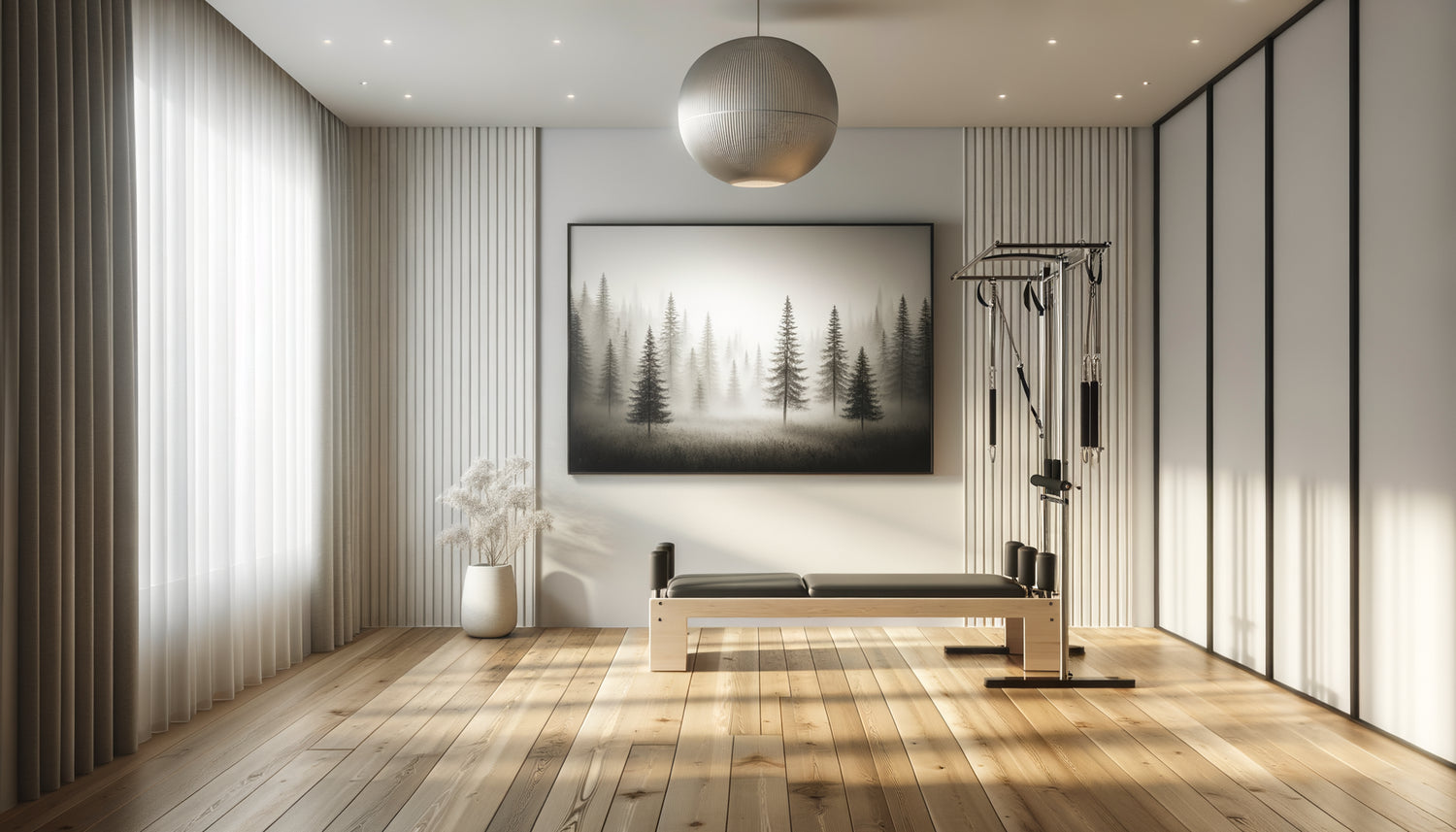
For a 60m² room, I usually suggest three to five large photographs rather than a multitude of small ones. This approach creates spaced visual anchors that structure the space without cluttering it. Images with moderate contrast – neither too graphic nor too flat – work better than extreme black and whites which can tire the eye.
Create the atmosphere your practice deserves
Discover our exclusive collection of wall art for yoga studios that will transform your studio into a sanctuary of conscious movement.
From vision to reality: installing your gallery
The physical installation of black and white nature photographs deserves as much attention as their selection. In Pilates rooms, the vibrations of the equipment and humidity variations related to physical activity impose specific constraints.
Choose robust fixing systems and opt for prints on rigid supports or frames with anti-reflective glass. This technical detail eliminates parasitic reflections that could hinder certain positions, particularly during exercises on your back where your gaze naturally turns towards the walls and ceiling.
Hanging height differs from living spaces. In a Pilates room, the optimal visual center is slightly lower than in a living room – about 140 cm from the floor – because many exercises are performed in a low or semi-lying position. This subtle adaptation maximizes the soothing impact of black and white nature photographs.
Imagine your next session: you enter your transformed room, and your gaze immediately meets these timeless black and white landscapes. Even before unrolling your mat, you feel your breathing deepen, your mind refocus. This purified atmosphere becomes the perfect cocoon to explore the precision of your movements, to feel each muscle engage consciously. Black and white nature photographs are not just decoration – they become a visual reflection of your intention: to get to the essential, cultivate presence, honor the beauty of conscious movement. Start with a single image, one that resonates with your vision, and observe how it subtly transforms the energy of your practice.
FAQ
Won't black and white make my room too cold or clinical?
This concern is understandable but stems from a misunderstanding. The coldness or warmth of a space depends less on colors than on the quality of textures, lighting and materials. Black and white nature photographs, with their rich organic textures – rough bark, undulating grasses, flowing water – bring a tactile depth that visually warms the space. Paired with warm lighting (2700-3000K), wooden floors, and a few natural plants, they create a sophisticated and welcoming atmosphere, far from medical austerity. I have seen dozens of studios adopt this aesthetic with remarkable success, their clients describing the ambiance as zen, elegant and soothing rather than cold.
How many photographs should I install in a standard room?
For an average-sized Pilates studio (40-70m²), I recommend three to five large photographs rather than a multitude of small ones. This approach creates visual anchor points without cluttering the space or distracting practitioners. Think of a breathing gallery: one panoramic image on the main wall (facing the reformers or center of the room), then two to three complementary images on the side walls. The common mistake is to overload, creating an art gallery rather than a practice space. Black and white nature photographs work best when they have neutral space around them – this visual void is an integral part of their soothing impact. Let your walls breathe, and let your images breathe with your practitioners.
Can I mix black and white nature photographs with other decorative elements?
Absolutely, and it is even recommended to avoid a too monolithic effect. Black and white nature photographs pair wonderfully with natural plants (which bring the touch of living green), inspiring quotes in clean typography, or a few zen objects like pebbles or bamboo. The important thing is to maintain a aesthetic coherence: prioritize natural materials, clean lines, and avoid overly colorful or graphic elements that would create a visual conflict. An excellent balance is to make black and white nature photographs your visual foundation – they occupy 70-80% of your wall decor – then add a few subtle complementary touches. This strategy preserves the soothing atmosphere while avoiding monotony, creating a rich environment without being cluttered, just like Pilates practice itself: precise, intentional, balanced.