

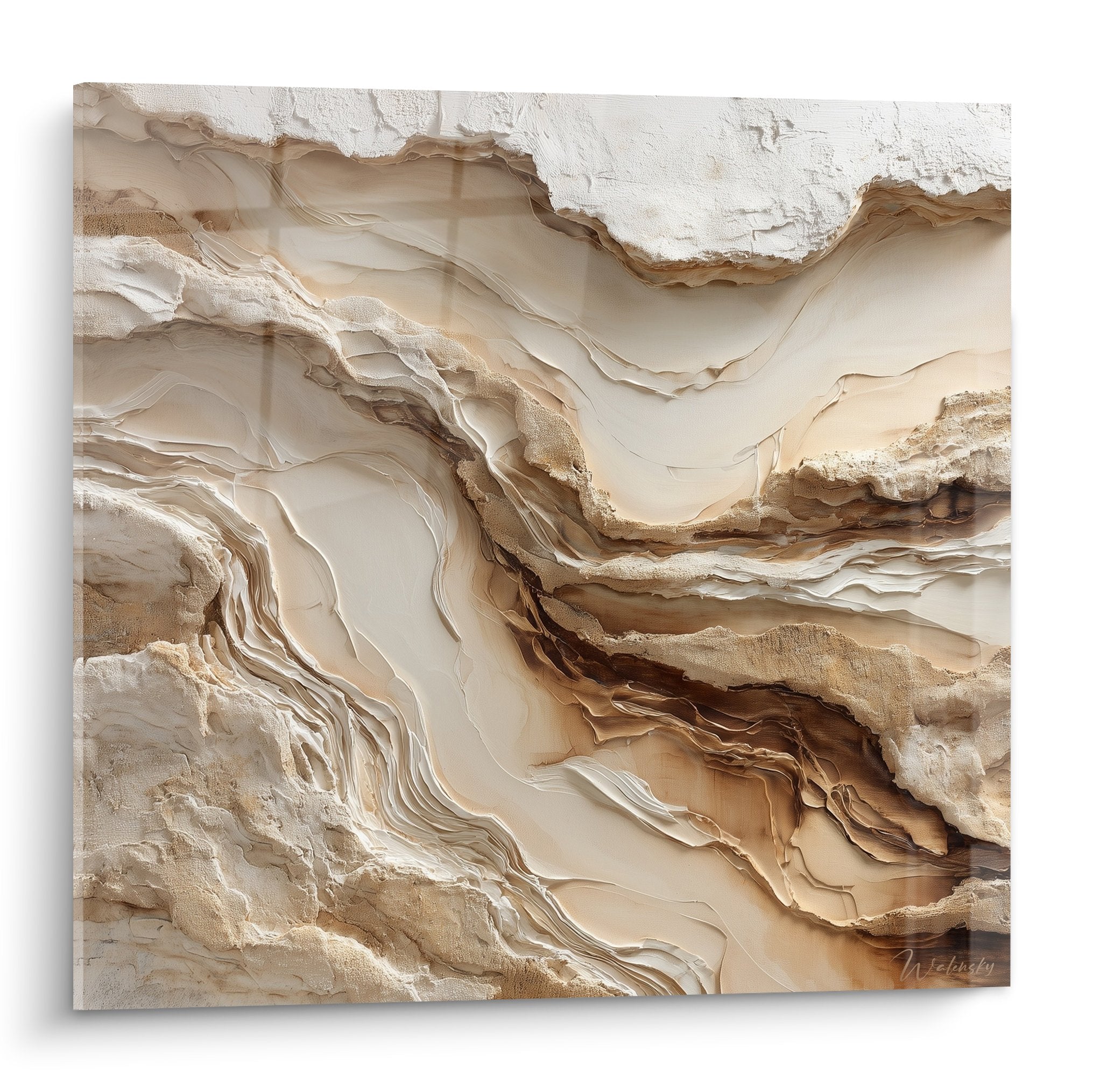






Why Were Textured Vintage Relief Wall Art Pieces Trending?
December 1, 2025 · 8 min read · by Walensky
I grew up surrounded by these wall artworks that proudly adorned my grandparents' living rooms. These thick paintings, almost sculpted, whose material seemed to want to escape the frame to invade the space. As a child, I ran my fingers over their reliefs, fascinated by this grainy texture that captured the light differently depending on the time of day. These pieces told a time when wall art had to be tangible, tactile, almost alive.
Here's what textured vintage relief wall paintings brought to interiors: a sculptural depth that transforms a flat wall into an architectural focal point, a play of light and shadows that evolves throughout the day, and a material presence that anchors the space in an authentic artisanal dimension. These works didn't just decorate; they literally inhabited the walls.
Today, faced with our flat screens and smooth digital prints, we have lost this sensory dimension of decoration. Our interiors sorely lack this physical depth that gave character to rooms. The current trend values surface over volume, image over matter.
Yet, this decorative phenomenon from the 1950s to the 1980s reveals arrangement secrets that contemporary designers are gradually rediscovering. Understanding why these relief paintings dominated an era sheds light on our current needs for authenticity and material presence in our living spaces.
The golden age of texture: when the wall became sculpture
Vintage textured relief wall paintings emerged in a very particular architectural context. After World War II, massive reconstruction produced standardized spaces with smooth, impersonal walls. These neutral surfaces called for strong decorative intervention, capable of giving character back to modern interiors.
The artisans and artists of the time responded with a revolutionary approach: transforming mural painting into bas-relief. Using techniques borrowed from sculpture – structured plaster, thick pastes, composite materials – they created three-dimensional works that broke the monotony of flat surfaces.
This trend was part of the Brutalist movement and mid-century aesthetic which valued the authenticity of materials and their raw expression. A textured relief painting was not just an image: it was a work of architecture in its own right, sometimes several centimeters thick, weighing several kilos, requiring solid installation.
The subjects depicted – Mediterranean landscapes, still lifes, port scenes, geometric abstractions – gained almost cinematic dimension thanks to the relief. The sailboats seemed to sail out of the frame, the fruits were within reach, the rocky textures invited touch.
The magic of light captivates
What made the raised vintage paintings truly fascinating was their unique relationship with natural and artificial light. Unlike a flat print, these works constantly evolved according to the ambient lighting.
In the morning, the grazing light revealed every imperfection, creating deep shadows that accentuated the sculptural dimension. At noon, zenithal lighting softened the reliefs, revealing more of the color nuances. In the evening, the side lighting from lamps completely transformed the work, generating new volumes invisible during the day.
This light dynamic offered a renewed decorative experience daily. The same painting seemed to tell several stories depending on the time, creating a living interaction with the space. Interior designers of the era deliberately played with this effect by strategically positioning these works near windows or facing light sources.
The creation techniques amplified this phenomenon: generous impastos, wide spatulas creating deep furrows, additions of sand or marble powder to accentuate texture, multiple layers creating complex reliefs. Some artisans even incorporated three-dimensional elements – ropes, fragments of wood, shells – melted into the composition.


Our favourite
Red and White Poppies Painting with Fine Stems - Relief Impasto - Poppy Edition
232,90€
Discover this artworkA bulwark against industrial uniformity
The popularity of textured raised wall paintings can also be explained by a deep cultural reaction. The 1960s-1970s saw the massive industrialization of interior decoration. Mass-produced furniture, mechanically printed wallpapers, offset reproductions invaded homes.
Faced with this standardization, raised paintings represented an island of authentic craftsmanship. Even mass-produced, each piece retained unique variations due to the manual creation process. Impastos differed slightly, textures varied, color nuances were never exactly identical.
This artisanal dimension reassured owners who wanted to personalize their interiors without the budget necessary to order original works of art. A raised vintage painting offered a compelling compromise: the accessibility of a manufactured product with the soul of a handmade creation.
Flea markets and antique shops still abound with these signed or anonymous pieces, testimonies of an era when wall decoration was thought of as a lasting investment rather than a fleeting element changed according to seasonal trends.
— Our selection

The secret acoustics of raised wall reliefs
A little-known aspect of textured relief paintings concerns their acoustic impact. Textured surfaces do not reflect sound in the same way as smooth walls. The reliefs create a diffuse acoustic effect which slightly softens the reverberation of a room.
In apartments with bare walls and tiled floors typical of the 1960s-1970s, this property was not insignificant. A large textured painting contributed to humanizing the acoustics of a space, making it warmer and more comfortable, even if the inhabitants were not aware of it.
This quality adds to the visual and tactile benefits, creating a complete sensory experience. An interior with several relief paintings offered an ambiance distinctly different from a space with bare walls or adorned with simple prints.

Why this trend still resonates today
The current return of vintage relief paintings in contemporary interiors is not just an aesthetic nostalgia. It responds to a deep need for authentic materiality in an increasingly dematerialized world.
New generations, saturated with screens and virtual images, are looking for objects that have an undeniable physical presence. A textured relief painting offers exactly this quality: it is impossible to confuse it with a digital image, impossible to reproduce by printing, impossible to ignore its sculpted dimension.
Interior architects are also rediscovering the ability of these works to visually structure a space. In lofts and contemporary open spaces, a large textured painting instantly creates a defined area, a visual anchor that organizes circulation and attention.
The current trend of slow design and sustainable decoration values precisely what these vintage pieces embody: objects designed to last, resist time, and transcend trends without losing their relevance. A relief painting from the 1970s dialogues perfectly with minimalist contemporary furniture, creating that textural contrast sought by decorators today.
Give your walls the depth they deserve
Discover our exclusive collection of Vintage paintings that transform your flat surfaces into captivating tactile landscapes.
— You may also like


How to integrate these pieces into a contemporary interior
Integrating a textured vintage wall painting into a modern decor requires a balanced approach. These pieces have a strong presence that needs space to breathe and carefully chosen visual companions.
The golden rule: prioritize uniqueness. A single large textured painting on a clean wall creates more impact than an accumulation. Leave at least 30 centimeters of free space around the artwork so that its reliefs can project their shadows without visual interference.
Lighting requires particular attention. Install adjustable directional lighting – spotlights or orientable sconces – to control the angle of light and reveal textures according to your preferences. Avoid direct frontal lighting which flattens the reliefs.
In terms of style, these vintage paintings harmonize remarkably with minimalist Scandinavian furniture, minimalist spaces where they become the centerpiece, or eclectic interiors that mix eras. Their material presence warms up overly clinical spaces and adds depth to monochromatic rooms.

In the same vein
The Silk of Whispers Wall Art - Abstract Relief Edition
233,90€
Discover this artwork →The heritage value of these exceptional objects
Beyond their decorative function, textured relief paintings represent today an artistic and artisanal heritage that is little known. Many were created by artists trained at the School of Fine Arts who chose accessible decorative production rather than elite galleries.
Some signed pieces, produced in limited editions by renowned workshops, are gradually acquiring collectible value. Enthusiasts seek out discreet signatures on the back of frames, stamps from disappeared workshops, and particular techniques specific to certain regions or periods.
This heritage dimension enriches the ownership experience. Acquiring a vintage relief painting is becoming the temporary guardian of a know-how, the passer of an aesthetic between generations. It is also investing in an object whose emotional and potentially financial value will only grow with time.
Imagine your living room transformed by this sculptural presence. The morning light caressing the reliefs, creating a renewed spectacle each day. Your guests intrigued, tempted to touch the surface to verify that yes, this material is real, tangible, moving. Your space finally freed from contemporary flatness, inhabited by a work that dialogues with light and time. Start by identifying the wall that calls for this transformation – the one your gaze naturally seeks when entering the room – and offer it the textured depth it deserves.
Frequently Asked Questions
How to tell if a vintage relief painting is authentic and of quality?
The authenticity of a vintage relief wall painting is first verified by touch and weight. Authentic pieces from the 1950s-1980s are remarkably heavy, due to the noble materials used – structured plaster, thick pastes, solid wood supports. Gently run your fingers over the surface: the reliefs should show natural variations, subtle irregularities that betray handwork. Modern resin molded reproductions are uniform and hollow sounding. Examine the back of the painting: old metal fixings, yellowed labels, marks from disappeared galleries are valuable clues. The natural patina of the varnish, slightly cracked but stable, differentiates an authentic piece from an artificially aged imitation. Do not hesitate to ask the seller for provenance – pieces from family estates or established antique shops generally offer more guarantees than opaque sources.
Do these old paintings require special maintenance?
Textured vintage relief paintings are surprisingly robust but require a few simple precautions. Dust naturally accumulates in the recesses: use a soft natural bristle brush or an air blower to gently clean every quarter. Absolutely avoid wet cloths that could alter the pigments or soften certain areas of old material. If your piece has localized stains, consult a restorer rather than attempting a hazardous intervention. Location is enormously important: avoid direct sunlight which gradually discolors the pigments, and excessive humidity which could weaken the support. A well-positioned painting in an interior with stable conditions will last for several more decades without noticeable degradation. These works are often 40 to 70 years old and remain beautiful, proof of their exceptional resilience when respected.
Can a textured vintage painting be mixed with modern decor without a faux pas?
Absolutely, and it's even one of the most successful associations in contemporary decor. The key lies in the deliberate contrast rather than an attempt at camouflage. A textured vintage artwork creates a focal point rich in history and material that paradoxically enhances the sobriety of modern minimalist furniture. Think of it as an antique jewel worn with a minimalist dress: the opposition creates elegance. In concrete terms, pair your textured artwork with furniture featuring simple lines, neutral colors that allow the work to shine, and natural materials – raw wood, linen, artisan ceramics – which share its material authenticity. Avoid multiplying vintage elements in the same room, which would create a museum-like atmosphere. A single antique artwork becomes a sophisticated personal signature; three transform your living room into a flea market. The balance is found in this simple rule: one statement vintage piece for nine contemporary elements.
Explore our collections


