Hanging a Heavy Picture in a Staircase | Professional Solutions
October 11, 2025 · 8 min read · by Walensky
Hanging a heavy picture in a staircase represents a particular technical challenge that many homeowners and interior designers encounter.Between pitch constraints, safety concerns, and access difficulties, this passageway requires specific mounting solutions. Discover our professional techniques for successfully hanging your artwork safely in this delicate space, while avoiding common mistakes that could compromise your installation.
The Specific Challenges of Hanging Pictures on a Staircase
Installing artwork in a stairwell has particularities that distinguish it from hanging on a standard wall. These constraints must be perfectly mastered to guarantee not only the aesthetics of your decoration, but above all the safety of people who use this passage daily.
- Variable inclination of the wall following the slope of the staircase
- Increased vibrations due to repeated passage
- Often significant height and difficult access
- Risk of impact when transporting bulky objects in the stairwell
Key point to remember: In a staircase, safety takes precedence over aesthetics. A picture poorly attached in this area of passage represents a real danger for all occupants of the home.
Choosing the Right Mounting System for Heavy Pictures on a Staircase
Criteria for Selecting a Mounting System for a Staircase
Unlike a classic wall, hanging in a staircase requires careful consideration of the type of support and the specific characteristics of your artwork. The weight of the picture is the first factor to consider, but other elements come into play to guarantee a durable and secure installation.
Professional tip: Multiply the actual weight of your picture by 1.5 to determine the minimum load capacity that your staircase mounting system should support. This safety margin compensates for additional vibrations and stresses in this location.
Invisible Mounting Solutions for Heavy Artwork
To preserve the aesthetics of your decoration while guaranteeing optimal safety, invisible mounting systems are an excellent alternative to traditional hooks. These devices are completely hidden behind the frame and offer superior resistance to frequent mechanical stresses in staircases.
Anti-Vibration Systems Specific to Passageways
Stairways are subject to constant vibrations that can, over time, destabilize classic fixings. Devices specifically designed to absorb these micro-movements help keep your picture perfectly in place, even in a very busy stairwell.
- Anti-vibration silicone pads
- Spring compensator systems
- Double locking fixings
Comparison of Different Fixings for Pictures on a Staircase
To help you make the best choice, here is a comparative table of the main solutions available on the market, with their specific advantages and disadvantages for use in a staircase.
| Type of fixing | Load capacity | Ease of installation | Anti-vibration protection |
|---|---|---|---|
| Reinforced wall hooks | Up to 15kg | Simple | Low |
| Rail and cable system | Up to 20kg | Moderate | Medium |
| Professional invisible fixings | Up to 30kg | Complex | Excellent |
| Automatic locking system | Over 30kg | Moderate | Superior |

Secure installation techniques for stairwell wall art
Determine the optimal anchor point
Choosing the right anchor point is crucial to ensure the solidity of your installation, especially in a staircase where walls may have different structural characteristics from one area to another.
- Stud detection: Use a stud finder to identify hidden load-bearing structures behind drywall, offering a much stronger anchorage than a simple partition wall.
- Material analysis: Adapt your choice of fixing to the type of wall (drywall, concrete, brick) to maximize the resistance of the anchor.
- Avoid fragile areas: Some parts of stairwell walls may conceal technical ducts or have structural weaknesses that should be absolutely avoided.
Secure drilling techniques in a staircase
Drilling in a staircase presents specific challenges related to the often uncomfortable position and access constraints. Here's how to proceed systematically to ensure accuracy and safety during this critical step.
- Stable position: Use a ladder suitable for stairs with adjustable feet to ensure your safety during installation.
- Precise marking: Use a laser level to compensate for the natural slope of the staircase and ensure perfect alignment.
Optimal distribution of fixing points
For particularly heavy artworks, it is essential to multiply and distribute fixing points judiciously to evenly distribute the load on the stairwell wall.
- Triangle rule: Prefer a triangular arrangement of fixing points rather than in a line to maximize stability.
- Frame adaptation: Take into account the structure of the frame to position your fixings at the most resistant points.
Safety first: For any artwork over 10kg in a staircase, systematically double the number of fixing points compared to what you would do on a standard wall. This precaution compensates for the specific constraints of this environment.
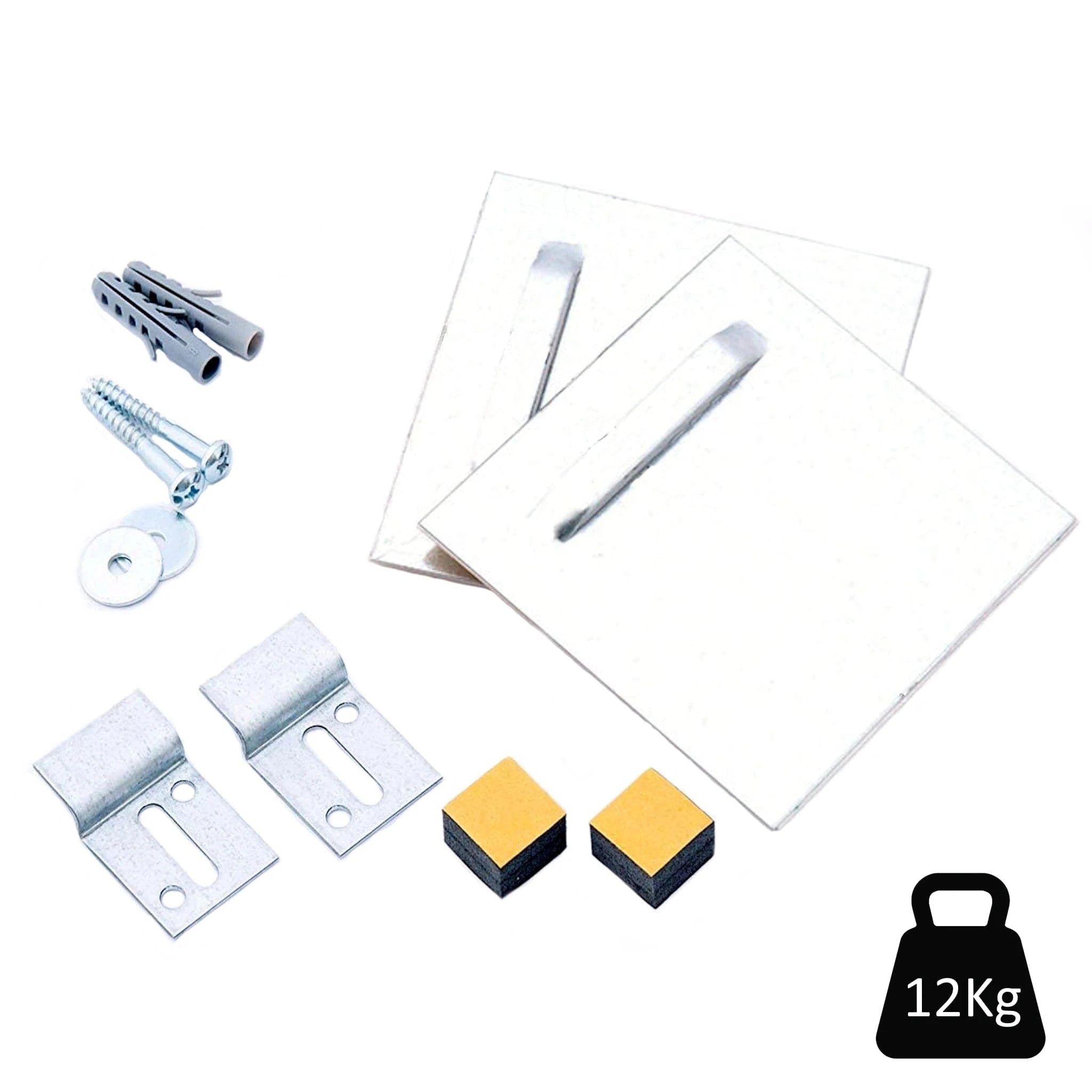
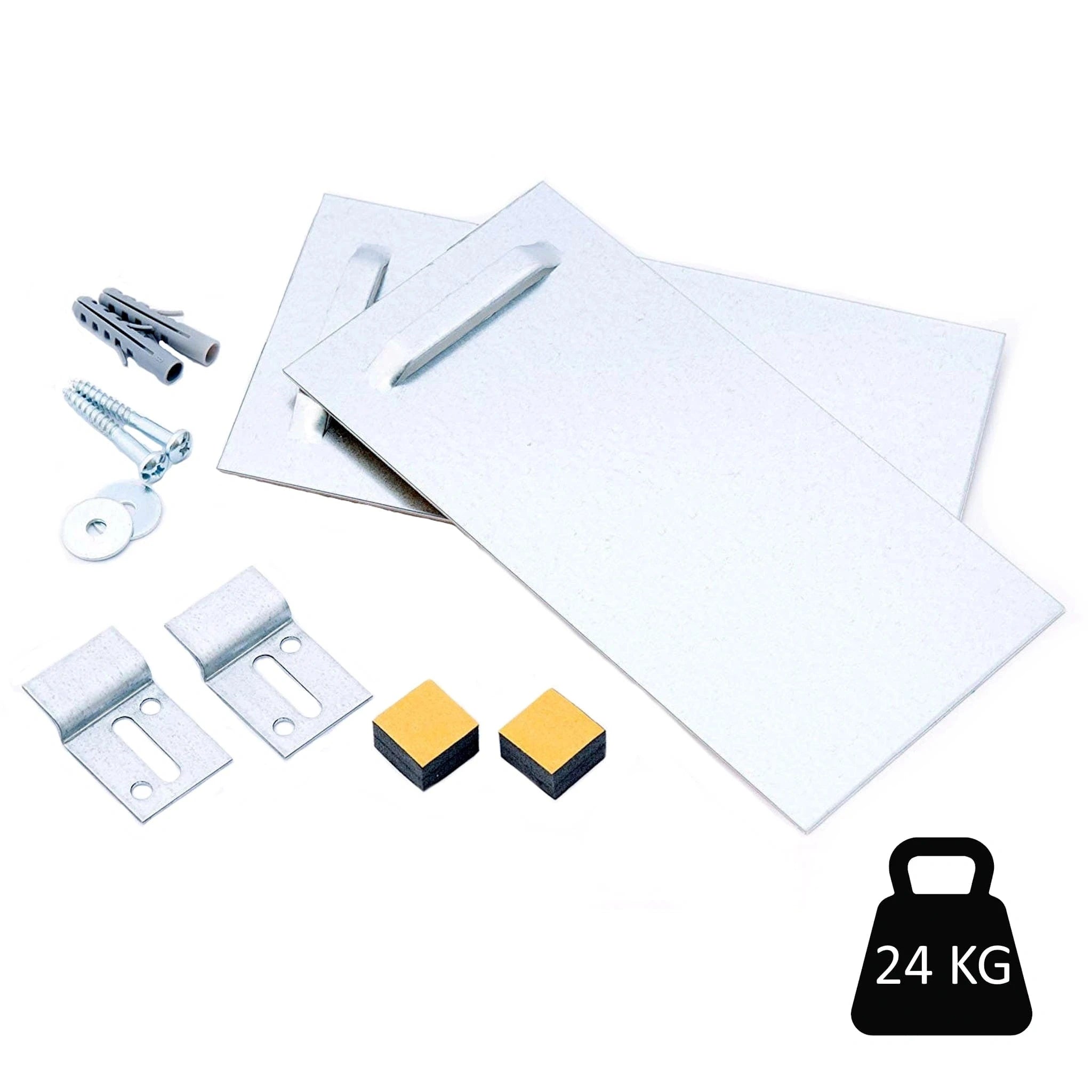
OUR RECOMMENDED PRODUCTS
Discover our selection of products specially chosen for the secure hanging of heavy artworks in stairwells. Click on the images to learn more.

Crochets de fixation mural 12kg max - kit complet
39,99 €
|
Crochets de fixation mural 24kg max - kit complet
49,99 €
|
Pourquoi choisir nos produits : Tous nos crochets muraux sont fabriqués avec des matériaux de haute qualité pour garantir une durabilité et une robustesse exceptionnelles. Installation facile et rapide sans outils spéciaux.
Determining the optimal height for hanging in a staircase
The hanging height in a staircase follows different rules than those applicable in a standard room. Between aesthetic considerations and practical imperatives, here's how to avoid common installation errors at height.
- Progressive midline rule : Unlike standard walls where the center of the work is placed at eye level, in a staircase it is necessary to create a midline that gradually follows the rise of the steps.
- Calculation of optimal viewing angle : Consider the main points from which the painting will be viewed (top, bottom and middle of the staircase) to determine an ideal compromise.
- Spacing between multiple works : Respect a regular spacing between paintings aligned along the staircase, taking into account the inclination.
- Minimum safety clearance : Always maintain a space of at least 15cm between the outer edge of the frame and the passage limit to avoid any risk of impact.
- Adaptation to configuration : Think about how natural or artificial light will illuminate the work at different times of the day.
- Position relative to light sources : Avoid areas prone to annoying reflections that could compromise visibility of the artwork.
- Consideration of perspective : Slightly adjust the tilt of the painting to compensate for the perspective effect created by the staircase.
Professional decorator tip: To check the visual effect before drilling, create templates from kraft paper exactly the size of your paintings and temporarily fix them with removable adhesive tape. Observe the effect from different angles of the staircase to validate your choice.
Solutions for specific staircase hanging cases
Some staircase configurations or types of works require specific approaches to ensure both aesthetics and safety.
Fixation on curved or spiral walls
Spiral staircases present an additional challenge with their curved walls. Articulated fixing systems allow the hanging to be adapted to these non-linear surfaces while keeping the work perfectly stable.
Installation on glass or transparent railing walls
For modern staircases with glass panels, specific mounting systems allow you to hang your artwork without compromising the integrity of the glass or the safety of the installation.
Hanging on stone or irregular material walls
Staircases with stone or textured walls require specific drilling techniques and suitable anchors to guarantee the stability of your heavy paintings.
Common mistakes to avoid when hanging in a staircase
- Underestimating the actual weight: Not taking into account the weight of the frame in addition to the canvas can lead to choosing unsuitable fixings.
- Neglecting vibrations: Ignoring the impact of repeated passages in the staircase on the stability of the fixings.
- Fixing to plasterboard only: Installing heavy artworks without ensuring anchoring to a load-bearing structure.
- Poor distribution of anchor points: Concentrating fixings on too small an area instead of distributing them judiciously.
- Forgetting the safety factor: Prioritizing aesthetics over the safety of the installation.
Step-by-step guide for a professional installation
Follow this professional protocol to guarantee a durable and secure fixing of your heavy painting in a staircase:
- Preliminary assessment
- Choice of suitable materials
- Wall preparation
- Precise marking of the fixing points
- Secure drilling
- Installation of anchors
- Verification of solidity
Frequently asked questions about hanging paintings in a staircase
Although our systems can support up to 30kg, we recommend limiting the weight of artworks to a maximum of 20kg in a staircase to guarantee optimal safety over time. Beyond that, specific professional fixing systems become necessary.
For fixing on plasterboard in a staircase, it is imperative to locate the metal or wood studs with a detector. If this is not possible, use special expanding plasterboard anchors, doubling the number of anchor points compared to a standard installation.
Adhesive solutions, even high performance ones, are not recommended for paintings weighing more than 5kg in a staircase. Constant vibrations and temperature/humidity variations typical of these passageways compromise their long-term effectiveness.
The most effective method is to draw a guide line parallel to the stair railing, at a constant distance, and then position the center of each painting on this line. A laser level greatly facilitates this operation to guarantee impeccable alignment.
Successfully hanging your heavy picture on a staircase
Fixing a heavy picture in a staircase is a technical challenge that requires a methodical approach and adapted solutions. By respecting safety principles and professional techniques presented in this article, you will guarantee not only the aesthetics of your decoration but above all the safety of everyone on a daily basis.
Never forget that in a passageway area like a staircase, the quality of fixings is not an area where you should economize. Investing in adapted professional solutions will avoid many inconveniences and protect both your precious works and your loved ones.
For any particularly complex installation or for exceptionally heavy artworks, do not hesitate to call on a professional who will be able to assess precisely the specific constraints of your staircase and propose the most suitable solution for your situation.
Explore our collections