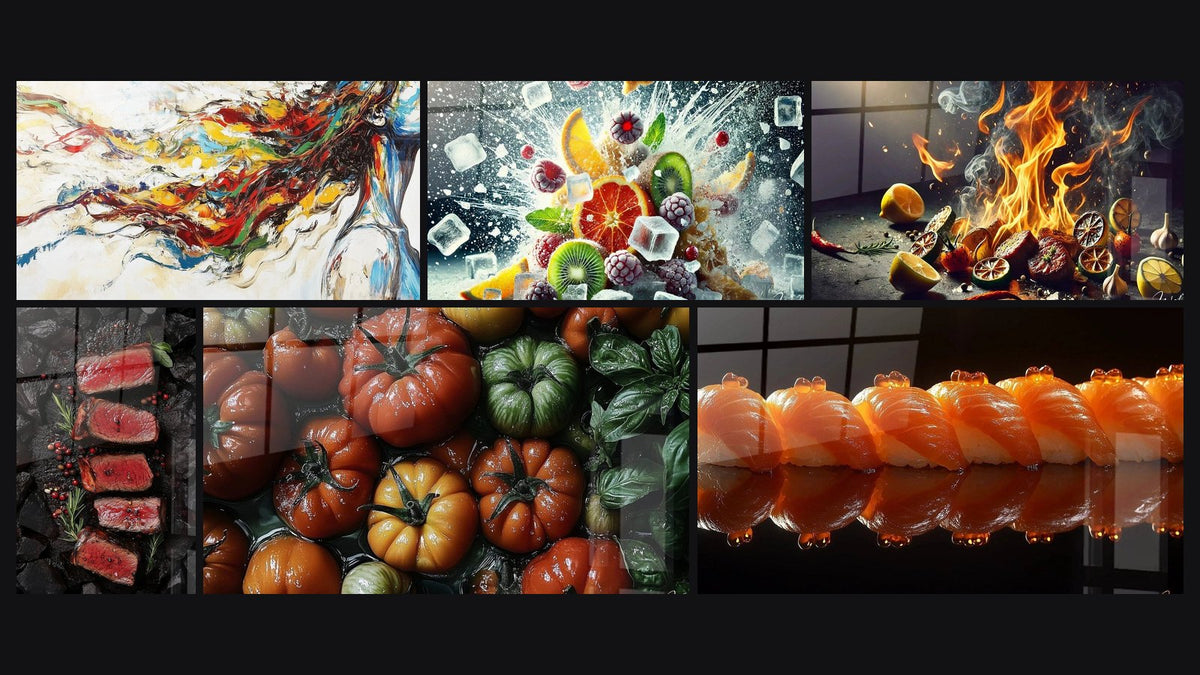
Interior design professionals: what artwork should you recommend to your clients?
11 October 2025 · 15 min read · by Walensky
You've just completed a magnificent project, your client is delighted with their new interior...
but when it comes to choosing wall artworks, it's a drama: "I don't know, you advise me what?"
And there, you feel that little cold sweat. You master volumes, colors, lighting perfectly...
but when it comes to wall art, you often navigate by sight, fearing to suggest something that doesn't match your client's tastes.
That's perfectly normal! Selecting artwork requires a different approach than traditional decoration.
The problem isn't your expertise, but the lack of a clear method to guide your clients towards choices they will love.
By the end of this article, you will have a proven method for advising the perfect artworks for each client, strengthening your expertise and creating truly memorable interiors.
Why do your clients trust you for their walls?
Imagine the disappointment of a client who discovers, six months after the layout,
that their artwork is "already dated" or no longer corresponds to their personal evolution.
It's like choosing a perfume for someone else: without understanding their deep personality,
you risk missing what will truly touch them.
You have this unique opportunity to create interiors that permanently mark your clients.
💡 Testimonial from an experienced interior designer: "I used to offer 'safe' artworks out of caution. One day, a client told me: 'I love my living room, but my walls don't speak to me.' That's when I realized that wall art was the emotional signature of every interior design project."
Conversation with a design expert
The golden rule of professionals: A successful artwork doesn't just decorate a wall, it reveals the personality of the person looking at it. Expect to see your clients smile differently in their spaces within a maximum of 15 days.

Our curated selection
Muse Modern Painting - Contemporary Abstract Art Edition
233,90€
Discover this artwork →Why your artistic recommendations don't always work?
Do you recognize yourself? You suggest a painting that seems perfect to you,
your client hesitates for a long time, eventually buys... and calls you three weeks later
to "see if there might be something else that would fit better".
What's really happening is that we're applying the codes of classic decoration
to a field that operates according to different psychological principles.
It's like using a classical music score to play jazz:
the basics are good, but the approach must be adapted.
The error of perfect harmony
Contrary to what one might think, a painting that blends perfectly
with everything else can create a... perfectly boring ensemble.
The difference between "pretty" and "memorable" often lies in that small creative tension
that always draws the eye back to that area.
It's like the difference between a balanced menu and a menu that has that little something
that makes people still talk about it months later.
As a result: your clients have "correct" interiors but which lack that emotion
that makes you feel truly at home.
🔍 Instant test: Look at the last painting you advised. If you can imagine the exact same in 10 other similar interiors, it probably lacks that part of uniqueness that creates attachment.
The trap of "coherent style"
We are told that an interior must have a uniform style.
But in reality, the most endearing interiors subtly mix influences.
It's like a wardrobe: the most elegant don't wear only Chanel or only vintage.
A contemporary painting in a classic living room can create exactly that refined contrast
that adds character to the whole. Your customers are subconsciously looking for this authenticity
that reflects the complexity of their personality.
The oversight of emotional projection
Here's what few professionals notice: our clients don't choose a painting
for what it represents now, but for what it allows them to become.
This client hesitating in front of a seascape? She secretly dreams
to feel freer, more connected to nature.
It is this aspirational dimension that transforms a decorative purchase
into a true crush that will last for years.
🎯 3 signals that your recommendation will create attachment:
- The customer slows down in front of the artwork: their pace changes, they lean slightly - a sign that something resonates emotionally
- They ask personal questions about the artist: "Where did he live?" reveals that they are looking for a human connection with the artwork
- They imagine the artwork in their daily life: "In the morning, while having my coffee..." means that they are already projecting themselves into a life with this painting
The Trigger: Personal Story
What really makes the difference is when a painting resonates
with your client's personal story. Like a book you reread,
A work that "speaks" to us reveals new nuances over time.
Spot the clues: a significant journey, a hidden passion, a childhood dream...
These elements are your best guides to offer the art that will touch them deeply.
The rule of personal resonance: A perfect painting for your client is one that tells them a story they want to hear every day. Test by asking: "What does this artwork evoke for you?"
| ❌ Classic decor approach | ✅ Artistic advisory approach | 💡 Why this changes everything | 🎯 Benefit for your client |
|---|---|---|---|
| "This color matches perfectly" | "This artwork reveals the personality of the space" | Emotion takes precedence over technique | An interior that truly reflects them |
| "This is trendy this year" | "It's timeless because it touches you" | Attachment resists trends | A lasting emotional investment |
| "It goes with your furniture" | "It tells your story" | Consistency comes from meaning, not aesthetics | A home that nourishes the soul |
| "It's good value for money" | "It's made to last through the years with you" | Value lies in lasting emotional connection | Walls that evolve with him |

The 3 circles method to guide your clients
Rest assured, you're not going to become a psychologist! This approach relies
on your already solid expertise by adding just three strategic questions.
It's like adding a new layer to your palette of skills:
it enriches your practice without disrupting it.
In three steps, you will transform your clients' hesitations into confident crushes.
🎯 Overview of the method: Circle 1 (Explore) reveals the emotional universe, Circle 2 (Contextualize) anchors in the living space, Circle 3 (Concretize) finalizes with confidence. Each step increases the certainty of the choice.
Step 1: Explore the emotional universe
Start by understanding what makes your client tick, it's like knowing
their favorite ingredients before composing a menu.
This step lays the emotional foundations that will guarantee a lasting attachment.
You will immediately feel a deeper connection with your client.
Your exploration tools
- The question of the defining journey: "What is the place where you felt most yourself?" reveals the atmospheres that revitalize him - avoid the classic "what style do you like?" which is too restrictive - look for the emotion behind the words
- Exploring cherished moments: "At what time of day does this piece live best?" reveals the intimate use of space - avoid purely technical questions - focus on personal feelings
- Projecting into 5 years: "How do you see yourself evolving in this space?" anticipates changes in taste - avoid choices too rooted in the present moment - prioritize emotional flexibility
Let's now move on to practical application
How to conduct this exploration
Creating an atmosphere of confidence: Settle comfortably in the room to be decorated, avoid the "salesperson standing" position which creates distance. This physical proximity fosters emotional openness and makes confessions more natural.
⏱️ Time: 10-15 minutes | ✅ Successful when: your client spontaneously talks about personal memories | ⚠️ Attention: Do not chain questions - allow silences for them to develop
Asking the revealing question: "If this wall could tell a story, what story would you like it to tell?" This formulation releases the imagination without technical constraints and reveals deep aspirations.
⏱️ Time: 5 minutes of active listening | ✅ Successful when: you identify 2-3 recurring emotional keywords | ⚠️ Attention: Resist the urge to immediately bounce on the words "style" or "color"
Discreetly noting clues: Note emotions (serenity, escape, dynamism...) more than aesthetic references. These words will become your compass for selection.
⏱️ Time: Continuously | ✅ Successful when: you have identified 3-4 key emotions | ⚠️ Attention: Do not over-interpret - validate your deductions with the client
✅ Validation of the step: You know this step is successful when you can summarize in a sentence the desired emotional atmosphere. If you are still hesitating, ask a synthesis question: "So if I understand correctly, you are primarily looking to feel... ?" If there is any ambiguity, resume the exploration without rushing.
Step 2: Contextualizing in the living space
Now that you know the emotional universe, you are going to anchor it in the physical reality.
This is the moment when the abstract becomes concrete, when dreams take shape on the walls.
This step is often the most rewarding because you see the magic happen:
the space transforms before your eyes into a projection of your client's personality.
Analysis of the existing space
- Natural and artificial lighting: observe how the light travels through the room at different times - a painting with warm tones will be revealed differently depending on the exposure - test with your phone at various times to anticipate variations
- Architectural lines of force: identify the elements that naturally attract the eye (beam, fireplace, large window) - your painting should dialogue with these points of attraction, not compete with them - seek balance rather than domination
- Flows of circulation: observe how your client and their family move around the space - a painting placed on a passageway will be perceived differently than a work contemplated from a reading chair
Testing locations with your client: Use magazines or your tablet to simulate different sizes and positions. This concrete visualization helps to overcome apprehensions and make informed decisions.
⏱️ Time: 15-20 minutes | ✅ Successful when: your client spontaneously says "yes, that works!" | ⚠️ Attention: Do not multiply options - maximum 3 locations to avoid confusion
Step 3: Making it concrete with the right artworks
You are arriving at the moment of truth: transforming all this understanding into artistic selection.
This is where your expertise truly comes into its value, as you will be able to guide
with precision towards artworks that perfectly match the established profile.
Your clients will immediately feel this difference: endless hesitations are a thing of the past!
Effective pre-selection criteria
- The adapted artistic technique: watercolor for softness and fluidity, acrylic for modernity and vibrancy, mixed technique for complexity and originality - each medium conveys a particular emotion that must resonate with the established profile
- Composition and rhythm: soft lines to soothe, marked angles to energize, centered composition to reassure, off-center to surprise - adapt according to the personality and use of the space
- The palette and its psychological impact: earthy tones for grounding, blues for escapism, vibrant colors for energy - but be careful with automatic associations, always test the real emotional reaction
Present maximum 3 pre-selected artworks: Explain for each why it corresponds to the established emotional profile. This personalized argumentation transforms the purchase decision into validation of a thoughtful choice.
⏱️ Time: 20 minutes of presentation | ✅ Successful when: your client expresses a clear preference with emotional arguments | ⚠️ Attention: Do not present "just in case" - each option must be justified by the previous analysis
Final validation rule: Your client must be able to explain their choice in their own words, using the emotional vocabulary discovered together. If they remain in the technical description, delve deeper into the personal connection.
Congratulations, you now master the fundamentals!
Here are a few expert subtleties that will make all the difference
and will give you that edge over your colleagues
who are still navigating by instinct.
💎 Pro tip level: Always propose an artwork slightly "above" the initial budget. Not to sell at a higher price, but because authentic crushes naturally lead to exceeding the set limits. It's a sign that you've hit the mark!
"What if my clients find it too complicated, all these questions?"
"I'm afraid my clients will think I'm wasting their time with all these questions..."
I perfectly understand this concern! In reality, it's exactly the opposite that happens. Your clients are so used to being offered things that "will do" that they are touched that a professional is genuinely interested in what they feel. This particular attention reinforces your positioning as an expert and justifies your rates. Start with one or two clients you trust to test the approach. You will see the difference immediately!
🎯 Concrete action: At your next appointment, just ask one of these exploratory questions and observe how your client relaxes and opens up. You will see that it naturally enriches your exchange.
— Also to discover


Absolutely Essential Pitfalls to Avoid (Even with Good Intentions)
Be Careful, These Mistakes Are Tempting Because They Seem Logical,
but they can compromise all of the advisory work.
The good news? Now that you know them,
you are less likely to fall into them!
- 🚫 Starting by showing your personal favorites: It's natural to want to share what you love, but this unconsciously directs the client towards your tastes rather than theirs - show curiosity for their preferences before revealing yours - your enthusiasm will be more authentic when it is aligned with their expectations
- 🚫 Reassuring by minimizing the investment: "it's not that expensive" or "it can always be changed" gives the impression that you are not taking the decision seriously - instead, emphasize the importance of the choice and the support you offer - a well-considered purchase is always more satisfying
- 🚫 Multiplying options to be sure: Presenting 6-7 paintings "just in case" creates choice anxiety and dilutes your expertise - it is better to confidently assume 2-3 precise selections and explain why the others are not suitable - your client trusts you to filter
- 🚫 Neglecting the reflection time: Pushing for an immediate decision, even with enthusiasm, can create regrets - systematically offer 24-48 hours of reflection with the artwork "in situ" (photo montage) - true loves resist time
- 🚫 Forgetting the evolution of taste: Choosing only for the present moment without considering that tastes evolve - subtly question past style changes to anticipate future ones - prioritize works that offer multiple levels of reading
🛡️ Your quality control points: Your client can explain their choice with emotion (not just "it's pretty"), they concretely imagine the artwork in their daily life, they easily accept the delivery time (a sign that they are not pressured by impulse), you yourself feel enthusiasm for this choice. Warning sign: prolonged hesitations, repeated comparisons with other options, obsessive questions about exchange or refund.
— In the same spirit


Frequently Asked Questions from Decor Professionals
In reality, this approach saves time! Rather than 3-4 rounds of hesitation, you finalize in a maximum of 1-2 appointments. Initial budget: +30 minutes of discussion, but -2h of managing doubts and changes of opinion. My colleagues who apply it report a 60% reduction in "maybe it would be better to have something else" post-installation.
Absolutely! This method naturally justifies a valuation of your advisory services. Clients immediately perceive the difference in service. A Parisian decorator now charges her "artistic consultation" 150€ more and her clients specifically recommend her for this skill. The investment in training pays off after the 3rd project.
Use the "emotional portfolio" technique: show 6 very different atmospheres (zen, urban, nature, vintage, modern, artistic) and simply ask "towards what do you feel drawn?" Without asking for an explanation. Spontaneous reactions are often more revealing than long speeches. Then delve deeper: "what do you like about this atmosphere?"
It's very rare with this method as the choice is deeply considered. But if it happens, it often reveals a positive personal evolution! Offer an "evolution decor" service that updates the selection according to new needs. Some of my clients use this service every 2-3 years, creating a lasting and evolving relationship.
Yes, because it is not based on a decor style but on human psychology. Whether your client loves Scandinavian minimalism or Baroque, they are always looking to express their personality. A contemporary painting can perfectly reveal a classic interior, and vice versa. Harmony comes from emotional consistency, not aesthetics.
Your new status as an art consulting expert
In a few weeks, imagine receiving this message from a client:
"Thank you infinitely, our living room has become our favorite room.
My friends all ask me who advised me on this painting,
it completely transforms the atmosphere!"
You will feel this particular pride of the professional
who hit the mark, who knew how to reveal their clients' personalities
through their recommendations.
This mastery of art consulting goes far beyond simple decoration.
You develop psychological sensitivity, listening skills
and a justness of proposal that will enrich all your projects.
Your clients feel it and recommend you differently:
no longer as "a good decorator" but as "THE person
who really understands what we are looking for".
You now have all the keys.
The hardest part was understanding this different approach.
Start at your next appointment by asking
this simple question: "If this wall could tell a story,
which story would you like it to tell?"
You will be surprised by the richness of the answers!
🚀 Your first step towards expertise: Every great expert started with a different first question. You have everything to become this reference in art consulting that your clients recommend with their eyes closed. Your next opportunity to apply this method awaits you!
Also read: 🎨 Explore our guides on artistic styles
— Other selected pieces


Explore our collections