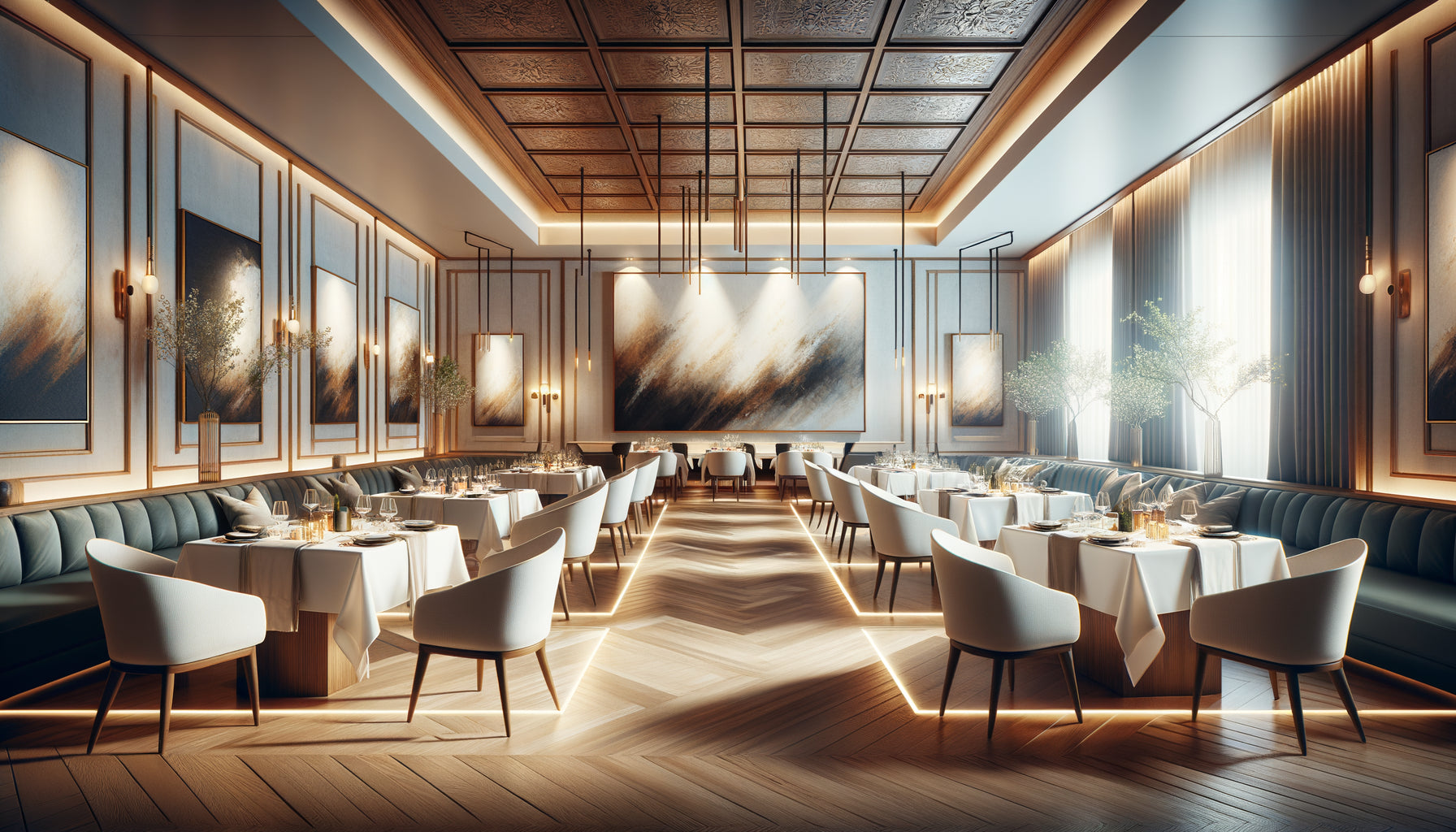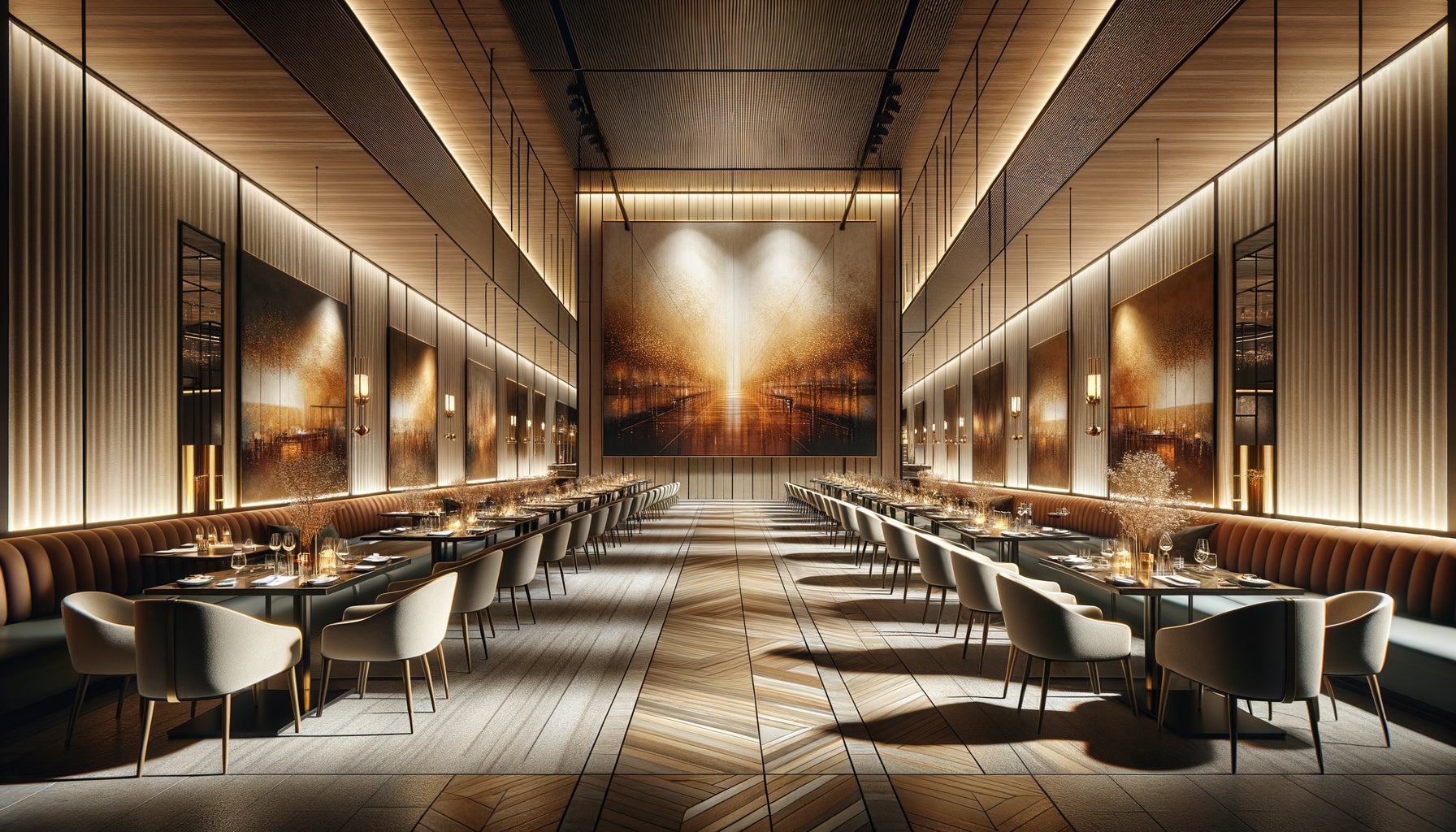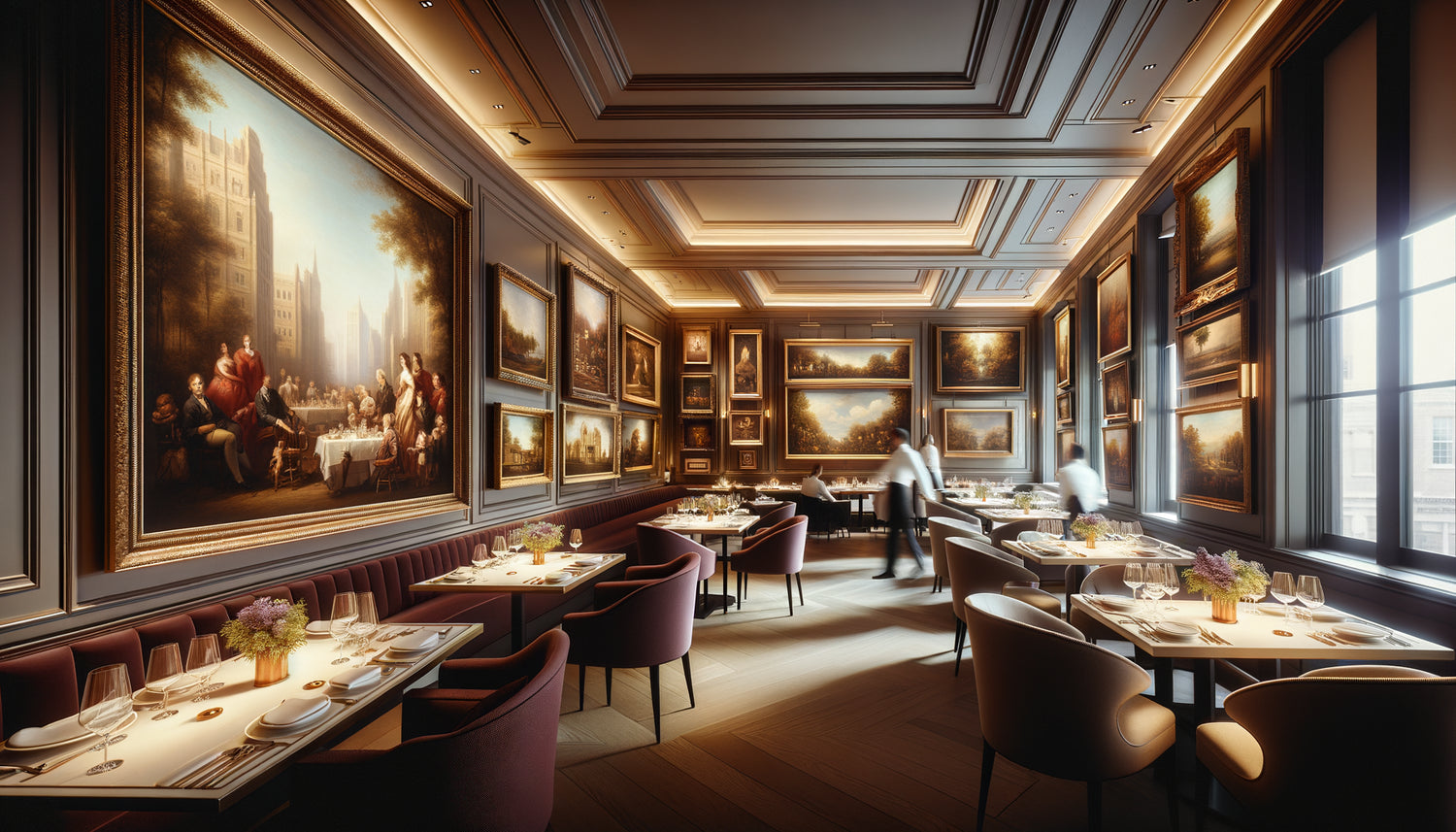
One evening at a vernissage in my restaurant, as the guests admired the new series of artworks I had installed, a server accidentally bumped a frame with his tray. My heart stopped. Fortunately, only the frame was slightly dislodged, but this incident made me realize how vulnerable my paintings were. Between projections in the kitchen, humidity, temperature variations and the constant flow of customers, artwork in a restaurant faces specific risks. Yet, these pieces often constitute the soul of the place, that visual signature which transforms a simple meal into a memorable experience.
Here's what tailored wall art insurance for a restaurant provides: financial protection against accidental damage, coverage specific to the professional risks of catering, and the peace of mind to exhibit authentic artworks without fear, enhancing your establishment.
Many restaurateurs I meet think that their multi-risk professional insurance automatically covers their artwork. They often discover too late, after a disaster, that standard coverage only takes into account basic furniture and equipment. Valuable wall paintings require specific declaration and prior expertise.
Rest assured: properly insuring your wall paintings in your restaurant is neither complex nor prohibitive. With the right information and a methodical approach, you can effectively protect your collection while controlling your budget.
In this article, I share my experience and the concrete strategies that I have developed to secure the artworks exhibited in my establishment, so that you can create an artistic environment without taking reckless financial risks.
Why standard home insurance is not enough for a restaurant
The first mistake I almost made was assuming that my basic professional insurance covered my wall paintings automatically. During my first discussion with my insurer, I discovered a very different reality.
Standard multi-risk professional contracts for restaurants generally provide limited coverage for furniture and decoration, with a ceiling often derisory compared to the actual value of artworks. In my case, the limit was 3,000 euros for all decorative furniture – barely the price of one of my contemporary paintings.
The risks specific to catering are also not taken into account in generic policies. Consider projections of grease, thermal shocks near an open kitchen, constant vibrations from footsteps and doors, or even risks of deterioration by clumsy or intoxicated customers. These everyday situations in a restaurant require adapted coverage.
Furthermore, standard insurances often exclude gradual damage such as fading due to light exposure, accumulated humidity or degradation related to the environment. However, in a catering space where temperature and humidity fluctuate constantly, these risks are very real.
The accurate assessment: the foundation of any wall art insurance
Before even contacting a specialist insurer, I had to have my wall artworks assessed by a certified expert. This step is absolutely fundamental and often underestimated by restorers.
A certificate of authenticity for each work constitutes the basic document. If you buy directly from artists or reputable galleries, systematically request this document which mentions the author, dimensions, technique, year of creation and ideally an inventory number. This information will be essential for your insurance file.
For wall artworks of significant value, invest in a professional appraisal carried out by an auctioneer or an expert approved by the courts. This assessment, renewed every three to five years, establishes the current replacement value of your works. The cost of this appraisal (between 150 and 500 euros per painting depending on complexity) is largely offset by the accuracy of compensation in the event of a claim.
Also photograph each wall artwork from several angles, in detail and in its installation context. These dated visual documents constitute proof of the initial condition of the work and considerably facilitate procedures in the event of damage. I keep these photos both in a secure digital version and in a paper version outside the restaurant.

Specific insurance options for artworks in a commercial space
After gathering all the documentation on my wall artworks, I explored the different insurance formulas adapted to restaurants. Several options are available to you, each with its advantages depending on your situation.
The extension of guarantee of your professional multi-risk contract remains the most economical solution for modest collections. For an annual additional premium (generally 0.5 to 2% of the insured value), you add a specific clause covering your wall artworks. This option is perfect if you own between three and ten works of average value.
For larger collections, a dedicated fine art contract offers optimal protection. These specialized policies, offered by insurers such as Hiscox, AXA Art or Allianz, cover all specific risks: accidental damage, theft, vandalism, water damage, fire, and even depreciation after restoration. Deductibles are generally lower and expertise more equitable.
Some restorers opt for all-risk insurance which also covers wall art temporarily removed for cleaning or loan to an exhibition. This premium formula, more expensive, offers absolute peace of mind if you regularly change your display or lend your works to cultural events.
Essential guarantees to verify
Whatever contract you choose, make sure that certain essential guarantees are explicitly stated in your policy. The replacement value at new price rather than the depreciated value is paramount: in the event of total destruction, you must be able to acquire a comparable work on the current market.
Coverage of ancillary costs also deserves your attention: secure transport, temporary storage, adversarial expertise, restoration by an approved specialist. These costs add up quickly and can double the amount of a claim.
Finally, check the waiting period and specific exclusions. Some contracts exclude damage occurring during private events in the restaurant or during renovation work – situations that are nevertheless frequent in our business.
Preventive measures that reduce insurance premiums
My insurers quickly explained to me that by adopting certain precautions, I could significantly reduce my annual premium while better protecting my wall art. Prevention thus becomes a doubly profitable investment.
Secure installation is the first criterion for risk assessment. Using professional anti-fall hanging systems, safety cables for large pieces, and positioning works away from areas at risk (swinging doors, narrow passages, immediate proximity to the kitchen) can reduce your premium by 15 to 30%.
Security systems are also decisive. An alarm system connected to remote monitoring, smoke and humidity detectors in exhibition areas, and ideally video surveillance covering the most valuable wall art reassure insurers considerably.
Preventive maintenance of your works demonstrates your seriousness. Regular dusting by a professional, annual inspection of frames and fixings, and photographic tracking of the evolution of each painting demonstrate your commitment to preserving your collection.
Finally, staff training on safety procedures around artworks – how to pass near a painting with a tray, wall cleaning instructions, incident procedures – drastically reduces the risk of accidents. Some insurers even offer discounts if you document this awareness.

The claim and compensation process in the event of an incident
Despite all precautions, an incident can occur. Experiencing a minor loss has taught me the importance of knowing exactly what procedure to follow to optimize compensation.
As soon as damage to a wall painting is discovered, photograph the artwork from all angles before even taking it down. Do not attempt any restoration yourself – this could worsen the damage and compromise your compensation. Secure the artwork in a stable location and contact your insurer within 48 hours.
Gather all original documents: certificate of authenticity, purchase invoice, valuation expertise, photographs of previous condition, and write a factual account of the circumstances of the incident. The more complete your file is from the start, the faster and more favorable the processing will be.
The insurer will generally mandate an art expert to assess the damage. You have the right to appoint your own expert for a counter-expertise if you dispute the initial assessment. This approach, although costly, is often worthwhile for high-value wall paintings.
For repairable degradation, insurance will cover restoration by a qualified professional. Insist on choosing a restorer specializing in the technique of your artwork – an antique painting restorer will not necessarily have the skills to restore a contemporary work on mixed media.
Transform your restaurant into a secure art gallery
Discover our exclusive collection of tableaux for Restaurant that combine remarkable aesthetics and design adapted to demanding commercial spaces.
Optimizing the art investment - insurance cost ratio
Over the years, I have developed a strategic approach to maximize the visual impact of my collection while controlling the insurance costs of my wall art. This economic reflection does not diminish the artistic value of the display.
The diversification of the collection is a judicious approach. Rather than investing your entire budget in a few very valuable works, consider mixing masterpieces individually insured with creations by emerging artists or limited editions whose unit value remains within the limits of your standard insurance.
The rotating renewal of your display also helps to optimize costs. Instead of simultaneously exhibiting all your valuable artworks, create a seasonal rotation. Wall art temporarily stored benefit from reduced coverage (known as 'in storage') which is less expensive, while offering regular customers a renewed visual experience.
Some restaurateurs develop partnerships with galleries or local artists. In this consignment system, the works exhibited remain the property of the gallery or artist who assumes the insurance, while you benefit from a constant renewal of your decoration and a commission on any sales.
Finally, consider pooling insurances if you manage multiple establishments or belong to a group of restaurateurs. Floating contracts allow coverage of several locations with advantageous rate conditions, particularly interesting if you occasionally move artworks between your different restaurants.
Beyond insurance: the valuation of your collection
Properly insuring your wall art is only the first step in a global approach to valuing your artistic heritage. This cultural dimension considerably enriches the identity of your restaurant.
Document your collection in an art catalog that you make available to curious customers. A few elegant pages presenting each artist, the genesis of the exhibited works and your collecting approach create an emotional connection with your guests and position your establishment as a cultural place, not just gastronomic.
Organize cultural events around your wall art: vernissage evenings during the renewal of the display, meetings with artists, guided tours before service. These initiatives generate natural communication and attract customers sensitive to the artistic dimension.
This assumed cultural dimension can also justify premium prices and retain demanding customers. Studies show that customers accept prices 12 to 18% higher in establishments where the overall experience integrates a real artistic proposition, beyond simple decoration.
Finally, your properly insured and documented collection constitutes a patrimonial asset that can be valued. In case of sale of your business, a collection of authentic, traceable and protected artworks significantly increases the value of your establishment.
Conclusion: Balancing Artistic Passion and Professional Prudence
Three years after structuring the insurance for my wall art, I measure every day the peace of mind this approach brings me. I can hang works that I deeply love, share my artistic favorites with my clients, without the dull anxiety that used to plague me with every busy service.
Properly insuring your wall art in your restaurant is not an additional administrative constraint, but an investment in your entrepreneurial vision. It allows you to fully affirm the identity of your establishment, create a unique and memorable place, while rationally protecting your heritage.
Start this week by precisely inventorying your current works, gathering their certificates and invoices, and making an appointment with a specialized insurer. This methodical approach will transform your relationship with the artworks that adorn your walls: from sources of worry, they will become real assets for your restaurant, fully assumed and valued.
FAQ: Insuring Wall Art in a Restaurant
What is the average cost to insure a collection of paintings in a restaurant?
The insurance cost for your wall art varies considerably depending on their total value, but generally count between 0.5% and 2% of the insured value per year. For example, for a collection valued at €20,000, your annual premium will range from €100 to €400 depending on the level of guarantees chosen and the security measures you have put in place. This rate is significantly lower than what most restaurateurs fear. Insurers often offer discounted rates for large collections and grant substantial reductions if you install alarm systems or if your works are hung in low-risk areas. Don't hesitate to play the competition by requesting several quotes – differences can reach 40% between insurers for the same collection. Also, keep in mind that this cost is tax deductible as a professional expense, which reduces its actual impact on your cash flow.
Do I need to have all my paintings appraised, even those of low value?
For wall art pieces with a unit value exceeding €2,000 to €3,000, professional expertise is essential to ensure correct compensation in the event of damage. However, for works of lesser value, a simple purchase invoice or a certificate of authenticity provided by the artist or gallery is generally sufficient. I would recommend keeping meticulous records of all purchase documents and photographing each artwork with a reference object for scale and a visible date. This 'in-house' documentation will greatly facilitate any claims if you need to report damage. Some insurers also accept valuations carried out by online platforms specializing in this area (such as Drouot Estimation or France Estimations), which are less expensive than a physical appraisal, for mid-range artworks. The key is to be able to credibly justify the declared value – an insurer suspicious of overvaluation may drastically reduce their compensation or even invoke a false declaration.
Does my insurance cover damage caused by a client?
Yes, this is precisely one of the major advantages of specific wall art insurance in a commercial space. Unlike standard home insurance policies that often exclude damage caused by third parties in a professional setting, policies adapted for restaurants explicitly cover accidents involving your clients: projection of food or drink, accidental impact, and even vandalism in some formulas. However, be aware of exclusion clauses regarding private events with alcohol (weddings, festive seminars) which may require a temporary extension of coverage. In the event of damage caused by a client, you must of course report the incident to your insurer who will cover the repair or replacement, then pursue the responsible party if their identity is established and the damages are significant. You should never demand compensation from the client yourself – it is your insurer who manages this aspect. This protection allows you to maintain a courteous relationship with your customers even in the event of an unfortunate incident, which preserves your reputation and avoids unpleasant conflicts.