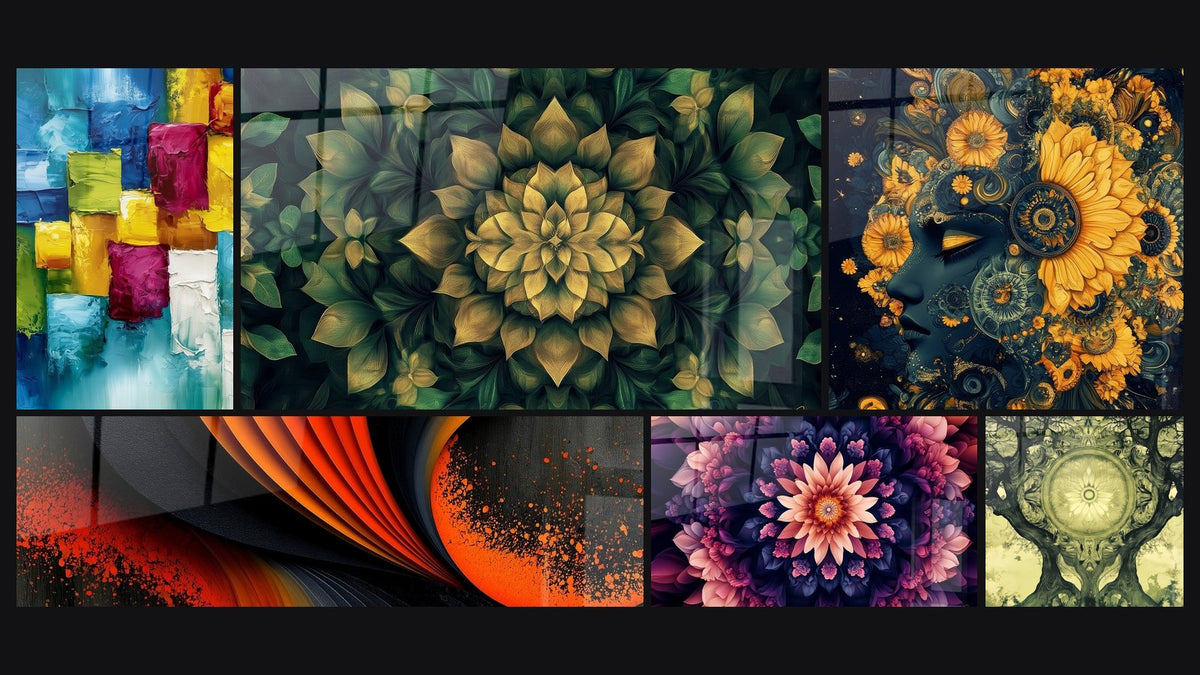
Why do certain geometric compositions feel calming?
October 11, 2025 · 18 min read · by Walensky
You enter your living room after a tiring day, and instead of feeling that longed-for sense of relaxation, something irritates you without you being able to pinpoint it. The space seems cluttered, chaotic, even if everything is perfectly tidy.
Your eyes dart from one element to another without ever finding rest. The colors seem to fight each other, the shapes create a visual cacophony, and your brain stubbornly refuses to find that harmony you are desperately seeking.
You've tried though: buying matching cushions, moving the furniture, changing the lighting... But nothing works. Your interior remains a source of stress rather than comfort, and you start to wonder if you simply don't have "taste" in decor.
Rest assured, it's absolutely not a question of taste! The problem comes from specific visual mechanisms that have never been explained to you. Your brain follows ancestral geometric rules to feel safe and calm.
By the end of this article, you will know exactly why certain shapes instantly soothe you and how to transform your space into a true haven of peace thanks to the secrets of harmonious geometric compositions.
Why does your brain constantly "scan" your environment?
Every second, your brain processes millions of visual information to assess whether your environment is safe. When shapes and proportions follow certain ancestral geometric rules, it can finally relax. Otherwise, it remains constantly on alert, creating that feeling of discomfort you feel without understanding it. It's like trying to fall asleep with an alarm ringing in the distance: even faint, it keeps your nervous system awake. Understand these mechanisms now avoids you years of costly trial and error and gives you the keys to immediate well-being.
🏡 Revealing testimonial: Marie, interior designer, says: "I had a client who spent fortunes on decor without ever being satisfied. By analyzing her photos, I discovered that she systematically hung her paintings too high and chose works with unbalanced proportions. In 30 minutes of geometric adjustment, her living room became her favorite refuge."
Conversation with a decor expert
The golden rule of visual soothing: Your brain seeks familiar patterns and balanced proportions, just like your ear recognizes a harmonious melody. Respect these geometric codes and you will get a feeling of well-being in less than 24 hours.

Our selection
Painting Circles red and black textured - Suspended balance - Edition geometric abstract
233.90€
Discover this artworkWhat's really going on in your head when you face a work of art?
Do you recognize yourself? You go around in circles in decoration stores, attracted by beautiful pieces but unable to know if they will work in your home. You buy a painting that you like in the store, but once hung, it seems dull or disproportionate. Or you feel a strange sensation in front of certain works without understanding why.
It's not your fault! Your brain reacts to unconscious visual codes that the decoration industry deliberately obscures. These perception mechanisms follow precise mathematical laws, not marketing trends.
It's like trying to drive without knowing the rules of the road: you move blindly, hoping not to have an accident. But once you master the rules, driving becomes smooth and safe.
Sacred geometry hides a disturbing truth
Contrary to what you are led to believe, visual harmony is not subjective. It is based on mathematical proportions that artists have used since antiquity: the golden number, the rule of thirds, the Fibonacci sequences. These formulas create a resonance with the natural structures that your brain recognizes instinctively.
It's exactly like music: a sequence of perfect chords moves you, while a false note makes you cringe. Geometric shapes work the same way on your nervous system.
As a result? You stop searching desperately for what's wrong with your decor and begin to understand the real reasons for your crushes. Your confidence in artistic choices develops naturally.
🧪 Instant test: Look at the wall in front of you. If your eyes don't find a natural "anchor point" where to rest comfortably, it's that the geometric balance is broken. You should feel an obvious visual attraction zone.
Your primitive brain sabotages your decor choices
Most people buy according to their current emotions without considering the long-term psychological impact. Your reptilian brain, the one that manages survival, constantly analyzes shapes to detect potential threats.
Too sharp angles evoke dangers, unbalanced shapes signal instability, chaotic proportions maintain a background stress. It's like living with a faulty smoke detector that flashes randomly.
Once you understand these mechanisms, you can deliberately choose compositions that activate the pleasure and serenity zones of your brain. Your space becomes an ally of your well-being rather than a factor of unconscious stress.
The fatal error of "trendy" decorations
Decoration magazines bombard you with polished images, but neglect a crucial detail: these spaces are designed to be photographed, not to be lived in daily. The proportions, lighting, and viewing angles are optimized for the camera, not for your brain.
Identify this difference by observing: are you comfortable in a showroom or do you feel "on display"? If it's the second option, it's that the space prioritizes aesthetics over psychological comfort.
This distinction transforms your approach: instead of copying trends, you create an environment that truly nourishes your daily well-being and that of your family.
🔍 3 signals your brain is sending you:
- Difficulty concentrating at home: Your space lacks visual resting points. It's like trying to think in a room where all the furniture is slightly moving
- Unexplained fatigue in certain rooms: Uneven proportions force your brain to constantly compensate. You draw on your reserves of energy without realizing it
- Feeling of discomfort facing certain walls: The absence of a clear geometric structure creates a background anxiety. It's your alert system that refuses to switch off
The trigger factor that no one sees
Lighting reveals or destroys the geometric harmony of your works. A perfect composition can seem chaotic under bad lighting, while an average piece can radiate under the right light. It's the magnifying effect that amplifies the qualities or defects of your decorative choices. Identify this factor by observing how your paintings change appearance according to the hours of the day and light sources.
Universal rule of visual well-being: Your eye must be able to trace a fluid and predictable path in your space. Test it now : does your gaze naturally find a harmonious path from one element to another?
| ❌ Stressful preconceived idea | ✅ Soothing reality | 💡 Brain mechanism | 🎯 Immediate benefit |
|---|---|---|---|
| Everything must be perfectly matched | Controlled contrasts create relief | Your brain likes controlled variety | Rediscovered creative freedom |
| Geometric rules are rigid | They offer a reassuring framework | Structure = safety for the unconscious | Confidence in your choices |
| Art must impress visitors | It must first revitalize you | Personal well-being = natural radiance | Authentically you space |
| Only experts understand art | Your brain knows how to recognize harmony | Innate geometric intuition in everyone | Legitimacy of your tastes |
— Also to discover


How to create the perfect geometric harmony in 3 steps
You are about to understand why some spaces soothe you while others exhaust you. The good news? Creating this harmony is simpler than you imagine. Imagine your approach as preparing a gourmet dish: first choose the right ingredients, then master the basic techniques, and finally refine the seasoning. In 3 weeks, your space will exude that natural serenity you have been seeking for so long.
🎯 Overview of your transformation: Step 1 - Decode the architecture of your space to identify natural anchor points. Step 2 - Select and position your artworks according to the rules of geometric art. Step 3 - Refine the overall balance to create an optimal visual flow. Final result: a space that instantly recharges you and naturally impresses your guests.
Step 1: Decipher the geometric DNA of your space
This first step is crucial because it lays the foundations of your entire approach. It's like studying the terrain before building a house: ignoring this phase risks everything collapsing. Once you master the visual "geography" of your walls, you immediately feel a new clarity on your decorative choices.
Your diagnostic tools
- Tape measure: Opt for a model of at least 5 meters with automatic locking. It will allow you to accurately measure the proportions of your walls and spaces. Avoid fabric tapes which deform and distort your basic calculations.
- Bubble level app: Download a reliable app on your smartphone to check the horizontal and vertical. Traditional physical models are more precise, but the app allows for quick checks. Impact: perfectly straight lines instantly soothe the brain.
- Pencil and graph paper: To sketch your walls and note measurements. The grid helps to respect proportions naturally. Why not plain paper? Without visual cues, you risk unconsciously distorting the actual proportions.
Now, let's move to concrete action
Map your space like a pro
Identify natural lines of force: Observe where your eye naturally settles when entering the room. These areas correspond to the intersection points of imaginary lines that divide your walls into thirds. Why this technique? Your brain instinctively seeks these balanced proportions. It's easier than you think : most people identify these areas in 30 seconds.
⏱️ Time: 15 minutes per room | ✅ Success when: You can point to 2-3 areas where your gaze naturally stops | ⚠️ Attention: Do not confuse "line of force" and "center of the wall" - the geometric center is not always the most visually harmonious place
Measure golden proportions: Divide the height and width of your main walls by 1.618 (the golden number). These points correspond to the most soothing locations for your artworks. Lightly trace these markers with pencil - they will become your placement guides. This method eliminates guesswork and hesitation.
⏱️ Time: 10 minutes per wall | ✅ Successful when: You have 4 precise points marked on each main wall | ⚠️ Attention: Always measure from the floor, not from the ceiling - ceiling heights vary and skew calculations
Evaluate lighting according to the hours: Photograph your walls at 4 key moments (morning, noon, late afternoon, evening). The goal: to identify how natural and artificial light changes the perception of shapes and colors. These photos become your reference for future choices.
⏱️ Time: 5 minutes x 4 moments | ✅ Successful when: You clearly see the zones that remain harmonious at all times | ⚠️ Attention: Don't just photograph bare walls - include your existing furniture to see the real lighting interactions
✅ Validation of step 1: Your space now reveals its hidden geometric structure. You should feel a new clarity about the "good" and "bad" locations. If you are still hesitating, it's normal - continue, practice confirms theory. Next step: transform this knowledge into concrete choices.
Step 2: Select and position according to geometric codes
You now possess the cartography of your space. This step transforms your knowledge into concrete aesthetic choices. The difference is striking: instead of groping, you select and place your works with the precision of an architect. The snowball effect begins here - each good choice facilitates the next.
Geometric selection criteria
- Harmonic proportions: Look for works whose dimensions respect ratios of 1:1.618, 2:3, or 3:5. These ratios create a natural resonance with your perception. Where to find them? Always check the exact dimensions before purchasing - many "standard" works already respect these proportions without mentioning it.
- Balanced internal composition: The work itself should present a visual balance between full and empty areas, warm and cool colors. Quick test: does your eye easily find a point of rest in the image? Crucial impact: an unbalanced composition keeps your brain in permanent tension.
- Chromatic coherence: The dominant colors should create a harmonious dialogue with your existing space. Expert rule: maximum 3 main colors + their nuances to maintain visual serenity.
Position with the precision of an expert
Apply the vertical rule of thirds: The center of your main work is positioned at 1/3 or 2/3 of the total height of the wall, never exactly in the center. Why this "peculiarity"? The geometric center creates a static symmetry that your brain finds boring. Controlled offsetting generates a soothing dynamism.
⏱️ Time: 5 minutes per work | ✅ Successful when: The work seems "naturally placed" at first glance | ⚠️ Attention: Measure from the floor, not from your eye level - the latter varies depending on the position and distorts your perception
Create visual breaths: Leave a minimum space equal to 1/5th of the width of the work between each element. This space is not "lost void" - it allows your brain to process each visual information separately. Result: feeling of order and mastery instead of confusion.
⏱️ Time: 10 minutes to plan the whole | ✅ Successful when: Each work "breathes" without being isolated | ⚠️ Attention: Too much space isolates the works - they lose their harmonious dialogue
Step 3: Refine the overall balance for a professional result
You are now entering the advanced mastery level. This step transforms a "correct" decor into a truly restorative space. The difference between an amateur and a connoisseur lies in these subtleties that your guests will notice without being able to explain it. Your space then exudes that "high-end" quality that is difficult to imitate.
Expert-level refinement
Create an optimal visual flow: Mentally trace the path your gaze takes from one work to another. This path should be fluid, without "breaks" or areas of confusion. Expert technique: slightly adjust the angles and heights to naturally guide the eye in a harmonious movement. This is the signature of a truly accomplished space.
⏱️ Time: 20 minutes of active observation | ✅ Successful when: Your gaze circulates naturally without conscious effort | ⚠️ Attention: Do not over-adjust - natural harmony is more powerful than forced perfection
Balance visual masses: Distribute the "visual weight" of your works according to the principle of asymmetrical balance. A large, clear work can balance two small, dark works. Your goal: create a stability that reassures the unconscious without creating boredom through too much symmetry.
⏱️ Time: 15 minutes per wall | ✅ Successful when: The whole seems stable even with your eyes half-closed | ⚠️ Attention: Perfect balance can seem artificial - keep a slight dynamic tension
Rule of progression towards mastery: You are ready for the next step when you feel an immediate satisfaction when entering your space, and when your guests spontaneously comment on the soothing atmosphere without precisely identifying why. Patience in each step guarantees a lasting result.
You now master the fundamentals of geometric harmony. True experts go further by adjusting invisible subtleties that transform a beautiful space into a complete sensory experience. These advanced techniques give you that distinct advantage that your guests notice without being able to explain it.
🔥 Professional secret: Use the "minimum contrast rule" - create variations of a maximum of 10 to 15% between the elements of the same composition. This subtlety prevents monotony while preserving harmony. Concrete example: If your main work is 80cm wide, the satellite works should measure between 68 and 72cm to create this perfect variation.
"But what if I make mistakes in my calculations?"
"I'm afraid of mismeasuring and messing everything up... Mathematics and I, that's two!"
I perfectly understand this concern! The beauty of these geometric rules is that they tolerate a margin of error of 10 to 15%. Your eye will not perceive a difference of 2-3 centimeters, but it will immediately capture the general improvement in harmony. Think of it like cooking: a pinch of salt more or less does not ruin the dish, but the total absence of salt makes it bland. Start with confidence - the result will necessarily be better than your current situation.
💡Reassuring tip: Before permanently drilling, use masking tape to test your locations for 2-3 days. You will quickly see if the effect suits you and you can adjust without stress.
— In the same spirit


Our eye-catching selection
Floral mandala painting - Fractal floral symphony - fractal edition
233.90€
Discover this painting →The 5 mistakes that sabotage your efforts (and how to avoid them)
Now that you know the method, let's protect your investment in energy and money. These mistakes are so common that even beginner decorators make them. They are normal but totally avoidable when you know how to recognize them.
- 🚫 Filling every wall: The idea that "the more there is, the better" creates an exhausting visual chaos. Your brain needs resting areas to appreciate the important works. Solution: prioritize 2-3 strong works rather than 10 average items. A well-proportioned "empty" wall can be more elegant than an overloaded one.
- 🚫 Ignoring lighting when choosing: Selecting works under the artificial lighting of the store and then discovering them differently at home. Frustrating consequence: dull colors or proportions that seem false. Solution: always ask to see the work under different lighting or take a photo with your smartphone to simulate your home lighting.
- 🚫 Copying a style without adapting to proportions: Reproducing a magazine ambiance without taking into account your actual dimensions. Disappointing result: the expected effect does not work and you feel "failed". Winning approach: get inspired by the principles but always adapt to the measurements and constraints of your specific space.
- 🚫 Placing everything at eye level: The classic mistake that creates a horizontal monotony. Your space seems flat and predictable. Pro technique: vary the heights according to the function - contemplative works slightly higher, dynamic works at eye level.
- 🚫 Choosing according to the mood of the moment: Buying under the influence of a fleeting emotion without considering the long-term impact on your daily well-being. Frequent trap: the work tires you after a few weeks. Sustainable method: test your reaction on several visits and imagine living with this work for 5 years.
🔍 Quick verification system: Before finalizing your choices, check these 4 points: (1) Does the work respect a harmonic proportion? (2) Does your eye find a natural rest when looking at it? (3) Does it integrate into your overall visual flow? (4) Does it still inspire you after 10 minutes of observation? Alarm signals: rapid visual fatigue, sensation of "obligation" to look, persistent hesitation about the location.
— Other selected pieces


Your most frequent questions about geometric harmony
The good news: 0€ if you reorganize your existing works according to these principles! For new items, count 150-300€ to transform a main room with 2-3 quality works. Budget optimization: start with a strong work with good proportions, then gradually complement it. Concrete example: Sarah transformed her living room with a single 200€ painting well positioned - the effect was immediate and her guests noticed the change.
The soothing is immediate as soon as you reposition your existing elements correctly! For a complete transformation with new works: 2-3 weeks to fully feel the psychological benefits. Why this delay? Your brain needs a few days to "record" the new balance and stop analyzing the environment. It's like getting used to a new pair of glasses perfectly adjusted.
Excellent question! These rules are well-being tools, not artistic constraints. They help you express your tastes more effectively. Think of it as grammar: it doesn't prevent your writing style, it makes it more readable and impactful. You can love contemporary, classic, or eccentric art - harmonious proportions will amplify your aesthetic pleasure rather than restrict it.
Absolutely! Use drilling-free mounting systems (reinforced adhesive hooks, tension rails, roller supports...). Unexpected advantage: you can test different configurations more easily. Pro tip: works placed on consoles or floating shelves follow the same proportion rules and create an equally sophisticated effect.
Even better than in large ones! Small spaces immediately reveal proportion errors, but double the reward for good choices. Special rule for small spaces: one quality work with perfect proportions is better than three average items. The visual enlargement effect is spectacular when done right. Example: a 25m² studio can feel more spacious than a 40m² poorly balanced living room.
Your transformation into a visual harmony expert
In a few weeks, you will enter your home with that immediate feeling of well-being you've been searching for so long. Your daily stress will naturally dissipate as you interact with your harmonious environment. Your friends will spontaneously ask who decorated your interior, impressed by this "professional" atmosphere they can't quite define.
This mastery of geometric codes extends far beyond decoration. You develop an expert eye that serves you in all your aesthetic choices: clothing, restaurant choices, evaluation of vacation spots... Your natural confidence in terms of taste and harmony radiates in all aspects of your life.
The hardest part was understanding these invisible mechanisms that affect your well-being. Now that you master them, each adjustment becomes obvious. Your first move? Observe your main wall with this new expert eye. You will never see it the same way again - and that's exactly the beginning of your transformation.
🚀 Your new power: You now possess the keys to lasting and visible well-being. Each glance at your space will confirm that you have made the right choices. It's your personal signature finally expressing itself with the power of geometric harmony!
Explore our collections