I spent three months in New Zealand exploring the galleries of Auckland and the workshops of Rotorua, fascinated by these works where the earth seems to breathe. Maori artists don't just paint volcanoes: they give form to atua (deities) that inhabit those mountains of fire. Each lava flow tells the story of Ruaumoko, god of earthquakes, while craters become the wounds of forbidden loves.
Here’s what integrating volcanic legends brings to Maori landscape representations: a narrative depth that transforms each mountain into a living character, a color palette dictated by the emotions of the gods, and a spiritual dimension that makes art a bridge between the visible and the invisible.
You may admire Maori art for its powerful aesthetics, but you feel that part of the message escapes you. These spirals, these incandescent reds, these organic forms seem to carry a meaning that you cannot fully grasp.
That's normal. Maori art is a coded language where each visual element corresponds to an ancestral narrative. Without knowing the volcanic legends underlying these works, one misses their true essence.
I am going to reveal how these artists weave mythology and landscape to create works that don’t just show nature, but tell its soul.
When volcanoes bear the names of lovers: mythology as a foundation
The first time I heard the story of Rangitoto, I understood why this volcano appears so often in contemporary Maori art. It's not just a volcanic island in the Hauraki Gulf: it’s the frozen blood of a battle between rival tribes, emerging only 600 years ago.
Maori artists integrate these narratives directly into their landscape compositions. Take the works of Robyn Kahukiwa: her representations of Mount Taranaki never show a simple volcanic cone. You see a banished lover, condemned to eternally look towards the Tongariro Mountains from where he was driven after courting another volcano's wife.
This narrative approach radically transforms representation. Where a Western landscape artist would compose with lines, masses and colors, the Maori artist composes with geological emotions. The slope of the volcano becomes body posture. The clouds surrounding it are its tears or anger.
Anthropomorphic volcanoes in traditional art
In wood carvings and tapa (beaten bark cloth), volcanoes take on stylized human forms. I saw at the Te Papa museum in Wellington an 18th-century carved panel where Mount Ngauruhoe was depicted as an ancestor sitting, his legs forming the flanks of the mountain, the summit being his head crowned with smoke.
This tradition continues in contemporary art. Shane Cotton, an internationally renowned Maori artist, paints volcanic landscapes where geological strata become tattoos, where stone bears the same motifs as human skin. His volcanoes have eyes – sometimes explicit, sometimes suggested by the arrangement of rocks.
The red of fire, the black of creation: a palette dictated by cosmology
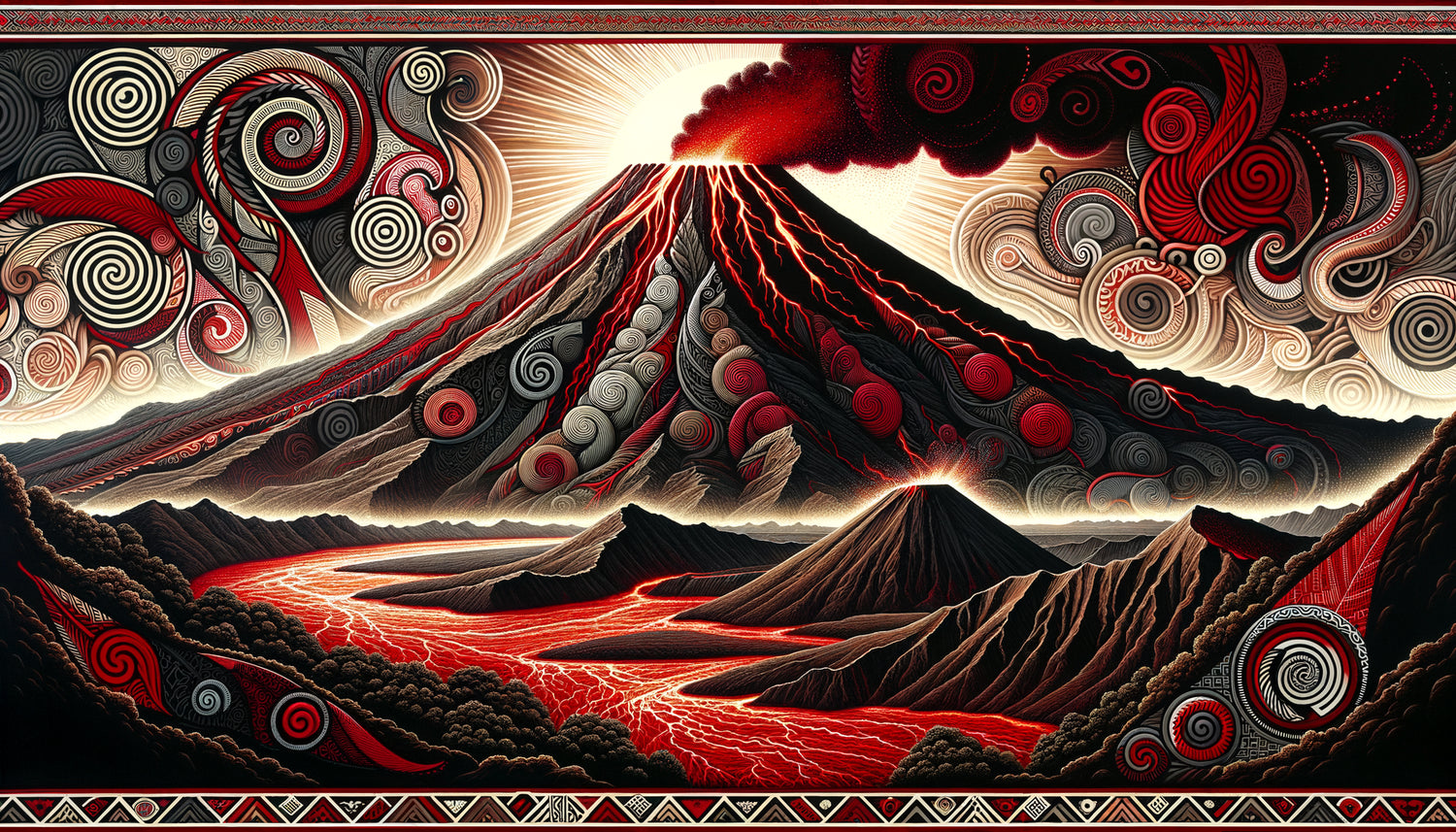
If you look closely at Maori landscape representations, you will notice a striking chromatic recurrence: deep red (kura), intense black (mangu), pure white (ma). This is not an arbitrary aesthetic choice.
In Maori cosmology, these colors tell the story of creation. Black represents Te Kore, the primordial void from which everything emerges. Red is the blood of Papa-tū-ā-nuku (Earth Mother) when her children tore her apart to separate earth and sky. White symbolizes the light that entered the world during this separation.
When a Maori artist paints an erupting volcano, he is not just capturing a geological phenomenon. He is visually recreating the act of creation. I spoke with Lisa Reihana, multimedia artist, who explained to me: 'Each eruption re-enacts the birth of the world. Our ancestors knew it. Our works show it.'
Volcanic pigments: matter and symbol fused
The integration goes even further. Traditionally, Maori artists used pigments from the volcanoes themselves: red ochre from iron-rich volcanic soils, volcanic charcoal for tattoos and paintings. The substance of the work literally contained the substance of the legends.
This practice continues. Several contemporary artists I met still collect volcanic earth from sacred sites (with appropriate permissions) to create their paintings. The landscape is not represented: it is incorporated into the work.

The spirals of Ruaumoko: recurring symbols in volcanic art
If you see a spiral in Maori art, you probably think of koru, these motifs inspired by the silver fern unfurling. But in representations of volcanic landscapes, spirals have an additional meaning: they evoke the movements of Ruaumoko, the unborn god who lives in the belly of the Earth Mother and causes earthquakes and eruptions with his gestures.
The works of Paratene Matchitt, a major sculptor, perfectly illustrate this duality. His monumental installations combine carved wood and metal, with spirals that evoke both plant growth and telluric forces. In his work 'Te Wehenga' (The Separation), volcanoes are represented by spiral columns that seem to both rise from the ground and sink into it.
Perpetual movement in frozen stone
This paradox – representing movement in what seems immobile – is at the heart of the Maori approach to volcanic landscape. A dormant volcano is never truly inert: it breathes, dreams, waits. Maori artists translate this latent life with dynamic lines, asymmetrical compositions that suggest a precarious balance.
I was particularly struck by a series of etchings by Sandy Adsett showing the volcano Ruapehu from different angles. No view is static: force lines always suggest an imminent movement, as if the mountain were about to rise and walk.
Between sky and earth: the vertical composition of legends
The Maori volcanic legends do not only explain eruptions: they structure the cosmic space into three levels. Ranginui (Sky Father) at the top, Papa-tū-ā-nuku (Earth Mother) at the bottom, and volcanoes as points of connection, places where the inner fire of the Earth meets the celestial realm.
This vertical cosmology directly influences the composition of works. Traditional and contemporary landscape representations often present a structuring in superimposed horizontal bands, each corresponding to a cosmic level. The volcanic summit is never simply a culminating point: it is a portal, a place of passage between worlds.
Cliff Whiting, artist and historian, has created monumental murals where volcanoes function as ladders linking the different domains of the Maori universe. Lava flows do not only descend: they weave links between spiritual realms.

Maori contemporary art: reinventing legends without betraying them
How do young contemporary Maori artists integrate these ancestral legends while developing a modern visual language? That was the question I asked myself when visiting the 'Volcano' exhibition at the Sarjeant Gallery in Whanganui.
The answer lies in what Maori call tikanga: the fundamental principles remain, but forms evolve. Michael Parekowhai creates installations where lacquered pianos reflect video projections of changing volcanic landscapes. The technology is contemporary, but the concept remains that of perpetual transformation, fire reshaping the earth.
Nathan Pohio uses photography to capture volcanic landscapes in a way that initially seems documentary, then you notice subtle interventions: digital elements evoking the atua, overexposures that make stone look like flesh.
Volcanic street art: legends invest urban space
In Auckland, I discovered spectacular murals where volcanic legends are reinterpreted in the aesthetics of contemporary graffiti. Artists like Flox combine traditional Maori motifs with stencil and aerosol techniques to create stylized volcanoes that seem to pulsate on city walls.
These urban works make ancestral stories accessible to an audience that might never enter a gallery. They also recall that Auckland itself is built on a volcanic field of 50 cones: the legend is not far away, it is under the feet of the city dwellers.
Do you feel this primal force emanating from volcanic landscapes?
Discover our exclusive collection of nature paintings that captures the telluric and spiritual power of legendary landscapes to transform your interior into a space for contemplation.
Integrating the Maori volcanic spirit into your space
You don't need to travel to New Zealand to feel this deep connection between legend and landscape. By choosing works inspired by the Maori approach, you invite into your home this worldview where nature is not decor but a living narrative.
Look for landscape representations that prioritize dramatic verticality, palettes of deep reds and intense blacks, asymmetrical compositions that suggest movement. Even without being Maori, a work can capture this spirit if it treats the landscape as a living being rather than an inert subject.
In a contemporary living room, a large canvas evoking a stylized volcano brings this presence both soothing and electrifying. It's like installing a silent guardian who recalls primordial forces – exactly what Maori artists seek to evoke.
The volcanic legends radically transform the way Maori artists represent landscapes. They don’t paint what they see, but what they know: that each mountain is an ancestor, that each eruption tells a story of love or betrayal, that the earth beneath our feet breathes and dreams. This approach invites us to look at all landscapes differently – not as decorations, but as characters in their own right in the history of the world.