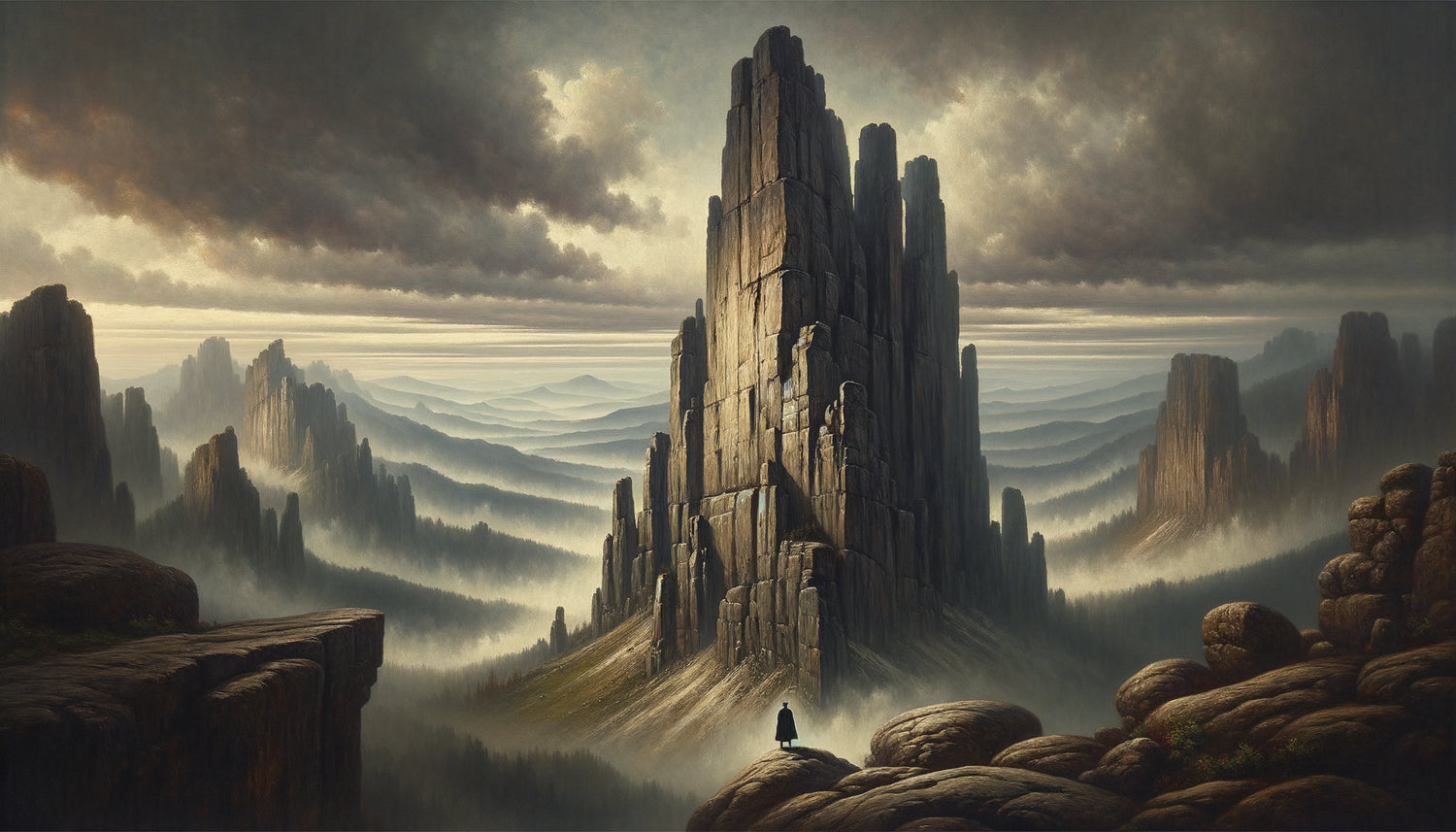
I spent three hours this morning in front of The Traveler Contemplating a Sea of Clouds, this iconic work where a solitary figure stands facing the misty immensity. But what fascinates me infinitely more than this romantic figure is the rocky outcrops on which he stands. These geological masses that pierce the veil of mist are not simply landscape elements. With Caspar David Friedrich, each rocky formation becomes a metaphysical revelation, a fragment of eternal truth emerging from terrestrial chaos.
Here's what Friedrich's depiction of rocky outcrops brings to our contemporary interiors: a spiritual depth that transforms the space into a contemplative sanctuary, a vertical dimension that elevates the gaze and soul, and a soothing mineral presence that anchors our frenetic daily life. You may feel that 19th-century German romantic art has no place in a modern decor, that these dark and meditative landscapes would weigh down your living room. Yet, the most discerning collectors are discovering today how these representations of raw stone dialogue beautifully with contemporary minimalist aesthetics. I will reveal to you how Friedrich transforms geology into visual theology, and why this artistic alchemy resonates with a new intensity in our current living spaces.
The sacred verticality: when rock becomes cathedral
In Friedrich's work, rocky outcrops never extend horizontally like simple geological strata. They burst forth, they rise, they pierce. Observe The Chalk Cliffs of Rügen: these white chalk formations that frame the precipice are not represented in their flat geological reality, but as monumental pillars, natural arches that transform the landscape into divine architecture.
This calculated verticality of rocky outcrops in Friedrich responds to a specific intention: to direct the gaze towards the transcendent. The German painter applies to the rock formations the same compositional principles as medieval Gothic architecture. Each edge, each crack, each projection guides the eye to the sky, creating what I call a mineral aspiration. Stone becomes prayer.
Human scale abolished
Friedrich consistently positions his human figures at the intersection of rocky outcrops and infinity. In Morning in the Riesengebirge, the female figure stands precisely where solid rock meets ethereal mist. This staging creates an existential threshold effect: the rocky outcrop becomes the last bastion of the material world before plunging into the immaterial. The metaphysical dimension emerges from this contrast between geological permanence and atmospheric ephemerality.
Texture as a Revelation of Deep Time
What fascinates me about Friedrich's treatment of rocky outcrops is the obsessive attention paid to mineral surfaces. Friedrich never paints stone as a uniform mass. Each striation, each erosion, each crystallization is rendered with almost geological precision. This meticulousness is not documentary; it is philosophical.
The rocky outcrops in Friedrich's work bear the mark of deep time, that geological temporality which crushes human existence. By representing the eroded texture of the rock with such fidelity, the painter materializes eternity. The rough surface of the outcrop becomes a writing of time, a mineral text that only silent contemplation can decipher. This infinite temporal dimension confers on rock formations their metaphysical charge: they were there before man, they will survive after.
Mineral Chiaroscuro
Friedrich applies to rocky outcrops a technique of dramatic chiaroscuro inherited from Caravaggio, but diverted from its narrative function. Observe how, in Rocks on the Coast of the Baltic, the grazing light sculpts the rock formations by revealing every crevice. These games of light and shadow on the stone do not serve to model a realistic volume: they create a spiritual hierarchy within the mineral matter itself. The illuminated parts of the rocky outcrops seem to touch divine grace, while the shaded areas retain their primordial mystery.

Rocky Isolation as a Mystical Experience
Friedrich consistently chooses isolated rock outcrops: a solitary rock emerging from a sea of mist, a rocky peak detached from the surrounding mountains, a limestone formation encircled by the ocean. This geology of solitude is not accidental. The isolated rock outcrop becomes in his painting a visual equivalent of the mystical experience: separation from the profane world, elevation to the sacred, solitary confrontation with the absolute.
In Monk by the Sea, although the human figure is minuscule, it is the presence of invisible rock outcrops beneath the monk's feet that gives power to the composition. The viewer intuitively understands that this silhouette does not float: it stands on a fragment of solid ground, an outcrop that resists maritime engulfment. This mineral resistance becomes a metaphor for faith that resists doubt.
Mineral Chromaticism: From Cosmic Grey to Transcendent White
The chromatic palette that Friedrich reserves for rock outcrops constitutes in itself a metaphysical language. His rocks are never banally brown or grey. They oscillate between almost lunar silvery greys and luminescent calcareous whites that seem to radiate from within. This purified chromaticism removes the material terrestrial nature of the rock outcrops to elevate them to an abstract, almost platonic dimension.
In his representations of the Rügen chalk cliffs, Friedrich pushes this logic to its paroxysm: the dazzling whiteness of the calcareous rock outcrops rivals that of the clouds, creating a deliberate confusion between mineral and celestial. The rock becomes cloud, the densest matter lightens until it borders on the immaterial. This chromatic alchemy transforms the rock outcrop into a bridge between earth and sky, between presence and absence, between being and nothingness.
Atmospheric Variations
Friedrich paints the same rock outcrops under different atmospheric conditions, thus creating a series of metaphysical variations. The outcrop in the morning mist does not offer the same spiritual revelation as the outcrop under the harsh light of midday or in the twilight gloom. This multiplicity of visual states suggests that the metaphysical truth of the stone is never fixed: it unfolds gradually, according to the state of consciousness of the contemplator and the quality of the light that reveals it.

The symbolic framing: rocky outcrops and sacred composition
One of Friedrich's most subtle techniques is to use rocky outcrops as a framing device. In several of his works, rock formations in the foreground create a natural window through which the viewer glimpses infinity. This technique of repoussoir rocheux transforms the painting into an initiatory experience: to access the sublime, the gaze must first pass through raw matter.
The Rügen chalk cliffs masterfully illustrate this principle: the two white rock masses that frame the composition function as the uprights of a portal. The viewer does not simply contemplate a seascape; they symbolically cross a mineral threshold to access a vision that surpasses them. The rocky outcrop is no longer an obstacle but a necessary passage, a material ordeal necessary for any spiritual elevation.
Integrating the Friedrichian vision into contemporary space
Today, Friedrich's representation of rocky outcrops finds an unexpected resonance in our streamlined interiors. These images of raw and contemplative stone bring exactly what is often lacking in contemporary spaces: a temporal depth, an invitation to silence, a presence that does not shout but persists.
I observe a fascinating phenomenon among my most sensitive clients: faced with a reproduction of Friedrich's rocky outcrops, the rhythm of the room changes. The space slows down. The mineral verticality of these painted formations creates a meditative anchor point that structures the entire environment. In a minimalist living room in neutral tones, a large format representing the rocks of the Baltic Sea establishes a spiritual gravity without decorative heaviness.
Transform your interior into a contemplative sanctuary
Discover our exclusive collection of nature paintings
The metaphysical legacy: why these rocks still speak to us
Why do the rock outcrops painted by Friedrich two centuries ago retain such emotional power? Because they embody a universal and timeless quest: to find in raw matter a reflection of the absolute, to discover in geological permanence solace from our own finitude.
At a time when our lives accelerate and dematerialize, these representations of eternal and silent stone offer a saving counterpoint. Friedrich's rock outcrops are not simply elements of romantic landscape: they are existential propositions, invitations to stand with us on these promontories of meaning, facing the infinity of our own questions.
Imagine yourself tomorrow morning, coffee in hand, facing this large print of the Rügen cliffs in your living room. The morning light touches the white rock formations. You no longer see simply a landscape: you feel that magnificent tension between mineral solidity and the call of the void, between your embodied presence and your aspiration to something beyond you. This is exactly the metaphysical revelation that Friedrich knew how to capture in his rock outcrops: not the representation of a place, but the embodiment of a state of consciousness. Start today by observing differently the images of landscapes around you. Look for those that carry this quality of mineral presence, this silent gravity. Your space will be transformed.
Frequently Asked Questions
Why do Friedrich's landscapes seem so different from other Romantic painters?
Friedrich radically transforms the function of landscape in painting. Where his contemporaries represent nature as a picturesque backdrop or spectacular sublime, Friedrich makes it a metaphysical language. His rock outcrops are not there for their geological beauty, but as visual metaphors of spiritual experience. Every natural element – and particularly rock formations – functions as a symbol in a coherent system of representation of the relationship between human, cosmos and divine. This conceptual, almost philosophical approach explains why his works retain an emotional power that simple romantic landscapes do not have. With Friedrich, contemplating a rock outcrop is meditating on one's own existence.
How to integrate a work inspired by Friedrich into a modern interior without creating too strong a contrast?
The key lies in understanding what makes Friedrich surprisingly contemporary: his streamlined compositional style and restrained palette. The rocky outcrops he paints often appear within minimalist compositions, with vast areas of mist or sky creating visual breathing spaces. For a harmonious integration, prioritize large-format reproductions in clean spaces with neutral tones. The grays, whites, and deep blues of Friedrich naturally complement contemporary palettes. Avoid traditional gold frames: opt for simple black or white frames, or even prints on aluminum that accentuate the abstract and timeless dimension of these landscapes. The desired effect is not stylistic contrast but a meditative continuity between the modern space and the spiritual depth of the work.
What are Friedrich’s works centered on rocky outcrops that I should discover first?
Start with The Chalk Cliffs of Rügen (1818), the iconic work that shows how Friedrich transforms geology into sacred architecture. Continue with The Traveler Contemplating a Sea of Clouds (1818), where the rocky outcrop becomes an existential platform. Then explore Morning in the Riesengebirge (1810-11) to understand how rock formations create thresholds between the material and immaterial worlds. Rocks on the Baltic Coast masterfully illustrates the treatment of mineral chiaroscuro. Finally, Reefs by the Sea (c. 1824) shows rocky outcrops in their metaphysical solitude, emerging from a misty sea. These five works offer a complete panorama of how Friedrich elevates stone to the rank of spiritual revelation. Observe how, from one canvas to another, the rock formations change symbolic function while maintaining their role as a bridge between earth and transcendence.