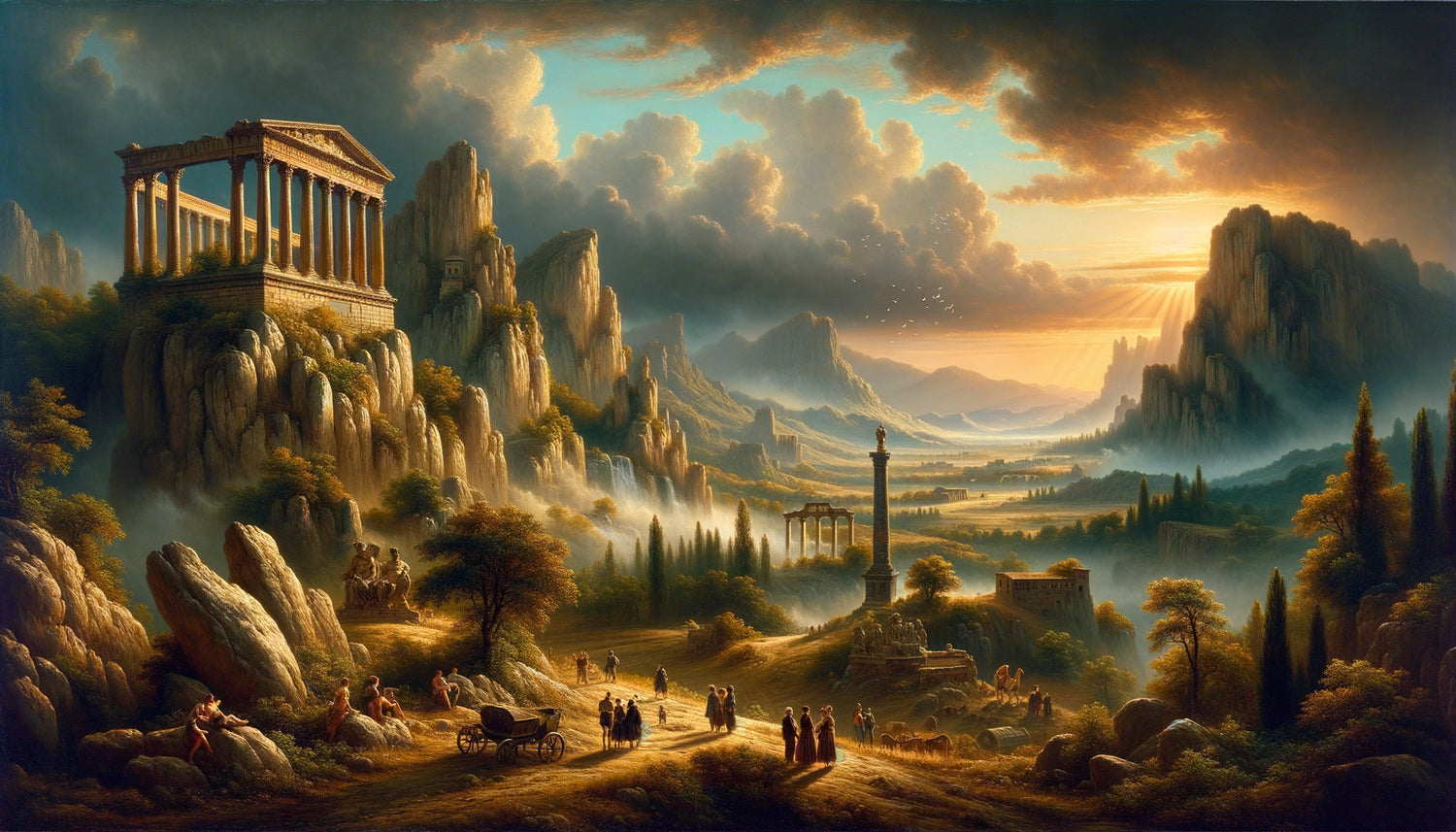
Imagine a scene for a moment: a large Parisian studio in 1865, bathed in northern light. On the easel, an immense landscape: Roman ruins, misty valleys, ancient figures. Every element seems real, yet this landscape composition does not exist anywhere. The painter has never seen this perfect Arcadia. He built it, stone by stone, tree by tree, according to a rigorous protocol passed down by the École des Beaux-Arts.
Here's what the academic method of landscape composition brings: a balanced visual architecture that naturally guides the eye, a spatial depth that creates the perfect illusion, and a narrative harmony where each element reinforces the historical message.
You may be admiring these academic landscapes in museums, fascinated by their perfection. But you wonder how these masters achieved this masterful coherence, this feeling of absolute harmony. Why do their compositions seem so natural when they are entirely constructed? Rest assured: these painters followed precise rules, a true visual grammar that they perfected for years. Today, I take you behind the scenes of this alchemy, where History meets landscape, where nature becomes decor for great painting.
The studio as a laboratory of landscape creation
Unlike the Impressionists who would come later, French academic painters almost never worked on location. Their process began with a methodical accumulation of references. In their studios piled sketchbooks filled with quick sketches taken during the Grand Tour in Italy, an initiation journey obligatory after the Prix de Rome.
Jean-Auguste-Dominique Ingres, Pierre-Henri de Valenciennes, Anne-Louis Girodet: all these masters of historical landscape collected preparatory studies. A cypress drawn near the Villa Medici. A fragment of aqueduct in the Roman countryside. Rocks seen in the Fontainebleau forest. These elements became their visual vocabulary, their library of natural forms.
The composition of the academic landscape then involved a learned assembly. Like an architect, the painter arranged his elements according to strict geometric principles. The foreground, always dark, created a repoussoir effect. Trees framed the scene like theater curtains. The gaze progressed in successive planes towards a luminous vanishing point, often a clear horizon or a heavenly opening.
The rule of three plans: building depth
Academicians taught a fundamental law: every landscape must be organized into three distinct planes. This tripartite structure guaranteed readability and spatial depth.
The foreground: the terrestrial anchor
Area of shadow and precise details. It housed natural elements: detailed rocks, lush vegetation, sometimes a spring or ruins overgrown with moss. This is where historical or mythological characters were often placed, on a human scale. This proximity created intimacy with the viewer.
The middle ground: the territory of narrative
Transition zone where the main subject unfolded. A valley with an ancient temple, a procession to a sanctuary, shepherds with their flocks. Academic painters created luminous contrasts there to guide the eye. The light was more diffused, the details simplified, creating that characteristic atmospheric feeling.
The background: escape to infinity
Mountains bluish due to atmospheric perspective, sky with layered clouds, luminous horizon. This area created a sense of grandeur, of limitless space. Masters applied the optical laws discovered during the Renaissance there: colors cool down, contrasts soften, shapes simplify.

The formal vocabulary of the Academy
The teaching of academic landscape composition was based on strict conventions, almost a codified language that every artist had to master.
Trees followed a precise typology. The oak symbolized French strength and anchorage. The parasol pine immediately evoked ancient Italy. The vertical cypress created rhythmic accents. Academic painters did not simply represent nature: they selected species for their symbolic and compositional value.
Ruined architecture was a fundamental element. Greek temples, Roman aqueducts, broken columns: these historical fragments justified the term historical landscape. They also created strong geometric structures, guiding lines for the eye. A rounded arch naturally framed a scene, a colonnade created a vertical rhythm.
Water appeared systematically: spring, river, lake or distant sea. It brought reflections, zones of horizontal light, a living element in the composition. 19th-century academics excelled at rendering shimmering effects, that silvery transparency which animated their landscapes.
Dramatic light: sculpting space
What truly distinguishes French academic landscapes is their treatment of light. No harsh, direct sunlight, but carefully orchestrated atmospheres.
The preferred hour? Dawn or dusk. These moments offered sidelight that sculpted forms, created long shadows, and allowed for spectacular skies. Claude Gellée, known as Le Lorrain, established this canon in the 17th century, and 19th-century academic painters faithfully perpetuated it.
The technique of backlighting created dramatic effects. Silhouetted figures against a luminous sky, foliage cut out like dark lace. This approach reinforced the theatricality of the composition, this sense of landscape staging so characteristic.
Clouds were never left to chance. Stratified, they created horizontal bands that accentuated depth. Pierced by divine light, they guided the eye to the focal point. The academicians meticulously studied cloud formations, creating libraries of celestial studies.

The figures: giving scale and meaning
An academic historical landscape was never deserted. Human figures, although often small, played a crucial role in the composition.
First, they gave scale. Faced with a temple or a monumental tree, a human silhouette made it possible to appreciate the dimensions. Academic painters precisely calculated these size ratios to create either a sense of intimacy or that of overwhelming sublimity.
Next, they carried the narrative. Shepherds evoked pastoral Arcadia. Travelers in antique costumes suggested classical antiquity. Pilgrims reinforced the spiritual dimension. These historical figures transformed a simple landscape into a narrative scene.
Finally, they created colorful accents. A red drape in a landscape of ochre and green tones. A white tunic catching the light. Academicians used these touches of pure color to punctuate their composition visually, subtly guiding the eye's path.
The creation protocol: from sketch to painting
The realization of an academic landscape followed a rigorous process, almost ritualistic, taught at the École des Beaux-Arts.
First step: the compositional sketch. On a small format, the painter established the general structure in dark and light masses. No details, only the visual architecture. This crucial step determined the balance of the final work.
Second step: detailed preparatory studies. Each important element was the subject of a separate study. A group of trees meticulously drawn. An architectural fragment painted in oil. These studies ensured the accuracy of each part.
Third step: squaring. The validated sketch was gridded, then proportionally transferred to the large canvas. This ancestral technique ensured fidelity to the initial composition while changing scale.
Fourth step: execution in successive layers. Background to background, plane by plane, from foreground to background. Academic painters literally built space, as one builds a theater set. Successive glazes created this atmospheric depth, this recognizable luminosity.