Imagine a moment: you are standing before The Isle of the Dead* by Arnold Böcklin. It's not the water you see first, but what it hides. These dark depths, almost black, that seem to draw your gaze towards an elusive elsewhere. That unsettling feeling that rises within you, that fascination mixed with concern, is exactly what Symbolist painters were seeking: to plunge you into the abysses of your own psyche.
Here's what water as a symbol of the unconscious in Symbolist painting reveals: a gateway to our repressed emotions, a mirror of our hidden desires, and a visual language to express the unspeakable of the human soul. Three dimensions that transformed the pictorial representation of the liquid element into a true psychological exploration, long before Freud theorized the unconscious.
Today, we admire these Symbolist paintings without always grasping their revolutionary dimension. We see beautiful images of ponds, rivers or oceans, without perceiving that each reflection, each ripple was for these artists a powerful symbol of what agitates our inner depths. This misunderstanding deprives us of an essential key to deciphering a whole section of modern art.
Rest assured: understanding this symbolism requires no technical knowledge of psychoanalysis or art history. You just need to learn to look at the water in these works as the Symbolists conceived it: not as a simple landscape, but as a living metaphor for our inner world. I invite you to dive into this fascinating universe where each wave tells an emotion, each reflection reveals a secret of the soul.
The deep waters of the Symbolist psyche
Symbolist painters of the late 19th century operated a silent revolution. Where the Impressionists captured light dancing on the Seine, the Symbolists sought what lay beneath the surface. For Odilon Redon, Gustave Moreau or Fernand Khnopff, water becomes the territory of the unconscious, that mysterious kingdom that consciousness cannot directly apprehend.
This vision was not born by chance. In the 1880s-1900s, intellectual Europe seethed with questions about the nature of the human mind. The first psychological theories emerged, exploring dreams, impulses, and shadowy areas of thought. Symbolist artists, true antennae of their time, visually translated these questions even before they were scientifically formulated.
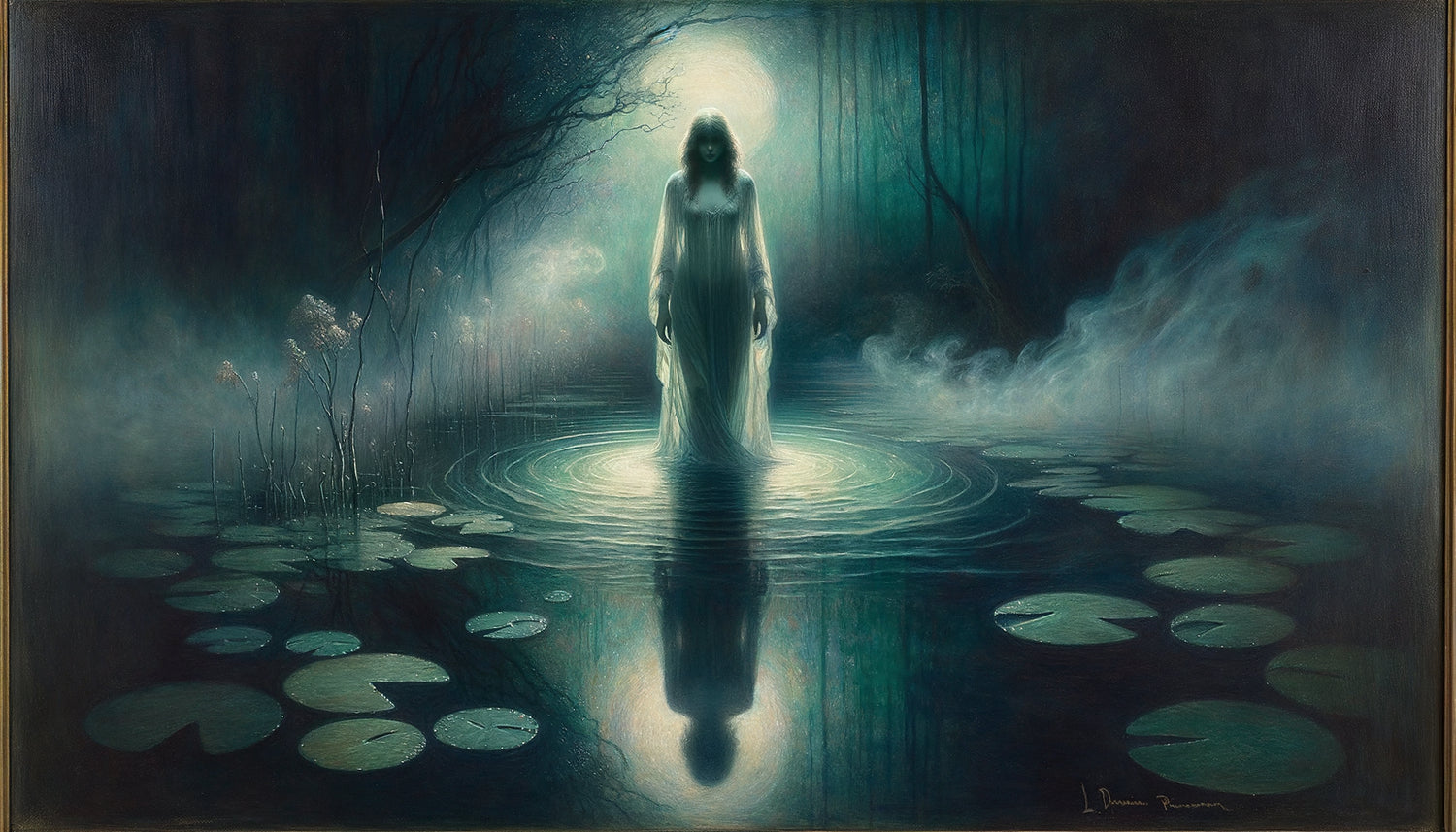
Symbolic water has specific characteristics: it is rarely agitated in a realistic way, but rather still, stagnant, or animated by strange movements that defy the laws of physics. It does not faithfully reflect the external world, but transforms it, deforms it, revealing a psychic reality rather than a material one. These dark, greenish or black waters evoke the depths of the ocean more than country rivers.
The revealing stillness
Observe the ponds in Khnopff’s works: their perfectly smooth surface acts as a magical mirror. This stillness is not that of still life, but that of inner contemplation. Still water symbolizes the meditative state necessary to access the unconscious, that moment of mental silence where dreamlike images can surface into consciousness.
Ophelia and the drowned: when water engulfs consciousness
If a motif dominates aquatic symbolic painting, it is that of the woman in the water. Ophelia, the Shakespearean heroine, becomes the absolute archetype: her body floating between two waters materializes visually the passage between consciousness and unconsciousness. John Everett Millais inaugurates this tradition with his Ophelia from 1852, but it is the symbolists who exploit its psychological dimension.
For these artists, drowning is not death but transformation. The water that engulfs represents the unconscious absorbing waking consciousness, allowing access to another mode of knowledge. Hair floating like seaweed, clothes blending with aquatic plants: everything suggests a fusion with the liquid element, a dissolution of the boundaries of the self.
Paul-Albert Steck, Arnold Böcklin, and Alexandre Séon multiply immersed female figures. Why women? In the symbolism of the time, deeply marked by Jungian archetypes before their time, femininity embodies intuitive, emotional nature, close to the unconscious. The woman in the water becomes a symbol of the human soul diving into its own depths to discover hidden truths.
Between eroticism and thanatos
These symbolic drowned women possess a disturbing dimension: they are simultaneously alive and dead, desirable and unsettling. This ambiguity perfectly translates the paradoxical nature of the unconscious as conceived by the symbolists: both a source of creativity and desires, but also a reservoir of anxieties and destructive impulses. The water caressing these bodies expresses the dangerous seduction of our own inner depths.

Deceptive reflections: water as an alteration of reality
Another masterful use of water in symbolic painting concerns reflections. But unlike the Impressionists who sought optical fidelity, Symbolist artists create impossible reflections, distorting mirrors that reveal a psychological truth rather than a physical one.
In the works of Fernand Khnopff, particularly his series of deserted cities where water plays a central role, reflections never exactly correspond to their source. A building is reflected with an extra window, a silhouette strangely doubles. This inaccuracy is deliberate: it suggests that our conscious perception of the world is only one version among others, and that the unconscious perceives an alternative reality, equally valid.
The aquatic reflection becomes a metaphor for dreams and psychic projection. We do not see the world as it is, but as our psyche transforms it. Symbolic water materializes this process of transformation: it takes the light of the external world and returns it modified, enriched with the contents of the unconscious.
Artists use different techniques to accentuate this effect: selective blurring, colors that do not correspond to visible reality, impossible perspectives in the reflection. These pictorial choices are not mistakes, but conscious strategies to represent the activity of the unconscious which constantly distorts and reinterprets our perceptions.
Sources, fountains and wells: portals to interiority
Beyond large bodies of water, Symbolist artists attach particular importance to concentrated points of water: sources, fountains, wells. These architectural or natural elements function as symbolic portals to the unconscious, privileged access points to psychic depths.
Gustave Moreau, in several of his works, places fountains at the center of mysterious compositions. The water that gushes from these springs represents the emergence into consciousness of unconscious contents: creative inspirations, sudden intuitions, inexplicable emotions rising from the depths of the psyche. The source becomes a metaphor for the creative process itself, this mysterious alchemy by which the unconscious nourishes artistic creation.
The well possesses an even more charged symbolism. Vertical, dark, it evokes diving into the depths. Several symbolic paintings depict figures leaning over a well, scrutinizing its unfathomable depths. This posture perfectly illustrates the introspective approach: to lean over the inner abyss, to try to glimpse what is hidden in the darkness of our own psyche.
Running water and stagnant water
Symbolists establish a subtle distinction between different types of water. The flowing water of rivers symbolizes the flow of consciousness, the perpetual movement of awakened thought. Conversely, stagnant water in ponds and marshes represents the deep unconscious, that immobile zone where memories and repressed emotions settle. Between the two, springs and fountains embody the meeting point, the place where the unconscious surfaces to consciousness.
Let symbolic water transform your interior
Discover our exclusive collection of nature paintings that capture the emotional depth of aquatic landscapes and create a contemplative atmosphere in your living space.

Colors and textures: the visual vocabulary of the aquatic unconscious
Symbolists do not merely represent water; they create a veritable chromatic and textural language to differentiate the strata of the unconscious. This visual grammar remains consistent from artist to artist, forming a shared symbolic system.
Dark waters, almost black, dominate. This choice is not realistic but symbolic: it evokes the deep unconscious, those areas of the psyche inaccessible to ordinary consciousness. The dark-green waters of Böcklin or the deep, almost nocturnal blue of Khnopff suggest unfathomable depths, charged with mystery and potentially dangerous.
Conversely, the bright reflections on the surface symbolize the unconscious contents that surface to consciousness. These areas of light, often silvery or golden, create a dramatic contrast with the dark depths. They represent moments of revelation, intuition, where something from the unconscious becomes briefly visible before plunging back into the shadows.
The texture itself of symbolic water differs radically from the impressionistic treatment. Where Monet dissolves forms in luminous vibration, symbolists create smooth, almost glazed surfaces that accentuate the dreamlike dimension. This particular quality, between liquid and solid, evokes the strangeness of dream images, their paradoxical sharpness despite their unreality.
Aquatic creatures: the inhabitants of the unconscious
Symbolic water is never empty. It teems with presences, generally invisible but perceptible. When creatures appear, they embody the specific contents of the unconscious: desires, fears, fantasies, repressed memories.
Sirens and nymphs dominate this aquatic bestiary. Unlike light romantic representations, symbolic aquatic creatures possess a disturbing dimension. They seduce but threaten, attract but can engulf. This ambivalence reflects the double nature of the unconscious: a source of creativity and inspiration, but also of potentially destructive impulses.
Arnold Böcklin excels in representing these hybrid beings. His tritons and naiads are not graceful mythological ornaments, but tangible manifestations of unconscious forces. Their half-human, half-animal bodies symbolize the instinctive part of our psyche, that dimension which escapes rational control.
Some symbolic paintings suggest aquatic presences without showing them directly: unexplained undulations, bubbles rising from the depths, indistinct shadows under the surface. This suggestion is perhaps even more powerful than direct representation: it evokes those unconscious contents that we sense without being able to identify them clearly, those movements in the depths of our psyche of which we only perceive the effects on the surface.
The contemporary legacy: symbolic water today
The symbolic vision of water as a metaphor for the unconscious has not disappeared with the artistic movement. It continues to influence contemporary creation, from cinema to photography through video art. Understanding this lineage allows us to enrich our reading of current works and rediscover symbolic masterpieces with a renewed perspective.
In contemporary interior decoration, reintegrating this symbolic dimension transforms our relationship to aquatic representations. A water painting is no longer just a soothing decorative element, but becomes an invitation to inner contemplation, a reminder of our own psychic depths. This awareness considerably enriches the daily aesthetic experience.
The most sophisticated interior designers are rediscovering this approach. They choose aquatic works not for their simple beauty, but for their ability to create an atmosphere conducive to introspection. Symbolic water in decoration creates spaces of transition between exterior and interior, between activity and rest, between consciousness and reverie.
Imagine your interior transformed by this new understanding. Every morning, when passing this painting of deep water in your entrance hall, you no longer see a simple landscape but a portal to your own inner world. In the evening, in your living room, these impossible reflections remind you that visible reality does not exhaust reality, that there are other dimensions to explore. Your living space thus becomes a place of psychological replenishment, as well as physical.
To concretely integrate this approach, start by observing the aquatic representations around you differently. Ask yourself: is this water clear or dark? Still or moving? Does it reflect faithfully or transform? Each characteristic resonates with a different aspect of our inner life. Choosing consciously then becomes an act of self-knowledge.
Frequently Asked Questions about Symbolic Water
Why did Symbolist painters represent water so darkly?
The dark waters of symbolic paintings do not seek to reproduce visual reality, but to express a psychological truth. This darkness represents the deep unconscious, that part of our psyche inaccessible to ordinary consciousness. For the symbolists, these shadows are not negative but mysterious and full of creative potential. Just as we cannot see the bottom of a very deep lake, we cannot directly access the most deeply buried contents of our psyche. This dark water invites contemplation rather than action, creating a mental space conducive to introspection. In your interior, such a representation naturally creates a meditative atmosphere, particularly suitable for rest or reading areas.
How can you differentiate an Impressionist representation of water from a symbolic version?
The distinction is fundamental and completely changes the interpretation of the work. Impressionistic water captures a specific moment of natural light: reflections are optically accurate, colors correspond to those of the sky and environment, movement suggests actual wind or current. Symbolic water, on the other hand, often defies optical laws: reflections do not exactly match their source, colors are expressive rather than descriptive, stillness or movement cannot be explained by weather conditions but express a psychological state. Impressionistic water makes you say , symbolic water makes you ask yourself This difference determines the effect of a work in your space: one brings light and immediate joy, the other invites deep contemplation and inner questioning.
Can we integrate artworks inspired by symbolic water into a modern interior?
Absolutely, and it's particularly relevant today. Our hyper-connected and externalized era precisely needs these visual spaces that invite introspection. A representation of symbolic water creates a beneficial contrast with contemporary agitation. In a minimalist interior, it brings symbolic depth without visually cluttering. In an industrial loft, it softens the environment while maintaining intellectual sophistication. The important thing is to choose an appropriate scale: a large dark aquatic work in a living room creates a meditative focal point, while a smaller one in a bedroom or office establishes a discreet but constant presence, reminding of the need for introspection. The shades of symbolic waters - deep blues, dark greens, silvery blacks - harmonize perfectly with contemporary gray, white and natural palettes.